
Selecting the right agility ladder is one of the most straightforward ways to upgrade your footwork, coordination, and explosive speed on the field. Whether you are training for football, basketball, or general fitness, this simple tool forces your brain and muscles to communicate faster, translating to sharper cuts and quicker acceleration. However, choosing the wrong model can lead to constant tangles, sliding rungs, and materials that quickly degrade under intense use.
To find the best agility ladder for your training sessions, you must evaluate key technical specifications: total ladder length, the number of rungs, spacing adjustability, and material durability. For athletes in the Philippines, local environmental factors like high humidity, intense tropical sun, and muddy pitches also play a critical role in determining which gear will survive season after season. By matching these specifications to your specific training space and athletic goals, you can secure a durable tool that keeps your drills fluid and safe.
Ladder Length and Rung Count: Matching Your Space and Drills
The overall length of an agility ladder directly dictates the types of footwork patterns you can execute and how much space you need to set up. Most standard ladders range from 4 meters (approximately 13 feet) to 9 meters (approximately 30 feet) in length. A shorter 4-meter ladder typically features 8 rungs, which is highly effective for rapid, high-intensity explosive bursts and quick lateral transitions. These compact options are ideal if you have a limited training footprint, such as a small backyard, a crowded indoor gym, or a paved carport.
Products mentioned in this guide
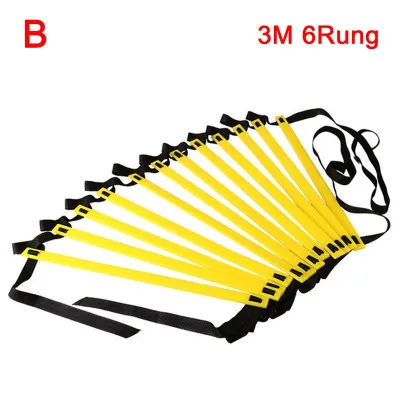
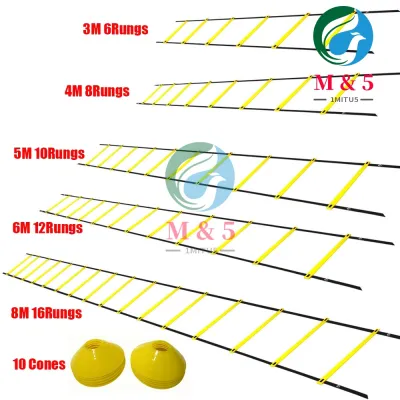
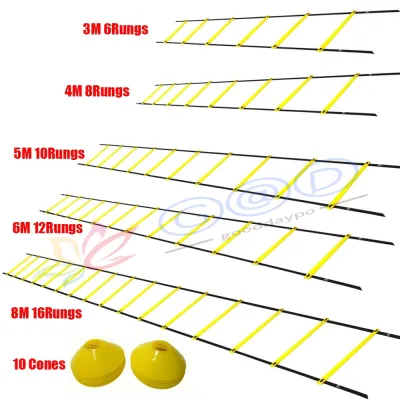
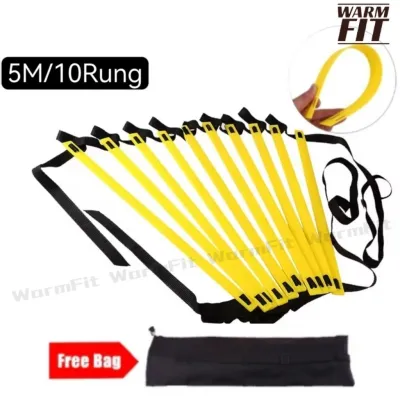
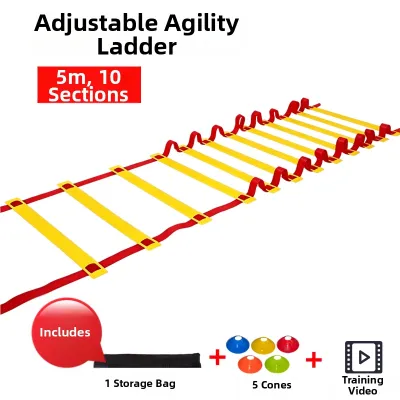
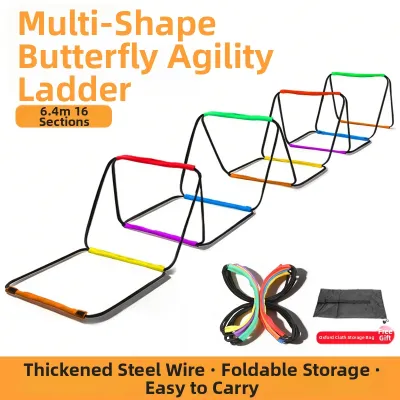
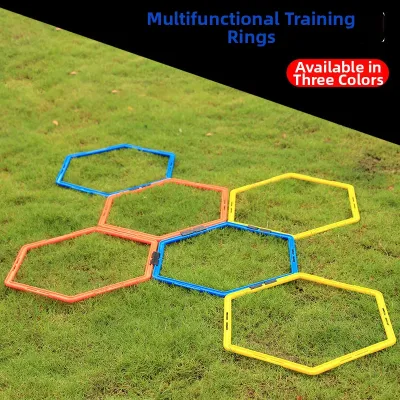
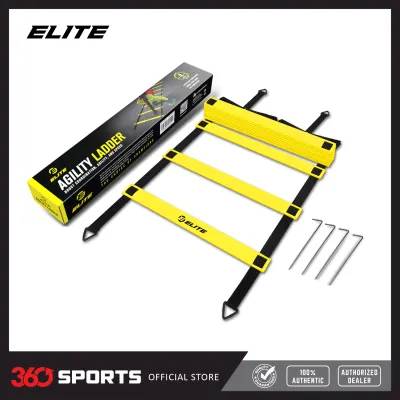
Prices are valid at publication and may change. Please refer to the product page for the latest price.
Conversely, longer ladders containing 12 to 20 rungs are designed for sustained footwork sequences and endurance training. A longer configuration allows you to combine multiple movement patterns—such as transitioning from an Ickey Shuffle directly into forward high-knees—without stopping to reset. This setup is highly beneficial for football players who need to simulate the prolonged, multi-directional demands of a full 90-minute match.
Before making a purchase, it is essential to measure your primary training area to ensure the ladder can be laid out completely flat. If you train on a local pitch, a standard 6-meter or 9-meter model provides excellent versatility. However, if your workouts are confined to indoor spaces or small concrete courts, a shorter ladder prevents the webbing from bunching up or obstructing nearby traffic.
Remember that a longer ladder is not inherently superior to a shorter one. If your primary focus is pure acceleration and rapid-fire foot speed, a short, high-quality ladder allows you to focus your energy on maximum intensity over a brief distance. For complex, continuous coordination drills, a longer ladder is the more practical choice.
Rung Spacing: Fixed vs. Adjustable Options for Different Skill Levels
Rung spacing determines the distance your feet must travel with every step, directly influencing your stride frequency and movement mechanics. Standard spacing is typically set around 38 to 50 centimeters (15 to 20 inches) apart, which closely mimics the natural stride length of an average adult athlete. However, the choice between fixed and adjustable rungs depends heavily on who will be using the equipment and the specific skills you want to develop.

Fixed-spacing ladders feature rungs that are permanently stitched or riveted to the side straps. This design is incredibly convenient because it eliminates the need to manually measure or adjust the gaps before every workout. It is the go-to option for team practices, school sports programs, and adult athletes who simply want to unroll the gear and start moving. The primary drawback is rigidity; you cannot customize the spacing to accommodate shorter strides or target specific micro-movements.
Adjustable-spacing ladders allow you to slide the rungs along the side straps to customize the size of each square. This adaptability is highly advantageous for youth football players or beginners who find standard adult spacing too wide, which can lead to overstriding and poor form. By narrowing the gaps, younger athletes can maintain proper posture and build confidence before progressing to wider steps.
Advanced athletes also benefit from adjustable rungs by creating uneven spacing patterns. For example, you can set the first few rungs close together to train rapid foot speed, and gradually widen the subsequent rungs to transition into full-stride acceleration. If you choose an adjustable model, pay close attention to the locking mechanism. Look for rungs fitted with secure plastic buckles or high-friction slots that prevent the rungs from sliding out of place when accidentally clipped by a cleat.
Material Durability for Tropical Weather and Field Conditions
An agility ladder must withstand constant impact, accidental stomping, and exposure to the elements. In the Philippines, the tropical climate introduces unique challenges, including intense heat, high humidity, and sudden heavy rainfall. Purchasing a ladder made from cheap, substandard materials will quickly lead to brittle plastic and moldy straps that tear under minimal stress.
The side straps, or webbing, should be constructed from heavy-duty, high-density nylon or polyester. These synthetic fibers are highly resistant to tearing and do not readily absorb moisture, which is crucial for preventing mold and mildew growth when the ladder is stored damp. Look for reinforced stitched edges along the straps, which help the ladder lie flat and resist fraying over time.
For the rungs, prioritize high-impact, flexible plastics such as polypropylene (PP) or polyethylene (PE). These materials are designed to bend and flex under pressure rather than snap. This flexibility is a vital safety feature; if an athlete steps directly on a rigid plastic rung with football cleats, a cheap material can shatter, creating sharp edges that pose a puncture hazard. Flexible rungs will simply deform and pop back into shape.
Sun exposure is another major factor that degrades training gear. Prolonged exposure to ultraviolet (UV) rays can cause standard plastics to become brittle and crack. When comparing models, check the product specifications for UV-resistant coatings or treatments. This feature ensures the plastic rungs retain their flexibility and vibrant color, even during mid-day training sessions under direct sunlight.
To ensure long-term durability, avoid relying solely on generic brand claims. Instead, verify the specific material composition on the product label. A quality ladder designed for outdoor athletic use will explicitly state the use of heavy-duty nylon webbing and high-impact, UV-treated plastic rungs.
Setup Stability, Accessories, and Portability
The effectiveness of your footwork session depends heavily on how securely the ladder stays in place. When performing high-speed lateral shuffles or quick-cut drills, a loose ladder can easily slide, bunch up, or lift off the ground. This not only ruins the flow of your drill but also creates a serious tripping hazard.
To prevent this, look for ladders that include heavy-duty ground stakes or metal pegs. These anchors pin the ends of the side straps securely into grass or turf pitches, keeping the entire unit taut and aligned throughout your workout. For indoor training or concrete courts where stakes cannot be used, a heavier webbing material is beneficial, as the added weight helps keep the straps flat against the smooth floor.
Another feature to prioritize is an anti-tangle or anti-curl strap design. Some ladders are engineered with slightly stiffer webbing or weighted ends that naturally resist twisting when unrolled. This saves valuable training time, allowing you to focus on your drills rather than spending ten minutes untangling a knot of straps and rungs.
Portability is equally important for athletes who travel between home, school, and local training grounds. A quality agility ladder should come with a breathable mesh or heavy-duty carrying bag. This bag not only makes transportation effortless but also allows wet or damp straps to air out, reducing the risk of odor and material degradation.
Finally, consider models equipped with end-connection clips. These plastic buckles or snaps allow you to link two or more ladders together seamlessly. This feature is highly useful if you start with a basic 4-meter setup but want the flexibility to expand to an 8-meter or 12-meter lane in the future as your conditioning improves. Prioritize these practical stability and connection features over unnecessary digital add-ons or gimmicks.
Frequently Asked Questions (FAQ)
Can I use an agility ladder on concrete or indoor courts?
Yes, you can use an agility ladder on hard surfaces like concrete, gym floors, or indoor basketball courts. When training on smooth indoor surfaces, it is best to choose a ladder with flat, textured rungs that provide a non-slip grip against the floor. Because you cannot use ground stakes on hard surfaces, ensure the ladder is pulled completely straight and lies flat to minimize the risk of catching your toe and tripping.
How do I prevent the ladder straps from curling or tangling?
To prevent tangling, avoid stuffing the ladder carelessly into its bag after a workout. Instead, gather the rungs neatly in a stack, slide the straps around them, and secure them with the integrated strap or band before placing them in the carrying bag. If the nylon straps have curled due to tight storage, unrolling the ladder on a warm surface or under the sun for a few minutes will help soften the synthetic fibers, allowing the webbing to lay flat.
Community discussion
Share your experience or ask a question. Comments are reviewed before publication.