
Quick Guide to Badminton String Specs
Choosing a suitable badminton string is just as important as selecting a compatible racket. The string bed is the only part of your equipment that makes direct contact with the shuttlecock, making its specifications critical to your performance on the court. Three core specifications define any string: gauge (thickness), tension (tightness), and material (composition). Selecting the right combination requires balancing the fundamental trade-off between durability and performance, which includes repulsion power and control. Your optimal setup depends heavily on your current skill level, swing speed, and how frequently you play.
Understanding String Gauge and Thickness
When browsing for a badminton string, you will encounter various model names and numbers, but the most reliable indicator of performance is the actual gauge measured in millimeters (mm). Manufacturers typically print this measurement directly on the packaging. Generally, badminton string gauges range from a thick 0.70 mm down to an ultra-thin 0.61 mm.

Thicker strings, usually measuring 0.68 mm to 0.70 mm, offer high durability. They contain more material to withstand the friction generated during high-velocity impacts, making them highly suitable for beginners, recreational players, or those who find themselves breaking strings frequently. On the other hand, thinner strings, ranging from 0.61 mm to 0.66 mm, provide greater repulsion power and a better “bite” on the shuttlecock, allowing for sharper slices and precise control. However, these thin gauges are highly sensitive. They require precise hitting technique and consistent contact with the racket’s sweet spot; off-center hits near the frame can cause them to snap prematurely.
Products mentioned in this guide

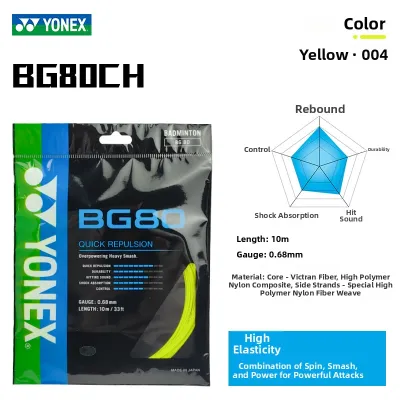
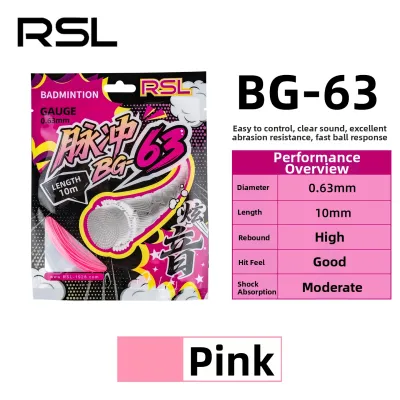
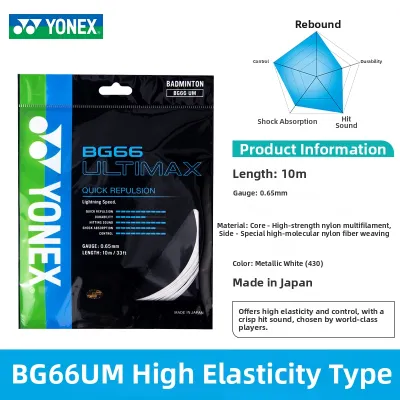
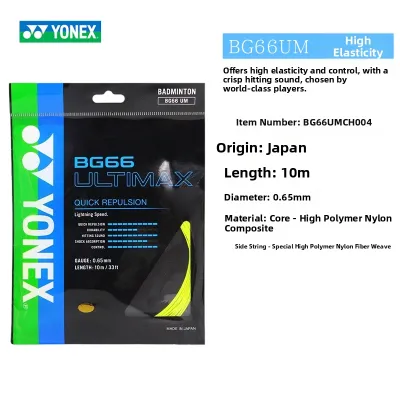
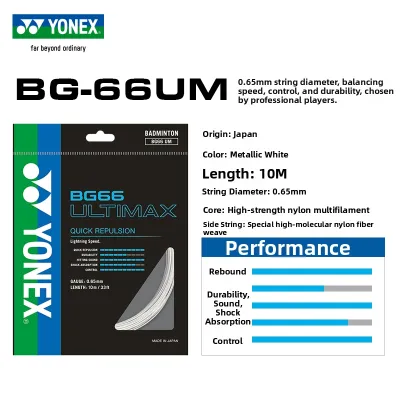
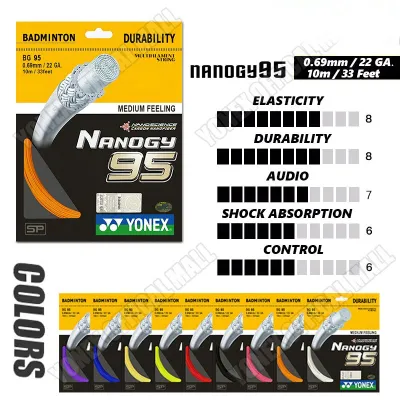
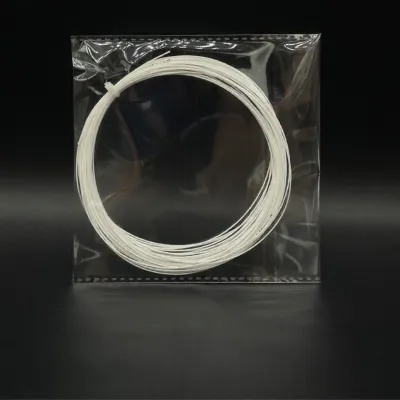
Prices are valid at publication and may change. Please refer to the product page for the latest price.
Decoding String Tension Ranges
String tension, measured in pounds (lbs), dictates how the string bed behaves when it impacts the shuttlecock. Lower tensions, typically between 20 lbs and 24 lbs, create a “trampoline effect.” This flexible bed deforms more upon impact, returning energy to the shuttlecock and helping developing players generate deep clears with less physical effort. Conversely, higher tensions, generally from 25 lbs to 30 lbs or more, create a highly rigid surface. This rigidity offers immediate feedback and precise control, allowing advanced players to direct the shuttlecock accurately, though it demands significant physical strength to generate power.
Before requesting a high tension, always check the recommended maximum tension limit printed on your racket’s shaft or cone. Exceeding this limit risks warping or cracking the racket frame during a hard smash or when restringing, which typically voids the manufacturer’s warranty. Additionally, players must realize that string tension is not permanent. Due to a physical phenomenon known as tension creep, strings naturally lose tightness over time and with regular use. This gradual loss of elasticity means you may need to restring your racket periodically to maintain your desired playability, even if the strings have not physically broken.
Material Composition and Construction
Modern badminton strings are highly engineered products, far removed from simple nylon threads. The most common construction is a multifilament design, where thousands of ultra-fine nylon fibers are braided together around a central core. This construction provides a balanced blend of durability, shock absorption, and repulsion. Advanced composite strings may incorporate specialized materials like Vectran, Kevlar, or carbon fibers within the core or outer sheath to alter the string’s physical properties.
The core material primarily dictates the string’s fundamental feel, shock absorption, and repulsion power. Meanwhile, the outer coatings and braided wraps influence surface texture, durability, and how well the strings grip the shuttlecock. When selecting a string, look past flashy marketing buzzwords and focus on the manufacturer’s official ratings for “hard feel” or “soft feel.” A hard-feeling string provides crisp, immediate feedback preferred by aggressive attackers, while a soft-feeling string absorbs more vibration, offering a comfortable sensation that is gentler on the wrist and elbow.
Matching Specs to Your Playstyle
To make an informed purchase, you must combine gauge, tension, and material into a cohesive setup tailored to your current playing profile. For beginners or casual players, a foundational setup focusing on durability and ease of use is highly recommended. This typically involves a thicker gauge string (0.68 mm to 0.70 mm) strung at a moderate tension of 20 lbs to 23 lbs, utilizing a standard multifilament nylon material. This combination maximizes the lifespan of the string bed while providing a forgiving sweet spot that assists with power generation.
For intermediate to advanced players who have developed consistent hitting techniques, a performance-oriented setup is more appropriate. This configuration utilizes thinner gauges (0.61 mm to 0.66 mm) pulled to higher tensions (24 lbs to 28 lbs or more), paired with specialized composite materials that offer either a crisp hard feel or high repulsion. When configuring your setup, also consider your local playing environment. In tropical regions with high humidity, such as the Philippines, strings tend to lose tension faster due to moisture absorption and heat. If you play in humid, non-air-conditioned indoor courts, you may need to adjust your restringing schedule or choose materials specifically rated for reliable tension retention.
Frequently Asked Questions (FAQ)
How often should I restring my badminton racket?
A practical rule of thumb is to restring your racket as many times per year as you play per week. For example, if you play twice a week, aim to restring your racket at least twice a year. However, you should also inspect your string bed regularly for visible signs of wear. If you notice severe fraying, deep notches where the vertical and horizontal strings intersect, or a sudden, mushy loss of control and tension, it is time to take your racket to a professional stringer.
Does a higher string tension mean more power?
No, higher string tension does not automatically translate to more power. Lower tension creates a trampoline effect that helps generate power easily, making it suitable for players with slower swing speeds or developing techniques. Higher tension makes the string bed stiff, requiring a very fast swing speed, precise timing, and advanced physical strength to generate power. If an inexperienced player uses excessively high tension, the racket will feel like a wooden board, resulting in shorter clears and an increased risk of arm injury.
Community discussion
Share your experience or ask a question. Comments are reviewed before publication.