
Choosing the right tennis trainer requires looking past general promises and focusing on your specific training environment, skill level, and budget. There is no single equipment type that serves as a universal solution for every player. Instead, the ideal choice depends on whether your immediate priority is fixing raw stroke mechanics, improving reaction times for net play, or building baseline consistency through high-volume hitting. By analyzing your personal training goals alongside your physical space constraints, you can select a tool that actively elevates your performance on the court.
To simplify your decision, consider this conditional framework based on your primary training objective:
- Choose a Ball Machine if you need high-volume shot repetition, want to practice realistic footwork patterns across a full court, and have a flexible budget along with a reliable way to transport heavy equipment.
- Choose a Rebound Net if you want to work on reaction time, rapid volley exchanges, and continuous rally rhythm in a compact driveway or backyard without relying on electrical power.
- Choose a Swing Trainer if your primary goal is isolating stroke mechanics, building muscle memory, or warming up off-court in highly restricted spaces like a garage or living room.
Evaluating these options requires a balanced look at three primary dimensions: skill focus, practical space constraints, and long-term financial investment. Understanding how each tool interacts with your body and your environment will prevent you from purchasing equipment that ultimately sits unused in storage.
Products mentioned in this guide
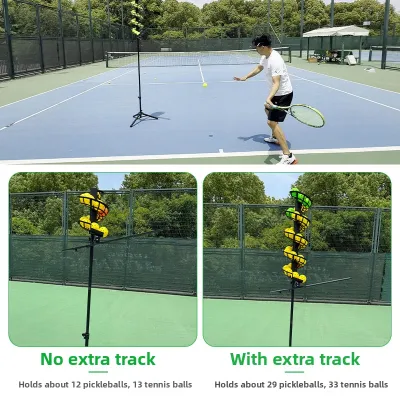
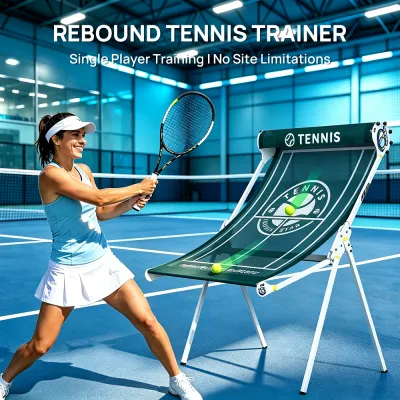
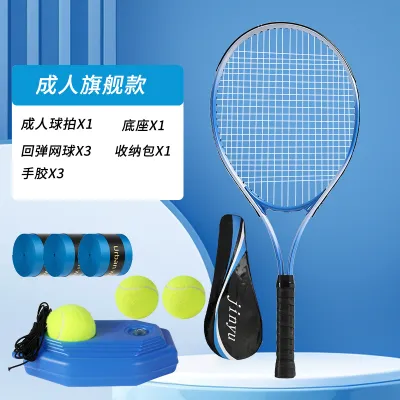
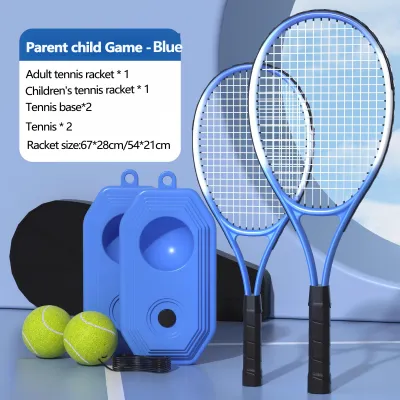
Prices are valid at publication and may change. Please refer to the product page for the latest price.
Skill Focus: How Each Trainer Improves Your Game
Every tennis trainer engages your muscles and visual tracking in fundamentally different ways. Selecting the wrong tool can reinforce bad habits, while the right tool builds functional, transferable skills that translate directly into match play.
Ball Machines: Repetition, Footwork, and Shot Tolerance
Ball machines excel at delivering identical, high-volume feeds that allow you to groove your groundstrokes into deep muscle memory. Most modern portable machines utilize counter-rotating wheels to propel the ball, allowing you to adjust spin, speed, and feed intervals. By setting the machine to deliver a consistent ball to your forehand, you can isolate specific mechanical adjustments without the pressure of an unpredictable opponent. This predictable feed is highly effective for practicing complex footwork patterns, such as the open-stance forehand or the transition from the baseline to the mid-court for an approach shot.
However, this predictability introduces a distinct training limitation. Because the machine lacks the physical preparation cues of a human player—such as a shoulder turn or racket face angle—you must actively practice your split-step timing based on the sound of the machine’s launch. Relying solely on a ball machine without consciously simulating match-like movement can lead to passive footwork and flat-footedness. To counter this, advanced players use random horizontal and vertical oscillation settings to force continuous adjustment and build authentic shot tolerance.
Rebound Nets: Reaction Time, Volleys, and Rhythm
Rebound nets, or tennis rebounders, use tensioned fabric or mesh to return your shots immediately, creating a fast-paced, continuous rally. The physics of a rebound net dictate that the harder you hit the ball, the faster and deeper it returns to you. This instant feedback loop forces you to shorten your backswing and prepare your racket early, which is highly beneficial for developing a compact, efficient swing path. Because the return angle can vary slightly depending on where the ball strikes the tensioned surface, your spatial awareness and micro-adjustment steps are constantly put to the test.
This rapid return rate makes the rebound net an exceptional tool for practicing volleys, half-volleys, and quick reflex exchanges. It teaches you to absorb pace and redirect the ball using your core and lower body rather than relying on a wild, looping swing. The primary limitation of a rebound net is its inability to simulate deep, heavy baseline topspin or the high-trajectory flight of a deep lob. It is a tool designed for rapid, close-to-mid-range exchanges rather than deep baseline-to-baseline baseline rallies.
Swing Trainers: Muscle Memory, Mechanics, and Grip Path
Swing trainers encompass a variety of mechanical aids, including tethered ball systems, guided swing paths, and weighted training rackets. These tools are designed to isolate the kinetic chain, allowing you to focus entirely on your body’s alignment, grip pressure, and follow-through without the distraction of tracking a moving ball. For players struggling with a specific mechanical flaw—such as dropping the racket head too late or failing to brush up for topspin—a swing trainer offers a controlled environment to repeat the correct movement pathway until it becomes second nature.
These devices are also highly effective for targeted strength building and pre-match warm-ups. Using a weighted swing trainer or a resistance-band system helps activate the rotator cuff, core, and forearm muscles safely before you step onto a court. However, because most swing trainers do not simulate the actual impact force of a pressurized ball hitting a tensioned stringbed, they cannot help you develop spatial timing or court positioning. They should be viewed as supplementary tools for mechanical alignment rather than a complete replacement for hitting active targets.
Practical Constraints: Space, Setup, and Portability
Even the most advanced training tool is useless if your living environment or transportation options prevent you from setting it up regularly. Comparing the logistical demands of each category is essential for matching the equipment to your daily routine.

- Space Requirements: A ball machine requires a full-sized tennis court or an exceptionally long, flat concrete surface (at least 15 to 20 meters of open length) to allow the ball to bounce and rise to a realistic hitting height. Rebound nets are much more accommodating, requiring only a flat surface of about 3 to 5 meters in depth, making them ideal for suburban driveways, carports, or small backyards. Swing trainers require the least amount of space; as long as you have enough clearance to swing your racket fully without hitting walls or furniture, you can practice indoors, on a balcony, or in a garage.
- Setup and Power: Operating a ball machine involves a multi-step preparation process that includes charging the internal lithium-ion battery, loading up to 150 balls into the hopper, and calibrating the speed and feed rates. Rebound nets require a one-time physical assembly of the metal frame and tensioning bungees, after which they can typically be left standing or quickly folded flat against a wall. Swing trainers require virtually zero setup time, allowing you to pick them up and begin practicing instantly.
- Portability: If you plan to practice at local public or subdivision courts, portability is a major factor. Ball machines are heavy, typically weighing between 15 and 25 kilograms, and while most feature wheels and transport handles, lifting them into a car trunk requires physical effort. Rebound nets can be bulky and difficult to transport unless you purchase a specialized, lightweight folding model with a carrying bag. Swing trainers are highly portable, easily fitting directly inside your standard tennis bag alongside your rackets.
Budget and Value: Evaluating the Investment
Investing in tennis training equipment involves weighing the upfront purchase price against the long-term maintenance costs and the frequency of your practice sessions.
Swing trainers represent the entry-level tier, typically ranging from ₱1,000 to ₱5,000. They offer an incredibly cost-effective entry point for beginners who need to build basic muscle memory without renting court time. The long-term costs are minimal, occasionally requiring the replacement of an inexpensive elastic tether or a worn-out rubber band.
Rebound nets sit in the mid-range tier, generally costing between ₱4,000 and ₱15,000 depending on the frame size and the quality of the weather-resistant netting. These nets provide excellent long-term value because they do not require electricity or specialized tennis balls. Over time, the primary maintenance concern is the gradual degradation of the elastic bungee cords or the net itself due to tension and weather exposure, both of which are relatively inexpensive to replace.
Ball machines are premium, high-investment tools, with prices starting around ₱40,000 for basic battery-powered models and climbing well over ₱150,000 for smart, programmable machines with multi-line oscillation. While the upfront cost is substantial, a ball machine can replace the need for a hitting partner or expensive private coaching sessions for self-motivated players. However, you must factor in the ongoing cost of tennis balls; ball machines require pressureless tennis balls to maintain consistent launch distances, and a full hopper of 100 to 150 balls must be replaced periodically as the felt wears down.
Side-by-Side Comparison Matrix
| Equipment Type | Primary Skill Focus | Space Required | Setup Time | Solo Practice Suitability | General Price Tier |
|---|---|---|---|---|---|
| Ball Machine | Footwork, Consistency & Depth | Full Court / Large Driveway | Moderate (5-10 mins) | Excellent | Premium (₱40,000+) |
| Rebound Net | Reflexes, Volleys & Rhythm | Compact Flat Area (3-5m) | Quick (1-2 mins) | Excellent | Mid-Range (₱4,000 – ₱15,000) |
| Swing Trainer | Mechanics, Grip & Muscle Memory | Minimal / Indoor Clearance | Instant (0 mins) | Excellent | Entry-Level (₱1,000 – ₱5,000) |
Matching Your Skill Level and Practice Goals
To maximize your development, your training equipment should align with your current playing ability and the specific technical bottlenecks you are trying to overcome.
Beginners: Building the Foundation
For those who are new to the sport, the primary challenge is establishing a clean, repeatable swing path and developing basic hand-eye coordination. A swing trainer is highly recommended during this phase because it removes the chaotic variable of a moving ball, allowing you to focus entirely on maintaining a firm wrist, finding the correct contact point, and finishing your stroke over your shoulder. Once you can execute a clean swing, transitioning to a rebound net helps you build foundational timing and learn how to position your body relative to a bouncing ball without the frustration of constantly chasing missed shots across a full court.
Intermediate Players: Developing Movement and Consistency
Intermediate players often struggle with consistency when forced to hit on the move. At this stage, a ball machine becomes an invaluable asset. By setting the machine to alternate shots between your forehand and backhand sides, you are forced to practice recovery steps, split-steps, and dynamic balance. If a ball machine is outside your budget, a rebound net can be used to practice transitioning from baseline groundstrokes to net volleys, helping you develop the quick hands and short backswings necessary for doubles play.
Advanced Players: Fine-Tuning and Match Simulation
Advanced and competitive players require high-intensity training that simulates the pace and spin of real match play. High-end ball machines that can deliver heavy topspin, slice, and unpredictable oscillation patterns are ideal for testing your physical conditioning and shot tolerance. For mechanical maintenance, advanced players often use specialized, weighted swing trainers to keep their strokes compact and maintain forearm and shoulder strength during the off-season.
Regardless of your skill level, it is important to recognize the inherent limitation of all solo training tools: none of them can fully replicate the tactical decision-making, emotional pressure, and unpredictable shot selection of a live human opponent. Solo trainers should be used to build and maintain your physical tools, which you must then test and refine in real match play.
Equipment Care and Storage in Humid Weather
Operating and storing sports equipment in tropical environments with high relative humidity, intense seasonal rains, and high temperatures requires strict maintenance habits to protect your investment from premature wear.
Electronics Protection
Ball machines contain sensitive electronic motherboards, control panels, and rechargeable batteries that are highly vulnerable to moisture and heat damage. Never leave your ball machine outdoors, in a damp garden shed, or in the trunk of a car where temperatures can soar. Store the machine in a dry, climate-controlled indoor space to prevent humidity from condensing on the internal circuitry. If you do not plan to use the machine for an extended period, consult the manufacturer’s care instructions regarding battery storage; typically, you should charge the battery fully before storage and top it up every few months to prevent deep discharge damage.
Rust and UV Prevention
Rebound nets feature steel or aluminum frames that can quickly develop rust at the joint connections when exposed to humid air and rain. To prevent structural failure, check the frame regularly for signs of corrosion and consider applying a thin coat of rust-inhibiting spray to the metal joints. The net mesh and elastic bungee cords are highly susceptible to UV degradation under intense sunlight, which causes the fibers to become brittle and snap. When not in use, fold the rebounder and store it in a shaded area or cover it with a heavy-duty, UV-resistant waterproof tarp.
Material Care for Swing Trainers
Swing trainers often utilize synthetic rubber tethers, foam handles, and elastic resistance bands that degrade quickly when exposed to sweat and humidity. Sweat contains acidic oils that can break down foam grips and cause rubber bands to lose their elasticity or develop micro-tears. After every training session, wipe down the grips and rubber components with a clean, damp cloth, allow them to air dry completely in a shaded area, and store them indoors away from direct sunlight.
Final Verdict: Building a Complete Practice Routine
Selecting the right tennis trainer is not about finding the most expensive piece of technology; it is about identifying the specific bottleneck in your game and choosing the tool designed to solve it. If you need to fix a hitch in your backswing, a swing trainer is your most efficient option. If you need to sharpen your net reflexes, a rebound net will serve you best. If you need to build baseline stamina and footwork, a ball machine is the ultimate partner.
If your budget and space allow, you do not have to limit yourself to a single tool. Many players design a highly effective, multi-tiered solo practice routine by combining these devices. For example, you can use a compact swing trainer in your living room for a quick five-minute mechanical warm-up, spend twenty minutes practicing rapid volleys against a driveway rebound net, and reserve your weekends for high-volume footwork drills with a ball machine on a local court. By integrating these tools consistently and purposefully, you will build a reliable foundation of muscle memory and physical conditioning that will make you a far more formidable opponent in your next live match.
Community discussion
Share your experience or ask a question. Comments are reviewed before publication.