
Choosing the right bike for stroke patient rehabilitation is a pivotal decision that directly impacts both recovery progress and physical safety. There is no single “best” option for every survivor; instead, the ideal choice depends entirely on the patient’s current stage of motor recovery, core stability, and cognitive readiness. For those in the early phases of rehabilitation or dealing with significant balance challenges, a recumbent bike offers the most secure, supportive environment. As motor control improves, an upright bike can help rebuild active trunk stability, while an under-desk pedal exerciser provides a highly accessible, space-saving alternative for gentle joint mobilization.
Assessing Physical Readiness and Rehab Signals
Before introducing any exercise equipment into a home recovery routine, you must carefully evaluate the survivor’s physical capabilities. A stroke can affect motor pathways in highly individual ways, making a thorough assessment of physical signals the first essential step. Look closely at the patient’s sitting balance stability and core trunk control. If they struggle to sit upright on the edge of a bed without support, their torso will require maximum external stabilization during exercise. Lower limb spasticity—characterized by muscle stiffness or involuntary spasms—and the overall range of motion in the hips, knees, and ankles must also be observed, as these factors dictate how smoothly the legs can follow a circular pedaling path. Severe spasticity can cause the foot to slip off the pedal or lead to joint strain if forced through a range of motion the body cannot currently accommodate.
Cognitive and visual factors are equally critical when determining if a patient is ready for cycling therapy. The survivor must possess the cognitive ability to understand and follow a rhythmic, repetitive movement pattern safely. They need sufficient spatial awareness to avoid catching their feet on the pedals and enough sustained focus to recognize when they are fatiguing. Visual field deficits, common after a stroke, require careful consideration to ensure the patient can safely see and interact with the equipment. If a patient experiences hemispatial neglect, they may not notice if their foot on the affected side slips out of the pedal strap, which poses a serious injury risk.
Products mentioned in this guide
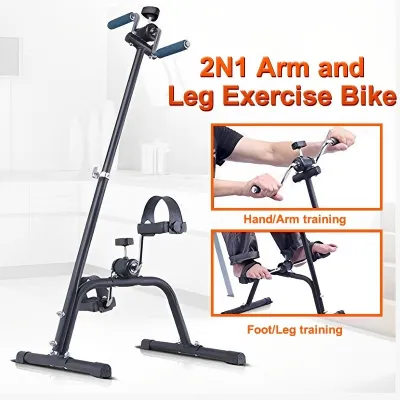
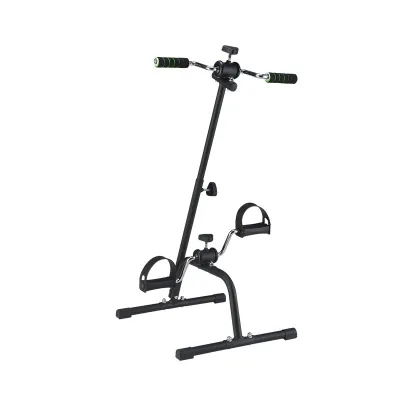
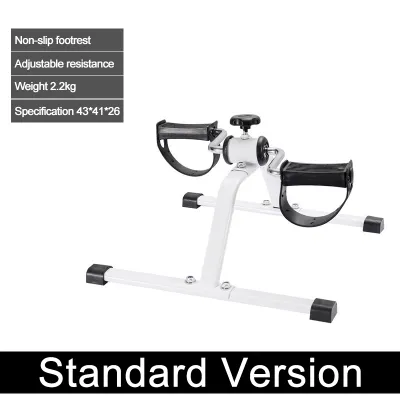
Prices are valid at publication and may change. Please refer to the product page for the latest price.
Crucially, no home cycling program should begin without a mandatory safety check. You must obtain explicit medical clearance and a customized movement plan from the patient’s physical therapist or rehabilitation physician. A professional can assess whether the repetitive motion of cycling is safe for the patient’s joints, recommend specific limits on duration, and verify that the cardiovascular demands align with their current health status. They can also provide guidance on how to safely assist the patient during transfers to and from the bike.
Matching Bike Types to Recovery Stages and Needs
Selecting the right exercise bike requires matching the equipment’s physical design to the survivor’s specific recovery stage. Each style of bike serves a distinct therapeutic purpose, offering varying levels of physical support, cardiovascular challenge, and spatial convenience.

Recumbent Bikes: Maximum Support for Early Recovery
For stroke survivors in the early to intermediate stages of motor recovery, a recumbent exercise bike is widely considered the safest and most practical option. These machines are characterized by a wide, contoured seat and a full backrest, which distribute body weight evenly and significantly reduce the strain on the lower back. The semi-reclined positioning places the pedals in front of the rider rather than directly beneath them, lowering the cardiovascular strain compared to upright riding. A critical feature to look for is a low step-through frame, which allows the patient to mount and dismount the bike without having to lift their leg over a high central barrier—a major hazard for anyone experiencing hemiparesis or unilateral weakness.
This design is best suited for patients who have poor seated balance, weak core muscles, or a high risk of falling. The secure bucket seat holds the pelvis and torso stable, allowing the patient to focus entirely on lower-limb coordination and muscle recruitment without the fear of tipping sideways. Many models offer adjustable seat distances and secure pedal straps to keep the affected foot firmly in place, preventing it from slipping during the rotation. In the Philippines, high-quality recumbent bikes generally fall within a broad price band of ₱15,000 to ₱45,000+, depending on the resistance mechanism and digital tracking features.
However, recumbent bikes do have clear limitations. Because the machine provides complete back and torso support, it does not actively challenge or train standing balance, weight-bearing core stability, or the natural upright posture required for walking. It is primarily a tool for building initial leg strength, joint mobility, and cardiovascular endurance, rather than a direct simulator of walking mechanics.
Upright Bikes: Building Core Control and Balance
An upright exercise bike represents a step forward in difficulty and is designed to challenge a patient’s physical stability. Featuring a traditional saddle design positioned directly above the pedals, this style of bike requires the rider to maintain an upright posture using their own muscular strength. There is no backrest to lean against, which forces the abdominal, back, and hip muscles to engage continuously during the workout.
This style is best suited for stroke survivors who have already regained basic seated balance and are ready to actively challenge their core stability. Riding an upright bike helps improve overall cardiovascular endurance and more closely simulates the vertical, weight-bearing mechanics of normal walking. It helps transition the patient from passive support to active muscle recruitment across the entire kinetic chain. In local fitness stores, reliable upright bikes are typically priced in a broad band from ₱8,000 to ₱25,000+.
Before introducing an upright bike, several safety checks and adjustments are mandatory. Ensure the seat height is calibrated correctly: when the pedal is at its lowest point, the patient’s knee should have a slight bend of approximately 15 to 20 degrees to avoid hyperextension, which can aggravate joint issues or trigger spasticity. Additionally, the patient must have sufficient grip strength and upper-body control to use the handlebars for support, especially if unilateral weakness is present, to prevent leaning heavily to one side.
Under-Desk Pedal Exercisers: Seated Mobility for Limited Space
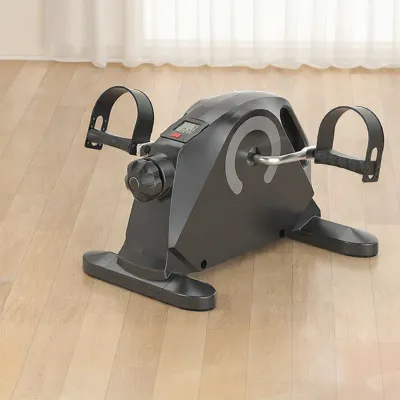
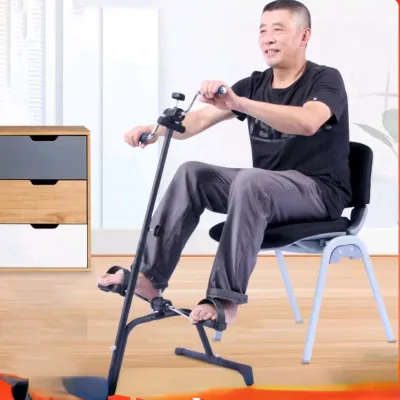
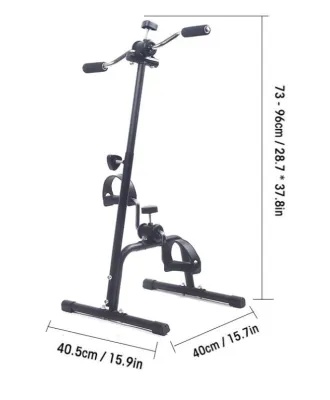
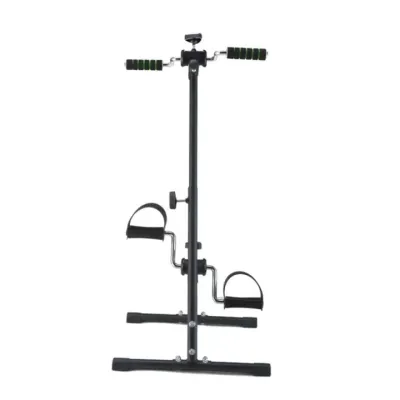
For homes with limited floor space, such as high-rise condominiums in busy urban centers, or for patients with severe mobility limitations, an under-desk pedal exerciser offers a highly adaptable solution. These compact, lightweight devices consist of a simple pedal mechanism with low-resistance settings, designed to be placed on the floor in front of a standard household chair, a supportive sofa, or even a wheelchair.
This setup is highly beneficial for early-stage rehabilitation where the primary goal is simply to keep the joints moving and stimulate blood flow. It allows the patient to exercise from the familiar comfort and safety of their preferred seating, eliminating the transfer risks associated with mounting a full-sized stationary bike. These portable devices are also the most budget-friendly option, generally ranging from ₱1,500 to ₱5,000 on local online marketplaces and medical supply stores.
Despite their convenience, pedal exercisers have distinct limitations and safety hazards. Because they lack built-in back support, the safety of the exercise relies entirely on the stability and ergonomics of the chair being used. They also offer limited resistance progression, meaning they may be outgrown quickly as the patient’s strength improves. Furthermore, because these devices are lightweight, they present a significant slipping hazard; on the smooth tile or polished hardwood floors common in Philippine homes, they can easily slide forward during use if they are not physically secured.
Configuring a Safe Home Workout Space
Integrating a bike for stroke patient rehabilitation into a home environment requires careful planning to prevent secondary injuries and ensure daily workouts remain stress-free. In typical local households, space constraints and flooring materials demand specific safety modifications.
First, consider the spatial requirements for safe mounting and dismounting. You must provide a wide, clear perimeter around the bike—ideally at least one meter of unobstructed space on all sides. This is particularly critical for patients experiencing hemiparesis, who may need to pivot slowly on their unaffected leg or require the assistance of a caregiver to transfer onto the seat. Ensure there are no loose rugs, electrical cords, or low furniture nearby that could trip the patient or block a caregiver’s access.
Floor stability and traction are paramount. Because many local homes feature smooth ceramic tiles, marble, or polished hardwood, any exercise equipment can easily slide or wobble. To prevent this, place a heavy-duty, high-traction rubber mat beneath the bike or pedal exerciser. This mat serves a dual purpose: it grips the floor to prevent the machine from shifting under the force of uneven pedaling, and it protects your flooring from scratches.
Finally, optimize the surrounding environment for comfort and safety. Given the tropical heat and high humidity in the Philippines, ensure the workout area is well-ventilated, ideally positioned near an air conditioning unit or a steady electric fan to prevent heat exhaustion. Keep a stable side table positioned on the patient’s unaffected side. On this table, keep essential items within easy reach: a water bottle for hydration, a towel, and an emergency communication device, such as a mobile phone, so they can call for help instantly if needed.
Safety Boundaries and Warning Signs During Use
While consistency is key to neurological recovery, safety boundaries must never be compromised. Exercising past the point of safe physical tolerance can lead to setbacks, muscle strain, or cardiovascular distress.
During every session, monitor the patient closely for immediate stop signals. You must halt the exercise immediately if the survivor experiences dizziness, lightheadedness, chest pain, shortness of breath, sudden joint pain, or an abrupt, painful increase in muscle spasticity. Extreme fatigue, characterized by a sudden loss of coordination or an inability to maintain a basic pedaling rhythm, is also a clear signal to stop and rest.
When tracking progress, prioritize safety metrics over high intensity. The goal of stroke rehabilitation is neural retraining and joint mobility, not high-speed athletic conditioning. Focus on maintaining a consistent, low-resistance cadence and a smooth, symmetrical pedaling motion. Avoid rapid speed increases or high resistance levels that cause the patient to strain, hold their breath, or lean heavily to one side, as these compensations can reinforce poor movement patterns.
Establish clear criteria for when to pause the home routine and consult a professional. If you notice the patient consistently leaning to one side, experiencing persistent joint pain after workouts, or if their muscle stiffness worsens over several days, stop using the bike. Contact their physical therapist or physician to reassess the setup, modify the resistance levels, or adjust the overall recovery plan.
Frequently Asked Questions (FAQ)
Is a spin bike suitable for stroke rehabilitation?
No, spin bikes are generally not recommended for stroke rehabilitation. These bikes are designed for high-intensity athletic training and require an aggressive, forward-leaning posture that places significant strain on the lower back, neck, and shoulders. This position demands exceptional core strength and bilateral grip control to maintain balance, which is highly unsafe for a patient recovering from a stroke. Additionally, spin bikes often feature heavy, fixed-gear flywheels that do not stop spinning immediately when the rider stops pedaling, presenting a severe risk of joint hyperextension or muscle injury if the patient loses control of their legs.
How can I prevent a pedal exerciser from sliding on smooth floors?
To prevent a portable pedal exerciser from sliding on smooth tile or hardwood floors, you can employ several practical stabilization methods. The most effective approach is to place a high-grip rubberized mat directly underneath the device to create traction. Alternatively, you can position the front of the pedal exerciser flush against a solid wall or the base of a heavy, immovable piece of furniture, such as a sofa, to physically block it from sliding forward. When shopping for a device, look for models that feature a weighted base and wide, non-skid rubber feet, as these design elements provide superior natural stability during use.
Community discussion
Share your experience or ask a question. Comments are reviewed before publication.