
Learning to surf is an exhilarating journey, but choosing your first board can be challenging. In the Philippines, where tropical surf destinations are spread across different islands, transport logistics add an extra layer of complexity. An inflatable surfing board offers an excellent solution for beginners, combining stability, user-friendly performance, and unmatched portability. To get the most out of your sessions, your first board needs to balance buoyancy with structural rigidity, allowing you to focus on mastering your pop-up and riding your first waves.
Before committing to a purchase, it is vital to understand that an inflatable surfing board is not a toy; it is a specialized piece of sports equipment. The right board must match your body weight, physical fitness, and the specific wave conditions of your chosen break. While these boards provide a forgiving platform that minimizes bruises during wipeouts, they still require proper handling, ocean awareness, and realistic expectations of your current skill limits. Equipment cannot replace training or judgment. Always assess your physical limits and the ocean conditions before heading out; if waves are too large or currents are strong, do not enter the water.
Quick Guide: Ideal Specs for Your First Inflatable Surfboard
To ensure a successful start, beginners should look for specific dimensions that maximize stability and wave-catching potential. The ideal specifications for a beginner’s first board focus heavily on volume and outline.
Products mentioned in this guide
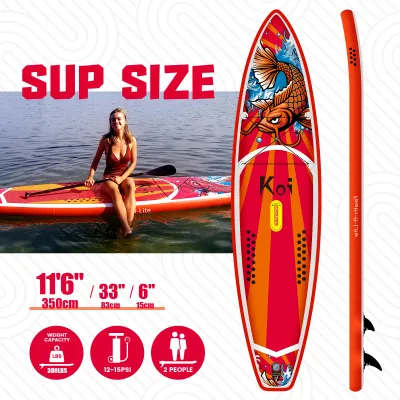
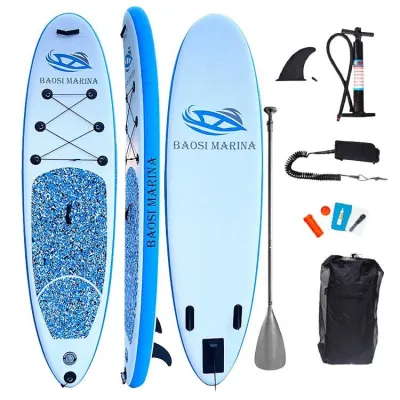
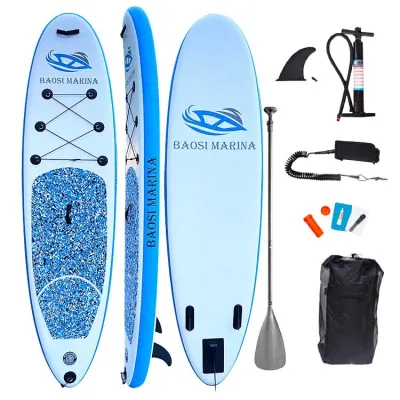
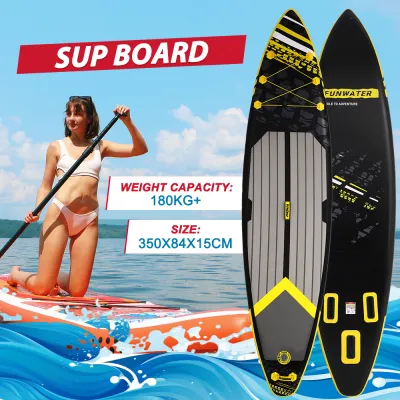
Prices are valid at publication and may change. Please refer to the product page for the latest price.
- Length (8'0" to 9'0"): A longer board provides more surface area, which translates directly to better glide. This extra length helps you match the speed of small, rolling whitewater waves, making it much easier to catch them early.
- Width (30 inches or more): Width is the primary factor in lateral stability. A wide board resists tipping from side to side when you transition from paddling to standing, giving you a wider margin of error during your pop-up.
- Thickness (4 to 6 inches): Thickness determines the overall volume and buoyancy of the board. For adult beginners, a thickness of 4 to 5 inches is generally preferred for surfing, as it keeps the center of gravity low while providing enough flotation to prevent the board from sinking or flexing under your weight.
- Shape (Rounded Nose and Wide Tail): A rounded nose prevents the front of the board from diving underwater (pearling) when catching a wave. A wide, stable tail catches the kinetic energy of the wave quickly, pushing you forward with minimal paddling effort.
Why Inflatables Are Perfect for Philippine Surf Towns
The Philippine archipelago is blessed with world-class surf breaks, but traveling between them with a traditional hard surfboard can be a logistical headache. Popular beginner destinations like San Juan in La Union, Sabang Beach in Baler, and the beginner-friendly breaks of Siargao often require long bus rides, regional flights, or navigating narrow coastal roads in tricycles. An inflatable surfing board eliminates the need for specialized vehicle roof racks or expensive airline oversized baggage fees. It deflates and packs down into a compact backpack, allowing you to travel light and store your gear easily in public transport compartments or small car trunks.

Beyond travel convenience, the natural environment of tropical surf breaks presents unique challenges for board durability. Many beginner spots in the Philippines feature shallow reefs, sandy bottoms with hidden rocks, or crowded lineups where accidental collisions are common. Traditional fiberglass surfboards are highly fragile; a minor bump against a shallow reef in Siargao or a collision on a busy weekend in La Union can crack the outer shell, leading to water damage and costly repairs. In contrast, high-quality inflatable boards constructed with heavy-duty, military-grade PVC and drop-stitch technology can withstand impacts with sandbars, rocks, and other boards without sustaining structural damage.
Finally, local accommodation and living spaces in popular surf towns are often compact. Whether you are staying in a cozy beachside hostel, a homestay, or a small condominium in the city, storing an eight-foot hard board can be highly impractical. High humidity and intense tropical heat can also degrade traditional board materials if they are left exposed on balconies or outdoor racks. An inflatable board can be thoroughly rinsed, dried in the shade, deflated, and stored safely inside a closet. This simple storage routine protects your investment from UV degradation and keeps your living space clutter-free.
Essential Inflatable Surfing Board Specs to Evaluate Before Buying
When shopping for an inflatable surfing board, understanding the technical specifications on the product label is crucial to making an informed decision. You must look past aesthetic designs and focus on how the board is engineered to perform in the water.
- Dimensions & Volume: Volume is measured in liters and represents the overall buoyancy of the board. For beginners, high volume is your best friend because it keeps the board riding high on the water's surface, reducing drag and making paddling significantly less exhausting. As a general guideline, adult beginners should look for a board with a volume of at least 70 to 100 liters, depending on their body weight. If a board lacks sufficient volume for your weight, it will sit too low in the water, making it incredibly difficult to paddle fast enough to catch waves.
- Construction & Rigidity: The rigidity of an inflatable board directly impacts its performance on a wave. When you stand up, your body weight concentrates in the middle of the board. If the board is poorly constructed, it will bend or sag in the center—a phenomenon known as the "taco effect." This bending destroys the board's glide, makes balancing nearly impossible, and prevents you from riding the wave smoothly. To ensure maximum rigidity, look for dual-layer PVC construction (either fused or laminated) and a high-density drop-stitch core. This internal structure consists of thousands of vertical threads connecting the top and bottom decks, allowing the board to hold its shape even when inflated to high pressures of 15 to 18 PSI.
- Fin Setup: Fins provide the lateral grip and directional stability needed to steer the board. For beginners, a thruster setup (three fins of equal size) is highly recommended because it helps the board track straight in turbulent whitewater and offers predictable handling. Some boards feature a 2+1 setup, which uses a larger center fin for straight-line tracking and two smaller side fins (side bites) for stability. Ensure the board utilizes a removable fin system (such as US Box or slide-in fin boxes) rather than fixed rubber fins. Removable fins allow you to pack the board tighter without bending the fins, and they can be easily replaced if damaged.
- Deck Pad & Traction: A high-quality deck pad is essential for maintaining your footing. Look for a full-length or generous EVA foam traction pad with a textured grip pattern, such as diamond or crocodile skin grooves. A good deck pad provides excellent traction underfoot when wet, reducing the need for traditional surf wax, which tends to melt quickly in the hot Philippine climate. The pad should feel comfortable against your skin, as you will spend a significant amount of time lying down and paddling.
Recommended Inflatable Surfboard Profiles for Beginners
The All-Around Inflatable Surfboard
For absolute beginners who are stepping onto a board for the very first time, the all-around profile is the most forgiving option. These boards feature a wide, rounded outline from nose to tail, creating a highly stable platform that resists tipping. This design is specifically optimized for catching whitewater waves close to the shore and riding them straight toward the beach.
The primary advantage of the all-around shape is its massive “sweet spot.” Even if your foot placement during the pop-up is slightly off-center, the board’s generous width and high volume will support your weight and allow you to regain your balance. However, this stability comes with a trade-off: the wide nose and thick rails make the board slower to turn. As your skills progress and you begin attempting to ride the open, unbroken face of a wave (green waves), you may find that this profile feels sluggish and less responsive to foot pressure.
The Inflatable Longboard Shape
If your goal is to transition quickly from riding whitewater to catching unbroken green waves, an inflatable longboard shape is an excellent choice. Typically measuring 9 feet or longer, this profile mimics the classic lines of a traditional fiberglass longboard, featuring a slightly tapered nose and a gently pulled-in tail.
The defining characteristic of the longboard shape is its exceptional glide. The increased length allows the board to cut through the water efficiently, meaning you can cover more distance with less paddling effort. This superior paddling speed makes it much easier to match the velocity of incoming waves, allowing for a smoother, earlier entry into the wave. The main trade-off is that the longer length requires more physical strength and coordination to turn, and the slightly narrower template demands more precise balance during your pop-up compared to an all-around board.
The Soft-Top Inflatable Hybrid
For those who prioritize safety, especially when learning in crowded lineups or surfing with family members, the soft-top inflatable hybrid offers a unique solution. This design combines a rigid, high-pressure inflatable drop-stitch core with a soft, cushioned foam top deck made from materials like EVA or high-density polyethylene.
The primary benefit of this hybrid construction is impact protection. In crowded beginner breaks, such as the main point in San Juan, La Union, runaway boards are a common hazard. If a soft-top hybrid strikes you or another surfer, the cushioned outer layer significantly reduces the risk of cuts, bruises, or more serious injuries. Additionally, the soft foam deck provides exceptional natural traction across the entire surface of the board, eliminating the need for wax entirely. The trade-off is that these hybrid boards tend to be slightly heavier and bulkier when deflated, requiring a larger storage bag and slightly more effort to transport.
Buying Checklist and Local Market Considerations
Investing in your first inflatable surfing board requires careful consideration of where you buy and what accessories are included. To avoid purchasing low-quality counterfeits or poorly constructed boards that will warp after a few sessions, always buy from official brand websites, authorized physical surf shops, or verified stores on reputable online marketplaces. Purchasing from authorized channels ensures you receive a valid manufacturer’s warranty, which is crucial for addressing any potential seam or valve defects.
When comparing different packages, use this checklist to verify that all essential accessories are included:
- High-Pressure Pump: A dual-action manual pump is standard, allowing you to inflate the board on both the upward and downward strokes to save energy. Alternatively, consider upgrading to a 12V electric pump that plugs into your vehicle's accessory outlet for effortless inflation.
- Coiled Surf Leash: Ensure the package includes a heavy-duty, coiled leash specifically rated for surfing. Avoid using lightweight flatwater paddle board leashes, as they lack the strength and swivel mechanisms required to handle the sudden pull of breaking waves.
- Heavy-Duty Travel Backpack: The backpack should be constructed from durable, water-resistant nylon and feature padded shoulder straps and waist belts to make carrying the board comfortable over long distances.
- Comprehensive Repair Kit: This should contain PVC patches, a valve tightening wrench, and waterproof adhesive. Note that if you plan to travel by air to local surf destinations, some airlines may restrict carrying liquid adhesives in your carry-on luggage, so pack it in your checked baggage.
Before finalizing your purchase, always verify the board’s maximum weight capacity and recommended inflation pressure (PSI). Budget inflatable surfing boards in the Philippines typically range from ₱12,000 to ₱18,000, while high-performance models can exceed ₱35,000. To ensure the board performs as intended and maintains its structural rigidity, it must be inflated to the manufacturer’s exact specifications—typically between 12 and 15 PSI. Never exceed the maximum rated pressure, as this can cause permanent damage to the internal drop-stitch core.
Frequently Asked Questions (FAQ)
Can I use an inflatable paddle board (iSUP) for surfing?
While it is technically possible to catch small waves on a standard all-around inflatable stand-up paddle board (iSUP), they are not designed for surfing and will hinder your progress. Standard iSUPs are generally much larger, typically measuring 10 to 12 feet in length, 32 to 34 inches in width, and 6 inches in thickness. This massive volume makes them highly stable for flatwater paddling but far too bulky and unresponsive to steer on a wave face. They also lack the nose rocker (the upward curve at the front) and tapered rails required to prevent the board from nosediving (pearling) when sliding down a wave. A dedicated inflatable surfing board is engineered with a thinner profile, refined rails, and specific fin configurations to allow for controlled turns and proper wave riding.
How do I prevent my inflatable surfboard from delaminating in the heat?
The tropical climate of the Philippines presents a significant risk of heat damage to inflatable boards. When a fully inflated board is left resting on hot sand in direct sunlight, the air inside expands rapidly, creating intense pressure that can rupture the seams or cause the PVC layers to delaminate. To protect your board, never leave it fully inflated on the beach during breaks. Always move your board to a shaded area, or release 2 to 3 PSI of air to allow room for thermal expansion if shade is unavailable. After your session, rinse the board thoroughly with fresh water to remove salt and sand, dry it completely in a shaded spot, and store it deflated in a cool, dry, and well-ventilated environment to prevent mold growth and UV degradation.
Community discussion
Share your experience or ask a question. Comments are reviewed before publication.