
Selecting your first holster is a critical step when entering the competitive world of practical shooting or high-intensity airsoft. For beginners in the Philippines, finding a reliable, rule-compliant, and weather-resistant setup can feel overwhelming. The most versatile and highly recommended starting configuration is a strong-side, belt-mounted Kydex JR holster with adjustable tension screws. This setup provides the optimal balance of safety, structural rigidity, and rule compliance for both IPSC (International Practical Shooting Confederation) and local airsoft matches, allowing you to build consistent muscle memory without fighting your gear.
Why Kydex and JR Holsters Suit the Philippine Climate
JR holsters have earned a strong reputation within the Philippine practical shooting and airsoft communities. Local shooters frequently face demanding outdoor environments, ranging from dusty, sun-baked bays in Lipa to muddy, rain-slicked ranges in Rizal. In these tropical conditions, gear durability is tested to its absolute limits by high humidity, intense heat, and heavy sweat.
Traditional holster materials like leather and nylon present significant drawbacks when subjected to the Philippine climate. Leather absorbs moisture and sweat, which can cause it to soften, warp, and lose its shape over time. This warping not only slows down your draw but also poses a severe safety hazard if the leather deforms into the trigger guard. Nylon, while lightweight, lacks the structural rigidity required for fast, repeatable draws, often sagging under the weight of a loaded pistol or a heavy gas blowback airsoft replica.
Products mentioned in this guide
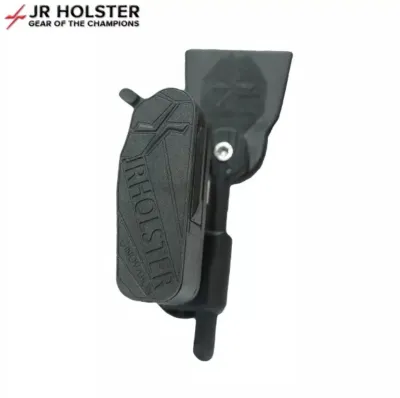
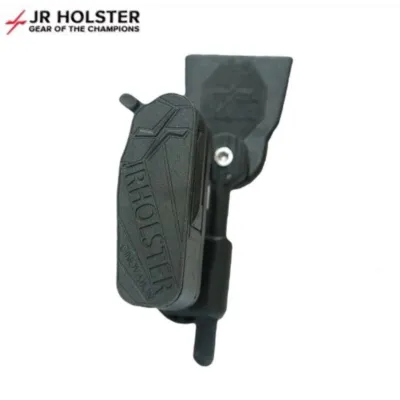
![[JR Holster] Duty Holster Automatic Lock](https://img.lazcdn.com/g/p/ee9ffb11c70688e458fdcbf3ed52d782.jpg_400x400q80.jpg_.webp)
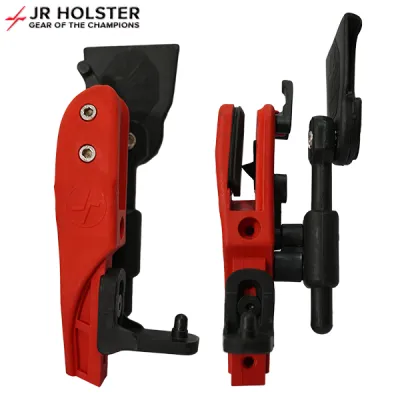
Prices are valid at publication and may change. Please refer to the product page for the latest price.
Kydex, a specialized thermoplastic, solves these issues by remaining completely rigid and impervious to moisture. A Kydex JR holster will not swell, shrink, or rot, regardless of how humid the range becomes. This material consistency ensures that your firearm or airsoft replica remains securely in place during dynamic movement, while still allowing for a smooth, friction-free draw when you need to perform under the clock.
Core Configuration Decisions for Beginner Shooters
Carry Position and Height: Strong Side vs. Drop Platforms
For beginners, the position and height of your holster dictate how quickly and safely you can access your firearm. The strong-side, high-ride (belt-level) position is the gold standard for developing foundational muscle memory. When mounted at the hip, the holster remains in a fixed, predictable location that aligns naturally with your hand’s default resting position, minimizing the need for complex upper-body movement during the draw.

Drop and offset platforms lower the holster below the belt line and push it slightly away from the body. While this configuration can shorten the vertical distance your arm must travel to clear the holster, it introduces biomechanical complexities. A lower holster requires more pronounced hip rotation and shoulder drop to maintain a clean vertical draw. If your draw stroke is not perfectly linear, you risk binding the gun inside the holster, which slows down your time and increases physical strain.
Furthermore, holster height is strictly regulated in competitive disciplines. Many IPSC divisions restrict or outright ban drop and offset platforms to keep the playing field level. Mastering the standard strong-side, high-ride draw first ensures you build a clean, efficient draw stroke that complies with the widest variety of match rules. Once your muscle memory is fully established, you can make an informed decision about whether a dropped rig is truly beneficial for your specific shooting discipline.
Material Choice: Kydex Advantages in High Humidity
One of the primary functional benefits of a Kydex JR holster is the ability to fine-tune your retention. These holsters utilize adjustable tension screws paired with rubber spacers. By tightening or loosening these screws, you can customize exactly how much force is required to release the firearm from the holster, ensuring it stays secure while running through a stage but releases effortlessly during the draw.
This adjustability is particularly valuable on outdoor Philippine ranges where dust, sand, and mud are common. If fine grit gets trapped inside a non-adjustable holster, it can dramatically increase friction, making your draw sticky and unpredictable. With Kydex, you can easily adjust the tension to compensate for environmental factors, maintaining a consistent feel throughout a long match day.
Additionally, cleaning Kydex is incredibly straightforward compared to fabric or leather. After a muddy outdoor match, you can simply rinse the holster under running tap water, wipe it down with a clean cloth, and let it air dry. Before reassembling, always inspect the interior surfaces for any embedded dirt or sharp plastic artifacts. Checking for a smooth interior finish prevents unnecessary wear on your firearm’s slide and ensures a clean, drag-free draw every time.
Attachment Hardware: Belt Loops vs. Paddles
How your holster connects to your belt is just as important as the holster itself. Direct belt loops offer the most stable, secure connection possible. These loops slide directly onto your outer competition belt, locking the holster in a fixed position. Because there is no play between the holster and the belt, the rig cannot tilt, shift, or slide, providing a perfectly consistent index point every time you reach for your gun.
Paddle attachments, by contrast, feature a plastic flange that slips over your waistband or belt, allowing for quick removal. While convenient for casual range use, paddles are highly discouraged for competitive shooting. Under the stress of a rapid, forceful draw, a paddle can flex or even detach entirely from your waistband, pulling the entire holster up with the firearm. This is a catastrophic failure that can lead to match disqualification due to unsafe muzzle angles.
To maximize the stability of your belt loops, you must pair your holster with a dedicated, reinforced gun belt. A standard fashion belt or a soft tactical belt will sag and twist under the weight of a loaded pistol and multiple magazine pouches. A rigid, dual-belt system (consisting of an inner velcro belt and a stiff outer belt) prevents any twisting, ensuring your holster remains perfectly vertical. Many local match directors require these secure, non-shifting attachments to maintain strict safety standards on the range.
Recommended JR Setups for IPSC and Airsoft Rules
IPSC Production and Standard Division Compliant Setups
If you are planning to enter the IPSC Production or Standard divisions, your gear must strictly adhere to the official rulebook. The IPSC Production Division is designed for out-of-the-box, duty-style handguns, and the equipment rules are highly specific. Your holster must be worn on the strong side, and the entire handgun, including the grip, must be positioned close to your body—specifically, the distance between the handgun and your torso must not exceed 50 millimeters.
For these divisions, the ideal setup is a JR strong-side, high-ride Kydex holster mounted via standard, rigid belt loops. The holster should feature an adjustable cant mechanism, allowing you to tilt the holster slightly forward (typically between 0 and 10 degrees). This slight forward angle aligns the grip of the handgun with the natural angle of your wrist as you reach down, facilitating a faster, more ergonomic draw without violating the height or distance rules.
In the Standard Division, minor offsets are permitted, but beginners are still advised to stick to a high-ride, belt-level configuration. Keeping your gear setup consistent across different divisions prevents confusion and helps you focus entirely on shooting fundamentals rather than adjusting to a new holster position. Always use a ruler to verify your heel-to-belt distance and torso clearance before heading to the equipment check station at local matches, as failing these measurements will result in being moved to the highly competitive Open Division.
Airsoft and Open Division Flexible Setups
Airsoft practical shooting and IPSC Open Division matches offer far more freedom regarding gear selection. Airsoft players often wear tactical chest rigs, plate carriers, or bulky utility belts that can physically block a standard high-ride holster. In these scenarios, a standard belt-level draw can cause your hand or the gun slide to snag on your tactical gear, disrupting your flow and creating safety hazards.
To clear these obstacles, a dropped JR holster mounted on a mid-ride offset platform is highly effective. This configuration lowers the handgun just enough to clear the bottom edge of a plate carrier, allowing for a completely unobstructed draw path. It also positions the gun at a more natural arm extension, which can reduce shoulder strain during long days of shooting.
When using a dropped or offset platform, securing the lower portion of the rig is essential. A high-quality, elasticized leg strap should be used to anchor the holster to your thigh. Without a leg strap, a dropped holster will bounce and wobble when you run between shooting boxes, making it difficult to establish a clean grip on the move. Additionally, look for quick-detach (QD) mounting systems if you frequently need to remove your holster when transitioning between different airsoft loadouts or resting in the staging area.
Fitment, Safety Checks, and Sourcing Locally
No matter which configuration you choose, safety must remain your absolute priority. A properly designed holster must completely enclose the trigger guard, preventing any foreign objects, clothing drawstrings, or stray fingers from contacting the trigger while the gun is holstered. It is important to remember that high-quality equipment is a tool to assist your performance; it can never replace rigorous training, muzzle discipline, and strict adherence to basic firearm safety rules.
When setting up a holster for airsoft, be aware of dimensional differences between real steel firearms and airsoft replicas. Even if an airsoft gun is marketed as a 1:1 replica, minor manufacturing variances—such as slightly wider slide serrations, thicker trigger guards, or non-standard rail dimensions—can cause fitment issues. A holster molded for a real Glock 17 may pinch or fail to lock onto an airsoft Glock replica. Always test the retention, lockup, and draw safety with your exact replica before participating in a match to ensure it does not slip out or bind during movement.
Sourcing JR holsters in the Philippines is highly convenient, as they are locally produced and tailored to the needs of domestic shooters. You can find them at authorized tactical gear retailers, specialized shooting pro shops in major cities, or by ordering directly through custom Kydex makers. If you require a custom configuration for a specific gun model or accessory setup, be prepared for a lead time of several days to a few weeks. Planning your purchase well ahead of the local match season ensures you have ample time to assemble, adjust, and practice with your new rig.
Frequently Asked Questions (FAQ)
Can I use the same JR holster for both my real steel and airsoft guns?
While some high-end airsoft replicas share near-identical external dimensions with their real-steel counterparts, using the same Kydex holster for both is generally not recommended. Minor dimensional variations in slide width, frame thickness, or trigger guard shapes can cause the airsoft replica to fit too tightly or wobble inside a real-steel holster. A tight fit can scratch and wear down the plastic or pot-metal slide of an airsoft gun, while a loose fit compromises retention safety during rapid movement. For the best performance, safety, and consistency, it is highly recommended to maintain a dedicated holster for each individual platform.
How do I maintain my Kydex holster in the Philippine humidity?
Although Kydex is entirely waterproof and rust-proof, the metal hardware holding your holster together is not. The steel screws, eyelets, tension spacers, and belt attachment clips are highly susceptible to rust when exposed to salty sweat and humid tropical air. After every match or practice session, wipe down the entire holster with a clean, dry microfiber cloth to remove sweat and moisture. Periodically apply a very light coat of rust-preventative oil or dry silicone lubricant to the threads of the tension screws and metal eyelets. This simple maintenance step prevents the hardware from seizing, ensuring you can easily adjust your holster’s retention whenever necessary.
Community discussion
Share your experience or ask a question. Comments are reviewed before publication.