
Quick Recommendations: Match the Reflector Type to Your Run
Running in the Philippines presents unique visibility challenges. To escape the intense daytime heat and high humidity, many runners take to the streets during the cool hours of early morning or late evening. However, these times often coincide with low-light conditions, which are further complicated by unpredictable weather like sudden monsoon downpours or poorly lit provincial roads. Staying visible to motorists, cyclists, and pedestrians is a critical safety requirement. While active lights are helpful, passive reflective gear is a highly reliable, battery-free line of defense that ensures you remain visible whenever a headlight sweeps in your direction.
Choosing the right reflector band depends heavily on where and when you run. For casual runners navigating well-lit city streets or urban neighborhood loops, a lightweight arm band offers a simple, highly portable solution. If your route takes you along unlit provincial roads, rural paths, or rugged trails, ankle straps are exceptionally effective because they leverage the rapid movement of your feet to catch a driver’s attention. For long-distance marathon training, high-traffic highway shoulders, or routes with complex multi-lane intersections, a full vest-style reflector provides the necessary 360-degree coverage to keep you safe from all angles. Ultimately, the ideal choice is one that matches your specific running environment, route duration, and personal comfort preferences.
What to Look for When Choosing Reflective Running Gear
When selecting reflective gear, it is easy to assume that all shiny materials perform equally. In reality, several technical and practical factors determine how effectively a reflector band keeps you safe on the road. Understanding these criteria allows you to make an informed purchase that balances high visibility with long-term comfort.
Products mentioned in this guide
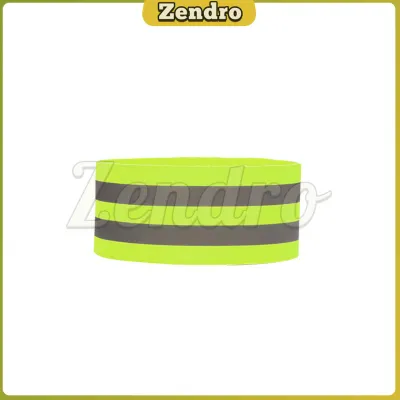
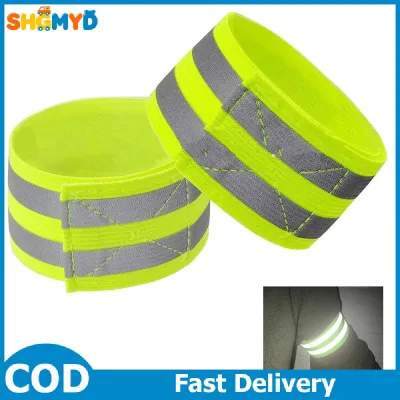
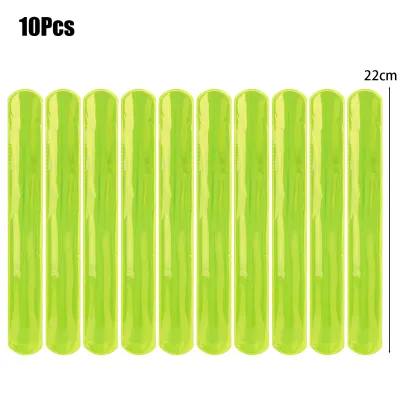
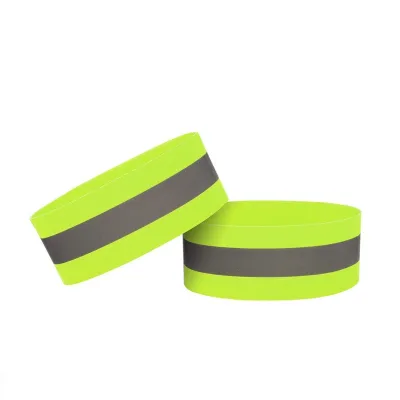
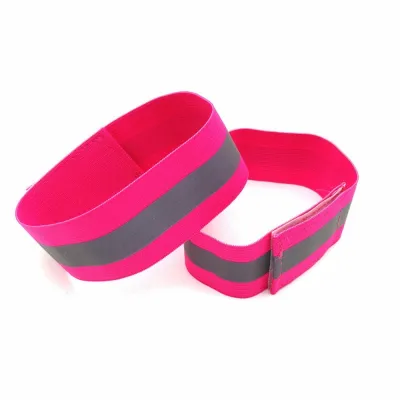
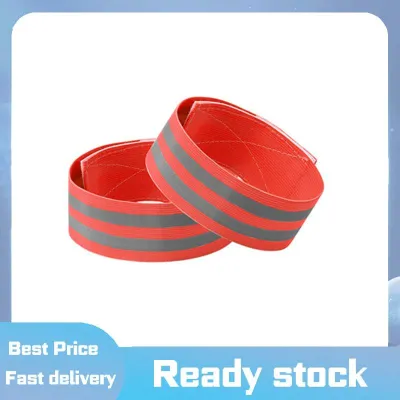
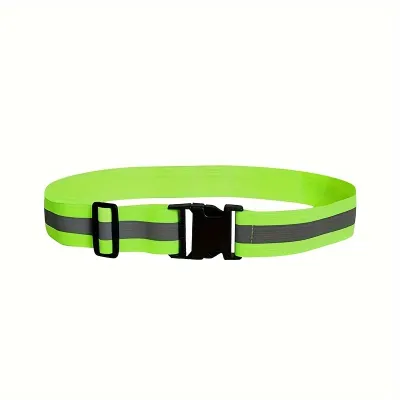
Prices are valid at publication and may change. Please refer to the product page for the latest price.

Visibility and Placement (Biomotion): The placement of your reflective gear dictates how quickly a driver can identify you as a human being. This concept, known as biological motion or biomotion, relies on the human brain’s ability to recognize familiar movement patterns. While a static reflective patch on your chest or back shows that something is there, reflective bands placed on your moving limbs—such as your swinging arms or pedaling ankles—instantly signal to a motorist that a runner is ahead. This motion-based recognition allows drivers to react and slow down much faster than they would for a stationary reflective object.
Reflective Materials: Reflective materials generally fall into two categories: glass bead and micro-prismatic technology. Glass bead reflectors use tiny spherical beads to scatter light back to its source, providing a wider angle of visibility but slightly less intensity. Micro-prismatic reflectors use microscopic prisms embedded in a vinyl film, which returns a highly concentrated, bright beam of light over longer distances. For runners navigating high-speed highways or dark provincial roads, micro-prismatic bands offer superior long-range detection, while glass bead options are often softer and more flexible for close-fitting wear.
Comfort and Chafing: The tropical climate of the Philippines means you will sweat heavily during almost every run. When sweat mixes with friction, poorly designed gear can cause severe chafing. Look for reflector bands made with soft, moisture-wicking backings, seamless edges, and highly breathable materials. If you frequently run in singlets or tank tops, ensure the band’s inner lining is gentle on bare skin and does not have sharp plastic edges that can scrape against your arms or legs.
Adjustability and Fit: A good reflector band must remain securely in place without restricting your circulation or breathing. Elastic straps with heavy-duty hook-and-loop fasteners allow you to customize the tightness to your body shape. Your gear should be versatile enough to fit snugly against bare skin during hot summer runs, yet stretch sufficiently to wear over a lightweight windbreaker or compression sleeves during cooler, rainy mornings.
Durability and Maintenance: Sweat, body oils, road dust, and humidity can gradually degrade reflective coatings over time. Micro-prismatic PVC and glass-bead reflective surfaces are sensitive to improper cleaning. Before purchasing, check the manufacturer’s care instructions. High-quality bands should withstand regular hand washing with mild soap without cracking, peeling, or losing their retroreflective properties.
Arm Bands: Ideal for Casual and Urban Commuter Runs
Arm bands are among the most popular and widely available reflective accessories on the market. Typically worn around the biceps or forearms, these bands are designed to provide localized visibility that moves in tandem with your natural running gait.
How They Work: As you run, your arms naturally swing forward and backward. This continuous, rhythmic motion creates a dynamic flashing effect when headlight beams strike the reflective material on your arm bands. Because the light source is constantly moving across the driver’s field of vision, it is highly effective at drawing attention, particularly when you are crossing intersections or navigating busy urban streets where drivers are looking for lateral movement.
Pros: One of the biggest advantages of reflective arm bands is their sheer convenience. They are incredibly lightweight, easy to slip on and off, and highly adjustable. If you start your run before dawn and finish after the sun has fully risen, you can quickly slide the bands off and tuck them into a small pocket or a running belt without adding bulk. They are also relatively inexpensive, making them an accessible entry-point for runners building their safety kit.
Cons: Despite their convenience, arm bands have notable limitations. If you sweat heavily or have slender arms, some bands may slide down toward your elbows or wrists during high-intensity intervals, requiring frequent adjustments. Additionally, because they are worn on the upper body, they provide limited visibility to drivers approaching directly from behind or in front if your arms are held close to your torso or if your body blocks the line of sight.
Best For: Arm bands are best suited for short-to-medium distance runners who stick to well-lit urban environments, neighborhood parks, or established running paths. They are also excellent for urban commuters who need a quick, fuss-free safety accessory to wear during their daily run-commutes through busy city centers.
When wearing arm bands, placement and quantity can make a significant difference. Wearing a single band on your road-facing arm is a common minimalist approach, but wearing bands on both arms provides balanced, symmetrical visibility. This dual-point setup ensures that regardless of whether a vehicle is overtaking you or approaching from a side street, your movement is detected. Additionally, look for bands with a soft neoprene backing, as this material grips sweaty skin better than standard nylon, reducing the need to over-tighten the strap and restrict blood flow.
Ankle Straps: Top Choice for Trail and Low-Light Routes
Ankle straps are often overlooked by beginners, but they are highly favored by experienced night runners and trail enthusiasts for their superior biomotion performance. Worn just above the ankle bone, these straps place reflective material at the lowest point of your moving body.
How They Work: The up-and-down motion of your feet is the most distinct and recognizable human movement to a driver. Because car headlights are angled downward to illuminate the road surface, they naturally strike your lower legs first. Ankle straps catch this low-angled light immediately, reflecting a bright, bobbing signal back to the driver long before the headlights reach your waist or chest.
Pros: These straps are exceptionally effective on unlit roads, provincial highways, and dark trails where overhead streetlights are absent. Because they are positioned far from your upper body, they stay completely out of the way of your arm swings, hydration vests, or waist belts. They also tend to stay securely in place, as the flare of your ankle bone and running shoes prevents them from sliding downward.
Cons: The primary drawback of ankle straps is their exposure to ground-level elements. When running on muddy trails or wet roads during the rainy season, these straps are prone to getting splashed with mud, dirt, and road grime. A layer of dirt can severely dull the reflective surface, requiring you to clean them frequently. Additionally, they are less effective if you wear long, loose-fitting running pants or thick compression socks that accidentally cover the reflective material.
Best For: Ankle straps are the premier choice for trail runners, night runners navigating unlit rural or provincial roads, and anyone looking to maximize their biological motion visibility. They also serve as an excellent secondary layer of protection when paired with upper-body reflective gear.
Ankle straps are also highly compatible with different types of running footwear. Because they sit just above the collar of your shoe, they do not interfere with your laces or gaiters. However, trail runners should note that low-hanging brush, tall grass, and trail debris can rub against the straps, potentially snagging the hook-and-loop fasteners. Choosing straps with a secure, double-locking closure mechanism ensures they remain attached even when brushing through dense vegetation.
Vest-Style Reflectors: Maximum Safety for High-Traffic and Long Runs
For runners who refuse to compromise on safety, vest-style reflectors offer the highest level of passive visibility available. Unlike small bands, these vests cover your entire torso, creating a massive reflective silhouette that is visible from significant distances.
How They Work: Reflective vests feature wide bands of retroreflective material running across the shoulders, chest, and back. This design ensures that no matter which direction a vehicle is approaching from—whether it is a car turning a corner, a motorcycle weaving through traffic, or a bus approaching from behind—you present a large, continuous reflective surface that is impossible to miss.
Pros: The main advantage of a vest is its comprehensive 360-degree visibility. Many modern running vests are constructed from ultra-lightweight, highly breathable mesh fabrics specifically designed to prevent heat retention in hot and humid tropical climates. Some high-end models also feature integrated storage pockets for small essentials like keys, energy gels, or a smartphone, eliminating the need for a separate running belt.
Cons: On the downside, vest-style reflectors are naturally bulkier and heavier than simple arm or ankle bands. If you need to take the vest off mid-run, it cannot be easily stashed in a pocket and must be carried or packed into a running vest backpack. They can also feel slightly restrictive if the fit is not perfectly adjusted, and they generally carry a higher price point than basic straps.
Best For: Vests are highly recommended for marathon runners undergoing long-distance training, athletes who run on high-traffic national roads, and anyone who frequently has to cross busy, multi-lane intersections in low-light conditions.
Another critical aspect of vest-style reflectors is weight distribution and its effect on your running posture. Unlike heavy hydration packs, a dedicated reflective safety vest is incredibly light, usually weighing less than 100 grams. This minimal weight is distributed evenly across your shoulders, meaning it will not alter your running form or cause shoulder fatigue over long distances. When adjusting a vest, look for side straps that allow you to tighten the fit around your ribs, preventing the vest from bouncing or riding up against your chin during downhill segments.
Reflector Band Types Compared at a Glance
To help you quickly evaluate which style fits your daily running routine, the table below summarizes the key differences between arm bands, ankle straps, and vest-style reflectors.
| Reflector Type | Best For | Primary Visibility Focus | Key Advantage | Main Limitation |
|---|---|---|---|---|
| Arm Bands | Casual urban runs, well-lit city streets, and daily run-commutes. | Lateral movement and intersections via natural arm swing. | Lightweight, highly portable, and very easy to store. | Can slip down sweaty arms; limited direct front/rear visibility. |
| Ankle Straps | Trail running, unlit provincial roads, and low-light environments. | Downward headlight beams and biological motion recognition. | Highly visible to low headlights; does not interfere with upper gear. | Prone to getting dirty or muddy; can be covered by long pants. |
| Vest-Style | Marathon training, high-traffic routes, and multi-lane crossings. | 360-degree torso visibility from all approaching angles. | Maximum reflective surface area; often includes extra pockets. | Bulkier to carry when not worn; can feel warmer in high humidity. |
While each reflector type has its unique strengths, you do not have to limit yourself to just one. In fact, combining different types—such as wearing an arm band on one side and an ankle strap on the opposite leg—creates a highly effective multi-point visibility system that outlines your entire moving body to drivers.
How to Maximize Visibility and Care for Your Reflective Gear
Investing in high-quality reflective gear is only the first step; using and maintaining it correctly is what ensures your safety over hundreds of kilometers.
Layering for Safety: To achieve the highest level of road safety, aim for multi-point placement. By wearing a combination of reflective gear—such as ankle straps to catch low headlights and an arm band to signal lateral movement—you create a complete biomotion profile. This allows drivers to instantly recognize your speed, direction, and human form from a distance.
Understanding Retroreflection: It is important to remember that standard reflector bands are passive safety devices; they do not emit their own light. Instead, they rely on retroreflection, which means they bounce light directly back to its original source, such as car headlights. If you are running in complete darkness with absolutely no external light sources, your reflector bands will not glow. For this reason, always remain alert and never assume a driver has seen you until they actively slow down or yield.
Cleaning and Storage: Sweat, salt buildup, and road grime can quickly dull the micro-prisms or glass beads that make your gear reflective. After a sweaty run in hot weather, gently wipe down your bands with a damp, soft cloth. When a deeper clean is necessary, check the manufacturer’s care label. Avoid throwing reflective gear into a washing machine or dryer unless explicitly permitted, as the heat and friction can crack, peel, or permanently degrade the reflective coating. Instead, hand wash them in cool water with a mild detergent and hang them to dry in a shaded, well-ventilated area.
Inspection and Replacement: Regularly inspect your reflective gear under a bright light to check for signs of wear. If you notice deep scratches, peeling edges, or a general fading of the reflective material, its effectiveness has been compromised. Replace your bands promptly to ensure you remain fully visible on your next low-light run.
Frequently Asked Questions (FAQ)
Do reflector bands work without streetlights?
Yes, reflector bands are highly effective in areas without streetlights. Because they use retroreflective technology, they do not need ambient street lighting to work. They only require an external light source, such as a vehicle’s headlights, a cyclist’s front light, or a runner’s headlamp, to strike their surface. Once light hits the band, it bounces directly back to the source, making you highly visible to the person behind that light, even in pitch-black conditions.
Can I wear reflective gear in the rain?
Yes, you can wear reflective gear in the rain, and it is highly recommended to do so, as rainy weather significantly reduces driver visibility. However, heavy downpours can scatter light waves, slightly reducing the maximum distance at which a driver can spot your reflective gear. To ensure longevity, always check the manufacturer’s water-resistance specifications. After running in wet weather, wipe your reflective bands dry and store them in a well-ventilated space to prevent moisture from weakening the adhesives or damaging the reflective micro-prisms.
Community discussion
Share your experience or ask a question. Comments are reviewed before publication.