
Quick Answer: How to Choose the Right Football Cones
Selecting the right football cones depends entirely on the specific drills you run, the training surface, and the local environmental conditions. For training sessions in the Philippines, durability and visibility are the primary factors to consider. The intense tropical sun and heavy seasonal rains can quickly degrade low-quality gear, making high-quality, UV-resistant materials and high-visibility colors essential for long-term safety and performance.
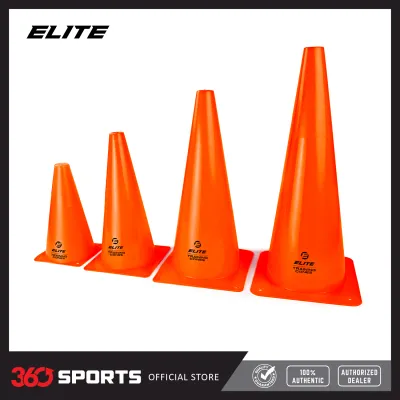
When choosing cones for training, coaches and players typically need to balance two primary categories: low-profile disc cones and taller marker cones. Low-profile disc cones are the standard choice for high-speed agility work, footwork patterns, and marking out pitch boundaries because they are safe to step on and do not obstruct the ball. Taller cones, ranging from 9 to 12 inches, are better suited for technical dribbling, obstacle weaving, and simulated defensive opposition where players must physically navigate around a barrier. A versatile and effective training setup usually incorporates a strategic mix of both cone styles to accommodate different phases of player development.
Key Features to Evaluate Before Buying
Investing in training equipment requires a clear understanding of material science and design ergonomics. Selecting the wrong type of cone can lead to frequent replacements, disrupted training sessions, or even preventable player injuries on the pitch.
Products mentioned in this guide

Prices are valid at publication and may change. Please refer to the product page for the latest price.

Height and Profile: Disc vs. Tall Cones
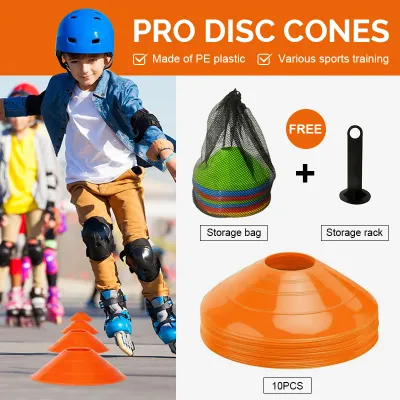
Cone height directly influences player movement, spatial awareness, and the overall safety of a drill. Low-profile disc cones, which typically stand between 1.5 and 2 inches tall, are designed to sit flush with the playing surface. Their low elevation ensures that if a player accidentally steps on one during a high-speed agility run or a rapid direction change, the cone simply collapses flat under the boot. This drastically reduces the risk of rolled ankles or slips, making them the ideal choice for marking out tight grids, defensive zones, and speed-ladder patterns.
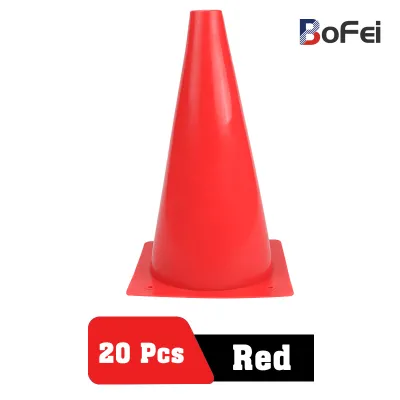
In contrast, taller cones standing 9 to 12 inches high serve as physical obstacles that players cannot easily ignore. These taller markers force players to lift their feet, maintain a lower center of gravity, and execute precise ball-control techniques when weaving through tight spaces. They simulate the physical presence of a defender’s legs, encouraging realistic body positioning during dribbling exercises.
- Safety Warning: Never use rigid, tall cones for high-speed agility drills, reaction training, or blind-footwork exercises. If a player steps on a tall, non-collapsible cone while moving backward or turning at full speed, the rigid plastic will not give way, which can cause severe ankle sprains, ligament tears, or dangerous falls.
Material Flexibility and Weather Durability
The tropical climate in the Philippines presents unique challenges for outdoor sports equipment. Training gear is routinely subjected to high humidity, heavy downpours, and intense ultraviolet (UV) radiation. Under these conditions, standard plastics can degrade rapidly through a process called photo-degradation, which breaks down chemical bonds, leaving the plastic brittle, chalky, and prone to cracking under the slightest impact.
To ensure your training gear survives multiple seasons, look for cones constructed from soft polyethylene (PE) or highly flexible polyvinyl chloride (PVC). These elastomers provide excellent “shape memory” or “step-on recovery.” When stepped on by a player wearing molded or metal studs, a high-quality cone will bend completely flat to absorb the impact and instantly pop back into its original shape without cracking or tearing.
When evaluating products, verify that the manufacturer specifies UV-resistant or fade-resistant properties. UV-stabilized plastics retain their flexibility and vibrant coloration even after hundreds of hours of exposure to intense midday heat, ensuring the cones remain safe and highly functional over time.
Color Visibility on Grass and Artificial Turf
Visual contrast is critical for rapid decision-making on the football pitch. Players must be able to spot markers instantly using their peripheral vision while keeping their eyes on the ball and surrounding players. The choice of cone color should therefore be matched directly to the primary training surface.
- Natural Grass Pitches: Natural grass fields can vary from lush green during the rainy season to dry, dusty brown during the hotter months. For these surfaces, high-visibility neon colors such as vibrant orange, bright pink, and neon yellow provide the sharpest contrast, making them easy to spot in any season.
- Artificial Turf Pitches: Modern synthetic turf pitches often feature a bright, uniform green color that can occasionally cause neon yellow or light green cones to blend in, especially under bright midday sun or strong stadium floodlights. For artificial turf, highly contrasting colors like deep royal blue, stark white, or bright red are far more effective.
Using multi-color cone sets offers significant advantages for structured training. Coaches can use different colors to designate specific zones (e.g., yellow for the passing grid, blue for the shooting zone), set up complex multi-stage drills, or split players into easily identifiable teams during tactical exercises.
Recommended Cone Types for Specific Football Drills
Matching the physical design of your training cones to the specific technical goals of your session is key to maximizing player development and maintaining a smooth training flow.
Agility, Speed, and Footwork (Disc Cones)
Disc cones are the undisputed workhorse of the football training pitch. Because they sit low to the ground, they do not interfere with low-flying passes or alter the trajectory of a ball rolling across the grass. This makes them the perfect tool for setting up agility grids, shuttle runs, and speed-endurance circuits.
- Drill Application: Use disc cones to map out the classic "T-Drill" or "Illinois Agility Test" patterns, where players must accelerate, decelerate, and change direction rapidly. They are also ideal for outlining small-sided game boundaries and temporary penalty boxes.
- Surface Grip: Wet grass and synthetic turf can cause lightweight plastic cones to slide out of position when brushed by a passing ball or a player's boot. Look for disc cones that feature a textured, non-slip underside or slightly thickened, weighted outer rims. These design features help the cones grip the surface and remain securely in place, even during windy monsoon conditions.
Dribbling, Weaving, and Ball Control (Tall and Blade Cones)
Developing close ball control and quick footwork in tight spaces requires markers that present a clear, physical obstacle. Taller cones force players to execute deliberate, controlled touches with different parts of the foot to successfully navigate the course.
- Drill Application: Set up a linear slalom course using 9-inch to 12-inch cones spaced approximately one to two yards apart. Players must weave through the cones using the inside and outside of both feet, keeping the ball as close to the markers as possible without knocking them over.
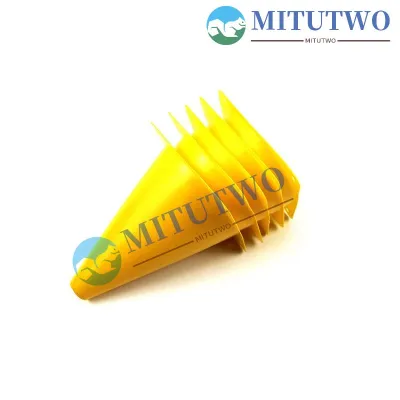
- The Advantage of Blade Cones: Slalom blades or "arrow" shaped cones offer a distinct advantage over traditional round-coned markers. These specialized cones feature a flat, aerodynamic profile and a wider, low-center-of-gravity base. If a player accidentally clips a blade cone with the ball or a boot, the flat design prevents it from rolling away across a sloped or uneven natural grass field, saving valuable training time that would otherwise be spent chasing loose gear.
Goalkeeping, Target Practice, and Pitch Marking (Large Markers)
For positional training, tactical shape work, and setting up large-scale field boundaries, oversized marker cones are highly beneficial. These cones typically stand between 12 and 18 inches tall and feature a wide, heavy-duty base.
- Drill Application: Goalkeepers frequently use large marker cones to establish simulated goalposts during training sessions on open fields, or to mark out specific shooting angles and diving targets. They are also highly effective for long-range passing drills, serving as visible targets that players must target from 30 to 40 yards away.
- Field Organization: When training on large public parks or school fields that lack painted touchlines, these large markers are highly visible from a distance, allowing coaches to quickly outline full-sized pitch boundaries, technical areas, and spectator lines.
Essential Accessories and Storage Solutions
Managing dozens of training cones can quickly become a logistical headache for coaches and players. Without proper organization, loose cones are easily lost, damaged, or warped during transit.
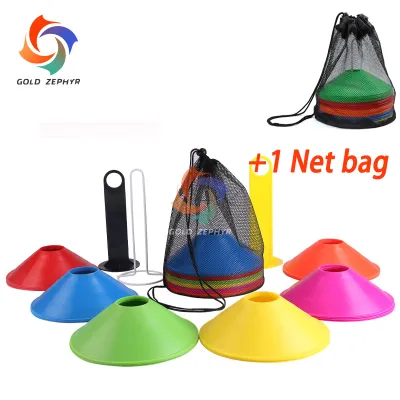
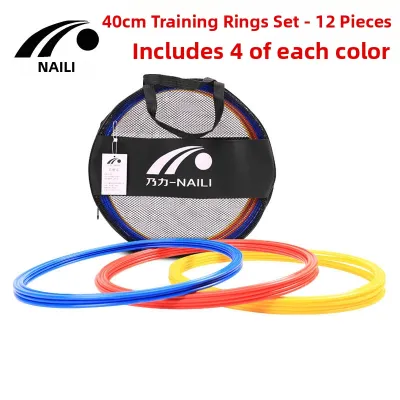
Investing in a complete cone set that includes dedicated storage accessories is highly recommended. A robust carrying spindle (or carrier pole) is an invaluable tool for keeping disc cones organized. Spindles allow you to stack cones quickly by color, preventing them from scattering in your gear bag and making setup and pack-up incredibly efficient. Many high-quality spindles feature an integrated handle or a shoulder strap for easy transport across the field.
For tropical environments, the choice of storage bag material is highly important. Always opt for heavy-duty, breathable mesh bags over solid plastic or canvas containers. Football sessions in the Philippines often take place in high humidity or sudden rain, meaning cones are frequently packed away wet. Storing damp plastic cones in a sealed, airtight bag traps moisture, creating an ideal breeding ground for mold and mildew. This moisture trap can also cause the plastic to degrade prematurely, resulting in a sticky, unpleasant residue on the surface of the cones. A breathable mesh bag allows air to circulate freely, ensuring the cones dry out naturally even while stored in your car or equipment locker.
Where to Buy and What to Verify Before Purchasing Cones for Training
When sourcing cones for training in the local market, you will find a wide range of options across different price points. To ensure you receive durable, safe, and high-performing equipment, it is important to shop through reputable channels and perform key quality checks.
Sourcing Channels
High-quality training cones can be found at established sporting goods chains located in major shopping malls across the Philippines, specialized football equipment retailers, and trusted online marketplaces. When shopping online, prioritize official brand stores or highly rated local sports distributors to ensure product authenticity.
Critical Verification Checks
Before finalizing your purchase, carefully review the product specifications and user feedback to verify the following details:
- Material Elasticity: Look for explicit product descriptions containing terms like "crush-resistant," "flexible PE," "step-on recovery," or "bounce-back design." Avoid listings that simply state "hard plastic" or "rigid PVC," as these materials are highly prone to cracking and shattering.
- UV and Weather Protection: Ensure the product details mention UV resistance or suitability for prolonged outdoor use to prevent rapid color fading and material brittleness.
- Package Contents: Double-check the exact quantity of cones included in the set. Many online listings feature photos of large, multi-colored stacks but only ship a small pack of 10. Verify whether essential accessories, such as a carrying spindle, strap, or mesh bag, are included in the package.
- User Reviews: Analyze customer reviews for feedback regarding long-term outdoor durability. Look for comments mentioning how the cones perform after being stepped on by players wearing cleats, whether they arrive warped or misshapen from shipping, and if the colors fade quickly under the sun.
Price Expectations
In the Philippine market, training cones generally fall into three broad price bands:
- Budget (₱150 – ₱400): Typically includes small packs of 10 to 20 basic disc cones. These are suitable for personal use or light backyard practice, but they may lack advanced UV stabilizers or heavy-duty flexibility.
- Mid-Range (₱500 – ₱1,200): This range generally offers comprehensive coaching sets containing 40 to 50 flexible disc cones, complete with a carrying spindle and a mesh bag. It also includes packs of 6 to 10 highly flexible 9-inch tall cones.
- Premium (₱1,300 – ₱3,000+): These are professional-grade, heavy-duty training sets from established sports brands. They feature advanced UV-treated, ultra-flexible materials designed to withstand daily, intensive use by clubs, academies, and professional training facilities.
Avoid buying ultra-cheap, unbranded rigid plastic cones (often sold for under ₱10 per piece). These low-grade plastics offer zero impact recovery and will quickly shatter into sharp, jagged fragments when stepped on, posing a direct puncture hazard to players sliding or falling on the pitch.
Frequently Asked Questions (FAQ)
How many cones do I need for a standard football training session?
For individual practice, personal fitness routines, or small-group technical drills (such as 1v1 exercises or basic agility ladders), a set of 20 to 30 disc cones is generally sufficient. If you are managing full-team training sessions, complex tactical rondos, or setting up multiple training stations simultaneously, you will require a minimum of 50 to 100 cones. Having a larger quantity in multiple contrasting colors allows you to run different drills side-by-side without confusing the players.
Can I use standard traffic cones for football training?
Using standard traffic or road cones for active football drills is strongly discouraged. Traffic cones are constructed from heavy, dense rubber or rigid, thick plastic designed to withstand low-speed vehicular impacts rather than athletic collisions. Because they do not collapse when stepped on, they present a severe ankle-injury and tripping hazard for players moving at high speeds. Furthermore, their bulky size and heavy weight make them highly impractical to transport and set up on a regular basis.
How do I clean and maintain my training cones?
To maximize the lifespan of your cones, rinse them with clean, fresh water after training on muddy or dusty fields to remove abrasive soil particles, dirt, and grass stains. Avoid using harsh chemical detergents, solvents, or bleach, as these substances can break down the plastic’s built-in UV inhibitors. Always allow the cones to air-dry completely in a shaded, well-ventilated area before stacking and storing them away. Storing damp cones in a sealed, airtight bag can lead to mold growth and cause the plastic to become sticky over time.
Community discussion
Share your experience or ask a question. Comments are reviewed before publication.