
Navigating the coastal waters, calm bays, and marine sanctuaries of the Philippines on a kayak, stand-up paddleboard, or small boat is an incredible way to explore the archipelago. However, the tropical marine environment presents extreme challenges for safety equipment, particularly electronics. Intense heat, high humidity, corrosive saltwater, and sudden tropical downpours will quickly ruin standard outdoor gear.
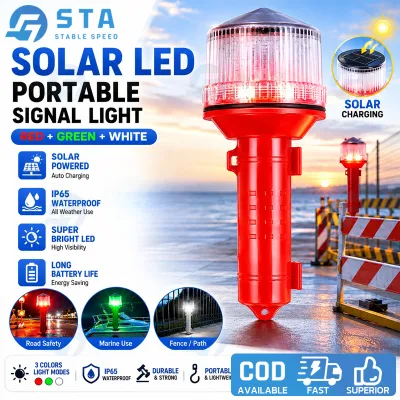
For paddlers and boaters operating during the low-light hours of dawn, dusk, or night, maintaining high visibility is a critical safety requirement. A dedicated solar signal light waterproof unit provides a self-sustaining, highly visible beacon that alerts larger motorized vessels to your presence. These lights harness the abundant tropical sun by day and illuminate automatically at night, offering a reliable safety layer without the constant need for manual battery replacements.
Selecting the right marine-grade light requires a clear understanding of waterproof ratings, material durability, and mounting compatibility. Equipment alone cannot replace proper water safety training, physical preparation, and sound maritime judgment. Before heading out onto the water, every boater must understand how to evaluate these devices to ensure they perform reliably when visibility drops.
Products mentioned in this guide
Prices are valid at publication and may change. Please refer to the product page for the latest price.
How to Choose the Right Solar Signal Light for Philippine Waters
Selecting a solar signal light for use in tropical marine environments requires careful attention to technical specifications. Standard outdoor garden lights or basic utility lights are not built to withstand the unique combination of high salinity, intense UV radiation, and heavy wave action found in coastal areas.
Waterproof vs. Water-Resistant Ratings
Understanding the exact Ingress Protection (IP) rating of a solar signal light is the first step in ensuring its survival on the water. Many products are marketed loosely as “waterproof,” but their technical specifications reveal they are only water-resistant.
- IP65 Rating (Splash-Proof): Lights with an IP65 rating are designed to withstand multi-directional water jets and light rain. While suitable for inland garden paths, they are highly vulnerable on a kayak or small boat where breaking waves, heavy spray, or temporary submersion during a capsize will quickly breach the seals.
- IP67 Rating (Temporary Submersion): An IP67-rated light can withstand complete immersion in water up to 1 meter deep for up to 30 minutes. This rating is the minimum recommended standard for sit-on-top kayaks, stand-up paddleboards, and inflatable boats where the gear is constantly exposed to heavy spray and potential capsizing.
- IP68 Rating (Continuous Submersion): This rating indicates that the light is hermetically sealed to withstand continuous submersion under pressure, typically beyond 1 meter. For offshore kayaking, coastal crossings, or mounting on low-profile decks that sit constantly in the splash zone, an IP68-rated light offers the highest level of reliable protection.
Saltwater and UV Resistance
Tropical sunlight in the Philippines carries a exceptionally high UV index, which rapidly degrades standard plastics, making them yellow, brittle, and prone to cracking. Once the outer housing cracks, moisture enters the internal circuitry, causing immediate failure.
- Housing Materials: Look for solar lights constructed from UV-stabilized polycarbonate or acrylic. These materials are engineered to resist solar yellowing and maintain their structural integrity despite prolonged exposure to intense sunlight.
- Metal Hardware: Saltwater is highly corrosive to standard metals. Ensure any screws, brackets, or mounting hardware are made from marine-grade 316 stainless steel or anodized aluminum. Avoid lights with exposed brass, iron, or low-grade steel components, as they will rust and seize within weeks of exposure to coastal air.
- Specification Verification: Always cross-reference product descriptions with official manufacturer datasheets. Avoid relying on generic "heavy-duty" or "marine-grade" marketing labels unless they are backed by specific material certifications and tested IP ratings.
Solar Charging Efficiency in Tropical Climates
While the Philippines receives abundant sunlight, high ambient temperatures and seasonal cloud cover during the monsoon months can severely impact solar charging performance.
- Solar Panel Quality: High-efficiency monocrystalline solar panels are preferred over polycrystalline alternatives. Monocrystalline panels perform better in low-light conditions, such as overcast days, and occupy a smaller footprint on the light housing.
- Battery Chemistry: Standard Nickel-Metal Hydride (NiMH) batteries degrade rapidly when subjected to the high internal temperatures of a sealed plastic housing sitting in the tropical sun. Lithium Iron Phosphate (LiFePO4) batteries are highly superior for marine solar lights. They tolerate extreme heat, offer significantly more charge cycles, and maintain their storage capacity over years of use.
- Thermal Protection: Verify if the light features built-in overcharge and thermal protection. This prevents the battery from swelling or degrading during intense afternoon heat waves when deck temperatures can exceed 40°C.
Visibility and Flash Patterns
To prevent collisions on busy waterways, your signal light must be visible to larger, faster vessels from a safe distance.
- Luminous Intensity: Ensure the light's output is rated for adequate visibility, ideally visible from at least 1 to 2 nautical miles away. This range gives larger motorized outrigger boats (bangkas) and commercial vessels sufficient time to alter their course.
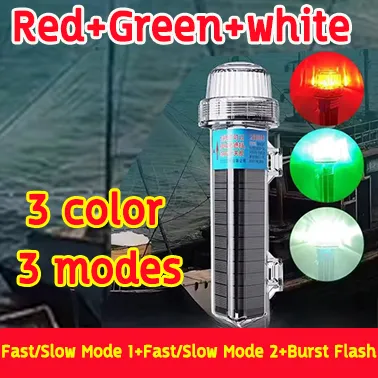
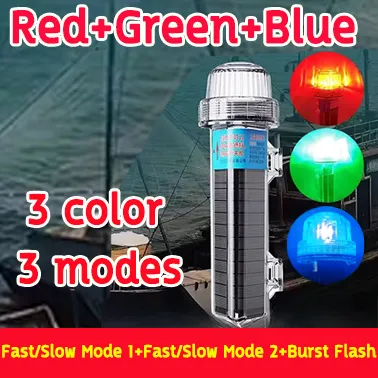
- Flash Modes: A steady white light can easily blend into the background lights of the shoreline. A flashing or strobe pattern is highly recommended for signaling, as it immediately alerts other mariners to a hazard or a slow-moving small craft. Many marine solar lights offer selectable flash patterns, including slow flash, quick strobe, and SOS distress signaling.
- 360-Degree Horizontal Beam: The light must feature a omnidirectional lens design. This ensures that regardless of how your kayak or boat pitches and rolls in the waves, the light remains visible from all horizontal angles.
Recommended Solar Signal Light Types for Kayaks and Boats
Matching the physical design and mounting style of a solar signal light to your specific watercraft is essential for both safety and convenience. Different hull shapes, deck layouts, and paddling styles require distinct light configurations.

Deck-Mounted and Low-Profile Lights
Deck-mounted solar signal lights are designed to sit flush or very low against the flat surfaces of your watercraft’s bow or stern.
- Ideal Scenarios: These low-profile lights are perfect for narrow sea kayaks and stand-up paddleboards. Because they sit close to the deck, they are highly resistant to snagging on overhanging mangrove branches, fishing lines, or rescue ropes during self-reentry maneuvers.
- Mounting and Hull Integrity: Secure mounting is critical. Common methods include marine-grade polyurethane adhesive sealants or stainless steel bolt-through fittings. Bolt-through mounting is incredibly secure but requires drilling holes into your kayak's deck. If you choose this method, always use rubber washers and marine sealant around the bolts to preserve hull integrity. Adhesive sealants are non-destructive but require a perfectly clean, dry, and lightly sanded surface to cure correctly.
- Stroke Interference Checks: Before permanently mounting a low-profile light, place it temporarily on the deck and perform a few dry paddling strokes. Verify that the light's footprint and height do not interfere with your paddle path, your feet, or your gear-strapping systems.
Pole-Mounted and Elevated Lights
Elevated solar lights are mounted on top of a rigid or flexible pole, raising the light source anywhere from 2 to 4 feet above the deck.
- Ideal Scenarios: Elevated lights are best suited for wider fishing kayaks, canoes, and small motorized boats. When you sit low in a kayak, your body, head, high-back seat, and personal flotation device (PFD) can easily block a deck-mounted light from the view of vessels approaching from behind. Raising the light ensures unobstructed 360-degree visibility over your head.
- Wave and Swell Visibility: In choppy coastal waters or heavy swells, a low-profile light on a kayak's deck can easily be hidden in the trough of a wave. An elevated light remains visible above the crests, significantly reducing the risk of being overlooked by larger vessels.
- Pole Flexibility and Wind Resistance: Coastal winds and narrow tidal creeks can put immense stress on an elevated pole. Look for poles made from flexible fiberglass or carbon fiber, or those featuring spring-loaded bases. A rigid, brittle pole can easily snap or rip its mounting base out of the deck if it catches a low-hanging branch or is subjected to sudden high winds.
Suction-Cup and Clip-On Portable Lights
Portable solar signal lights utilize temporary, non-destructive mounting mechanisms such as heavy-duty suction cups or spring-loaded clamps.
- Ideal Scenarios: These temporary options are ideal for inflatable boats, rental kayaks, or paddlers who use multiple watercraft and do not want to drill holes or apply permanent adhesives to their hulls.
- Suction Cup Maintenance: Suction cups rely on a perfect vacuum seal. Salt crust, fine sand, and UV degradation will cause suction cups to lose grip and fail unexpectedly. Always wash the mounting surface and the rubber cup thoroughly with fresh water before application.
- The Crucial Safety Tether: Never rely solely on a suction cup or clip-on mount in choppy water. Always attach a secondary safety tether (such as a marine-grade utility cord or lanyard) from the light housing to a secure deck loop, D-ring, or kayak carry handle. If the primary mount fails, the tether will prevent your light from sinking to the ocean floor.
- Clip-On Limitations: Spring-loaded clips are convenient but have strict limitations. They can easily slip on highly tapered gunwales, wet plastic, or thick inflatable tubes. Ensure the clip's jaw width and gripping tension are fully compatible with your boat's edges before launching.
Critical Safety and Navigation Compliance Checks
Equipping your watercraft with a solar signal light is a responsible safety step, but it must be done in compliance with maritime rules and with a clear understanding of the equipment’s limitations.
Basic Navigation Rules for Small Watercraft
Under international and local maritime regulations, small, unpowered vessels such as kayaks, canoes, and rowboats are generally not required to carry complex red and green navigation lights. However, they must meet basic visibility standards.
- Rule Requirements: Regulations typically state that unpowered vessels under 7 meters must have ready at hand an electric torch or lighted lantern showing a white light, which must be exhibited in sufficient time to prevent a collision.
- Supplementary Role: A solar-powered flashing signal light serves as an excellent continuous visibility aid and can be used as an anchor light. However, it should not be your sole light source. Always carry a secondary, manually operated white light (such as a high-powered waterproof flashlight or headlamp) that you can direct toward an approaching vessel's bridge to ensure they see you.
Monsoon and Overcast Limitations (Habagat)
The Philippine rainy season, or habagat (southwest monsoon), brings prolonged periods of heavy cloud cover, torrential rains, and tropical depressions.
- Solar Depletion Risk: During consecutive overcast days, your solar light's internal battery may not receive enough solar energy to recharge fully. If you rely on the light for consecutive night paddles or long evening fishing trips, the battery reserves can deplete rapidly.
- The Golden Rule of Backups: Never launch into open water during the rainy season relying solely on solar-charged devices. Always carry a fully charged, battery-operated or USB-rechargeable backup light. Check your solar light's charge level before every trip, and treat a dimming light as an immediate stop condition.
Verifying Marine Claims and Quality
The market is flooded with inexpensive solar lights that claim to be suitable for marine use but are designed only for residential gardens.
- Examine the Seals: High-quality marine lights feature thick, visible silicone or rubber O-rings around any threaded compartments or battery access ports. If a light has thin, flimsy foam seals or relies solely on glued plastic joints, it is highly likely to leak under marine conditions.
- Check the Weight and Build: Marine-grade polycarbonate housings feel dense and rigid. If the plastic flexes easily under hand pressure or feels extremely light and brittle, it will not survive the physical impacts of kayaking, such as paddle strikes, beach landings, or transport bumps.
Sports Safety and Personal Limits
No piece of safety equipment can replace personal skill, physical fitness, and sound decision-making on the water.
- Know Your Limits: Paddling in low-visibility conditions or at night requires advanced boat control and navigation skills. If you are an inexperienced paddler, avoid paddling after sunset, regardless of how many lights you have installed.
- Pre-Trip Assessment: Always check local wind, tide, and weather forecasts before launching. In the Philippines, coastal weather can change rapidly. If strong offshore winds or heavy squalls are predicted, postpone your trip.
- The Stop Condition: If your primary safety light fails during your pre-launch check, or if you notice water condensation inside the lens, do not proceed with your night paddle. Return to shore or wait for daylight.
Maintenance and Care for Tropical Marine Environments
To maximize the lifespan and reliability of your waterproof solar signal light, you must establish a consistent maintenance routine. Saltwater and tropical humidity are incredibly harsh on materials, and neglecting basic care will lead to premature equipment failure.
Regular Panel Cleaning
Salt spray dries into a fine, white crystalline crust that acts as a physical barrier to sunlight. Combined with tropical dust and bird droppings, this salt crust can reduce your solar panel’s charging efficiency by more than 50%.
- The Cleaning Routine: After every single outing in saltwater, rinse the light thoroughly with clean, fresh water to dissolve and wash away salt deposits.
- Avoid Abrasives: Wipe the solar panel and lens gently using a soft, non-abrasive microfiber cloth. Never use abrasive scrubbing pads, steel wool, or harsh chemical solvents (such as acetone or gasoline). These will scratch the protective polycarbonate cover, permanently clouding the lens and reducing both solar absorption and light output.
Seal and O-Ring Inspection
Intense tropical heat and UV exposure will eventually dry out and crack the rubber seals and O-rings that keep water out of your light’s internal electronics.
- Visual Inspection: Every few weeks, carefully open any battery compartments or threaded caps to inspect the rubber O-rings. Look for signs of dry rot, cracking, flattening, or fine sand particles trapped in the seal track.
- Lubrication: Clean the O-ring and the sealing track with a damp cloth to remove salt and sand. Apply a very thin layer of marine-grade silicone grease to the O-ring before reassembling. This keeps the rubber pliable and enhances the watertight seal. Strictly follow the manufacturer's care instructions, and never use petroleum-based lubricants (like WD-40 or Vaseline), as they will degrade and dissolve rubber seals.
Battery and Storage Care
Proper storage during the off-season or during active typhoon periods is essential to prevent permanent battery damage.
- Avoid Deep Discharge: Storing a solar light in a dark, humid gear locker for months will cause the internal battery to self-discharge completely. Once a lithium or NiMH battery drops below its critical voltage threshold, it may lose its ability to hold a charge permanently.
- Storage Environment: Store your lights in a cool, dry indoor environment away from direct, trapped heat (such as inside a hot car or a tin-roofed garden shed). Extreme heat accelerates battery degradation and can warp plastic housings.
- Maintenance Charging: If you are storing the lights long-term, place them near a window where they can receive indirect sunlight for a few hours each week. This keeps the battery active and prevents deep discharge cycles.
Frequently Asked Questions (FAQ)
Do solar signal lights work during the Philippine rainy season?
Yes, high-quality solar signal lights will still charge under overcast skies, but their charging efficiency is significantly reduced. On a bright, sunny summer day, a monocrystalline solar panel might fully charge the battery in 4 to 6 hours. During the heavy cloud cover of the habagat monsoon, that same panel may require 12 hours or more of ambient light to reach a full charge. Because of this reduced charging rate, the light’s nightly runtime will be shorter. During the rainy season, it is critical to use a light with a large battery capacity, monitor its performance closely, and always carry a fully charged, manually powered or USB-rechargeable backup light.
Can I use a standard waterproof bike light instead of a marine solar light?
While many high-end bicycle lights feature excellent IP waterproof ratings (such as IP67), they are not designed to survive marine environments. Standard bike lights typically lack UV-stabilized plastics, meaning their housings will quickly become yellow, brittle, and cracked under the intense Philippine sun. Furthermore, their mounting brackets, charging ports, and internal metal contacts are rarely made from marine-grade stainless steel or corrosion-resistant alloys. Exposure to saltwater and salty sea air will cause rapid galvanic corrosion, leading to electrical failure within a short period. Investing in a dedicated marine solar light ensures the materials are chemically engineered to withstand both high salinity and intense solar radiation.
Community discussion
Share your experience or ask a question. Comments are reviewed before publication.