
Selecting the correct mesh size for your cast net is the single most important decision you will make before heading out to the water. The ideal mesh size for a hand-thrown fishing net depends entirely on your target catch’s body girth and the environment where you plan to fish. Smaller targets like shrimp or baitfish require a tight 1/4-inch to 3/8-inch stretched mesh, medium species like Tilapia or Bangus (milkfish) need a 1/2-inch to 3/4-inch mesh, while larger targets like mullet require a 1-inch to 1.5-inch mesh. Choosing the wrong size means either watching your target fish slip right through the holes or dealing with a heavy, clogged net that is exhausting to throw.
When using a fishing net hand throwing technique, physical dynamics and environmental conditions play a massive role in your success. A net is not a universal tool; a model that works perfectly in a calm freshwater pond can fail completely in a fast-moving tidal estuary. By understanding how mesh dimensions relate to local fish species, water resistance, and regional regulations, you can select gear that maximizes your catch while preserving your physical energy.
Understanding Cast Net Mesh Measurements
Before purchasing a cast net, you must understand how manufacturers measure the gaps in the netting. The industry uses two distinct standards: stretched mesh and square (or bar) mesh. Misinterpreting these labels is the most common reason anglers end up with a net that is completely unsuitable for their target species.
Products mentioned in this guide
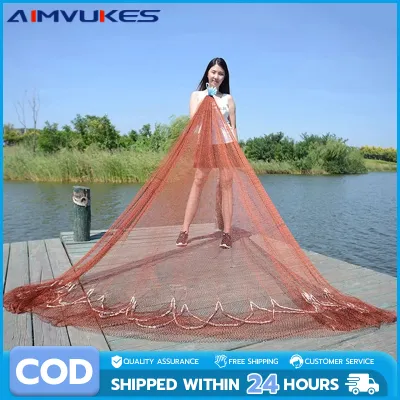
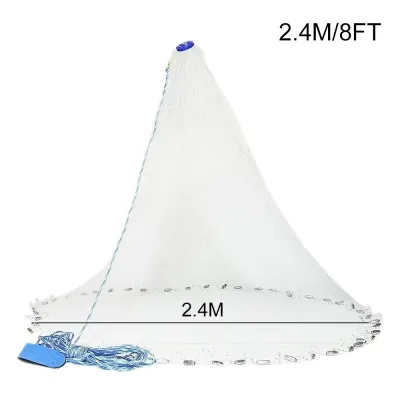
![[Fast Delivery] 8Ft 2.4M Fishing Net Bait Easy Throw Hand Cast 3/4 inch Strong Nylon Mesh Saltwater Fishing Cast Net 3ft Radius with Heavy Duty Zinc Sinker & Aluminum Disc For Bait Fish with Fish Shrimp Baske](https://img.lazcdn.com/g/p/e49f42ceb8ee5c1bb559f80f2b26c6b9.jpg_400x400q80.jpg_.webp)

Prices are valid at publication and may change. Please refer to the product page for the latest price.
Stretched mesh is measured by pulling the netting tight and measuring the distance from the top knot of a diamond to the bottom knot. Square mesh, on the other hand, measures the distance of a single side of the square bar from knot to knot. As a rule of thumb, a 1-inch stretched mesh is roughly equivalent to a 1/2-inch square mesh.
Always check the manufacturer’s specific measurement standard before purchasing a fishing net hand throwing model. If the product description is unclear, contact the seller or manufacturer to confirm whether they are listing square or stretched dimensions. Relying on guesswork can result in buying a net with holes twice as large—or half as small—as you actually need.
Matching Mesh Size to Common Fish in the Philippines
Matching your mesh size to the specific fish species you want to target is crucial for a successful outing. In the tropical marine and freshwater environments of the Philippines, target species vary widely in size, shape, and behavior.

Small Baitfish, Shrimp, and Fry
For catching small baitfish, glass shrimp, or fry (such as dilis or small freshwater shrimp), a very fine mesh is required. You should opt for a 1/4-inch to 3/8-inch stretched mesh. This tight weave ensures that tiny, delicate targets cannot slip through the net or get stuck in the holes, which can damage the bait.
However, this small mesh size comes with a distinct physical trade-off. The dense netting creates significant water resistance, meaning the net sinks slower and requires more physical effort to retrieve. It also traps a large volume of water and debris, making it much heavier to pull back to the shore or boat.
Medium Panfish (Tilapia, Milkfish/Bangus)
If you are targeting medium-sized fish like Tilapia or Bangus (milkfish) in local brackish ponds, rivers, or lakes, a medium mesh is the standard choice. A 1/2-inch to 3/4-inch stretched mesh is ideal for these species. This size allows you to either gill-catch the fish or wrap them securely within the pockets of the net.
When selecting a net for these species, always match the mesh to the fish’s maximum body girth rather than just its length. Tilapia have a tall, compressed body shape, whereas Bangus are more streamlined. A 3/4-inch mesh will easily hold a medium Tilapia but might allow a slender, juvenile Bangus of the same length to slip through.
Larger Forage Fish and Mullet
For targeting larger, faster species such as adult mullet (banak), larger spadefish, or gizzard shad in coastal areas and deep estuaries, you should use a larger mesh. A 1-inch to 1.5-inch stretched mesh is highly recommended for these larger targets.
This larger mesh size allows the net to sink incredibly fast because there is less surface area to create drag in the water column. It is also significantly lighter to pull up. While it will intentionally let smaller, non-target fish escape, it ensures that your target catch is caught efficiently without unnecessary bycatch.
How Mesh Size Affects Your Throw and Retrieval
The physical dynamics of throwing a cast net are heavily influenced by the mesh size you choose. A smaller mesh size creates more surface area, which acts like a parachute in the water. This increased drag causes the net to sink slower, giving fast-moving fish more time to swim out from under the dome before it seals on the bottom.
Furthermore, small-mesh nets are much heavier to retrieve because they trap water and collect fine silt, algae, and floating debris. If you are fishing over weedy, rocky, or debris-filled bottoms, a fine-mesh net is highly susceptible to snagging and tearing. Conversely, a larger mesh allows water and small debris to pass through freely, making the net sink rapidly and feel much lighter during retrieval.
When choosing a mesh size, you must balance these physical properties against your own physical strength, the depth of the water, and the bottom structure. If you plan to fish in deep water or areas with moderate currents, a larger mesh with a heavier lead line is necessary to reach the bottom before the current sweeps the net away. Always assess your physical stamina and the environment before choosing your gear.
Checking Local Fishing Regulations and Conservation Rules
Responsible fishing is essential to protect aquatic ecosystems and ensure that fish populations remain sustainable for future generations. Before using any hand-thrown fishing net, you must verify the local municipal and national fisheries regulations in your area.
In the Philippines, the Bureau of Fisheries and Aquatic Resources (BFAR) and local municipal governments set strict guidelines regarding minimum legal mesh sizes. Using a mesh size that is too small can result in the illegal capture of juvenile fish, which prevents them from reaching reproductive age and severely disrupts the local ecosystem. Violations can lead to heavy fines, gear confiscation, or legal penalties.
Always check the specific rules of the waterbody you plan to fish, including protected marine sanctuaries or seasonal fishing bans. Practicing sustainable fishing by using the correct mesh size helps preserve local fisheries while keeping your fishing activities fully compliant with the law.
Frequently Asked Questions (FAQ)
What is the best cast net radius for beginners learning to hand throw?
For beginners, a cast net with a radius of 4 to 6 feet is highly recommended. Smaller nets are much easier to manage, require less physical strength, and allow you to master the basic throwing technique and build muscle memory. Attempting to learn with a larger, heavier net (such as an 8- to 10-foot model) often leads to frustration, poor spreads, and physical fatigue.
Does the lead line weight matter as much as the mesh size?
Yes, the lead line weight is just as critical as the mesh size, though they serve different purposes. While the mesh size determines what size of fish can escape, the lead line weight determines how quickly the net sinks and how effectively it seals against the bottom. For deep water or strong currents, a heavier lead line (typically 1 to 1.5 pounds per radius foot) is required to keep the net from drifting or closing before it reaches the bottom.
Community discussion
Share your experience or ask a question. Comments are reviewed before publication.