
Choosing between a chipper golf club and a traditional wedge comes down to your swing consistency, your preferred style of play, and the specific turf conditions you face around the green. A chipper offers a highly stable, low-loft, putting-like stroke that minimizes the risk of mis-hits, making it ideal for straightforward, ground-hugging shots. Conversely, a wedge provides the loft, spin, and face versatility required to lift the ball over obstacles, stop it quickly on fast greens, and handle complex lies. Understanding how these clubs differ in design and application will help you make an informed decision to improve your short game.
Understanding the Core Differences in Design and Mechanics
To understand why these two clubs perform so differently, you must first look at their physical construction. A chipper is essentially a hybrid club that combines the loft of a short iron with the upright lie angle and shaft length of a putter. Typically, a chipper features a loft of 32 to 37 degrees, which is comparable to a standard 7-iron or 8-iron. This design is engineered to lift the ball just high enough to clear the rough or fringe before letting it roll out smoothly across the putting surface. Because the shaft is short and upright, it forces you to stand closer to the ball, promoting a vertical swing path that minimizes lateral movement.
Wedges, on the other hand, are highly specialized precision tools designed for a wide variety of trajectories and spin rates. The wedge family includes pitching wedges, gap wedges, sand wedges, and lob wedges, with lofts ranging from 45 to over 60 degrees. Wedges feature longer shafts and flatter lie angles than chippers, requiring a traditional athletic golf stance. The clubhead of a wedge is designed with “bounce”—the angle between the leading edge and the lowest point of the sole—which helps the club glide through grass or sand without digging.
Products mentioned in this guide
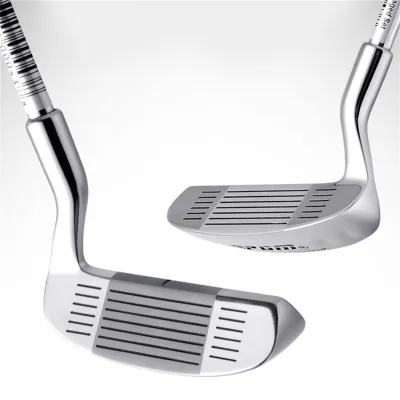
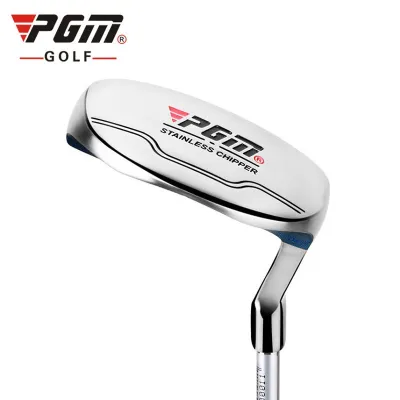
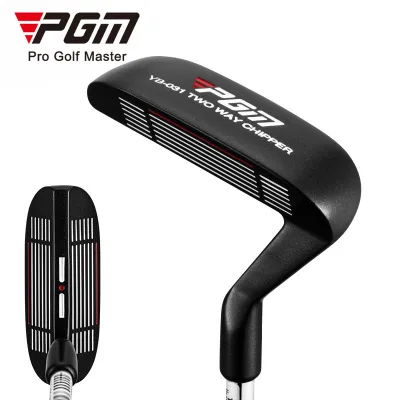
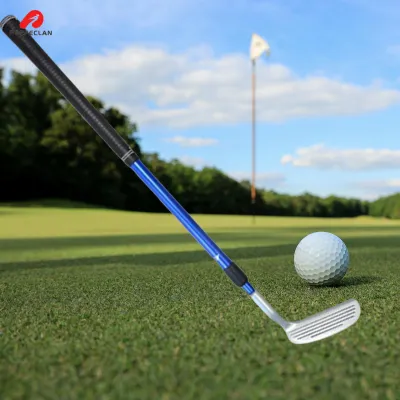
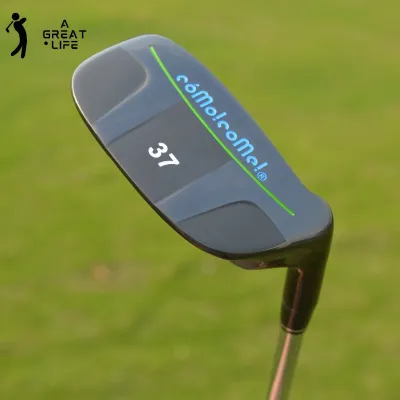
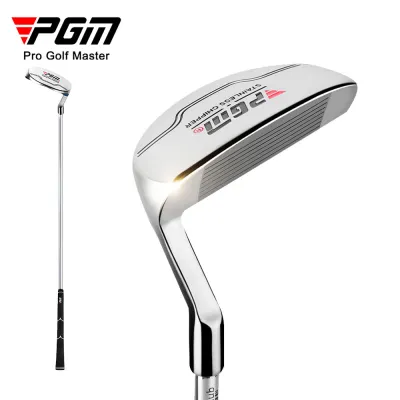
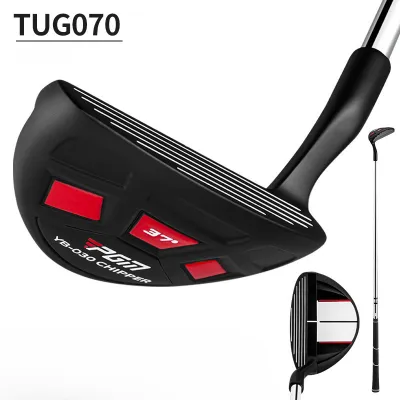
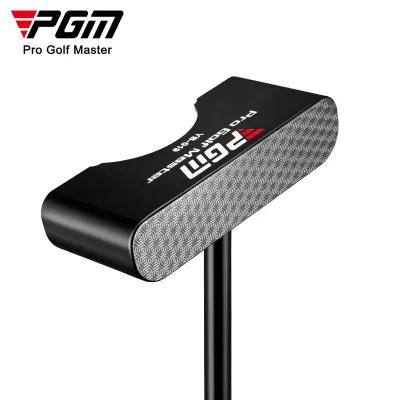
Prices are valid at publication and may change. Please refer to the product page for the latest price.
The mechanical execution of the swing represents the most significant difference between the two clubs. When using a chipper, you employ a simple, wrist-locked pendulum stroke, identical to a putting stroke. This motion eliminates the need for complex wrist hinges or body rotation, greatly reducing the margin for error. In contrast, playing a wedge requires a traditional chipping or pitching swing, which involves a controlled wrist hinge, precise body rotation, and careful weight transfer. While the wedge swing demands more practice and coordination, it allows you to manipulate the clubface to control the ball’s trajectory, distance, and spin.
When to Use a Chipper Golf Club Around the Green
A chipper golf club can excel in specific, predictable scenarios where simplicity is your greatest asset. The ideal lie for a chipper is on closely mown turf, such as the fairway or the collar just off the putting green. In tropical climates, dry-season fairways can become exceptionally firm and tight. Under these conditions, executing a traditional wedge shot can be nerve-wracking, as the leading edge of a wedge can easily bounce off the hard ground and cause a “skulled” or “thinned” shot. A chipper minimizes this risk by allowing you to sweep the ball cleanly off the tight turf with a low-stress putting motion.

This club is particularly beneficial for beginners, high handicappers, or recreational players who struggle with short-game consistency. If you frequently find yourself “duffing” your chips (hitting the ground behind the ball) or sending them screaming across the green, the chipper provides an immediate confidence boost. By removing the wrist hinge from the equation, you can focus entirely on distance control, much like you would on a long putt.
However, the chipper has distinct limitations that prevent it from being a universal short-game solution. Because of its low loft, a chipper cannot generate significant backspin, meaning the ball will roll a considerable distance after landing. You cannot use a chipper to hit high, soft-landing shots over obstacles like bunkers, water hazards, or steep ridges. Additionally, if your ball settles into deep, thick rough—such as the dense Bermuda grass common on many tropical courses—the low loft and upright design of a chipper make it highly susceptible to getting tangled in the grass, leading to unpredictable results.
When to Rely on a Wedge for Short Game Shots
A wedge is the ultimate tool for versatility and shot-making creativity around the green. The primary advantage of a wedge is its ability to generate high levels of backspin and stopping power. When struck correctly, the sharp grooves and high loft of a wedge compress the ball, creating friction that translates into spin. This spin allows you to fly the ball closer to the pin and have it stop quickly, which is essential when playing on fast, sloping greens or when you have very little green to work with.
Wedges are also indispensable when dealing with difficult lies and hazards. If your ball lands in deep, heavy rough, a wedge with sufficient loft and bounce can cut through the thick grass blades to pop the ball out safely. During the tropical wet season, golf courses can become soft and muddy. In these damp conditions, a wedge with high bounce is crucial because the wide sole prevents the club from digging too deeply into the wet soil, allowing for clean contact even when the ground is saturated.
Furthermore, specialized short-game shots require the unique design of a wedge. You cannot execute a high-flying flop shot, a soft pitch over a bunker, or a standard sand escape with a chipper. The wedge allows you to open or close the clubface to alter the effective loft and bounce, giving you the flexibility to manufacture almost any shot your imagination demands. While mastering these shots requires dedicated practice and a refined touch, the wedge remains the only tool capable of handling the full spectrum of short-game challenges.
Feature Comparison: Chipper vs Wedge
To help you quickly compare the practical differences between these two club types, the table below outlines their key specifications and performance characteristics.
| Feature | Chipper Golf Club | Golf Wedge |
|---|---|---|
| Loft Range | Typically 32° to 37° | 45° to 64° |
| Primary Swing Type | Putting-style pendulum stroke | Traditional chipping/pitching swing |
| Ideal Turf Lie | Tight fairways, fringes, firm ground | Rough, sand, soft turf, uneven lies |
| Spin Control | Low spin, high roll-out | High spin, quick stopping power |
| Learning Curve | Very low (highly intuitive) | Moderate to high (requires practice) |
| Shot Versatility | Low (limited to bump-and-run) | High (flops, pitches, bunker shots) |
How to Decide: A Practical Selection Framework
Choosing the right club for your bag requires an honest assessment of your current skill level, your typical playing conditions, and how you manage your equipment limits. Start by analyzing your most common short-game mistakes. If your misses are primarily mechanical—meaning you struggle to make clean contact with the ball and frequently hit fat or thin shots—prioritizing a chipper can save you multiple strokes per round. However, if you can make clean contact but find yourself frustrated by a lack of shot variety or an inability to stop the ball on fast greens, investing time into mastering your wedges is the superior path.
Next, you must evaluate the strict 14-club limit enforced by the rules of golf. Adding a chipper to your bag means you must remove another club, such as a long iron, a hybrid, or a specialized wedge. If you rarely use your 3-iron or a low-lofted hybrid, swapping it for a chipper that you might use several times a round is a highly practical trade-off. On the other hand, if your bag is already optimized for gapping and you rely on all your current clubs, adding a single-use club like a chipper may limit your options on longer shots.
If you remain undecided, the best stopping condition is to test both clubs under realistic conditions. A quality chipper or wedge can range from ₱3,000 to ₱8,000, so testing them first ensures you spend your budget wisely. Visit a local practice facility or golf course green during a quiet afternoon. Spend time hitting shots from both tight lies and light rough using both a chipper and your pitching or sand wedge. Observe which club gives you more consistent distance control and leaves you with shorter, more manageable putts. If you still find yourself struggling, consider booking a short-game lesson with a local golf professional, who can analyze your swing mechanics and recommend the best setup for your specific game.
Frequently Asked Questions (FAQ)
Is a chipper golf club legal in tournament play?
Yes, a chipper golf club is legal for tournament play under the rules established by the USGA and R&A, provided it meets specific design criteria. To be conforming, a chipper must have a single striking face, a standard circular golf grip (not a flat-sided putter grip), and a shaft that attaches to the clubhead in a conforming manner. Because some older or specialty models may feature double-sided faces or non-conforming grips, you should always verify your specific club model against the official conforming club list before entering a sanctioned tournament.
Can I use a chipper from the bunker?
It is highly recommended to avoid using a chipper from a sand bunker. Chippers are designed with very little bounce and relatively sharp leading edges, which are characteristics that cause the club to dig directly into soft sand rather than gliding under the ball. Attempting to use a chipper in a bunker will often result in the club getting stuck in the sand, leaving the ball behind. For bunker escapes, always rely on a sand wedge, which features the wide sole and high bounce necessary to splash the ball out of the sand safely.
Do I need both a chipper and a wedge in my bag?
Whether you carry both depends entirely on your skill level and how you prefer to manage your 14-club limit. For beginners and high handicappers, carrying both can be highly beneficial; you can use the chipper for simple, low-risk shots from the fringe, while keeping a sand wedge in the bag specifically for bunker escapes and high-lofted shots. However, as your skills improve and you develop a more consistent chipping swing, you may find that a single versatile wedge can perform all the duties of a chipper, allowing you to free up a valuable slot in your bag for other clubs.
Community discussion
Share your experience or ask a question. Comments are reviewed before publication.