
Staying active while living in a compact condominium in Metro Manila presents unique spatial challenges. With studio and one-bedroom units often ranging from a cozy 22 to 35 square meters, traditional fitness equipment like treadmills or full-sized stationary bikes are simply too bulky to be practical. A pedal exerciser portable offers an elegant, compact solution, allowing you to get a low-impact cardiovascular workout while sitting at your desk or relaxing on the sofa. However, finding the right model requires looking beyond the marketing labels to understand how a machine fits into both your physical layout and your daily routine.
To make an informed decision, you must evaluate how much space the machine occupies when tucked away, how much room it requires during operation, and how its mechanical design interacts with your condo’s environment. Choosing the wrong model can lead to bruised knees, scratched floors, or a piece of equipment that sits unused because it is too cumbersome to set up. By understanding the spatial dynamics of these compact machines, you can maintain your fitness routine without compromising your limited living space.
Understanding Space Requirements for Pedal Exercisers
When evaluating a portable pedal exerciser, you must distinguish between two critical spatial dimensions: the storage footprint and the operational clearance. The storage footprint refers to the physical dimensions of the machine when it is completely put away. This is the static measurement of length, width, and height that dictates whether the device will fit under your bed, inside a wardrobe, or in a narrow utility closet. For condo dwellers, minimizing this footprint is essential to keeping walkways clear and maintaining an uncluttered living area.
Products mentioned in this guide
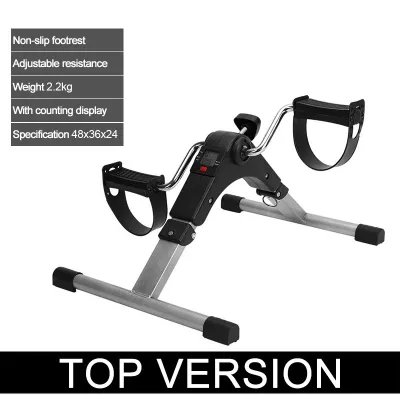
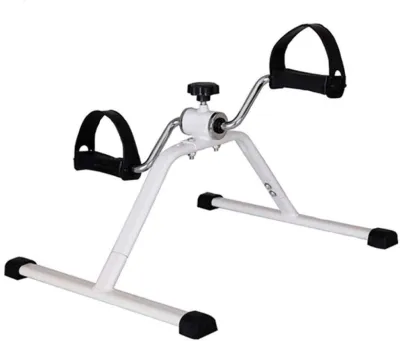
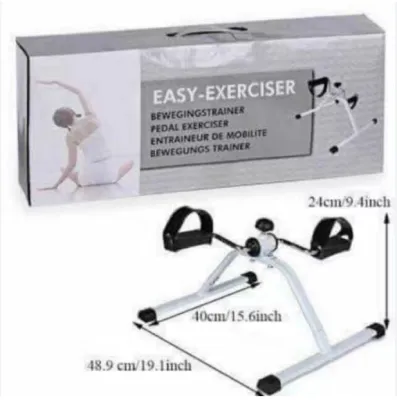
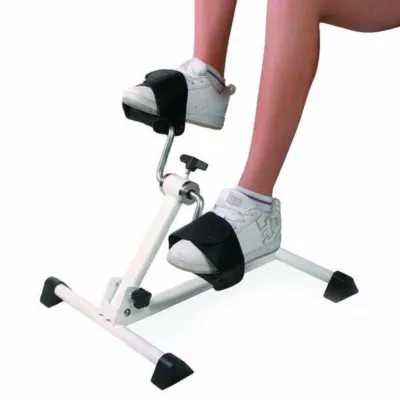
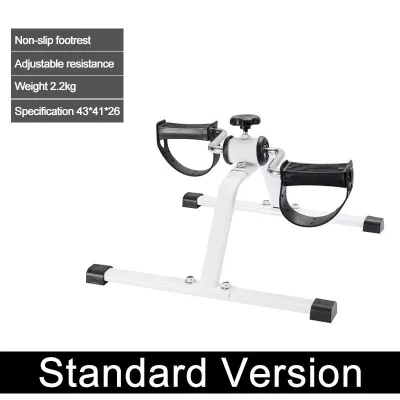
Prices are valid at publication and may change. Please refer to the product page for the latest price.
In contrast, the operational clearance is the dynamic space required when the machine is actively in use. This includes not only the physical base of the device but also the rotation radius of the pedals and the extension of your legs. When you pedal, your feet travel in an elliptical or circular path that extends beyond the front and back of the machine’s frame. Furthermore, your knees rise and fall with each stroke, requiring vertical clearance that depends heavily on your height and the design of your seating.
To determine if a machine will work in your space, start by measuring your primary seating area. Sit in the chair or on the sofa you plan to use and measure the distance from your seat to the floor, as well as the height of your knees when bent at a 90-degree angle. Next, extend your legs forward as if pedaling and measure the distance from your lower back to your heels. This diagonal extension represents the maximum horizontal space you will need. Comparing these personal measurements to the machine’s pedal height and crank length will help you avoid buying a device that forces your knees into the underside of your furniture.
Key Design Features for Maximum Space Efficiency
The overall volume and stowability of a pedal exerciser are heavily influenced by its frame structure and base design. Manufacturers use different engineering approaches to balance stability with compactness. A wider base with flared stabilizer bars provides excellent support during intense workouts but increases the static footprint. Conversely, a narrow, streamlined frame is easier to tuck away but may require more careful user balance to prevent tipping. Understanding these design variations allows you to select a structure that aligns with your storage limitations.

Foldable and Collapsible Frames
Foldable pedal exercisers are designed with scissor-style frames or quick-release hinge mechanisms that allow the legs to fold flat against the main body. This design drastically reduces the vertical or horizontal profile of the machine, often bringing the height down to less than 15 centimeters. In the Philippine market, these budget-friendly folding models typically range from ₱1,500 to ₱3,000, making them an accessible entry point for home fitness. Their collapsed shape makes them incredibly easy to slide into narrow closets, place on utility shelves, or tuck behind a door.
However, foldable frames come with practical trade-offs that you must consider. The addition of heavy-duty hinges, locking pins, and joint reinforcements can add unexpected weight to the unit, slightly compromising its portability. Furthermore, you must factor in the time and effort required to set up and break down the machine for every single workout. If the folding mechanism is stiff or requires manual screwing of locking bolts, the friction of daily setup can quickly become a deterrent to exercising. It is also vital to check the security of the locking pins before every session, as a loose pin can cause the frame to collapse under pressure.
Low-Profile and Flat-Storing Models
Low-profile pedal exercisers are engineered with a low center of gravity and a shorter pedal crank arm, allowing them to remain highly compact without needing to fold. These models are designed to slide directly under standard desks or sofas when not in use, eliminating the need for daily assembly. Because they do not rely on moving joints or folding hinges, these machines tend to have a more rigid, durable construction. They are highly convenient for users who want to transition instantly from working or watching television to pedaling.
While flat-storing models excel at quick access, their horizontal footprint remains constant. If you cannot slide the machine under a piece of furniture, you may need to store it vertically against a wall or in a corner. When storing a low-profile unit upright, you must verify its center of gravity and base stability. Some models are top-heavy due to internal flywheels, presenting a tipping hazard if bumped. If you have pets or small children in your condo, look for models with flat, squared-off stabilizer caps that allow the machine to stand securely on its end without wobbling.
Evaluating a Pedal Exerciser Portable for Daily Condo Use
The daily usability of a pedal exerciser portable depends heavily on how easily you can move it around your living space. In a small condo, furniture often serves multiple purposes, and walkways must remain completely clear when the machine is not in use. If an exerciser is too heavy or awkward to carry, it will likely end up permanently blocking a path or gathering dust in a closet. Therefore, evaluating weight, handles, and safety features is crucial for a seamless daily routine.
Total weight plays a double-edged role in the performance of a portable exerciser. Lightweight machines, often weighing between 2 and 4 kilograms, are effortless to lift with one hand and can be moved from room to room with ease. However, these lighter units are highly prone to “walking” or sliding across the floor during vigorous pedaling, requiring you to constantly pull them back into position. Heavier models, ranging from 6 to 10 kilograms, offer superior stability and a smoother pedaling motion due to their heavier internal flywheels, but they require significantly more physical effort to transport.
To bridge this gap, look for models equipped with dedicated carrying handles or integrated transport wheels. A well-positioned, molded handle balanced over the machine’s center of gravity makes a heavy unit feel much lighter and prevents wrist strain. Transport wheels, usually located on one of the stabilizer bars, allow you to tilt the machine and roll it across your condo’s floor rather than lifting it entirely. This is especially beneficial for seniors or individuals recovering from injuries who need to move the equipment without straining their backs.
Safety in tight spaces also requires careful management of cords and accessories. If you opt for a motorized or smart-connected pedal exerciser, you will need to manage a power cable. In a small studio condo, a trailing power cord stretching across a walkway is a major tripping hazard. Always position the machine close to a wall outlet, or choose a battery-operated magnetic model to eliminate cords entirely. When hosting guests or cleaning, ensure the machine is fully tucked away and any loose straps or cords are neatly coiled to keep your living area safe and presentable.
Matching the Exerciser to Your Condo Layout
Integrating a pedal exerciser into your condo requires analyzing the specific zones where you spend your time. Each area has unique spatial constraints and flooring considerations that dictate which type of machine will perform best without causing disruption.
- The Living Room: If you plan to pedal while watching television from your sofa, measure the height of your sofa cushions. Low, plush sofas cause your hips to sink, which naturally increases the angle of your knees during the upward pedal stroke. To prevent your knees from hitting a low coffee table, you will need a machine with a very low pedal height and a shallow rotation angle.
- The Home Office: Using an exerciser under a desk requires careful calculation of the desk's underside clearance. Standard office desks in the Philippines typically stand around 75 centimeters high. If your desk has a drawer, a keyboard tray, or a horizontal support bar, your usable clearance is further reduced. A low-profile magnetic model with a pedal height of 25 centimeters or less is usually required to prevent your knees from knocking against the desk frame.
- The Bedroom: If your storage plan involves sliding the machine under your bed, measure the vertical clearance of your bed frame. Many local platform beds or divans have very low clearances—sometimes less than 15 centimeters. In such cases, a folding model is often the only viable option, as standard low-profile models may still be too tall to slide underneath.
Beyond physical dimensions, condo living requires sensitivity to noise and vibration. High-rise concrete buildings can act as conductors for low-frequency vibrations. If you use a friction-resistance pedal exerciser, the rubbing of the strap or pad can create a persistent humming or squeaking sound. More importantly, the downward force of pedaling can send vibrations through the floor, which your downstairs neighbors will hear as a dull, repetitive thudding. To maintain neighborly harmony, opt for a magnetic resistance model, which operates almost silently, and always place a high-density, vibration-dampening rubber mat underneath the machine.
Flooring protection is another critical consideration for Philippine condominiums, which commonly feature engineered wood, laminate, vinyl planks, or large-format ceramic tiles. The high humidity of a tropical climate can cause sweat to pool quickly during a workout. Sweat is highly corrosive and can warp engineered wood or stain grout lines if left unattended. Furthermore, hard plastic stabilizer feet can easily scratch laminate or scuff polished tiles when the machine shifts during use. Always verify that the exerciser has soft, non-marking rubber feet, and use a protective mat to catch sweat and prevent sliding.
Common Sizing and Clearance Mistakes to Avoid
One of the most common mistakes buyers make is measuring only the static base of the pedal exerciser while ignoring the dynamic pedal rotation radius. A machine may have a compact footprint of 30 by 40 centimeters, but during use, the pedals extend beyond these boundaries. The highest point of the pedal stroke dictates your true vertical clearance. If you fail to account for this rotation, you may find that your feet hit the floor or your knees hit the underside of your desk, rendering the machine unusable in your preferred spot.
Another frequent error is ignoring your own body measurements and biomechanics. Your height, inseam length, and shoe size all affect how much space you need to pedal comfortably. A taller individual will have a higher knee trajectory and a longer leg extension than a shorter person using the exact same machine. Additionally, wearing athletic shoes adds a few centimeters to your foot profile, which can be the difference between clearing the underside of a desk and scraping your toes. Always factor in your footwear and physical height when calculating clearances.
Finally, do not assume that a “portable” label automatically guarantees easy storage. Some models are marketed as portable because they have a carrying handle, yet they feature wide, non-detachable stabilizer bars or awkwardly shaped adjustment knobs that prevent them from fitting into standard condo cabinets or under-bed storage bins. Before purchasing, check the fully assembled dimensions against the entry dimensions of your intended storage spaces, including wardrobe doors and shelf heights, to ensure a seamless fit.
Frequently Asked Questions (FAQ)
Optimizing a small living space for fitness requires balancing furniture compatibility, personal comfort, and property protection. Below are answers to common questions about using portable pedal exercisers in tight condo environments.
Can I use a pedal exerciser under a standard condo desk?
Yes, you can use a pedal exerciser under a standard condo desk, but success depends entirely on your desk’s clearance and your physical height. Standard desks typically have a clearance height of 70 to 75 centimeters. To use an exerciser comfortably without your knees hitting the desk, you generally need a low-profile model with a pedal height of 25 centimeters or less.
Before purchasing, sit at your desk and measure the distance from the floor to the lowest obstruction, such as a keyboard tray or drawer. Subtract your knee height while sitting from this measurement; the remaining space must be greater than the maximum height of the pedal at its highest stroke point. If you are tall or have a low desk, you may need to push the machine further forward to extend your legs at a shallower angle, which requires more horizontal floor space under your desk.
Do portable pedal exercisers scratch hardwood or tile floors?
Portable pedal exercisers can scratch, scuff, or dent hardwood, laminate, and tile floors if they are not properly equipped or positioned. The primary risk comes from the stabilizer feet; cheap models often use hard, rigid plastic caps that slide easily and grind dust and grit into polished surfaces. Additionally, the repetitive downward force of pedaling can cause the machine to shift, leading to friction scratches on delicate engineered wood or laminate flooring.
To protect your floors, look for machines that feature soft, non-slip rubberized feet, which grip the floor securely without leaving marks. However, the most effective way to prevent damage is to place a dedicated, high-density equipment mat or a heavy-duty rubber utility mat underneath the exerciser. This mat not only shields your flooring from scratches and scuffs but also absorbs sweat, dampens operational vibrations, and prevents the machine from sliding forward during your workout.
Community discussion
Share your experience or ask a question. Comments are reviewed before publication.