
Finding the perfect badminton net for your home or neighborhood space depends on balancing your available physical area, the ground surface, and how often you plan to set up and take down the court. If you are playing in a tight indoor area like a condo unit or garage, a highly portable, freestanding net with floor-safe weighted bases is your best option. For outdoor setups like backyards and concrete driveways, you need a weather-resistant net that can handle wind and uneven ground, utilizing either ground stakes for grass or heavy sandbags for pavement. Meanwhile, shared spaces like barangay courts or subdivision roads benefit most from heavy-duty, semi-permanent pole systems with ground sleeves. By matching your net selection to your specific environment, you ensure a safe, stable, and highly enjoyable playing experience.
Assessing Your Space: Measurements, Surfaces, and Usage Frequency
Before purchasing a badminton net, you must carefully evaluate the physical dimensions of your proposed playing area. A standard doubles badminton court measures 13.4 meters in length and 6.1 meters in width, but you also need to account for safety margins. Ideally, you should have at least 1.5 to 2 meters of clear space around the entire perimeter of the court boundary lines to prevent players from crashing into walls, fences, or parked vehicles during intense rallies.
Ceiling height is another critical factor that players often overlook when setting up indoors. While the Badminton World Federation (BWF) requires a minimum clearance of 9 meters for major tournaments, casual home play can comfortably occur with a ceiling height of 5 to 6 meters. If you are setting up in a garage, a covered patio, or a high-ceiling condo lobby, measure the lowest hanging obstacles such as light fixtures, ceiling fans, or structural beams to prevent damaged equipment or interrupted play.
Products mentioned in this guide
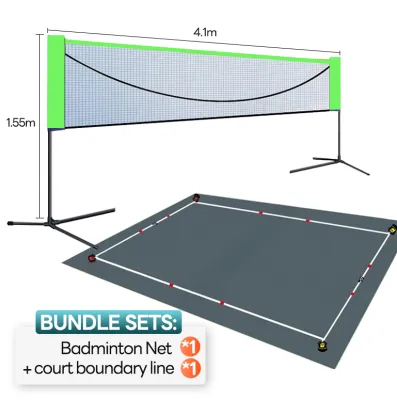
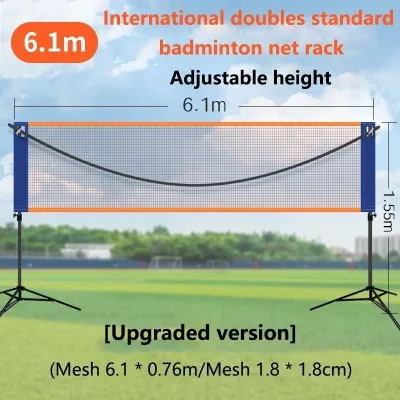
![[Fast Delivery] 6.1mX0.76m Badminton Net Original Professional Standard Badminton Net Outdoor Badminton Net Portable Folding Volleyball Tennis Badminton Net Outdoor Indoor Training Easy Setup Badminton Net](https://img.lazcdn.com/g/p/507784f8d9c0ddfabe55726a5aaea559.jpg_400x400q80.jpg_.webp)


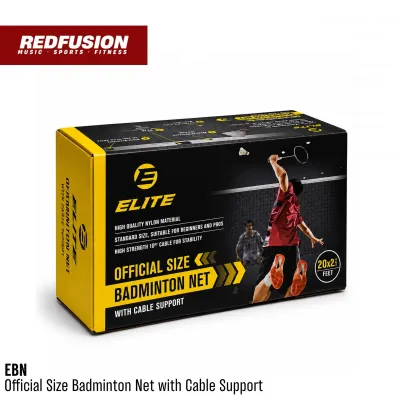
Prices are valid at publication and may change. Please refer to the product page for the latest price.
The ground surface of your playing area dictates the type of net support system you must use. Smooth indoor surfaces like ceramic tiles, polished concrete, or wood laminates require non-marking bases that will not scratch or slip during play. Conversely, outdoor surfaces like grass, soil, or gravel are uneven and soft, making them ideal for spiked ground stakes and tensioning guy ropes. If you are playing on a concrete driveway or a paved subdivision street, you cannot drive stakes into the ground, meaning you must rely on freestanding frames supported by heavy external weights.
Finally, consider your usage frequency and how the space is shared. If your playing area doubles as a garage or a driveway where cars park daily, a permanent or heavy setup will quickly become a hassle. In these multi-purpose spaces, a highly portable, quick-assembly net that can be packed away in under five minutes is essential. If you have a dedicated backyard lawn or a private court area, a semi-permanent or heavier freestanding system that can withstand the elements over several weeks is a much more practical investment.
Condo Units and Indoor Spaces: Portable and Floor-Safe Nets
Playing badminton indoors, particularly within the confines of a condominium complex or a private garage, requires specialized equipment that prioritizes portability and floor protection. Because you cannot drill anchors into the floor or use ground stakes, the net system must be completely self-supporting and stable enough to maintain tension without external tie-downs.

Retractable and roll-up net systems are excellent choices for tight indoor environments. These modern designs often feature lightweight, telescopic aluminum or carbon fiber poles that slide smoothly to adjust the net height. Many of these portable kits come with a hard plastic carrying case that doubles as the actual base of the net. The poles slot directly into the case, and an internal tensioning system keeps the net taut across the top tape. Because these systems are incredibly light and compact, they can be set up in minutes and stored easily in a closet or under a bed, making them perfect for space-conscious condo dwellers.
If you prefer a more traditional net aesthetic with greater stability, freestanding indoor nets with flat, weighted bases are the ideal alternative. These systems utilize a horizontal steel or fiberglass frame that runs along the floor, connecting the two vertical posts. To prevent the frame from sliding or tipping when the shuttlecock hits the net, the bases are weighted with flat steel plates or hollow plastic containers that can be filled with water or sand.
When using weighted bases indoors, protecting your flooring is paramount. Heavy steel bases can easily scratch hardwood, laminate, or ceramic tiles if dragged across the room. To prevent floor damage, select a net system that features rubberized or foam-padded feet on the underside of the frame. If your chosen net does not have built-in padding, you can place interlocking foam gym mats or heavy-duty rubber utility mats underneath the bases to distribute the weight evenly and prevent any unwanted movement or scuffing during active play.
Backyards and Driveways: Weather-Resistant and Freestanding Nets
Setting up a badminton court in your backyard or on a subdivision driveway introduces outdoor variables like wind, uneven terrain, and intense weather exposure. Unlike indoor play, outdoor equipment must be rugged enough to withstand sudden gusts of wind and prolonged exposure to the elements without collapsing or deteriorating.
The method you use to secure your net depends entirely on whether you are playing on soil or a paved surface. For grassy backyards and dirt patches, a traditional net system utilizing ground stakes and guy ropes is highly effective. The stakes are driven deep into the ground at an angle, and the guy ropes are tensioned using plastic sliders to pull the net posts outward, keeping the net perfectly straight. On concrete driveways or asphalt subdivision roads, however, ground stakes are completely unusable. For these hard surfaces, you must use a freestanding net frame. Because outdoor wind can easily blow a lightweight freestanding frame away, you should supplement the base with heavy sandbags, water weights, or concrete blocks to keep the structure anchored.
Weather resistance is a non-negotiable feature for outdoor badminton nets in the Philippines. The combination of high humidity, intense tropical sunlight, and sudden monsoon downpours can rapidly degrade cheap materials. When shopping for an outdoor net, look for poles made from powder-coated steel or heavy-duty fiberglass. Powder coating provides a durable barrier that prevents rust and corrosion, while fiberglass is naturally rust-proof and offers excellent flexibility in windy conditions.
The net mesh itself must also be built to survive the outdoors. Standard nylon nets can quickly become brittle and fray when exposed to ultraviolet (UV) radiation from the sun. Instead, look for nets made from high-density polyethylene (HDPE) or specially treated, UV-resistant nylon. The top tape of the net—the white band running along the upper edge—should be made from heavy-duty waterproof vinyl or canvas. This material resists water absorption, preventing the net from becoming heavy, sagging, and rotting after a sudden tropical rain shower.
Barangay Courts and Shared Spaces: Heavy-Duty and Semi-Permanent Nets
In many Philippine neighborhoods, local barangay courts and shared subdivision spaces serve as the primary hubs for sports and community gatherings. Because these courts experience high-frequency use from players of varying skill levels, they require heavy-duty, semi-permanent net systems that closely mimic professional playing conditions while remaining highly durable.
For dedicated concrete courts, a fixed pole system using ground sleeves is the most professional and practical solution. Ground sleeves are metal or heavy-duty PVC sockets that are permanently cemented flush into the concrete floor of the court. When it is time to play, heavy-duty steel posts are slid directly into these sleeves, providing absolute stability without the need for bulky bases or trip-hazard guy lines. When the court needs to be cleared for basketball games, community assemblies, or emergency response activities, the poles can simply be lifted out of the sleeves, and flat metal caps are placed over the holes to ensure a smooth, safe surface for other events.
To support serious competitive play, a community net must adhere to standard BWF regulation dimensions. The net must stand exactly 1.55 meters high at the outer posts and 1.524 meters high at the center of the court, spanning a total width of 6.1 meters. Achieving these precise heights requires a robust tensioning system. Casual nets often sag in the middle, which can frustrate players attempting precise net shots. Heavy-duty semi-permanent systems solve this by utilizing integrated hand winches, pulley systems, or heavy-duty ratchet tensioners mounted directly on the steel posts. These mechanisms allow you to pull the top cord of the net incredibly tight, ensuring a straight, professional-grade net line that remains taut throughout hours of intense play.
Additionally, community nets must be built to withstand physical wear and tear. Look for nets featuring double-stitched borders and reinforced corner pockets where the net meets the posts. A steel cable or a thick braided polyester cord running through the top tape is essential for handling the extreme tension required to keep a 6.1-meter net from sagging over time.
Cross-Scenario Compatibility: Can One Net Do It All?
For many families and casual players, investing in multiple specialized badminton nets is neither practical nor budget-friendly. This raises the question of whether a single, versatile hybrid net can serve all your playing spaces, from the indoor garage to the outdoor driveway.
While a single net is highly convenient, you must understand the practical trade-offs involved. If you choose a lightweight, highly portable net designed primarily for indoor use, it will struggle significantly when brought outdoors. Even a mild afternoon breeze can tip a lightweight frame over or cause the net to billow wildly, disrupting your game. Conversely, if you purchase a heavy-duty, semi-permanent outdoor net system, bringing it indoors can be highly problematic. These systems are often bulky, heavy, and difficult to maneuver inside a home. The rough metal bases can easily scratch delicate indoor tile or wood floors, and the sheer length of the frame may not fit comfortably within a standard garage or living area.
If you need a single net that can transition seamlessly between different environments, a mid-tier freestanding net is the most sensible compromise. Look for a model that features a modular, click-together steel frame that can be assembled without tools. To make it suitable for both indoor and outdoor use, ensure the frame is made of powder-coated steel to resist rust outdoors, and that the base feet are equipped with thick rubber pads to protect your indoor floors. While a mid-tier hybrid net may not offer the perfect wind resistance of a staked backyard net or the absolute stability of a barangay court sleeve system, it provides the ultimate balance of portability, durability, and floor safety for casual players who love to play wherever space is available.
Safe Setup, Maintenance, and Storage in Humid Climates
Setting up a badminton net safely is just as important as choosing the right equipment, especially in high-traffic residential areas or multi-purpose subdivision spaces. Taking a few proactive safety measures can prevent painful accidents and significantly extend the lifespan of your gear in the tropical Philippine climate.
One of the most common hazards associated with outdoor badminton setups is tripping. Guy ropes and ground stakes used to secure nets on grass can be incredibly difficult to see, especially for young children playing nearby or during late afternoon games as the sun sets. To prevent tripping hazards, always mark your guy lines with brightly colored ribbons, reflective tape, or safety cones placed directly over the stakes. If you are playing on a shared subdivision street or driveway, ensure your net setup does not block pedestrian pathways or vehicular access, and always have a player keep an eye out for oncoming traffic.
Routine maintenance is essential to keep your equipment safe and functional. Regularly inspect the metal joints of your net frame for signs of rust or paint chipping, which can weaken the structure over time. Check the net mesh for any fraying or tears, and inspect the tension cords or cables for signs of wear. If you notice any structural damage, address it immediately to prevent the net from collapsing unexpectedly during a game.
In the humid, tropical climate of the Philippines, proper storage is the key to preserving your badminton net. High humidity and sudden downpours create the perfect breeding ground for mold, mildew, and rot. Never pack your net away while it is wet or damp. If you get caught in a sudden rain shower, wipe down the metal or fiberglass poles with a dry cloth and hang the net mesh in a well-ventilated, sunny area until it is completely dry. Once dry, store the entire system in its dedicated carrying bag in a cool, dry indoor space away from direct sunlight to prevent heat damage and prolong the life of the materials.
Frequently Asked Questions (FAQ)
What is the standard height and width of a badminton net?
According to the Badminton World Federation (BWF), a standard regulation badminton net must have a width of 6.1 meters (20 feet) for doubles play. The height of the net must be exactly 1.55 meters (5 feet 1 inch) at the outer posts and 1.524 meters (5 feet) at the center of the court. While professional and semi-permanent community nets adhere strictly to these dimensions, casual portable nets designed for backyard or driveway use may vary, often offering narrower widths (such as 3 to 5 meters) to accommodate smaller playing spaces.
How do I secure a badminton net on a concrete driveway without drilling?
To secure a badminton net on a concrete driveway without drilling holes, you must use a freestanding net system supported by external weights. Avoid using ground stakes, as they are completely ineffective on hard pavement and attempting to force them into cracks can damage the surface. Instead, position your freestanding frame on the driveway and anchor the bases using heavy sandbags, water-fillable weight bags, or concrete blocks. To prevent scratching the concrete or the frame, wrap any abrasive weights in old towels or heavy-duty rubber mats before placing them on the base.
Community discussion
Share your experience or ask a question. Comments are reviewed before publication.