
Quick Answer: Matching Net Types to Practice Goals
To find the right golf practice net, you must match your swing speed, available space, and training objectives to the net’s structural design. For beginners or golfers who need a highly portable, quick-to-assemble setup for backyard or garage use, a flexible popup net is often the most practical starting point.
If you are an experienced player practicing high-velocity driver swings, a heavy-duty rigid frame net or cage is essential to safely absorb the high kinetic energy of real golf balls. For those focused on refining accuracy, short-game approach shots, and receiving immediate visual feedback on ball dispersion, a hitting net with an integrated target sheet provides the best training utility.
Comparing Golf Practice Net Designs
Selecting the right golf practice net requires understanding how different construction styles handle the physical forces of a golf ball impact. The market generally divides these training aids into three primary categories: flexible popup designs, rigid frame structures, and target-integrated nets.
Products mentioned in this guide


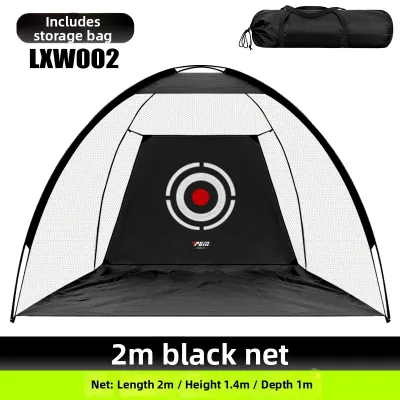
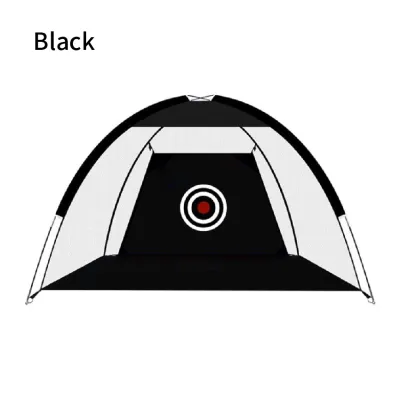
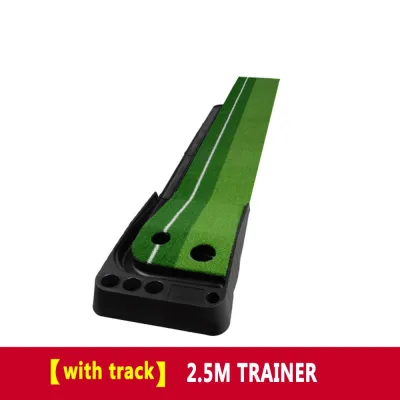
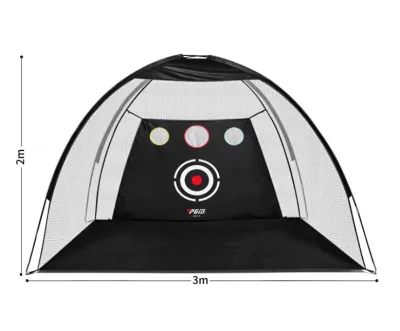
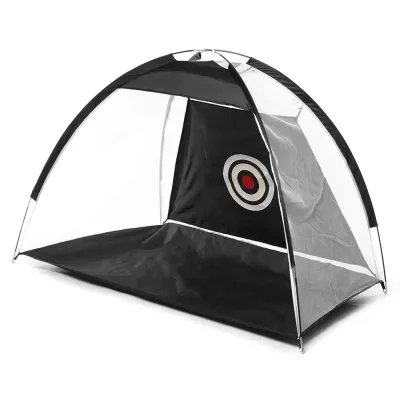
Prices are valid at publication and may change. Please refer to the product page for the latest price.

Each design offers a distinct balance between setup convenience, structural durability, and feedback quality. Choosing the right one involves evaluating your typical swing speed, how often you plan to move the net, and where you intend to set it up.
Popup and Tent-Style Nets
Popup and tent-style nets utilize flexible fiberglass or spring-steel poles that tension the netting into a dome or bow shape. This design is highly favored for its rapid assembly, often taking only a few minutes to spring open and secure with ground stakes. When collapsed, these nets fold down into a compact, lightweight carrying bag, making them ideal for golfers who must store their equipment after every session or transport it to different locations.
However, the lightweight nature of popup nets introduces specific limitations, particularly when exposed to outdoor elements. In windy conditions, these structures can act like sails, requiring secure anchoring to prevent them from shifting or blowing over. Additionally, the flexible frame absorbs impact by flexing, which can cause the net to shift backward during heavy use.
These nets are generally best suited for light to moderate practice sessions using irons and wedges. Because high-velocity driver shots exert immense kinetic energy, you should always verify the manufacturer’s specified club-speed or ball-speed limits before attempting full driver swings. Using a driver on a net not rated for high-velocity impacts can lead to rapid wear, tearing, or dangerous ball pass-throughs.
Rigid Frame and Cage Nets
Rigid frame and cage nets are engineered for maximum stability and durability, utilizing heavy-duty steel, aluminum, or thick PVC pipes to create a solid, non-yielding structure. Unlike flexible designs, these frames do not rely on the tension of the net to hold their shape, allowing them to support much heavier, commercial-grade netting. This robust construction makes them the safest option for absorbing high-speed driver shots and heavy daily use.
The primary trade-off with rigid frame nets is their assembly time and physical footprint. Setting up a metal frame or cage typically requires tools, multiple steps, and a dedicated space, making them less suitable for golfers who need to pack away their practice area after every session. They are best utilized as semi-permanent or permanent installations in spacious backyards, large garages, or dedicated indoor simulator rooms.
When planning an outdoor installation, material maintenance becomes a critical factor. Steel frames should feature rust-resistant powder coating to withstand tropical humidity and sudden rain showers, while the netting itself must be rated for UV resistance to prevent the fibers from degrading and weakening over time under intense sunlight.
Hitting Nets with Target Sheets
Hitting nets with integrated target sheets feature a heavy-duty fabric or canvas screen suspended in front of the primary netting. This target sheet serves a dual purpose: it absorbs the bulk of the ball’s kinetic energy before it reaches the outer net, and it provides clear visual and auditory feedback upon impact. The distinct sound of a ball hitting a canvas target helps golfers confirm a centered strike even without tracking the full ball flight.
The durability of the target material is paramount, as it bears the brunt of repeated, high-velocity impacts in a concentrated zone. Over time, tightly grouped shots can wear down even robust fabrics, so look for targets made from heavy-gauge canvas or dual-layer mesh that can be easily replaced or adjusted.
When using a target net, you must also consider the physics of ball rebound. A tightly tensioned target sheet can cause golf balls to bounce back toward the golfer with significant speed, requiring a safe buffer distance of several meters between the mat and the net. Conversely, a loose target sheet will safely drop the ball to the ground but may sag over time, requiring periodic adjustments to maintain a clean hitting surface.
Key Decision Factors for Your Setup
Before purchasing a golf practice net, you must carefully evaluate your physical environment and practice habits to ensure a safe and effective training experience.
- Space Constraints: Indoor setups require careful measurement of ceiling height, room width, and depth. A standard golf swing with a driver requires a ceiling height of at least 3 meters to clear the club path safely. Additionally, you must allow for a buffer zone of at least 1 to 1.5 meters behind the net to accommodate net deformation during impact, preventing the ball from striking the wall behind it.
- Club Selection: The clubs you plan to use dictate the strength and size of the net you need. Drivers and low irons launch balls at high velocities but lower angles, requiring a net with high impact resistance. Conversely, wedges launch balls at steep angles, meaning you need a taller net or a canopy design to catch high-lofted shots before they sail over the top of the structure.
- Weather and Storage: In tropical climates characterized by high humidity, intense UV exposure, and heavy seasonal rainfall, material selection is crucial. Look for nets treated with UV inhibitors and frames made of powder-coated steel or fiberglass. If you cannot leave the net outdoors permanently, prioritize designs with quick-release folding mechanisms that allow you to store the net indoors when not in use.
- Safety Buffers: No matter how durable a net is, mis-hits, shanks, and skyed shots can happen. Always position your net away from windows, parked vehicles, and pedestrian pathways. Installing side barrier nets or choosing a wider cage design can provide an extra layer of protection against erratic shots, ensuring your practice sessions remain safe for your surroundings.
Comparison Matrix: Net Types at a Glance
The following table summarizes how the three primary golf practice net designs compare across key performance and usability dimensions to help you identify the right fit for your training space.
| Net Type | Setup Time | Driver Suitability | Portability | Ideal Practice Focus | Relative Cost |
|---|---|---|---|---|---|
| Popup / Tent | 2–5 minutes | Limited (Verify specs) | High (Includes carry bag) | Short game, irons, light practice | Budget-friendly |
| Rigid Frame | 20–45 minutes | High (Heavy-duty mesh) | Low (Semi-permanent) | Full swings, high-speed drivers | Premium investment |
| Target Net | 10–20 minutes | Moderate to High | Medium (Foldable frames) | Accuracy, swing alignment, feedback | Mid-range |
How to Choose: The Decision Framework
To finalize your decision, match your specific training environment and goals to these practical guidelines:
- Choose a popup net if you have limited space, need to pack your gear away after every session, or primarily practice short-game chips and mid-iron swings. This style is excellent for casual backyard practice or taking your setup to a local park.
- Choose a rigid frame net if you have a dedicated garage, large backyard, or indoor simulator room where the net can remain assembled. This is the best choice for serious golfers who want to practice full-power driver swings daily without worrying about net wear.
- Choose a target net if you want to improve your accuracy and shot dispersion. The visual target and auditory feedback are highly beneficial for golfers working on swing alignment and consistent ball-striking.
- Verify first if the manufacturer specifies a maximum ball speed or club head speed rating, especially if you plan to use real golf balls with a driver. Always check the warranty conditions regarding outdoor exposure and frame rust to ensure your investment is protected against local weather conditions.
Frequently Asked Questions (FAQ)
Can I use a golf practice net indoors with real golf balls?
Yes, you can use a golf practice net indoors with real golf balls, provided you have sufficient space and safety measures in place. Ensure your room has a ceiling height of at least 3 meters and enough depth to position the net 2 to 3 meters away from your hitting mat, with an additional 1-meter safety buffer behind the net. To protect your floors from club impact and ball bounce-back, always use a high-quality hitting mat and place a protective rug or foam tiles underneath the setup. Always consult the manufacturer’s indoor safety guidelines before hitting real balls inside.
How do I prevent the net from tearing when hitting high-speed driver shots?
Preventing tears requires managing net tension and monitoring wear. Avoid rigging the net too tightly; a slightly loose net absorbs the ball’s kinetic energy much better than a rigid, over-tensioned one. Regularly inspect the netting for signs of UV degradation, fraying, or thinning fibers, particularly in the central impact zone. If you practice high-speed driver shots frequently, consider hanging a heavy-duty archery baffle or a dedicated target sheet in front of the main net to absorb the primary impact and extend the lifespan of the outer netting.
Do I need a separate hitting mat for my practice net?
Yes, a dedicated hitting mat is highly recommended to protect both your clubs and the ground beneath you. Practicing directly on natural grass will quickly wear away your lawn, while hitting off hard concrete or tiled surfaces can damage your club heads and cause severe joint strain in your wrists and elbows. When selecting a mat, choose a thickness and turf density that matches your typical strike pattern. A thicker, shock-absorbing mat is ideal for preventing injury and simulating the feel of a real fairway turf.
Community discussion
Share your experience or ask a question. Comments are reviewed before publication.