
Selecting your first serious badminton racket is a pivotal step in your athletic journey, especially when navigating a highly respected brand like Li-Ning. For beginners in the Philippines, the ideal Li-Ning badminton racket is one that prioritizes lightweight maneuverability, a flexible shaft, and an even or head-light balance. These features collectively ensure that you can develop correct swing mechanics, enjoy long rallies on humid local courts, and protect your joints from unnecessary strain.
What Makes a Badminton Racket Beginner-Friendly?
When you are first stepping onto a badminton court, your physical technique and muscle memory are still developing. Beginners lack the refined wrist snap, forearm strength, and precise timing of seasoned players. Consequently, using a racket designed for advanced athletes can hinder your progress and make the game unnecessarily frustrating.
A beginner-friendly racket must feature a forgiving sweet spot to compensate for off-center hits. Most entry-level Li-Ning rackets utilize an isometric frame shape, which squares the head and expands the hitting area. This design ensures that even if you miss the exact center of the string bed, the shuttlecock still travels over the net with reasonable control and depth.
Products mentioned in this guide
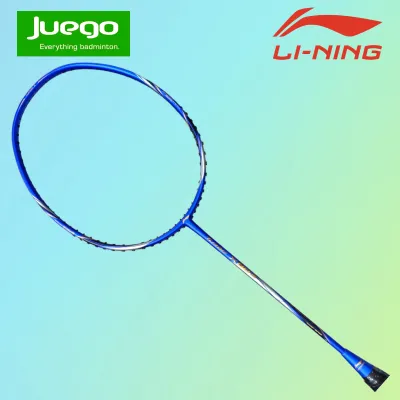
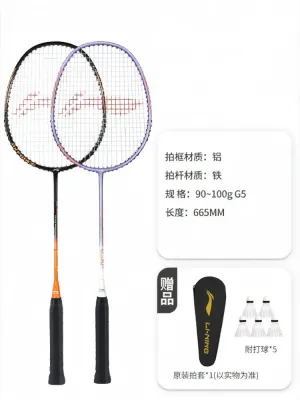
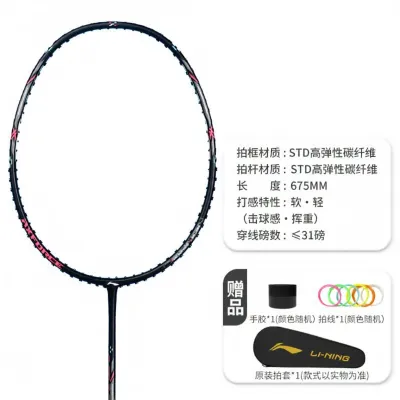
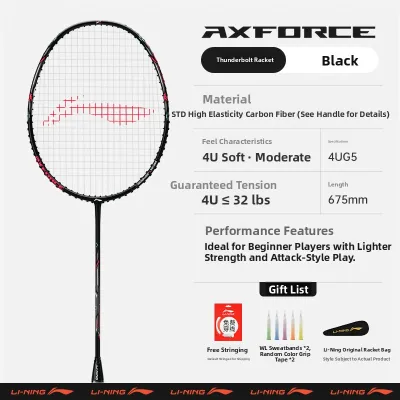
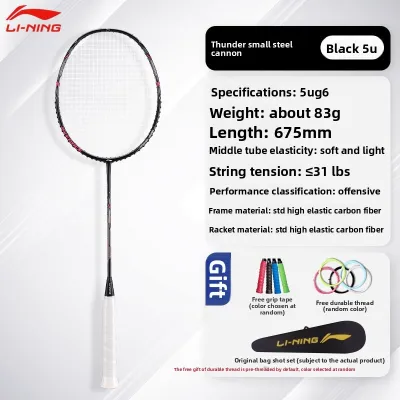
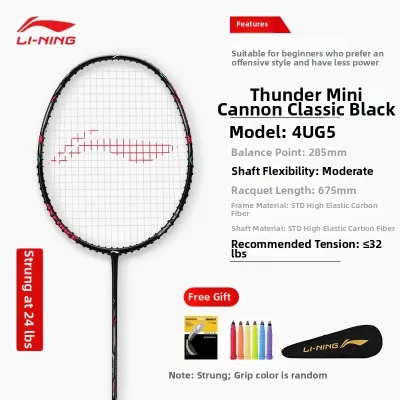
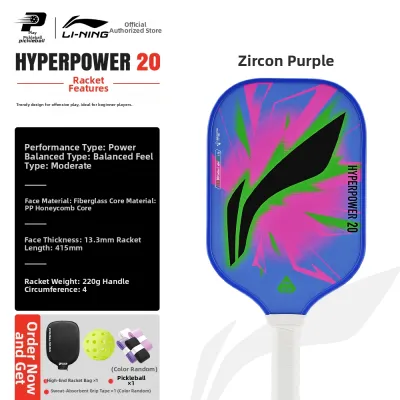
Prices are valid at publication and may change. Please refer to the product page for the latest price.
Maneuverability and arm-friendly impact absorption are equally critical. A racket that is too heavy or stiff will transmit harsh vibrations directly to your wrist, elbow, and shoulder joints. Over time, this repetitive shock can lead to painful conditions such as tennis elbow or rotator cuff strains. A lighter, more flexible frame dampens these vibrations, allowing you to practice longer without discomfort.
The learning curve of swing mechanics also requires a tool that does not punish improper form. Beginners often swing using their entire arm rather than a quick wrist snap. A heavy, head-heavy racket exaggerates this movement, making it difficult to recover quickly for the next shot. Starting with a balanced, manageable racket helps you build the correct habits from day one.
Local playing environments in the Philippines also play a significant role in your equipment needs. Many community, barangay, or commercial sports centers are non-air-conditioned, exposing players to high humidity and ambient temperatures. This tropical heat causes rapid perspiration, which can compromise your grip and control. A highly maneuverable racket reduces the physical effort required to swing through heavy, humid air, helping you maintain a secure hold even during intense, sweaty rallies.
Key Specifications to Check on Li-Ning Rackets
To select the right Li-Ning racket, you must understand the technical specifications printed on the frame, shaft, or handle cone. These measurements dictate how the racket behaves in your hand and during a swing.

Weight (The U System) Li-Ning uses the industry-standard “U” classification system to denote the weight of the racket frame. The higher the number preceding the U, the lighter the racket. A 3U racket weighs approximately 85 to 89 grams, which is generally too heavy for novices. Beginners should look for 4U (80 to 84 grams) or 5U (75 to 79 grams) models. A lighter frame allows for quicker reaction times, faster swing speeds, and significantly reduced fatigue during extended doubles matches.
Balance Point The balance point is measured in millimeters from the bottom of the handle. Rackets are categorized as head-light (under 285mm), even-balance (285mm to 295mm), or head-heavy (over 295mm). For defensive play and control, beginners should prioritize even-balance or slightly head-light rackets. These configurations offer excellent maneuverability for quick defensive blocks and rapid drives while still providing enough mass to help you learn the overhead clear technique.
Shaft Flexibility Shaft flexibility ranges from flexible to medium and stiff. Stiff shafts require rapid, explosive swing speeds to bend the frame and generate power. If your swing technique is still developing, a stiff shaft will feel like a wooden plank and produce weak shots. A flexible shaft, however, bends easily during your swing, storing potential energy and releasing it like a catapult. This built-in repulsion helps you clear the shuttlecock from baseline to baseline with minimal physical effort.
Grip Size (The S System) Li-Ning uses its own “S” sizing system for racket handles, where smaller numbers generally represent thinner grips (such as S1 or S2). A thinner handle is highly advantageous because it allows you to customize the feel. You can easily wrap an absorbent overgrip over a thin handle to achieve the perfect thickness for your hand size, whereas a handle that is too thick from the start cannot be easily reduced.
String Tension Range Always check the manufacturer’s recommended tension range, which is typically printed on the racket cone or shaft. Beginners should request their rackets to be strung at a lower tension, specifically between 20 and 24 lbs. Lower tensions create a softer string bed with a larger sweet spot and a pronounced “trampoline effect,” which aids in power generation. High tensions (25 lbs and above) shrink the sweet spot and demand flawless technique to avoid frame damage or joint strain.
Matching Li-Ning Racket Series to Your Playing Style
Li-Ning organizes its extensive catalog into distinct product families, each tailored to specific tactical approaches on the court. Navigating these series allows you to align a racket’s design with your current skill level and developmental goals.
The Windstorm and Wind Lite series are highly celebrated for their ultra-lightweight construction and flexible shafts. These rackets are engineered specifically for speed and defense, making them incredibly popular among beginners and intermediate players in the Philippines. Their lightweight nature minimizes arm fatigue, allowing you to react quickly to fast smashes and maintain control during long, humid rallies.
For players seeking a balanced, all-around performance, the Halbertec and G-Force series are excellent entry points. These series focus on even-balance profiles and medium-flex shafts, offering a versatile platform. They provide enough control for delicate net shots and defensive blocks, while still offering sufficient stability to generate power when you decide to transition into an offensive smash.
Conversely, the Axforce series is built for aggressive, power-oriented play, featuring head-heavy balances and stiffer shafts. While some entry-level Axforce models exist, absolute beginners should approach them with caution. Heavy, head-heavy frames require strong wrist and forearm development to swing safely, and using them prematurely can lead to poor form and potential wrist injuries.
When selecting a racket, pay close attention to the product descriptions, color coding, and decals on the frame. Li-Ning often uses clear labeling or distinct visual accents on the shaft to indicate whether a model is optimized for “Attack,” “Defense,” or “Control.” Always verify that the maximum string tension limit of the specific model accommodates your current setup and leaves room for future adjustments as your skills progress.
How to Buy Authentic Li-Ning Gear in the Philippines
Due to the high popularity of badminton in the Philippines, counterfeit sports equipment is a common issue in the local market. Purchasing a fake racket not only wastes your money but also deprives you of the advanced materials and safety engineering built into genuine Li-Ning gear.
To guarantee authenticity, always purchase your equipment from established, authorized channels:
- Official Brand Boutiques: Visit dedicated physical Li-Ning stores located in major shopping malls across urban centers.
- Authorized Sports Retailers: Reliable multi-brand sports chains, such as Toby's Sports or Olympic Village, carry genuine inventory.
- Verified Online Flagship Stores: If purchasing online, limit your search to official brand stores on reputable e-commerce platforms, ensuring they carry the official "Mall" or "Verified" badge.
Genuine Li-Ning rackets feature a specialized security label affixed to the shaft or handle cone. This label contains a scratch-off panel that reveals a unique 16-digit verification code. You can enter this code directly into the official regional Li-Ning anti-counterfeiting website to confirm that your product is authentic.
Be vigilant against common red flags of counterfeit rackets. A suspiciously low price is the most obvious indicator; while genuine entry-level Li-Ning rackets typically retail between ₱1,500 and ₱3,500, counterfeit models are often listed for under ₱800. Additionally, inspect the physical product closely. Fakes frequently exhibit poor paint finishes, bubbles under the decals, misaligned text, missing holographic stickers, or flimsy, unbranded plastic packaging instead of high-quality padded covers.
Essential Setup and Maintenance for Tropical Climates
The tropical climate of the Philippines, characterized by high temperatures and intense humidity, can take a heavy toll on your badminton equipment. Proper setup and regular maintenance are essential to preserve your racket’s performance and longevity.
String Selection Beginners are highly prone to “mishits,” which occur when the shuttlecock strikes the outer edges of the frame rather than the sweet spot. This off-center impact puts immense localized stress on the strings, causing thin, high-performance strings to snap prematurely. For your initial setup, choose durable, thicker multifilament strings, such as those with a diameter of 0.69mm to 0.70mm (like Li-Ning No. 7). These strings offer superior durability and tension retention, making them highly cost-effective for novice players.
Grip Care Sweat management is critical when playing on non-air-conditioned local courts. Always apply a high-quality polyurethane (PU) or towel overgrip over the racket’s original base grip. Replace this overgrip regularly—ideally every few weeks or as soon as it begins to lose its tackiness or smell of moisture. If sweat is allowed to saturate the grip completely, the moisture will eventually seep into the underlying wooden handle, causing the wood to rot, weaken, and potentially snap during a high-speed swing.
Storage and Handling Never leave your badminton racket in a hot vehicle or exposed to direct sunlight for extended periods. Extreme heat can soften the carbon fiber resin, leading to frame warping under the tension of the strings. Always store your racket in a padded, thermal-lined bag in a cool, dry room. Additionally, protect the frame’s integrity by avoiding accidental clashes with your doubles partner’s racket and refraining from scraping the frame against the court floor when picking up shuttlecocks.
Frequently Asked Questions (FAQ)
Is it better to buy a pre-strung or unstrung Li-Ning racket as a beginner?
For absolute convenience, a pre-strung Li-Ning racket is a practical choice because it is ready for the court immediately and is typically strung at a safe, beginner-friendly tension of 20 to 22 lbs. However, if you have access to a reliable local sports shop with an experienced stringer, purchasing an unstrung racket is highly recommended. This allows you to choose a durable, high-quality string and set the tension precisely to your current physical capability, ensuring optimal performance from day one.
Can a beginner use an advanced Li-Ning racket if it is heavily discounted?
It is highly advisable to avoid advanced, professional-grade rackets even if they are offered at a steep discount. Advanced rackets are engineered with stiff shafts and head-heavy balances that demand precise timing, rapid swing speeds, and excellent physical conditioning to generate power. When a beginner uses such a racket, they will struggle to flex the shaft, leading to weak clears, a tiny, unforgiving sweet spot, and a significantly higher risk of developing wrist, elbow, or shoulder injuries.
How often should a beginner restring their racket?
As a general rule of thumb, a beginner who plays once or twice a week should restring their racket every 3 to 6 months. Even if the strings do not break, they gradually lose their tension and elasticity over time, which reduces control and forces you to swing harder to achieve the same depth. Additionally, the high humidity and temperature fluctuations in the Philippines can accelerate this tension loss, so you should monitor your strings for visible fraying, sliding, or a dull sound upon impact as clear signs that it is time for a restring.
Community discussion
Share your experience or ask a question. Comments are reviewed before publication.