
Selecting the right boat rod holder is one of the most critical decisions you will make when rigging your vessel for fishing. A high-quality holder does more than just keep your hands free; it secures your expensive rods and reels against the sudden, violent strikes of powerful game fish. In the tropical waters of the Philippines, where high humidity, intense UV exposure, and highly corrosive saltwater are daily realities, choosing the wrong installation style can lead to structural damage to your boat or the heartbreaking loss of your favorite gear.
The three primary installation types are clamp-on, flush mount, and rail mount. Each serves a distinct purpose based on your boat’s design and your target species:
- Clamp-On Mounts require no drilling, attaching directly to the gunwale lip or transom. They are highly portable, adjustable, and perfect for temporary setups or small utility boats.
- Flush Mounts are permanent, low-profile fixtures installed directly into the deck or gunwale. They offer maximum structural strength, making them the standard for heavy-duty offshore trolling.
- Rail Mounts clamp onto existing metal tubing, such as T-tops, bimini frames, or grab rails, allowing you to maximize vertical space and keep your deck clear.
Ultimately, the ideal setup depends on whether your vessel has sturdy rails, your willingness to make permanent modifications to your hull, and the drag forces exerted by your target catch.
Products mentioned in this guide
![[COD] SHPYHT SPORTS 1Pc Fishing Rod Holder Portable Pole Rack Bait Holder V-shaped Rod Rack For Boat Marine Fishing Rod Gear Portable Accessories](https://img.lazcdn.com/g/p/919602b15735172cc7e1d43653025837.jpg_400x400q80.jpg_.webp)
Prices are valid at publication and may change. Please refer to the product page for the latest price.
Clamp-On Mounts: The No-Drill Solution for Versatile Setups
Clamp-on mounts are the go-to choice for anglers who prioritize flexibility and wish to avoid making permanent alterations to their vessels. These holders operate via a heavy-duty mechanical clamp, utilizing a tightening screw, threaded bolt, or cam-lock lever to grip the gunwale lip, transom, or coaming board. Because they require absolutely no drilling, they are highly favored by owners of small aluminum utility boats, fiberglass tenders, and inflatable vessels, as well as anglers who rent boats for weekend trips.
The primary advantage of the clamp-on style is its exceptional portability. You can easily reposition the holder along the gunwale to accommodate different fishing techniques, such as shifting from side-trolling to stern-casting. When the fishing day is done, or when you need to store your boat under a tight-fitting cover to protect it from tropical downpours, you can remove the holders entirely within seconds. This portability also makes them an excellent investment for multi-purpose boats that transition between family cruising and weekend fishing.
However, these benefits come with distinct physical limitations. Because clamp-on holders rely entirely on friction and clamping pressure to stay in place, they are susceptible to slipping or twisting under extreme lateral force. If you are trolling for fast-swimming pelagic species like tanguigue (Spanish mackerel) or talakitok (giant trevally), a sudden, high-drag strike can rotate the holder or, in worst-case scenarios, pull it completely off the gunwale. Additionally, the physical clamp mechanism protrudes inward, which can snag cast nets, dock lines, or loose clothing, and can limit your usable deck space on narrower boats.
Before purchasing a clamp-on holder, you must verify several physical dimensions of your boat. Measure the thickness of your gunwale lip to ensure it falls within the clamp’s operational range, which typically spans from 1 to 3 inches. Examine the slope of the gunwale; an extreme inward or outward angle can prevent the clamp’s jaws from seating flush, resulting in an insecure grip. Finally, always check that the clamp jaws are equipped with heavy-duty, UV-resistant rubber or silicone padding. Bare metal clamps will quickly scratch gelcoat, crack fiberglass, or scrape protective paint off aluminum hulls, exposing the metal to rapid saltwater corrosion.
Flush Mounts: The Permanent Choice for Heavy-Duty Fishing
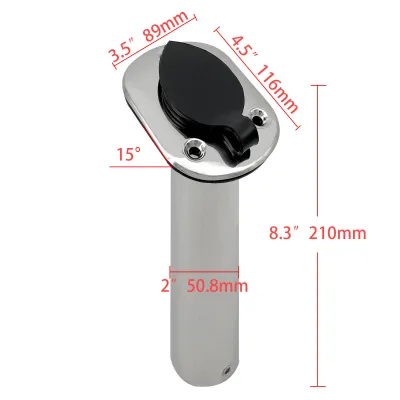
For serious offshore anglers targeting large, hard-fighting species, flush-mount rod holders represent the gold standard of structural security. Unlike temporary attachments, flush mounts are integrated directly into the boat’s gunwale or deck. Installation is a permanent commitment, requiring you to drill a pilot hole, cut a large-diameter opening (typically 2 inches) through the fiberglass or aluminum deck using a hole saw, and secure the flange with heavy-duty marine-grade fasteners.

The structural integrity of a flush-mount holder is unmatched. Because the body of the holder sits entirely below the deck line, the leverage exerted by a bent rod is distributed across a wide surface area of the gunwale rather than concentrated on a single external clamp or rail. This makes flush mounts highly capable of handling the extreme drag settings required when trolling or deep-drop bottom fishing for heavy groupers (lapu-lapu). Furthermore, their low-profile design ensures that the top flange sits nearly level with the gunwale surface, creating a clean, snag-free aesthetic that prevents fishing lines, cast nets, and mooring ropes from getting caught during critical maneuvers.
Despite their superior strength, flush mounts present several distinct challenges. The installation process is irreversible and demands a high level of precision; a single misplaced hole can permanently damage your boat’s deck or compromise its structural core. Because these holders penetrate the deck, they create a direct pathway for water to enter the inner hull or bilge. To prevent water intrusion, you must use high-quality, marine-grade polyurethane sealants during installation and ensure the holder’s drain tube is properly routed to the bilge or deck drains. Over time, these seals must be inspected regularly, as the intense tropical heat can cause sealant degradation and lead to core rot in plywood-cored fiberglass decks.
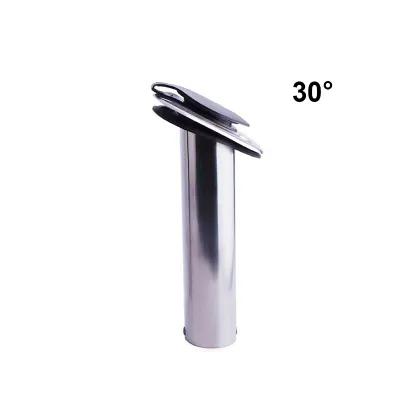
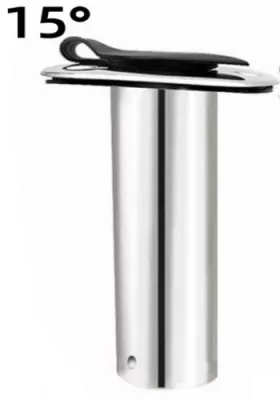
This mounting style is ideal for center consoles, walkarounds, and larger sportfishing boats where gunwales are wide and structurally reinforced. If your fishing style involves high-speed trolling, downrigger fishing, or targeting species that exceed 10 to 15 kilograms, flush mounts are practically mandatory. They are typically offered in 0-degree (vertical), 15-degree, and 30-degree angles, allowing you to customize your trolling spread. When planning your layout, remember that you will need to choose the angle that best matches your gunwale’s slope and your preferred rod presentation.
Rail Mounts: Maximizing Existing Tubing and T-Tops
Rail-mount rod holders are designed to capitalize on the existing metal framework of your vessel, making them exceptionally spatial-efficient. These holders feature a split-collar clamp that wraps around round or square metal tubing, securing in place with hex bolts or tension screws. They are commonly installed on bow rails, stern grab rails, T-top supports, bimini frames, and the sturdy aluminum structures of pontoon boats, turning otherwise unused safety features into functional fishing stations.
The primary benefit of rail mounts is their ability to clear valuable deck and gunwale space. By mounting your rods overhead on a T-top—often referred to as a “rocket launcher” configuration—or high up on a cabin grab rail, you keep your active casting deck completely free of obstacles. This is highly advantageous on smaller center consoles where floor space is at a premium. Additionally, rail mounts offer superb adjustability; most models feature a 360-degree rotational axis and variable tilt angles, allowing you to fine-tune your rod positions for trolling, drifting, or simple vertical storage while underway.
However, rail-mount holders are strictly limited by the availability and structural strength of your boat’s existing tubing. If your vessel lacks rails or has very thin, decorative trim rather than structural grab rails, this mounting style is not an option. Furthermore, mounting a heavy rod and reel high up on a T-top or bimini frame creates a long leverage arm. Under a heavy load, this leverage can place immense torque on the rail’s mounting brackets, potentially flexing or cracking the fiberglass deck where the rail is attached. There is also the risk of the holder spinning around the circular rail if the clamp is not perfectly sized or if the internal grip material fails.
To ensure a safe and secure rail-mount installation, you must use a caliper to measure the exact outer diameter of your tubing. Common marine rail sizes include 7/8-inch, 1-inch, and 1-1/4-inch diameters, and even a millimeter of variance can cause a holder to slip or fail to clamp completely. Additionally, inspect the physical condition of the rail itself; ensure that the stanchions supporting the rail are securely bolted to the deck with backing plates, rather than just secured with simple wood screws. If the rail flexes when you apply firm hand pressure, it is not strong enough to support a rod holder under active fishing loads.
Side-by-Side Comparison and Decision Framework
To help you visualize how these three installation types compare across key operational categories, review the comparative matrix below. This framework evaluates each style based on structural and practical performance metrics:
| Feature | Clamp-On Mounts | Flush Mounts | Rail Mounts |
|---|---|---|---|
| Installation Effort | Very Low (No tools required) | High (Requires drilling and cutting) | Moderate (Requires basic hand tools) |
| Hull Alteration | None (100% reversible) | Permanent (Irreversible deck cuts) | None (Attaches to existing rails) |
| Drag Suitability | Low to Moderate | Maximum (Heavy trolling) | Moderate to High (Depending on rail strength) |
| Deck Space Impact | High (Protrudes inward over gunwale) | Minimal (Low-profile, flush with deck) | Minimal (Elevates rods off the deck) |
| Repositioning Ease | Excellent (Can be moved in seconds) | None (Fixed permanently) | Good (Can be slid along the rail) |
| Primary Material | Nylon, Aluminum, or Stainless Steel | 316 Stainless Steel or Heavy Duty ABS | 316 Stainless Steel or Anodized Aluminum |
Choose Clamp-On if:
- You fish from a small utility boat, kayak, or rental vessel where drilling holes is prohibited or structurally impossible.
- You target smaller, light-tackle species such as local snappers or small groupers, where drag settings remain relatively light.
- You want the ability to pack up your entire fishing setup at the end of the day to prevent theft or weather damage.
Choose Flush Mount if:
- You own a center console or offshore sportfisher with wide, structurally sound gunwales.
- You engage in heavy-duty trolling for large pelagic species and require absolute structural reliability under high drag.
- You want a clean, professional, and permanent deck layout that eliminates line snags and maximizes walking space.
Choose Rail Mount if:
- Your boat is already equipped with a sturdy T-top, bimini frame, bow rail, or stern grab rail.
- You need to maximize vertical storage space and keep your rods high and dry, away from deck traffic and saltwater spray.
- You want the flexibility to adjust rod angles dynamically depending on wind, current, or trolling patterns.
Verify First if:
- Your gunwale has an unusual lip profile or thin, unreinforced fiberglass that might crack under clamping pressure.
- Your under-deck area contains hidden fuel lines, wiring harnesses, or structural stringers that could be damaged during a flush-mount installation.
- Your existing rails are constructed of lightweight, thin-walled tubing that could bend or twist under the leverage of a trolling rod.
Pre-Installation Checklist: Verifying Boat Compatibility
Before purchasing any marine hardware or starting the installation process, performing a thorough physical audit of your vessel is essential to prevent costly damage and ensure safety on the water. Boating safety and structural integrity must always take precedence over convenience.
For Clamp-On Mounts:
- [ ] Measure Gunwale Thickness: Use a tape measure or caliper to confirm your gunwale lip falls within the clamp's operational specifications.
- [ ] Inspect the Flange Angle: Ensure the mounting surface is flat enough to allow the clamp pads to make full, uniform contact with the hull.
- [ ] Verify Pad Material: Confirm the clamp includes non-marking rubber or silicone protective inserts to prevent galvanic corrosion on aluminum or gelcoat cracking on fiberglass.
- [ ] Check Clearance: Ensure the clamp handle or tightening screw does not obstruct throttle controls, steering paths, or passenger seating.
For Flush Mounts:
- [ ] Inspect Under-Deck Space: Access the area beneath the gunwale to ensure there is sufficient depth and clearance for the tube of the flush mount, which typically extends 8 to 10 inches downward at an angle.
- [ ] Locate Hidden Hazards: Carefully trace and mark the paths of all fuel lines, electrical wiring harnesses, steering cables, and structural deck stringers to ensure they are far clear of your drilling zone.
- [ ] Check Core Material: Determine if your deck is solid fiberglass or cored with wood or foam. Cored decks require specialized sealing techniques to prevent water from rotting the core.
- [ ] Prepare Marine-Grade Materials: Secure high-quality polyurethane marine sealant and Type 316 stainless steel fasteners (bolts, washers, and locking nuts) rather than standard screws.
For Rail Mounts:
- [ ] Confirm Tubing Diameter: Measure the outer diameter of your rail with a caliper to ensure you purchase the exact matching clamp size.
- [ ] Assess Rail Rigidity: Grasp the rail firmly and apply force in multiple directions. If you observe any flexing, cracking noises, or loose deck mounts, the rail must be reinforced before mounting a rod holder.
- [ ] Review Clearance and Pathing: Ensure that a rod placed in the holder will not strike your bimini canvas, interfere with your outboard motor's turning radius, or block the captain's line of sight.
If your boat’s structural layout is complex, if you find cored fiberglass during your inspection, or if you are unsure of what lies beneath your deck, stop immediately. Consult your boat manufacturer’s owner manual or hire a certified marine technician to assist with the installation. Making incorrect cuts can compromise your vessel’s flotation compartments or structural integrity, posing a severe safety risk when navigating open waters.
Community discussion
Share your experience or ask a question. Comments are reviewed before publication.