
The choice between curved and flat Muay Thai kick pads depends entirely on the primary techniques being drilled and the holder’s comfort. Neither shape is universally superior; curved pads excel at catching angled roundhouse kicks, while flat pads offer a versatile target for linear strikes and mixed martial arts cross-training. This guide breaks down the functional differences to help you select the right design for your specific training style and partner drill requirements.
In the tropical climate of the Philippines, where high humidity makes training sessions intensely sweaty, the physical interaction between a striker’s shin and the pad holder’s forearms becomes even more critical. Slippage, moisture buildup, and impact distribution are daily challenges in local gyms. Selecting the right pad shape directly influences how safely and effectively you can run partner drills under these demanding conditions.
Core Design Differences and Impact Mechanics
Curved pads feature a pre-curved striking surface that mimics the natural contour of a kicking shin, whereas flat pads are completely straight from top to bottom. This structural variation dictates how force travels through the pad and into the holder’s arms. While both designs aim to protect the training partners, they distribute the kinetic energy of a strike in fundamentally different ways.
Products mentioned in this guide
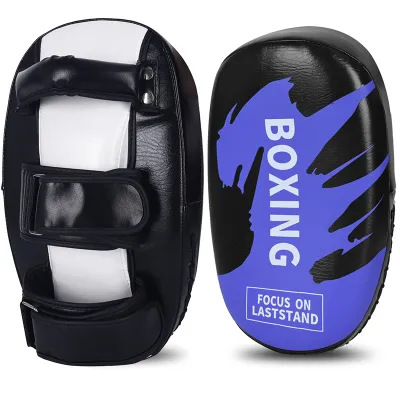
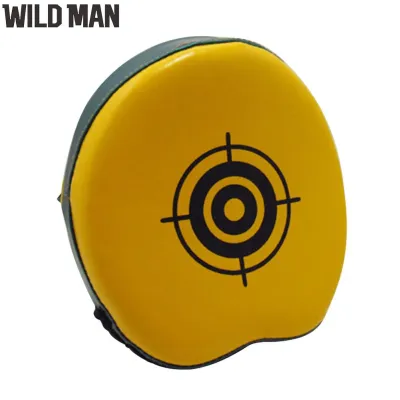
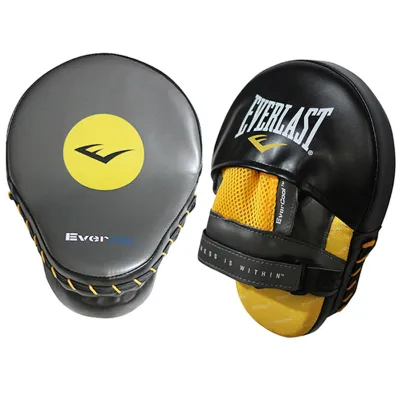
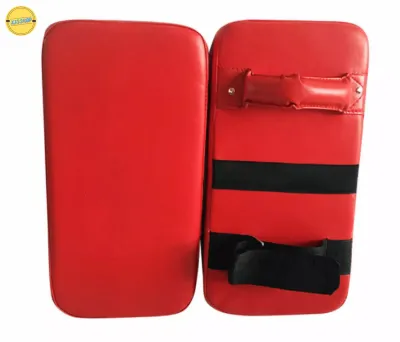
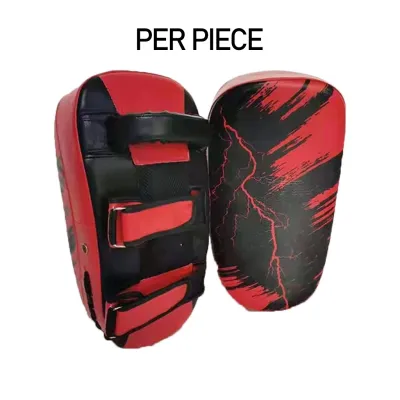
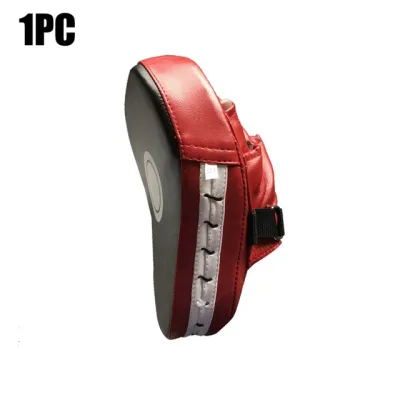
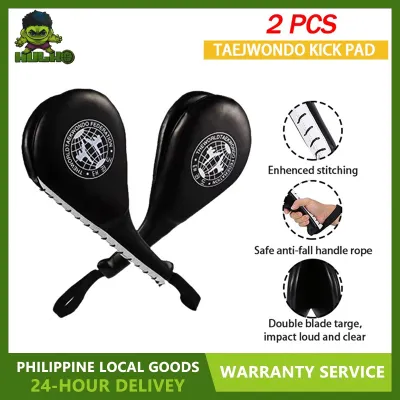
Prices are valid at publication and may change. Please refer to the product page for the latest price.
Inside these pads, manufacturers layer different densities of foam to absorb impact. A curved pad distributes the kinetic energy of an incoming roundhouse kick along the arc of the pad, which helps redirect the force away from the holder’s joints. This curved surface naturally cradles the shin upon impact, acting as a pocket that guides the strike to the center and reduces the likelihood of the shin slipping off the top or bottom edge.
The physical weight and profile of the pad also vary between these two designs. Curved pads often feature a more compact, tapered profile because the molded shape naturally hugs the forearm, reducing excess material at the top and bottom. Flat pads, by contrast, are typically uniform blocks of foam that can feel bulkier, though they offer a larger overall surface area for striking.
Conversely, flat surfaces provide a uniform, predictable target area for direct, linear strikes. Because there is no curve, a striker can land straight punches, elbows, and front push kicks without worrying about the angle of the pad surface deflecting the strike awkwardly. This makes flat pads highly predictable for straight-line combinations.
It is important to note that actual shock absorption and impact protection depend heavily on manufacturer specifications, foam density, and overall thickness. Buyers must verify these details on the product label or specification sheet before purchasing, as a poorly padded curved pad will still offer less protection than a high-density flat pad.
When to Use Curved Muay Thai Kick Pads
Curved Muay Thai kick pads are the traditional standard for a reason, highly optimized for repetitive roundhouse kick drills. The pre-curved design matches the natural curvature of the human shin, allowing for a flush connection that minimizes the risk of shin-on-edge contact. This makes them the go-to choice for traditional Muay Thai gyms where the roundhouse kick is the primary weapon.

For the pad holder, curved designs offer significant ergonomic relief. When catching heavy, angled kicks, the curved shape directs the force straight back into the holder’s forearms and body rather than twisting the wrists or forcing the elbows outward. This alignment is particularly beneficial during long, high-volume training sessions in warm, humid environments where fatigue sets in quickly.
In crowded training environments, such as busy urban gyms in Manila, the compact nature of curved pads is highly practical. Because the curved shape keeps the target closer to the holder’s body, it allows partners to run high-energy kicking drills in tighter spaces without accidentally colliding with neighboring training pairs.
However, curved pads have distinct limitations when it comes to linear strikes. Throwing a straight punch or a direct front kick against a curved surface can feel awkward and unstable. The curved edges can cause a straight punch to slip or roll, potentially straining the striker’s wrist or ankle if the strike does not land perfectly in the center of the arc.
Furthermore, holding curved pads requires the holder to maintain a specific angle to catch kicks properly. Because the pad is already curved, over-angling can result in the kick sliding off completely. Holders must learn to present the curved face perpendicular to the incoming shin’s trajectory to ensure safe impact absorption.
When to Use Flat Muay Thai Kick Pads
Flat Muay Thai kick pads shine when your training involves a diverse mix of linear and straight-line strikes. If your drills frequently feature front push kicks, straight punches, elbows, and knee strikes, the flat, uninterrupted surface provides a consistent and reliable target. Strikers can plant their foot or fist firmly on any part of the pad without encountering an angled edge.
This versatility makes flat pads highly popular in mixed martial arts (MMA) and general cross-training environments. In MMA, where fighters transition rapidly between boxing combinations, low kicks, and clinch work, a flat pad accommodates the wide variety of striking angles more easily than a highly specialized curved pad. It serves as a jack-of-all-trades training tool.
For instructors and coaches, flat pads serve as an excellent tool for teaching precise footwork and striking alignment. Because the flat surface does not offer a natural pocket to catch off-center kicks, it provides immediate tactile feedback to the striker. If a kick is thrown at an incorrect angle, the shin will visibly slide, prompting the student to correct their technique.
The primary trade-off with flat pads is the increased potential for shin slip-offs during heavy roundhouse kicks. Because the surface is completely flat, it does not naturally cradle the shin. If the pad holder does not actively angle and meet the kick to match the shin’s trajectory, the kick can easily slide upward or downward off the pad, risking injury to both partners.
Holding flat pads for heavy kickers also requires more active effort and wrist strength from the holder. To safely absorb a roundhouse kick, the holder must manually tilt the flat surface to create the necessary pocket, which can lead to faster forearm fatigue over the course of a long workout.
Curved vs Flat Kick Pads Comparison Matrix
To help you quickly evaluate which design fits your current training setup, the table below compares the key functional differences between curved and flat kick pads based on general design principles.
| Feature | Curved Kick Pads | Flat Kick Pads | Verification Needed |
|---|---|---|---|
| Primary Strike Suitability | Roundhouse kicks, angled knee strikes | Teeps, straight punches, elbows, linear kicks | Check manufacturer's recommended strike types |
| Holder Ergonomics | High forearm comfort, natural force redirection | Requires active wrist angling, higher forearm fatigue | Verify pad weight and handle thickness |
| Strike Catching Ease | Excellent; naturally cradles the shin | Moderate; requires precise holder positioning | Check surface dimensions and width |
| Versatility | Optimized for traditional Muay Thai | High; suitable for MMA and multi-discipline striking | Verify foam density and layering specs |
How to Choose the Right Shape for Your Training Needs
Selecting the right pad shape requires a clear assessment of your primary martial art focus, your training partners, and your physical environment.
Choose Curved if: Your primary focus is traditional Muay Thai, and your training consists heavily of high-volume roundhouse kicks, body kicks, and traditional pad-work flows. The ergonomic design will protect your holder’s arms and keep your shins safe during repetitive impact.
Choose Flat if: You train in a multi-discipline system like MMA, or if your style relies heavily on straight punches, front push kicks, and rapid transitions between upper and lower body strikes. The flat surface provides the uniform target area needed for these diverse techniques.
Verify first if: Before making any purchase, you must check the specific strap configurations, handle types, and overall pad weight. A heavy pad will quickly tire out a holder, regardless of its shape. Look for secure hook-and-loop straps or buckle systems that can withstand the high humidity and sweat typical of tropical training environments.
Additionally, verify the pad’s dimensions and thickness against the striker’s size, weight, and power level. A lightweight, thin pad will not provide adequate protection against a heavyweight striker, even if the shape is perfect. Always match the pad’s foam density to the force it is expected to absorb.
Maintenance and Safety Checks for Thai Pads
Proper maintenance is crucial, especially in hot and humid climates like the Philippines, where sweat can quickly degrade materials and harbor bacteria. After every training session, wipe down both synthetic and genuine leather surfaces with a damp cloth and a mild, non-abrasive cleaner. Avoid harsh chemical solvents that can dry out and crack the outer shell.
Allow the pads to air dry completely in a well-ventilated area away from direct sunlight, which can warp the internal foam and weaken the stitching. Never store damp pads in a closed gym bag, as this traps moisture and accelerates material breakdown.
Before every training session, perform a quick safety inspection. Check the straps, rivets, D-rings, and stitching for any signs of fraying or loosening. A sudden strap failure during a heavy kick can cause the pad to fly off, leading to severe injury.
If you notice deep, permanent foam compression where the pad bottoms out under light pressure, surface tearing that exposes the inner foam, or broken structural stitching, the pads must be retired immediately. Do not attempt temporary tape fixes for structural damage; consult a qualified professional or replace the equipment to ensure the safety of both training partners.
Frequently Asked Questions (FAQ)
Can beginners use curved kick pads for basic Muay Thai drills?
Yes, beginners can absolutely use curved kick pads. In fact, the curved design can be highly beneficial for novices because it is more forgiving of imperfect kick angles, naturally guiding the shin to the center of the pad. However, beginners should prioritize adequate pad thickness, manageable weight, and holder comfort over specific shape nuances. A pad that is too heavy or too thin will hinder learning more than the shape itself.
Do I need different pads for holding knee strikes?
No, you do not necessarily need different pads specifically for knee strikes. Standard Thai pads, whether curved or flat, are generally capable of absorbing knee strikes if they are sufficiently thick and dense. Before drilling heavy knees, always check the manufacturer’s specifications regarding foam density and structural integrity to protect the holder’s ribs and arms. If you feel the impact transferring directly through the pad to your body, stop the drill immediately and switch to a thicker, more protective pad.
Community discussion
Share your experience or ask a question. Comments are reviewed before publication.