
Selecting a tennis racket involves looking past cosmetic designs and understanding how technical specifications directly impact your performance on the court. Weight, balance, and string patterns are not just numbers on the frame; they dictate how much power you can generate, how easily you can swing, and how much shock your arm absorbs. In the tropical climate of the Philippines, where high humidity can make tennis balls feel heavy and damp, choosing the right specifications is essential to maintaining control and preventing physical fatigue during long matches.
Decoding Weight and Swingweight for Power and Stability
When evaluating a tennis racket, you must distinguish between static weight and swingweight. Static weight is the physical weight of the racket when it is resting on a scale. Manufacturers typically list the unstrung weight, which does not account for strings, overgrips, or dampeners. Once you add these essential components, the total strung weight of the racket will increase by approximately 15 to 20 grams.
Swingweight, on the other hand, measures how heavy the racket feels when you actually swing it through the air. This dynamic measurement is determined by how the mass is distributed along the frame. A racket with a high swingweight has more mass distributed toward the head, which provides excellent stability when blocking back fast, heavy incoming balls. However, this increased stability comes at the cost of maneuverability, requiring more physical effort to accelerate the frame.
Products mentioned in this guide

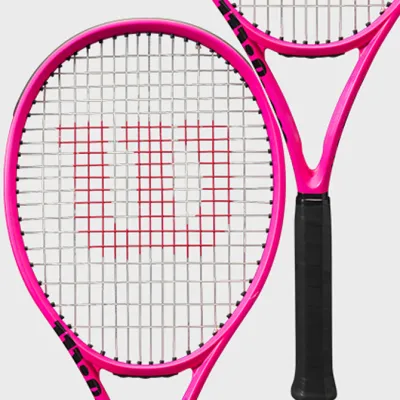
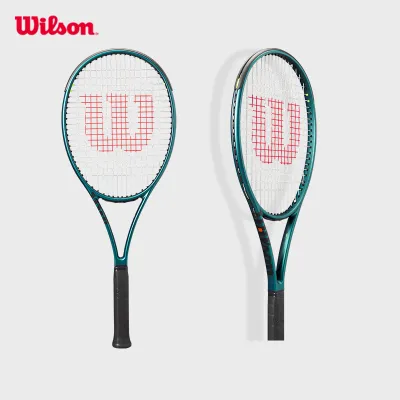
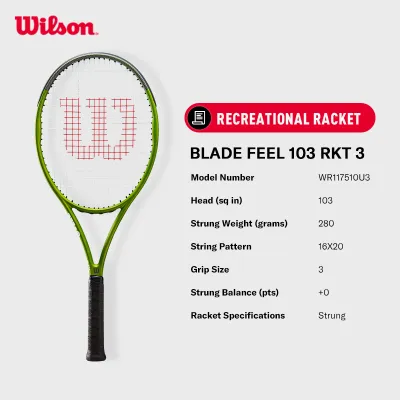
![[ONLINE EXCLUSIVE] WILSON Fusion Xl Tennis Recreational Racket](https://img.lazcdn.com/g/ff/kf/S9ee6dd6bb9284aca85cb86d0a03abb10H.jpg_400x400q80.jpg_.webp)
![[ONLINE EXCLUSIVE] WILSON Essence 2 Tennis Recreational Racket](https://img.lazcdn.com/g/ff/kf/S3fb2b7b17eae419d89f766515871136aT.jpg_400x400q80.jpg_.webp)
![[ONLINE EXCLUSIVE] WILSON Intrigue Recreational Tennis Racket](https://img.lazcdn.com/g/p/12e9c692f80b3485752571f77c6e0a26.jpg_400x400q80.jpg_.webp)

Prices are valid at publication and may change. Please refer to the product page for the latest price.
Choosing the right weight distribution is critical for physical conditioning and injury prevention. While a heavier frame can absorb more shock and protect your joints from impact, it requires sufficient muscular strength to swing consistently. If you play long sessions under the hot sun, a racket that is too heavy will quickly tire your forearm and shoulder, leading to poor swing mechanics and an increased risk of developing tennis elbow.
How Balance Points Affect Maneuverability and Comfort
A racket’s balance point determines how its weight is distributed between the head and the handle, directly influencing your swing mechanics and wrist comfort. Rackets are categorized into three main types: head-light, even-balanced, and head-heavy. Head-light rackets have more weight concentrated in the handle, making them feel nimble and easy to maneuver. Head-heavy rackets place more mass in the hoop to help players generate depth and power with less physical effort.

These balance profiles align closely with different playstyles. If you prefer fast-paced doubles play or frequently rush the net for quick volleys, a head-light racket allows for rapid reactions. Conversely, baseline players who rely on long, powerful groundstrokes often benefit from head-heavy or even-balanced frames, which help maintain momentum through the hitting zone.
You can easily check your racket’s unstrung balance point at home using a simple, non-destructive method. Place a thin cylinder, like a pen or a wooden dowel, on a flat table. Lay your unstrung racket horizontally across the cylinder, sliding it back and forth until it balances perfectly without tilting. Measure the distance from the bottom of the butt cap to this balance point. For a standard 27-inch racket, a balance point exactly at 13.5 inches (34.3 cm) indicates an even balance, while any measurement shorter than this is head-light.
Choosing a String Pattern for Spin and Control
The string pattern refers to the number of main (vertical) and cross (horizontal) strings on the racket face, which significantly alters ball bite and control. The two most common configurations are open patterns, such as 16×19, and dense patterns, such as 18×20.
An open string pattern has larger spaces between the strings, allowing them to deflect and snap back more during impact. This movement creates more ball bite, resulting in higher spin potential and a higher launch angle off the string bed. A dense string pattern, with its closely spaced strings, offers less string movement. This configuration provides a highly predictable, controlled ball flight, making it suitable for players with fast, flat swings who want to pinpoint their targets.
String gauge and tension also interact with your chosen pattern to alter the overall feel and durability of your setup. In humid environments, strings naturally lose tension more rapidly. If you use an open pattern, pairing it with a slightly thicker string gauge can help maintain tension stability and prevent premature breakage, ensuring your racket performs consistently during intense rallies.
Matching Racket Specs to Your Skill Level and Playstyle
Synthesizing weight, balance, and string pattern allows you to build a personalized selection profile based on your skill level. Beginners generally perform best with lighter frames (around 260g to 285g unstrung) that feature a larger head size and an even or head-heavy balance to assist with power. Intermediate players often transition to mid-weight frames (285g to 300g) with a slight head-light balance to develop their own swing speed and spin. Advanced players typically require heavier frames (over 300g) with a distinct head-light balance to maximize control and precision.
Before committing to a purchase, always demo rackets on a local court. Testing a frame in real playing conditions is the only way to verify how the specifications interact with your unique swing path, physical strength, and local court speed.
Be cautious of product descriptions on ecommerce platforms that rely on vague marketing terms while omitting specific technical details. If a listing fails to clearly state the static weight, balance point, and string pattern, it is likely a low-quality recreational frame. Investing ₱5,000 or more in a high-quality, properly specified performance racket is a better path to long-term game improvement and injury prevention.
Frequently Asked Questions (FAQ)
Does a heavier tennis racket always generate more power?
No, a heavier racket only generates more power if you can swing it at the same speed as a lighter one. If a racket’s mass exceeds your physical capability, your swing speed will decrease, resulting in shorter shots and increased muscle strain.
How do I know if my racket's balance is causing arm discomfort?
Persistent soreness in your wrist or elbow is a common sign of improper balance. A head-heavy racket can strain your wrist during late contact, while an excessively light, head-light racket may fail to absorb ball impact, transferring harmful vibrations directly into your arm joints.
Community discussion
Share your experience or ask a question. Comments are reviewed before publication.