
Choosing between disc cones and tall cones depends on the specific skills you want to develop, the age of your players, and the pitch conditions you encounter. While disc cones offer a low-profile, highly portable solution for rapid footwork and boundary marking, tall cones provide the vertical presence needed to simulate defenders and mark clear passing gates.
In the Philippines, where training environments range from muddy natural grass fields during the rainy season to hot artificial turf pitches in urban sports complexes, selecting the right marker affects both the flow of your drills and the longevity of your gear. Understanding how these two designs perform under tropical sun and sudden downpours ensures your training sessions remain efficient and uninterrupted.
Evaluating the physical differences of these markers helps you build an equipment kit that matches your coaching or personal development goals. By matching the right cone to your specific training environment, you can maximize player safety and drill efficiency.
Products mentioned in this guide
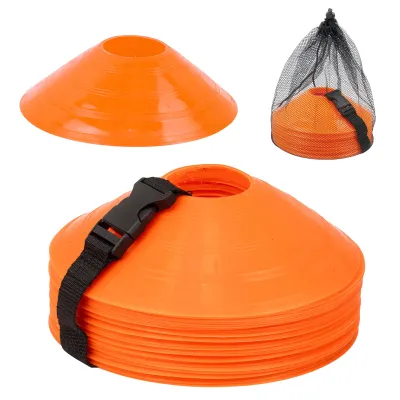
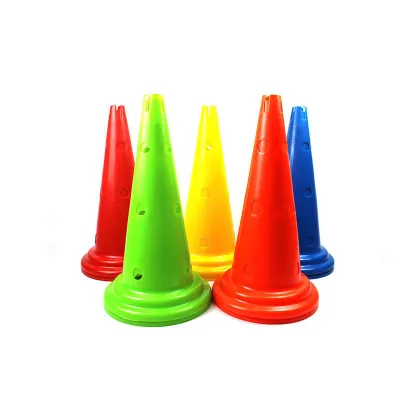
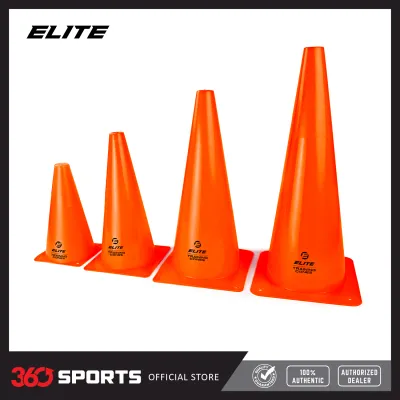
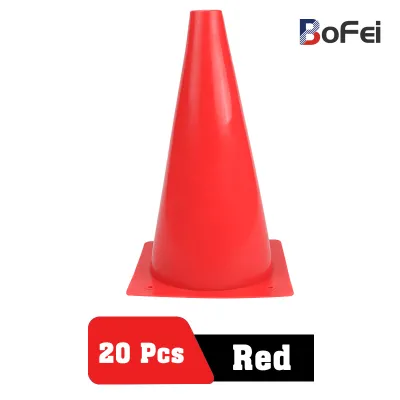
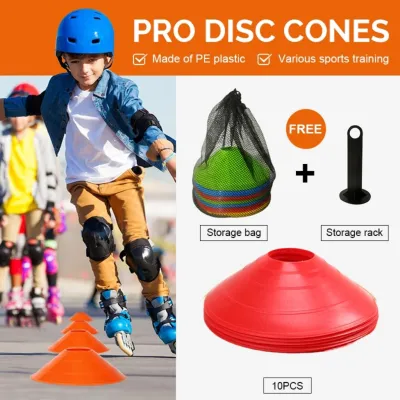
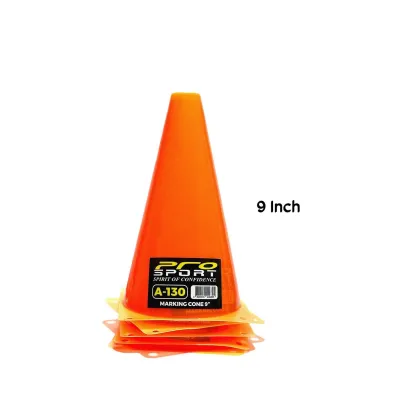
Prices are valid at publication and may change. Please refer to the product page for the latest price.
How Design and Visibility Impact Your Training Setup
The physical profile of a training cone dictates how players interact with it during high-intensity sessions. Disc cones feature a low-profile, dome-like shape with a wide, stable base that sits close to the ground. This design minimizes the risk of tripping, as players can step directly on or over them without losing their balance. In contrast, tall cones—often ranging from 9 to 12 inches or more—present a vertical, tapered structure with a narrower relative base. This upright stance makes them highly visible from a distance but also makes them easier to knock over if clipped by a stray boot or ball.
Visibility changes dramatically when a player is moving at high speeds. When sprinting or executing rapid changes of direction, a player relies heavily on peripheral vision to track markers while keeping their eyes up to scan the field for teammates or opponents. Tall cones excel in this scenario because their vertical height breaks the horizontal plane of the pitch, making them easy to spot without looking directly down. Disc cones, while excellent for close-up footwork, require players to look further downward to identify their exact position, which can sometimes encourage poor posture or limit situational awareness during fast-paced tactical drills.
Field conditions and weather play a massive role in how these markers behave on the pitch. On natural grass fields, especially those with uneven patches or thick tropical grass varieties, tall cones can struggle to stay upright if the ground is not perfectly level. Strong winds, common during the monsoon season, can easily tip tall cones over, disrupting the flow of your session. Disc cones, with their aerodynamic dome shape and low center of gravity, allow wind to pass over them easily, keeping them firmly in place on both natural grass and windy artificial turf pitches.
Matching Cone Types to Specific Football Drills
Disc cones are the standard for agility, speed, and coordination work. Because they sit flat against the turf, they are perfect for setting up tight agility ladders, rapid change-of-direction grids, and shuttle runs. If a player accidentally steps on a disc cone during a high-speed cutting maneuver, the flexible plastic simply collapses underfoot and pops back into shape, preventing ankle rolls or slips. They are also the ideal choice for marking boundaries, touchlines, and temporary penalty boxes, as they clearly define areas without obstructing low-flying passes or rolling balls.

Tall cones serve a completely different tactical purpose by acting as physical obstacles on the pitch. Their height makes them excellent for simulating defenders during dribbling sequences, forcing players to execute wider, more realistic body feints to clear the obstacle. They are also highly effective for setting up passing gates or shooting targets, as coaches can easily verify whether a pass went through the designated space. Additionally, tall cones can support training hurdles or crossbars when paired with slotted tops, adding a vertical jump dimension to your physical conditioning routines.
Let’s summarize how these two types compare across common training scenarios to help you plan your next session.
| Feature / Drill | Disc Cones | Tall Cones |
|---|---|---|
| Primary Drill Suitability | Agility grids, line marking, rapid footwork | Dribbling obstacles, passing gates, targets |
| Physical Profile | Low-profile dome (approx. 2 inches high) | Vertical tower (typically 9 to 12 inches high) |
| Player Safety | High; collapses safely when stepped on | Moderate; can cause trips if struck at speed |
| Wind Resistance | Excellent; aerodynamic shape resists tipping | Low to moderate; prone to blowing over in high winds |
| Visual Prominence | Requires downward gaze; low peripheral visibility | High vertical presence; easily spotted from a distance |
Evaluating Portability, Storage, and Field Conditions
Transporting your gear to and from the pitch is a major logistical consideration, especially for coaches managing multiple age groups or players traveling to community fields. Disc cones are incredibly space-efficient; dozens of them can be stacked tightly onto a single plastic or metal carrying strap, fitting easily into a standard backpack or small gear bag. Tall cones, even when nested together, occupy significantly more volume and can be awkward to carry without a dedicated, oversized duffel bag. If you rely on public transport or have limited storage space at home, the compact nature of disc cones is a massive advantage.
The tropical climate subjects training equipment to intense UV exposure and high humidity, which can rapidly degrade cheap plastics. When selecting cones, look for flexible, high-density polyethylene or vinyl compounds that resist cracking under the sun. Disc cones are often stepped on directly, meaning they must possess excellent shape memory to bounce back after impact. Tall cones, while less likely to be trodden on directly, are prone to cracking around their base or top peak if struck repeatedly by hard-driven footballs or heavy cleats during wet-weather sessions.
Before laying out your grid, observe the color and condition of your training surface. On lush, green natural grass, bright orange, yellow, or pink disc cones stand out clearly, but they can easily get lost in taller, un-mowed grass patches. Tall cones elevate the color marker above the grass line, ensuring players can see the boundaries even on poorly maintained community pitches. On artificial turf, which can heat up significantly under the midday sun, ensure your cones are made of heat-resistant materials that will not soften or stick to the synthetic fibers.
Final Decision Framework: Building Your Equipment Kit
Choose disc cones if your training sessions focus heavily on speed, agility, and quick footwork, or if you need to mark out large, multi-zoned pitches for small-sided games. They are also the best choice for younger players who are still developing their coordination, as the flat design minimizes the risk of tripping and injury. If you have limited storage space or need to transport your equipment long distances on a daily basis, a bulk pack of fifty disc cones with a carrying strap offers the best balance of utility and convenience.
Choose tall cones if your curriculum emphasizes tactical positioning, spatial awareness, and realistic dribbling drills where players must navigate around physical obstacles. They are highly beneficial for shooting drills, goalkeeper training, and setting up clear visual gates for passing exercises. If you frequently train on uneven natural grass or in windy coastal areas, look for weighted-base tall cones or those with wide, slotted designs that allow wind to pass through, reducing the frequency of tipped markers.
Verify first if your local league, school athletic association, or training facility has specific rules regarding equipment usage. Some indoor sports complexes or premium artificial turf pitches restrict the use of weighted tall cones that feature hard rubber bases, as they can scuff or damage the synthetic surface. Additionally, check your coaching curriculum requirements; certain certification courses prescribe specific cone colors and sizes to standardize drill setups, so purchasing a mixed-color set of both types is often the most versatile approach for professional coaches.
When budgeting for your gear—with typical quality sets ranging from ₱400 for basic disc packs to ₱1,500 or more for comprehensive multi-type kits—consider starting with a hybrid setup. A combination of forty disc cones for line marking and ten tall cones for targets and obstacles provides the ultimate flexibility for any football training session.
Frequently Asked Questions (FAQ)
Can I use disc cones for dribbling drills?
Yes, you can use disc cones for basic dribbling drills, but they require a different level of focus from the player. Because disc cones sit low to the ground, they do not force the player to lift their knees or execute wide body shifts to clear them, which can sometimes lead to lazy dribbling habits. They work well for tight, rapid touch drills where the focus is on quick footwork. However, for realistic defender simulation or wide-angle slalom dribbling, switching to tall cones is highly recommended to encourage proper body mechanics.
How do I clean and maintain plastic training cones?
To extend the lifespan of your training cones, wash them regularly with mild dish soap and lukewarm water to remove mud, grass stains, and sweat. Avoid using harsh chemical solvents or abrasive brushes, as these can degrade the plastic and fade the high-visibility colors. After washing, allow them to air dry completely in a shaded area before stacking them. Store your cones in a cool, dry place away from direct sunlight when not in use, as prolonged UV exposure will make the plastic brittle and prone to cracking.
How do I determine the right spacing for agility cones?
Agility cone spacing should be scaled based on the age, skill level, and specific physical attributes you are training. For youth players or tight footwork drills focusing on rapid deceleration and change of direction, space your disc cones approximately 1 to 2 yards apart. For older players, high-speed acceleration, or curved running drills, increase the spacing to 3 to 5 yards. Always run through the drill yourself at a moderate pace first to verify that the distances allow for natural running strides and safe turning angles.
Community discussion
Share your experience or ask a question. Comments are reviewed before publication.