
Selecting the right fitness tool depends on your movement goals, physical conditioning, and workout structure. If your primary focus is deep core stabilization, pelvic floor activation, and maintaining precise alignment during traditional mat Pilates, the Pilates ring is your ideal companion. Conversely, if you want to build full-body muscular strength, perform dynamic multi-joint exercises, or engage in versatile stretching routines, the resistance band offers the multi-directional tension you need.
In the Philippines, where home workouts and boutique studio sessions are highly popular, the Domyos Decathlon line provides accessible, budget-friendly options for both tools. While they are priced within a highly affordable range—typically under ₱1,000—they serve fundamentally different biomechanical purposes. Many practitioners eventually integrate both into their routines to create a balanced setup that addresses both structural alignment and progressive resistance training.
The Core Difference: How Each Tool Creates Resistance
To make an informed choice, you must understand the mechanical behavior of these two tools. The Pilates ring, historically known as the “Magic Circle,” is a rigid yet flexible circular hoop. It is typically constructed from a spring steel or fiberglass core encased in a protective rubber or thermoplastic elastomer (TPE) coating. Double-sided padded handles allow you to grip it with your hands or place it between your knees, ankles, or thighs. The resistance it provides is localized and bi-directional: you exert force by squeezing the ring inward (concentric contraction) or resisting its outward expansion as it returns to its natural shape (eccentric control). Because the ring has a fixed physical structure, the range of motion is limited by the hoop’s diameter, focusing your efforts on isometric holds and controlled, small-range pulses.
Products mentioned in this guide
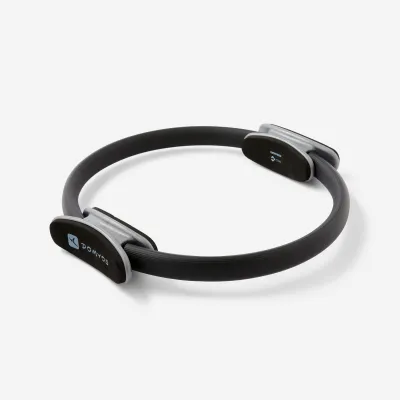
Prices are valid at publication and may change. Please refer to the product page for the latest price.
A resistance band operates on a linear elastic mechanism. Made from latex or woven fabric integrated with elastic threads, bands provide progressive resistance—meaning the tension increases the further you stretch the material. This continuous tension mimics the feel of cable machines or free weights, requiring constant muscular engagement throughout the entire range of motion. Unlike the ring, a band has no fixed shape; it conforms to your body, can be wrapped around feet, or anchored to external structures like doors or posts.
Decathlon’s Domyos line designs these products with the everyday enthusiast in mind. Rather than focusing on clinical-grade specifications, Domyos prioritizes durable, slip-resistant materials, comfortable foam pads, and clear resistance labeling, ensuring the equipment remains stable under pressure.
Key Comparison Dimensions for Your Practice
Resistance Type and Muscle Targeting
The biomechanical differences between the Pilates ring and the resistance band dictate which muscle groups they target most effectively. The Pilates ring is unmatched when it comes to deep, internal muscle activation. Because it relies heavily on isometric pressure, it forces you to engage the pelvic floor and the deep transversus abdominis—the corset-like muscle wrapping around your midsection. When you place the ring between your inner thighs (adductors) during a bridge exercise, the tactile feedback is immediate. If your engagement slips, the ring loses its shape or falls. This makes it an exceptional tool for isolating the adductors, glutes, and lower abdominals, as well as the chest and upper back during standing or seated arm squeezes.

In contrast, the resistance band excels at dynamic, multi-joint movements that target larger, superficial muscle groups. Because a band can be stretched across long distances, it is highly effective for working the latissimus dorsi (back), pectorals (chest), quadriceps, and hamstrings. For example, standing on a Domyos resistance band and performing bicep curls or overhead presses engages your muscles through a full, natural range of motion. It also allows for rotational core work, such as woodchops, which are difficult to replicate with a rigid ring.
Furthermore, the planes of motion differ significantly. The Pilates ring restricts your movement to specific, linear planes dictated by the squeeze-and-release path. The resistance band, however, offers 360-degree freedom. By altering your anchor point—whether it is under your feet, around a sturdy pillar, or high up on a closed door—you can pull, push, or rotate in any direction, making it a superior tool for functional, real-world movement patterns.
Versatility and Exercise Range
When evaluating versatility, the resistance band is arguably one of the most adaptable pieces of fitness equipment ever created. A single band can be modified to target almost every muscle in the body. By simply shortening your grip, folding the band in half, or looping it around a secure anchor, you can instantly increase the resistance. It can simulate heavy gym machinery, allowing you to perform rows, lat pulldowns, chest flies, and leg presses in a small living room. For those who travel frequently across the Philippines—whether for work or weekend trips to coastal provinces—the resistance band is incredibly practical. It folds down to the size of a small notebook, weighs next to nothing, and can be tossed into any backpack or suitcase without adding bulk.
The Pilates ring, while highly effective, is a highly specialized tool. Its exercise repertoire is more structured, revolving primarily around classical Pilates mat sequences. While you can use it for upper-body exercises like chest presses or overhead tricep extensions, its primary value lies in refining your posture, checking your alignment, and adding targeted resistance to core work. It does not easily adapt to heavy compound pulling movements like deadlifts or rows.
Portability is another point of comparison. While the Domyos Pilates ring is lightweight and easy to carry to a local studio, its rigid, circular shape cannot be folded. It requires flat storage space and can be awkward to pack in smaller bags. If your workout routine demands a wide variety of exercises with a single tool, the band holds a clear advantage; if your routine is centered on mastering the nuances of Pilates mat work, the ring’s specialized design is irreplaceable.
Learning Curve and Form Control
For beginners, the learning curve and the quality of form feedback are critical safety and effectiveness considerations. The Pilates ring offers exceptional proprioceptive feedback—the body’s ability to sense its position and movement in space. The physical presence of the ring, combined with its padded handles, provides an immediate tactile cue. When you squeeze the ring, you instantly feel which muscles are firing and whether your body is symmetrical. This immediate feedback helps prevent common compensation patterns, such as shrugging the shoulders or tilting the pelvis, making it highly accessible for beginners who are still developing mind-muscle connection.
The resistance band, conversely, presents a steeper learning curve that requires greater joint stability and motor control. Because the band’s resistance is progressive, the tension is lightest at the start of the movement and heaviest at the peak of the stretch. This variable tension can cause the band to snap back quickly if you do not actively control the eccentric (lowering) phase. Without proper joint stabilization, beginners may experience joint shearing or jerky movements, particularly in the shoulders or knees. There is also the physical risk of the band slipping off a foot or anchor point if not secured correctly.
To practice safely, beginners should first master basic bodyweight movements and establish joint stability before introducing high-tension resistance bands. The Pilates ring, due to its predictable, self-contained structure, can be integrated into your practice immediately to assist with alignment and help you identify muscle imbalances safely.
Quick Comparison: Pilates Ring vs Resistance Band
To help you decide quickly, this side-by-side comparison outlines the key practical differences between these two Domyos tools:
| Feature | Pilates Ring | Resistance Band |
|---|---|---|
| Primary Resistance Direction | Inward squeeze & outward press (isometric focus) | Linear pull (progressive tension) |
| Best Target Areas | Inner/outer thighs, pelvic floor, deep core, chest | Lats, shoulders, glutes, quads, full-body |
| Anchor Point Required | No (self-contained) | Yes (often uses feet, doors, or poles) |
| Ideal User Level | All levels (excellent for alignment feedback) | Intermediate to advanced (requires joint control) |
| Portability | Lightweight but rigid (does not fold) | Extremely high (folds flat, ultra-light) |
| Typical Domyos Use Case | Mat Pilates alignment, pelvic floor conditioning | Strength training, progressive stretching, mobility |
Before making your purchase, remember to check the specific resistance level on the Domyos product packaging. Domyos resistance bands are color-coded or clearly marked by tension weight (such as 15kg, 25kg, or 35kg), allowing you to scale your workouts as you grow stronger. In contrast, the Domyos Pilates ring typically features a standard, single resistance level designed to accommodate a broad range of core and lower-body exercises.
The Decision Framework: Choose Based on Your Routine
To finalize your decision, analyze your current fitness routine, your physical environment, and your long-term wellness objectives.
Choose the Domyos Pilates Ring if:
- Your primary fitness practice centers on classical or contemporary mat Pilates.
- You want to target hard-to-reach areas like the adductors (inner thighs) and pelvic floor muscles.
- You struggle with body awareness and require immediate physical feedback to maintain proper pelvic and spinal alignment.
- Your workouts are conducted primarily on a yoga mat at home or in a dedicated studio space where flat storage is available.
Choose the Domyos Resistance Band if:
- You want a highly versatile strength-training tool that can replicate dumbbell or cable machine exercises.
- You require an adjustable tool for dynamic stretching, mobility routines, or joint rehabilitation exercises.
- You focus on building upper-body pulling strength (such as rows and lat pulldowns) which a ring cannot accommodate.
- You travel frequently or have limited living space, requiring equipment that can be packed away in a small drawer or travel bag.
Use Both if:
- You want to build a comprehensive, low-impact home gym. The two tools complement each other perfectly: you can use the resistance band to perform larger compound movements and dynamic warm-ups, then transition to the Pilates ring for targeted core finishers, pelvic stability work, and final alignment checks.
Verify First if:
- You are recovering from a recent joint injury, surgery, or suffer from chronic conditions like arthritis. While elastic resistance is widely used in physical therapy, the progressive tension curve of a band can place sudden stress on healing tendons or joint capsules if not controlled. Always consult a licensed physical therapist or sports medicine professional to receive a customized exercise prescription before introducing elastic tension to compromised joints.
Safety Checks and Maintenance for Longevity
Proper maintenance is essential to ensure your workout remains safe and your equipment lasts for years, particularly under the environmental conditions of the Philippines.
Pre-Workout Inspection: Before every session, take a moment to inspect your equipment. For resistance bands, stretch the material slightly under a bright light to check for micro-tears, small punctures, white stress marks, or areas where the rubber has become thin or brittle. A compromised band can snap violently during use, potentially causing facial or eye injuries. For the Pilates ring, inspect the outer rubber or TPE coating for peeling or cracking. Ensure the inner fiberglass or spring steel core is completely covered and has not sustained any structural cracks, which could cause the ring to collapse suddenly under pressure.
Environmental Limits: The tropical climate of the Philippines—characterized by high humidity and intense heat—can accelerate the degradation of fitness equipment. Never leave your resistance bands or Pilates ring in direct sunlight, on outdoor balconies, or inside a parked car where temperatures can soar. Prolonged exposure to heat and UV radiation dries out natural rubber and synthetic elastomers, making them brittle and highly prone to snapping. Always store your gear in a cool, dry, indoor environment away from direct heat sources.
Cleaning Guidelines: Sweat, body oils, and humidity can degrade the padded foam handles of your ring and the surface of your bands over time. After each workout, wipe down the equipment with a soft cloth dampened with clean water and a small drop of mild, non-abrasive dish soap. Avoid using harsh chemical cleaners, alcohol-based sanitizers, or bleach, as these solvents break down the structural integrity of rubber, latex, and foam. Allow the equipment to air dry completely in a shaded, well-ventilated indoor area before storing.
Frequently Asked Questions (FAQ)
Can I use a Pilates ring and resistance band together?
Yes, combining both tools is an excellent way to increase the intensity of your workouts. For example, you can loop a light resistance band around your thighs to engage your glutes and outer hips while holding the Pilates ring between your hands to activate your chest and deep core during a shoulder bridge. When layering these tools, always ensure the band is securely positioned and does not rub against the ring’s padded handles, which could cause the band to slip or wear down prematurely.
Are Domyos tools suitable for advanced Pilates practitioners?
Domyos tools are exceptionally well-suited for beginner to intermediate practitioners, offering durable construction at an accessible price point. However, advanced practitioners who require extremely high tension or highly specialized, studio-grade feedback might eventually outgrow standard retail gear. If you are an advanced athlete, check the specific resistance ratings on the Domyos packaging before purchasing to ensure the tension aligns with your training demands, or consider layering multiple bands to increase the resistance.
Community discussion
Share your experience or ask a question. Comments are reviewed before publication.