
Quick Answer: Which Boxing Pad Fits Your Training Style?
To choose the right training targets, you must match the gear to your specific striking discipline, power output, and the physical limits of your training partner. Focus mitts are built for speed and precision; curved mitts prioritize power absorption and holder comfort; and Thai pads offer maximum versatility for full-body strikes like kicks, knees, and elbows. Choosing the wrong target can not only hinder your technical development but also lead to severe joint strain or acute injuries for both the striker and the pad holder.
If you are focusing strictly on classic Western boxing, rapid hand combinations, and head movement, traditional flat focus mitts are your best choice. If your training involves heavy power punches, hooks, and overhands—or if your pad holder suffers from joint fatigue—ergonomic curved mitts (often categorized under high-quality boxing mits) provide the necessary shock absorption. If you practice Muay Thai, kickboxing, or Mixed Martial Arts (MMA) where lower-body strikes are integrated, rugged Thai pads are indispensable.
The “best” pad is never a single universal option. It is defined by a balance of the striker’s goals, the holder’s safety, and the environmental demands of your training space. This is especially true when working out in humid tropical climates, where gear maintenance, grip stability, and sweat resistance become daily challenges.
Products mentioned in this guide
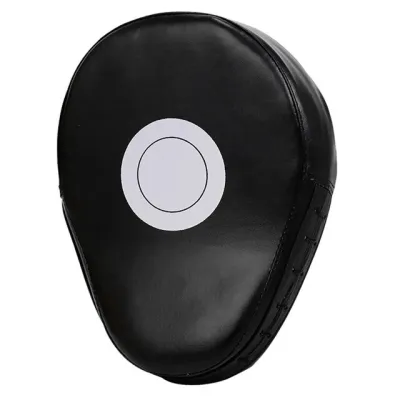
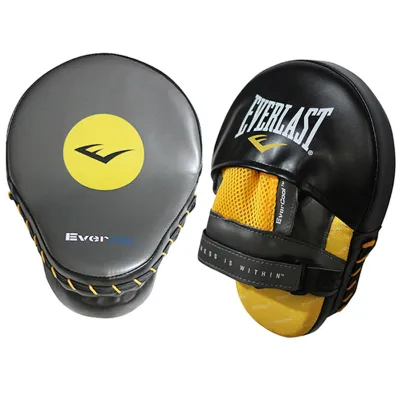
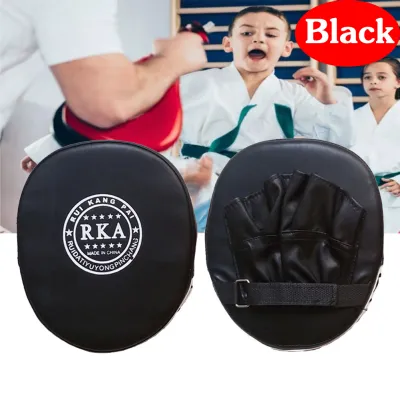
Prices are valid at publication and may change. Please refer to the product page for the latest price.
Focus Mitts: Precision, Speed, and Technical Refinement
Traditional flat focus mitts feature a flat, relatively thin profile with lightweight foam padding. They are designed to act as an extension of the trainer’s hands, allowing for rapid movement and minimal wind resistance. Because they lack bulky edges or heavy contouring, a skilled pad holder can flip, rotate, and reposition them in fractions of a second to simulate an opponent’s guard. The backing typically consists of a simple glove compartment or finger loops, keeping the overall weight of the target exceptionally low.

These targets are the gold standard for developing hand speed, timing, accuracy, and defensive reflexes. When training with flat mitts, the focus is not on throwing with 100% power, but on landing clean, centered strikes. Trainers use them to teach complex combinations, slipping, rolling, parrying, and counter-striking. The flat surface provides immediate auditory feedback—a sharp, satisfying “pop” when a punch lands perfectly in the sweet spot with correct alignment. This sound helps strikers gauge their impact quality without relying solely on visual cues.
Because traditional flat mitts are thin, they offer minimal shock absorption. When a heavy puncher hits a flat mitt, a significant portion of the kinetic energy transfers directly into the holder’s fingers, wrists, elbows, and shoulders. Holding these targets requires advanced “feeding” technique—the holder must slightly meet the punch upon impact to “catch” the blow and prevent their own hand from being blown backward. Without proper wrist stability and timing, holding flat mitts for heavy hitters can quickly lead to hyperextended joints or chronic strain.
Flat focus mitts are ideal for pure boxers, speed-focused martial artists, and coaches working on high-speed flow drills. If your training sessions prioritize rapid-fire combinations, head movement, and footwork over raw power testing, these lightweight tools are the perfect fit. They allow the holder to stay highly mobile, dancing around the ring to simulate a realistic, fast-moving opponent.
Curved Mitts: Power Absorption and Ergonomic Protection
Curved mitts, a highly popular evolution of traditional boxing mits, feature a distinct concave catching surface paired with significantly thicker, multi-layered high-density foam padding. The ergonomic curve is engineered to mimic the natural cupping shape of a human hand. Many models feature built-in palm domes (a small ball inside the glove compartment), padded wrist wedges, and secure finger hoods that protect the holder’s hands from stray punches. This design ensures that the hand remains in a natural, stress-free gripping position throughout the workout.
The primary function of curved mitts is to absorb heavy, high-impact punches while keeping the striker’s wrists safe. The concave shape naturally guides punches toward the center of the pad, drastically reducing the risk of a punch slipping off the edge and causing wrist rolls for either the striker or the holder. This makes them highly effective for practicing looping hooks, devastating uppercuts, and heavy overhand rights where maximum force is applied. Strikers can let their hands go with full power, knowing the target will catch and contain the force safely.
For coaches and training partners, curved mitts are a massive upgrade in joint protection. The thick padding and ergonomic palm domes disperse the shock of heavy blows across the entire hand and forearm rather than concentrating it on the wrist joint. This design reduces the physical toll on the holder, making it possible to run long, intense training sessions or hold pads for multiple heavy-hitting partners without experiencing joint fatigue, shoulder pain, or elbow tendonitis. The curved shape also requires less active “feeding” from the holder, as the pad naturally cups the incoming glove.
These are the ultimate utility targets for boxing coaches, personal trainers, and fitness enthusiasts who want a balance of speed and heavy impact protection. If you frequently train with power punchers or want to protect your joints during daily workouts, curved mitts are the most practical investment. They offer enough speed for technical combinations while providing the heavy-duty defense needed for power-focused training.
Thai Pads: Maximum Versatility for Kicks and Heavy Strikes
Thai pads are large, thick, rectangular targets designed to be strapped securely to the holder’s forearms. They typically feature a heavy-duty top handle for the hand and one or two adjustable hook-and-loop straps to lock the pad against the forearm. Built with multiple layers of dense, impact-resistant foam and covered in thick leather or high-grade synthetic materials, they are built to withstand extreme mechanical stress. Their flat or slightly curved rectangular face provides a massive target area compared to hand-held mitts.
Thai pads are engineered specifically to absorb the massive kinetic energy generated by lower-body strikes, including roundhouse kicks, teeps (push kicks), knees, and elbows. Their long, rectangular shape covers the entire forearm of the holder, providing a protective shield against heavy impacts. While you can throw punches at Thai pads, their sheer weight and bulk make them slow and cumbersome for fast, intricate boxing defense drills or rapid head-movement sequences. They are designed for heavy, devastating single strikes and powerful, rhythmic combinations.
Holding Thai pads is a physically demanding skill that requires proper body mechanics. The holder cannot simply hold their arms out; they must brace their core, step into the kicks, and use their entire body weight to absorb the impact. In professional Muay Thai and MMA gyms, trainers often pair Thai pads with a heavy-duty belly pad. This combination allows the striker to transition seamlessly from kicks and punches to knees and front kicks to the midsection without requiring the holder to constantly reposition the arm pads.
Thai pads are an absolute necessity for anyone practicing Muay Thai, kickboxing, or MMA. They are the only targets among the three that can safely handle repetitive, full-power kicks without putting the holder at immediate risk of severe arm, rib, or shoulder injuries. If your training regimen involves anything below the waist, Thai pads must be your primary training target.
Feature Comparison: Focus Mitts vs. Curved Mitts vs. Thai Pads
Every pad design involves a fundamental trade-off between mobility and protection. Understanding these differences helps you avoid buying gear that does not align with your training goals.
| Feature | Focus Mitts | Curved Mitts | Thai Pads |
|---|---|---|---|
| Primary Discipline | Western Boxing | Boxing & Kickboxing | Muay Thai, Kickboxing, MMA |
| Target Strikes | Jabs, straight crosses, light hooks | Heavy hooks, uppercuts, power crosses | Kicks, knees, elbows, heavy punches |
| Speed & Mobility | Exceptionally High | High to Moderate | Low (Heavy and bulky) |
| Holder Protection | Low (Requires active feeding) | High (Ergonomic joint relief) | Maximum (Engineered for kicks) |
| Weight Range | Ultra-lightweight (~150g – 300g per pad) | Lightweight to Medium (~250g – 450g per pad) | Heavy (~800g – 1.5kg+ per pad) |
| Typical Price Band | ₱1,500 – ₱4,000 | ₱2,000 – ₱5,500 | ₱3,500 – ₱8,500+ |
If you choose the ultra-lightweight focus mitt, you gain unparalleled speed and the ability to simulate realistic, high-tempo boxing exchanges, but you completely sacrifice the ability to train kicks or absorb maximum-power hooks safely. Conversely, choosing Thai pads gives you the ultimate shield for full-body striking, but the physical weight of the pads will quickly tire out the holder’s shoulders if they try to mimic fast, multi-directional boxing slips and parries. Curved mitts sit comfortably in the middle, offering a highly functional compromise for hand-striking disciplines.
When selecting your gear, pay close attention to the cover materials and construction. Genuine leather offers the highest durability and a classic feel, but it requires regular conditioning and can absorb moisture if not cared for properly. High-grade synthetic leathers (such as microfiber or engineered polyurethane) are highly resistant to sweat, making them an excellent choice for hot, humid environments like open-air gyms in the Philippines.
To prevent bacterial growth and foul odors, always wipe your pads down with a damp cloth and mild disinfectant after every session, and allow them to air-dry completely in a well-ventilated, shaded area. Never leave damp pads sealed inside a gym bag, as the trapped humidity will rapidly degrade the foam and stitching, leading to premature splitting and structural failure.
Final Decision Guide: How to Choose Your Target Gear
To make your final purchase decision, evaluate your primary training goals and match them against the following conditional framework:
- Choose Focus Mitts if: Your primary training goal is to refine hand speed, develop sharp defensive reflexes (slips, rolls, parries), and practice complex, fast-paced boxing combinations where accuracy is valued over raw power.
- Choose Curved Mitts if: You want a versatile hand-striking target that allows you to throw heavy hooks, uppercuts, and power punches with full force, while ensuring your training partner's wrists and shoulders are protected from chronic joint strain.
- Choose Thai Pads if: You practice Muay Thai, kickboxing, or MMA, and your training routines require you to integrate roundhouse kicks, knees, elbows, and low kicks alongside your punches.
Before purchasing your own targets, always consult with your head coach or gym instructors. Many gyms have specific preferences or safety standards regarding the weight, brand, or style of pads allowed on their mats. Furthermore, remember that no piece of equipment can compensate for poor holding technique. A pad holder must always maintain structural alignment, keep their wrists straight, and brace their core upon impact to prevent acute or chronic injuries, regardless of how thick the padding is.
Strikers must also take responsibility for their own safety. Even when hitting thick, shock-absorbing targets, you must always wear properly fitted hand wraps and boxing gloves (typically 12 oz to 16 oz for pad work) to support your wrist joints and protect your knuckles from impact injuries or skin abrasions. Never hit pads bare-knuckle, as the friction and impact can easily cause skin tears and bone bruising.
Frequently Asked Questions (FAQ)
Can I use Thai pads for pure boxing training?
While it is physically possible to punch Thai pads, it is not recommended for pure boxing. Their excessive bulk, weight, and rigid structure limit the holder’s ability to feed fast combinations, simulate realistic punch angles, or practice defensive slips and rolls effectively. Using them exclusively for boxing will quickly fatigue the holder’s shoulders and lead to stiff, unrealistic striking rhythms for the boxer.
Do I need to wear gloves when hitting focus mitts?
Yes, strikers must always wear hand wraps and appropriately sized boxing gloves when hitting focus mitts. The thin padding of focus mitts provides minimal shock absorption, and striking them bare-knuckle or with only wraps significantly increases the risk of hand, wrist, and knuckle injuries. Wearing gloves also protects the pad face from premature wear caused by sweat and friction.
How do I know if the pad holder is experiencing joint strain?
Observable signals of joint strain include the holder shaking out their arms between rounds, adjusting their grip frequently, or failing to maintain a solid brace upon impact (allowing the pads to fly back toward their own face). If these signs appear, the session should pause immediately. The striker should either reduce their power output, or the pair should switch to a more shock-absorbent target like a curved mitt.
Community discussion
Share your experience or ask a question. Comments are reviewed before publication.