
Quick Answer: Focus Mitts or Thai Pads?
Choosing between focus mitts and Thai pads depends on your primary martial arts discipline and your specific training goals. Focus mitts are lightweight, compact, and designed specifically for hand strikes, making them the ideal choice for boxing, hand speed, and rapid defensive movement. Thai pads are thick, heavy, forearm-mounted shields engineered to absorb high-impact kicks, knees, and elbow strikes, making them indispensable for Muay Thai, kickboxing, and full-body mixed martial arts (MMA) training.
If your training centers on traditional boxing, head movement, and fast punching combinations, focus mitts are the correct investment. If your routines require you to catch heavy roundhouse kicks, knees in the clinch, or low kicks, you must choose Thai pads to ensure the safety of both the striker and the pad holder.
Design and Striking Surface: How They Differ
To understand why these two types of training equipment cannot be easily substituted, you must examine their physical construction and how they disperse impact energy. Focus mitts feature a small, circular or teardrop-shaped striking surface that is roughly the size of an open hand. Most modern focus mitts are ergonomically curved to match the natural cup of the holder’s palm. This curvature helps catch punches securely, preventing the glove from slipping off the edge and reducing wrist strain for the holder. The padding inside focus mitts is typically composed of lightweight, multi-layered foam or gel inserts designed to disperse the shock of fist strikes without adding unnecessary weight. The back of the mitt features a glove pocket, often with an open-finger design or a protective mesh hood, allowing the holder to slip their hand in quickly and maintain high hand dexterity.
Products mentioned in this guide
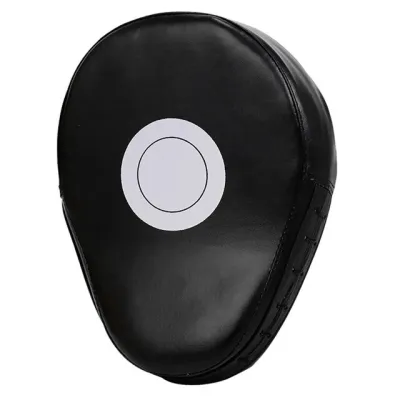
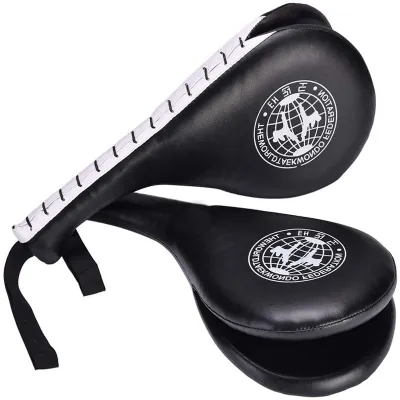
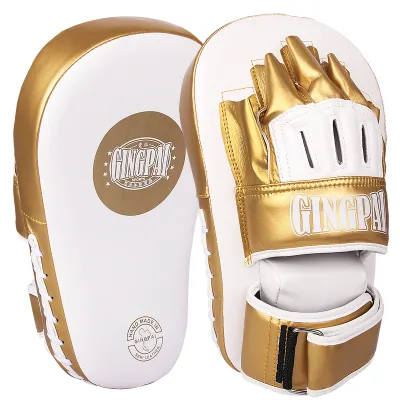
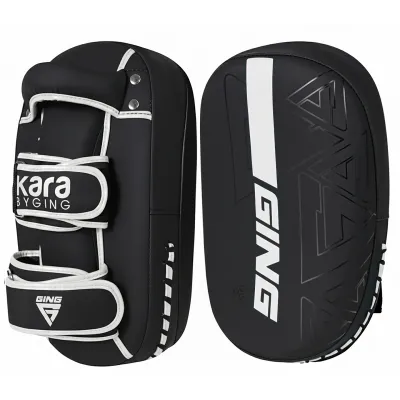
Prices are valid at publication and may change. Please refer to the product page for the latest price.

In contrast, Thai pads are large, rectangular, and substantially thicker. They are designed to be worn on the forearms rather than just held in the hands. A standard Thai pad features a heavy-duty handle at the top for the holder’s hand, paired with one or two wide hook-and-loop straps that wrap securely around the forearm. The padding is exceptionally dense, often consisting of multiple layers of compressed EVA foam and high-density sponge. This dense construction is necessary because a kick from a trained martial artist carries significantly more kinetic energy than a punch. The flat, elongated surface of a Thai pad provides a large target zone that can safely accommodate the entire length of a striker’s shin during a roundhouse kick.
The material composition also plays a massive role in how these pads handle impact over time. Genuine leather and high-grade microfibers are preferred for both types of pads because they stretch slightly under impact, helping to distribute the force while resisting the tearing forces of high-velocity strikes. Cheap synthetic alternatives tend to stiffen, which transfers more shock directly to the holder’s joints and leads to premature cracking along the seams.
The difference in surface area also dictates how these pads are used in practice. The small target of a focus mitt demands high accuracy; if a striker misses by even a few inches, they risk hitting the holder’s wrist or missing the pad entirely. This makes focus mitts excellent for developing hand-eye coordination. Thai pads, with their generous surface area, allow the striker to throw full-power kicks with a lower risk of missing the target. However, this larger size comes with a weight penalty, making Thai pads much slower to maneuver during fast-paced, multi-angle striking drills.
Matching the Pad to Your Martial Art
Aligning your training gear with your specific combat discipline ensures that you develop the correct muscle memory and avoid unnecessary injuries.
Focus Mitts: Precision and Speed for Boxing and MMA
In traditional boxing and the hand-striking portions of MMA, focus mitts are the industry standard. The primary value of focus mitts lies in their ability to simulate the speed and unpredictability of a real opponent’s head. Because the mitts are lightweight, a trainer can move them rapidly, changing angles, heights, and distances in a split second. This allows you to practice complex boxing combinations, such as a jab-cross-hook-weave-counter, with realistic timing and flow.
Furthermore, focus mitts are essential for developing defensive reflexes. A skilled pad holder does not just stand still and receive punches; they actively throw light counter-punches back at the striker. The small, soft profile of a focus mitt allows the holder to tap the boxer on the side of the head or shoulder, prompting them to slip, duck, roll, or parry. This constant back-and-forth flow builds the muscle memory required to transition seamlessly between offense and defense.
For MMA fighters, focus mitts offer a way to train dirty boxing and pocket exchanges. Because MMA gloves are much smaller and lighter than traditional boxing gloves, precision is paramount, and focus mitts help athletes refine their hand placement and distance management without the bulk of larger pads.
Thai Pads: Power and Versatility for Muay Thai and Kickboxing
When your training transitions to disciplines that utilize the lower body, such as Muay Thai, kickboxing, or Taekwondo, Thai pads become an absolute necessity. The “Art of Eight Limbs” relies heavily on powerful roundhouse kicks, push kicks, upward knee strikes, and spinning elbows. Attempting to catch a full-force roundhouse kick with a standard focus mitt is highly dangerous; the small mitt cannot absorb the impact, and the kick will likely blow past the pad, injuring the holder’s arm, shoulder, or face.
Thai pads are engineered to act as a shield for the holder’s entire forearm. When held properly, they form a solid V-shape or parallel wall that can safely stop the heaviest shin kicks. The elongated design allows the striker to land kicks along the center of the pad, ensuring that the impact is distributed evenly across the holder’s forearm bones. This design is also ideal for practicing knee strikes in the clinch, where the striker pulls the holder’s head down while driving their knee upward into the pads held against the chest.
While you can practice punches on Thai pads, their bulk makes them less than ideal for high-speed boxing combinations. The flat, rigid surface does not catch punches as naturally as a curved focus mitt, and the weight of the pads prevents the holder from moving their hands quickly enough to simulate rapid head movement. Therefore, in kickboxing and Muay Thai gyms, Thai pads are used as a versatile, all-in-one tool for power and combination flow, rather than pure speed.
Aligning Your Gear With Specific Training Goals
Choosing between these two types of punching pads should also align with your specific athletic goals. If your primary objective is to improve your hand speed, reaction time, and footwork, focus mitts are your best option. The lightweight design of focus mitts allows the holder to dance around the ring, forcing the striker to constantly adjust their stance, cut angles, and chase the target. This high-mobility training closely mimics the footwork required in a real match, helping you build cardiovascular endurance while maintaining sharp, rapid-fire hand speed.
If your goal is to build raw striking power, structural conditioning, and core stability, Thai pads are the superior tool. To throw a powerful roundhouse kick or a devastating knee, you must engage your entire core, hips, and legs. Hitting a dense, heavy Thai pad provides the necessary resistance to strengthen the muscles and connective tissues involved in these high-power movements. Additionally, the repetitive impact of shin-on-pad contact helps condition the shins of the striker, gradually desensitizing the nerves and toughening the bone over time.
Another critical goal is defensive integration. If you want to work on your blocking and parrying skills alongside your striking, Thai pads offer unique advantages for kick defense. The holder can use the heavy edge of the Thai pad to swing low kicks at the striker’s thighs or body, forcing the striker to practice checking kicks (blocking with the shin) or catching kicks. This type of heavy-contact defensive drill is impossible to perform safely with focus mitts, which lack the length and density to simulate incoming kicks.
The Holder’s Perspective: Mobility, Shock Absorption, and Fatigue
It is a common mistake to choose training gear based solely on the striker’s experience. In reality, pad work is a highly collaborative partnership, and the physical toll on the pad holder can be immense. Holding pads incorrectly or using the wrong gear for the task can lead to chronic joint pain, muscle strains, or acute injuries for the holder.
When holding focus mitts, the main challenge is managing joint fatigue in the shoulders, elbows, and wrists. Because focus mitts are small, the holder must actively “meet” each punch with a slight forward pop of the mitt. This counter-force absorbs the impact and prevents the holder’s hand from being blown backward into their own face. However, doing this repeatedly against a heavy puncher can cause micro-trauma to the holder’s rotator cuff and elbow joints. To minimize this, holders must focus on keeping their elbows tucked close to their body and engaging their core, rather than relying solely on arm strength.
Holding Thai pads presents a different set of physical demands. The sheer weight of the pads, combined with the force of incoming kicks, requires the holder to maintain a wide, stable stance and a braced core. When holding for kicks, the holder must adopt a staggered athletic stance, keeping one foot forward to absorb the backward push. When a striker throws a roundhouse kick, the holder must press the two Thai pads together and lean slightly into the kick to absorb the blow. If the holder relaxes their posture or fails to brace, the force of the kick can twist their torso, leading to lower back strain or shoulder misalignment.
To protect the holder from injury, it is crucial to verify the construction details of the pads before purchasing. Look for Thai pads that feature thick, ergonomic forearm cushions on the back. These cushions act as a shock-absorbing barrier between the rigid pad body and the holder’s forearm bones. Additionally, high-quality Thai pads should have heavily reinforced, riveted handles and wide, adjustable hook-and-loop straps that prevent the pads from shifting or twisting on the arm during heavy impact. For focus mitts, look for models with padded wrist supports and a secure hand compartment that keeps the fingers shielded from accidental thumb strikes or stray punches.
Feature Comparison at a Glance
To help you quickly evaluate the key differences between these two essential training tools, the table below compares focus mitts and Thai pads across several critical performance dimensions.
| Feature | Focus Mitts | Thai Pads |
|---|---|---|
| Primary Use | Speed, precision, and hand-striking drills | Power, versatility, and heavy kick absorption |
| Ideal Martial Arts | Boxing, MMA (hand work), Traditional Martial Arts | Muay Thai, Kickboxing, MMA (full-body striking) |
| Weight & Portability | Lightweight, highly compact, easy to pack | Heavy, bulky, requires more storage space |
| Strikes Accommodated | Punches, light elbows, fast combinations | Kicks, knees, elbows, and heavy punches |
| Holder Fatigue Level | Moderate (mostly shoulder and wrist engagement) | High (requires core bracing and full-body stabilization) |
This comparison highlights that while focus mitts excel in speed, mobility, and precision, they are strictly limited to hand strikes. Thai pads, on the other hand, offer unmatched versatility and shock absorption for full-body striking, but they require significantly more physical effort and core stability from the holder.
Final Decision Framework and Buying Checklist
To make your final decision, evaluate your current training environment, your primary martial art, and your budget. If you are still unsure which option to purchase, use the following decision framework to guide your investment.
Choose Focus Mitts if:
- Your primary discipline is boxing, traditional Western boxing, or the hand-striking aspect of MMA.
- Your training goals focus on hand speed, head movement, defensive slips, and rapid combination flow.
- You need lightweight, highly portable gear that easily fits into a standard gym bag for travel.
- You frequently train with partners who prefer fast, high-mobility movement drills over heavy power strikes.
Choose Thai Pads if:
- Your primary discipline is Muay Thai, kickboxing, Taekwondo, or full-contact MMA.
- You need to practice catching and throwing heavy roundhouse kicks, knees, elbows, and push kicks.
- You want to build shin conditioning, core rotational power, and heavy impact endurance.
- Your training partner is prepared to brace their core and hold heavier, forearm-mounted gear.
Verify first if you need a hybrid option: If your training is highly diverse and you want a single pair of pads that can do a bit of everything, look into hybrid options. Some manufacturers produce “oversized focus mitts” with extra forearm padding, or “curved mini-Thai pads” that are lighter and more compact than traditional Thai pads. These hybrid designs try to bridge the gap, offering better mobility than standard Thai pads while still allowing you to catch light kicks and knees safely.
Buying Checklist for Punching Pads:
- Material: Opt for genuine cowhide leather or premium microfiber synthetic leather. In the tropical, high-humidity climate of the Philippines, cheap vinyl or low-grade synthetic materials will quickly crack, peel, and absorb sweat, leading to unpleasant odors and rapid degradation.
- Padding Quality: Ensure the pads use multi-layered, high-density EVA foam or gel-integrated foam. Avoid single-layer soft foam pads, as they will quickly bottom out under heavy impact, risking injury to both partners.
- Stitching and Rivets: Check that all stress points, especially around the handles of Thai pads and the wrist straps of focus mitts, feature double-stitching or heavy-duty metal rivets.
- Wrist and Forearm Support: For Thai pads, look for dual adjustable straps with thick hook-and-loop closures. For focus mitts, look for an ergonomic palm dome and a padded wrist wedge to keep the holder's wrist in a neutral, safe position.
Frequently Asked Questions (FAQ)
Can I use Thai pads for boxing-only training?
While you can technically use Thai pads for boxing training, it is far from ideal. Thai pads are heavy, flat, and rigid, which makes them cumbersome for fast punch combinations. They lack the curved surface needed to naturally catch punches, which can lead to wrist strain for the holder. Additionally, their bulk makes it difficult for the holder to throw realistic, high-speed counter-punches, limiting your ability to practice defensive head movement and slips. For dedicated boxing, focus mitts are always the superior choice.
Do I need hand wraps when hitting focus mitts or Thai pads?
Yes, you must always wear hand wraps and properly fitted boxing gloves when hitting any type of punching pad. Hand wraps support the small bones, tendons, and joints in your hands and wrists, preventing them from shifting upon impact. Even if the pads are soft, the repetitive force of striking can cause chronic injuries like boxer’s knuckles or wrist sprains if your hands are unprotected. Equipment cannot replace proper hand protection and correct striking technique.
How do I maintain leather punching pads in a humid climate?
Maintaining training gear in a hot, humid climate like the Philippines requires consistent care to prevent mold, bacteria, and material rot. Always check the manufacturer’s care label first. After every training session, immediately wipe off all sweat from the pads using a dry microfiber cloth. Air-dry the pads in a well-ventilated, shaded indoor area; never leave them inside a closed gym bag or expose them to direct, harsh sunlight, which can dry out and crack the leather. To prevent mold and eliminate odors, you can lightly spray them with a diluted tea tree oil solution or a specialized gear disinfectant, and occasionally apply a high-quality leather conditioner to keep the material supple.
Community discussion
Share your experience or ask a question. Comments are reviewed before publication.