
Choosing between a full-length guide rod (FLGR) and a standard Government Issue (GI) guide rod for your 1911 is one of the most enduring debates among handgun enthusiasts. This decision depends primarily on your pistol’s intended application, your maintenance preferences, and your tolerance for tools during field stripping. For a dedicated self-defense, duty, or wilderness carry pistol where rapid, tool-free disassembly is paramount, the standard GI guide rod remains the industry benchmark. Conversely, if you are configuring a dedicated competition pistol, a range gun, or a highly tuned custom build where front-end weight and smooth slide travel are prioritized, a full-length guide rod offers a distinct alternative worth evaluating.
Before modifying any firearm component, ensure the weapon is completely unloaded, the magazine is removed, and the chamber is visually and physically inspected. Upgrading or changing internal parts like a guide rod requires a clear understanding of firearm mechanics; equipment modifications can never replace formal training, safe handling habits, or sound shooting judgment. If you encounter any binding, resistance, or unusual slide travel during installation, stop immediately and consult a qualified gunsmith.
The standard GI-style guide rod is a short, stubby metal component, typically measuring around 1.5 inches in length. It supports only the rear portion of the recoil spring, leaving the forward section of the spring to ride freely inside the spring plug. This classic design has served military and civilian shooters for over a century, relying on a simple, robust architecture that tolerates wide manufacturing tolerances and harsh environmental conditions. Because the spring is not fully enclosed, it has room to flex slightly within the slide channel, which historically allowed the pistol to function even when heavily fouled or neglected.
Products mentioned in this guide
Prices are valid at publication and may change. Please refer to the product page for the latest price.
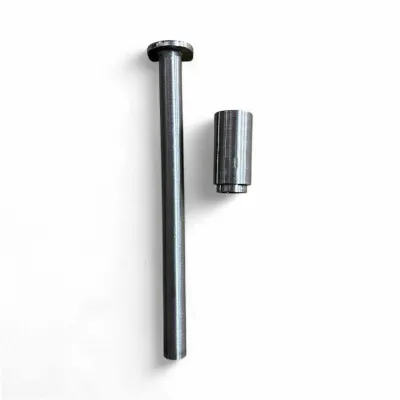
The full-length guide rod, on the other hand, extends the entire length of the recoil spring channel, supporting the spring along its entire travel path up to the spring plug. FLGRs are commonly manufactured as either one-piece solid rods or two-piece threaded assemblies. The two-piece design is particularly common because it allows the shooter to unscrew the front portion of the rod, simplifying the disassembly of pistols with tight barrel-to-slide fitment. By keeping the spring fully supported, the FLGR aims to eliminate any lateral movement or kinking of the spring during the slide’s cycle.
The mechanical theory behind spring alignment, coil binding, and slide travel is central to this comparison. Proponents of the FLGR argue that supporting the recoil spring along its entire length prevents the spring from kinking, rubbing against the inside of the slide, or experiencing coil binding during the cycling process. In theory, this continuous alignment ensures more consistent slide travel and reduces internal friction. However, standard guide rods have proven highly reliable for generations, as the internal dimensions of a properly machined 1911 slide naturally constrain the spring, making coil binding rare in well-maintained pistols using quality springs.
Reliability, Maintenance, and Field Stripping
The most immediate, observable difference between these two setups is how they affect the disassembly process. A standard GI guide rod allows for completely tool-free field stripping. You simply depress the recoil spring plug, rotate the barrel bushing, and remove the plug and spring from the front of the slide. This simplicity is highly valued in defensive and field scenarios where you might need to clean or inspect your pistol without access to a workbench or specialized tools.
In contrast, a full-length guide rod typically complicates the disassembly routine. One-piece FLGRs often require a specialized L-shaped wire or a paperclip inserted into a small hole in the rod to capture the spring tension before the slide can be removed. Two-piece FLGRs require an Allen wrench to unscrew the front half of the rod through the muzzle end before the barrel bushing can be rotated. If you lose this tool in the field or at a shooting range in a remote area, performing a basic field strip becomes exceptionally difficult.
In high-round-count training sessions or competitive matches, carbon fouling and debris accumulate rapidly around the guide rod and slide recesses. Because an FLGR has a much larger surface area in direct contact with the moving spring and slide components, it presents more opportunities for carbon buildup to create drag. In hot, humid tropical climates like the Philippines, where sweat, moisture, and airborne dust combine with carbon to form an abrasive paste, a tightly fitted FLGR requires diligent cleaning and lubrication to prevent sluggish cycling.
The standard GI setup, with its generous internal clearances, is highly forgiving of dirt, sand, and debris. If foreign matter enters the slide of a GI-configured 1911, the loose tolerances allow the spring to flex and push past the debris. An FLGR leaves very little empty space inside the spring channel. If sand or grit gets trapped between the tight tolerances of the full-length rod and the spring plug, it can cause immediate binding, potentially preventing the slide from returning to battery.
Shooting Dynamics and Balance
One of the primary reasons shooters install a full-length guide rod is to alter the balance of the pistol. A solid steel or tungsten FLGR adds noticeable weight to the very front of the frame and slide assembly. This extra mass shifts the pistol’s center of gravity forward, which theoretically dampens muzzle rise during rapid fire by resisting the upward rotational force of recoil.

While the physics of adding weight to the muzzle are sound, the actual impact on perceived recoil is highly subjective. Many shooters report that the added weight makes the pistol feel “flatter” during rapid-fire strings, while others find the difference negligible compared to proper grip technique and stance. Because hand size, physical strength, and shooting style vary greatly, you should conduct side-by-side live-fire testing with both configurations to determine if the weight shift genuinely improves your sight recovery time.
It is important to approach claims of “enhanced accuracy” or “reduced wear” with skepticism. A guide rod’s primary job is to guide the recoil spring, not to lock up the barrel or align the sights. Any perceived improvement in accuracy is usually a byproduct of the shooter’s increased confidence or the slight dampening of muzzle flip from the added weight, rather than a direct mechanical enhancement of the pistol’s inherent precision.
Compatibility, Springs, and Installation Checks
Before purchasing or installing any aftermarket guide rod, consult your pistol manufacturer’s documentation and warranty terms. Some custom or semi-custom 1911 makers design their pistols around a specific guide rod system and warn that altering this configuration can void the warranty or compromise the hand-fitted tolerances of the slide, barrel, and frame.
Recoil springs are not universally compatible across all guide rod designs. When switching to an FLGR, you must ensure that the inner diameter of your recoil spring matches the outer diameter of the new rod. A spring that is too tight will bind on the rod, causing short-cycling or failure to feed, while a spring that is too loose can snake and rub against the slide. Additionally, verify that the spring weight is appropriate for your ammunition and slide mass to prevent premature wear or frame battering.
After installing a new guide rod, perform a thorough manual check of the pistol’s cycle before live-firing. With the pistol completely unloaded, slowly cycle the slide by hand to feel for any catching, gritty movement, or resistance. Check that the guide rod head seats flat against the barrel lugs and does not interfere with the link or barrel feet. Ensure the spring plug does not bottom out against the guide rod head before the slide reaches its full rearward travel, as this can crack the plug or damage the slide.
Decision Framework: Choosing the Right Setup
Your choice should ultimately align with how you use your firearm. Choose a standard GI guide rod if your 1911 is a primary home defense weapon, a daily carry pistol, or a classic military-style build. The GI guide rod offers unmatched simplicity, tool-free maintenance, and a proven track record of reliability in adverse conditions. It is the ideal choice for shooters who value practical utility and ease of field care over minor weight adjustments.
Choose a full-length guide rod if you participate in practical shooting sports, use your 1911 primarily as a range toy, or have a custom-built pistol tuned by a gunsmith who specifically recommended an FLGR. The added front-end weight can assist in rapid sight tracking, and the controlled environment of a shooting range minimizes the risk of debris-induced failures.
Verify your pistol’s specifications first if your firearm features a bull barrel, a compact slide (such as Officer or Commander sizes), or a unique recoil system like a dual-spring assembly. These variants often require specialized guide rods and plugs that do not follow standard Government model specifications, making careful measurement and manufacturer consultation essential before making any changes.
Frequently Asked Questions (FAQ)
Do I need a special tool to install a full-length guide rod?
Whether you need tools depends entirely on the design of the specific full-length guide rod you choose. One-piece FLGRs often require a small takedown pin or a bent paperclip to hold the spring in place during disassembly, while two-piece designs require a standard hex key to unthread the rod halves. Always refer to the manufacturer’s installation instructions to identify the exact tools required, and keep them in your range bag to avoid being stranded with a firearm you cannot field strip.
Can I mix a standard recoil spring with a full-length guide rod?
You should never mix incompatible recoil springs and guide rods, as doing so can cause severe mechanical failures. A standard recoil spring designed for a GI guide rod may have an inner diameter that is too narrow for an aftermarket FLGR, leading to spring binding, coil stacking, or a complete failure of the slide to cycle. Always verify that your recoil spring’s specifications, including its inner diameter, length, and weight, are explicitly rated for use with your specific guide rod model.
Community discussion
Share your experience or ask a question. Comments are reviewed before publication.