
When selecting a heavy duty carabiner hook for climbing, load ratings and safety certifications are the primary indicators of whether a piece of gear can safely support human weight. These markings are not mere recommendations; they represent precise, standardized testing of how much force the metal can withstand before failing. Understanding how to read these specifications is a fundamental safety skill that prevents catastrophic gear failure during a climb or rigging setup.
Distinguishing Life-Safety Carabiners from Accessory Hooks
Walk into any local hardware store in the Philippines, and you will find rows of metal clips labeled as “heavy duty carabiner hooks.” While these utility hooks are excellent for securing hammocks or organizing gear, they are fundamentally different from life-safety climbing carabiners. Utility hooks are typically made from cast metals or low-grade steel, which can contain hidden internal flaws that fail suddenly under dynamic loads.
To protect yourself, perform a visual check on the spine. Certified life-safety carabiners have their load ratings and certification numbers permanently stamped or laser-etched into the metal, whereas non-climbing utility hooks often feature warning labels like “Not for Climbing.” The term “heavy duty” in general hardware is a marketing descriptor with no standardized legal definition; it does not account for the violent, multi-kilonewton forces generated during a lead climbing fall. True climbing carabiners are engineered from high-grade, hot-forged aluminum or stainless steel, designed to deform slightly and absorb energy rather than snapping under sudden impact.
Products mentioned in this guide
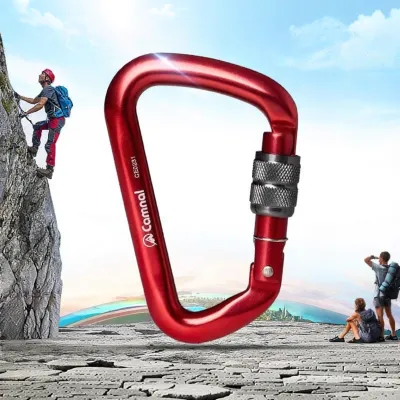
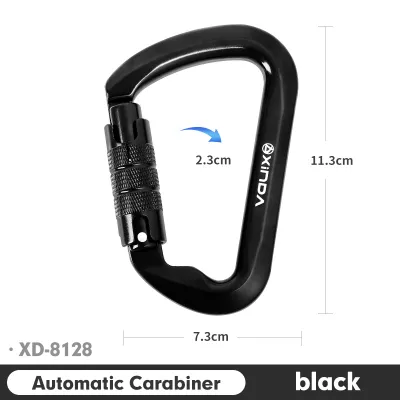
Prices are valid at publication and may change. Please refer to the product page for the latest price.
Reading kN Load Ratings on the Carabiner Spine
Climbing gear ratings are measured in kilonewtons (kN) rather than kilograms, where one kilonewton represents approximately 100 kilograms of static force. Because a falling climber generates dynamic force, the load on an anchor can easily exceed several kilonewtons in a fraction of a second. This is why climbing carabiners must be rated to withstand forces far beyond static body weight.

When you inspect the spine of a certified heavy duty carabiner hook, you will find three distinct kN ratings. The first is the major axis rating (gate closed, loaded end-to-end), which typically ranges from 20 kN to 30 kN or more. The second is the minor axis rating (cross-loaded side-to-side), and the third is the open-gate rating. Both cross-loaded and open-gate configurations are significantly weaker than the closed-gate major axis, often dropping the carabiner’s strength by more than half.
Before taking any gear onto the crag, verify these markings against the manufacturer’s official product documentation. While a higher kN rating indicates a stronger piece of metal, it should not be your sole selection criterion. A massive steel carabiner with an exceptionally high load rating might be ideal for industrial rigging, but its physical weight will quickly tire a climber on a long multi-pitch route. You must balance the load rating with other practical factors, such as the carabiner’s shape, weight, and gate clearance.
Choosing the Right Gate Type for Heavy Duty Tasks
The gate mechanism of a heavy duty carabiner hook determines how securely it remains closed during movement and rope play. Non-locking carabiners, which include solid gates and wiregates, are designed for quick clipping on quickdraws. However, for critical safety points where a rope could accidentally unclip itself, locking carabiners are mandatory.
Locking gates generally fall into two categories: manual screwgates and auto-locking gates. Screwgates require you to manually thread a sleeve over the gate to lock it, offering simplicity and reliability in dusty conditions. Auto-locking gates use spring-loaded sleeves that automatically twist and lock the moment the gate snaps shut, reducing the risk of human error but requiring regular cleaning to prevent grit from jamming the mechanism.
Matching the gate type to your specific task is essential for safe rigging. For belaying, anchoring, and master points, always use a locking carabiner—preferably a triple-action auto-locker or a secure screwgate—to prevent accidental gate opening from rope friction. Before every climb, perform a quick functional check on each gate. Press the gate open and let it snap back; it should close completely and lock without any hesitation. In the humid, tropical climate of the Philippines, salt air and moisture can cause gate springs to stiffen or corrode, making routine lubrication with a dry, wax-based lubricant necessary to maintain smooth operation.
Verifying CE and UIAA Safety Certifications
To ensure that a carabiner’s stamped load ratings are accurate, independent testing bodies must verify the manufacturer’s claims. The two most prominent safety standards in the climbing world are the CE (Conformité Européenne) mark and the UIAA (International Climbing and Mountaineering Federation) label. These certifications guarantee that the gear has undergone rigorous laboratory testing to meet strict international safety requirements.
The CE mark, followed by a four-digit number (such as CE 0333), indicates compliance with European safety standards (specifically EN 12275 for mountaineering equipment) and that the manufacturing facility is regularly audited. The UIAA label indicates that the gear meets even stricter safety requirements developed by climbers and safety engineers globally. You can typically find these marks stamped directly onto the carabiner spine alongside the kN ratings. If you encounter a carabiner that lacks these certification marks, or if the stamps are faded beyond recognition, you must treat the gear as unsafe for climbing and retire it immediately from life-safety use.
Inspecting and Retiring Your Climbing Carabiners
Even the most robust heavy duty carabiner hook will wear out over time, requiring regular inspection to determine when it must be retired. Begin your inspection with a thorough visual check under good lighting, looking for hairline cracks, deep scratches, or sharp burrs. Pay close attention to the areas where the rope runs, as friction can wear deep grooves into the metal over time. Run your fingers along the body of the carabiner to feel for any uneven wear or structural deformities.
If a rope groove exceeds a depth of one millimeter, or if you detect any visible cracks, the carabiner must be retired immediately. Additionally, inspect the rivets and the gate spring; if the gate does not align perfectly with the nose or if the spring feels sluggish, the carabiner is no longer safe for use. If you drop a carabiner from a significant height onto a hard surface, it should be retired even if there is no visible damage, as micro-fractures can develop deep within the metal structure. When in doubt about the integrity of your gear, stop using it immediately and consult the manufacturer or a certified safety professional.
Frequently Asked Questions (FAQ)
Is a hardware store heavy duty carabiner hook safe for climbing?
No, hardware store carabiners are not safe for climbing or any life-safety applications. These hooks lack the standardized testing, quality control, and certified kilonewton (kN) ratings required to withstand dynamic fall forces. Using non-certified hardware for climbing poses a severe risk of sudden structural failure.
Does a heavier carabiner guarantee a higher load rating?
No, physical weight does not directly correlate with a carabiner’s load rating. Modern manufacturing utilizes advanced hot-forging techniques and high-strength aluminum alloys to create lightweight carabiners with exceptionally high kN ratings. Always rely on the certified kN ratings stamped on the spine rather than the physical weight of the gear.
Community discussion
Share your experience or ask a question. Comments are reviewed before publication.