
Upgrading the sighting system on a classic 1911 pistol is one of the most effective ways to improve your shooting performance. Among the various options available, fiber optic sights have become incredibly popular for action shooting, target practice, and outdoor recreation. These sights work by gathering ambient light through the exposed sides of a small polymer rod and channeling it to the polished tip, creating a bright, glowing aiming point. They do not generate their own light but act as a passive amplifier for existing light, making them exceptionally useful in bright environments. For shooters in the Philippines, where intense tropical sunlight can wash out traditional black iron sights, a fiber optic front sight provides a high-contrast reference point that is easy to track.
While the mechanics of these sights are straightforward, choosing and using them effectively on a 1911 requires an understanding of light transmission, physical specifications, and slide compatibility. This guide breaks down how these sights function, what specifications you need to look for, and how to safely handle and maintain them on your pistol.
How Fiber Optic Sights Gather and Transmit Light
To understand how a fiber optic sight works, it helps to look at the polymer rod itself, which is typically made of an acrylic or polystyrene material. The exposed outer surface of this rod acts as a light collector, pulling in ambient light from the surrounding environment. Because the rod is mounted along the top of the sight housing, it has a large surface area exposed to the sky or overhead range lights, maximizing the amount of light it can capture.
Products mentioned in this guide
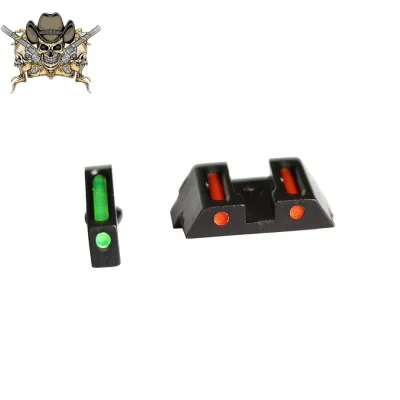
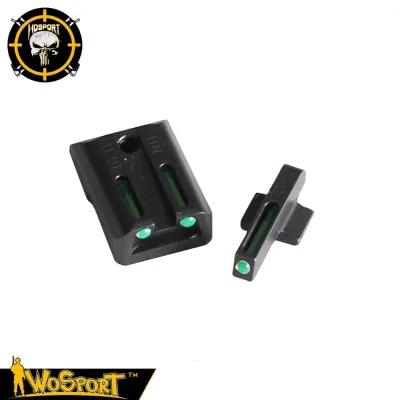
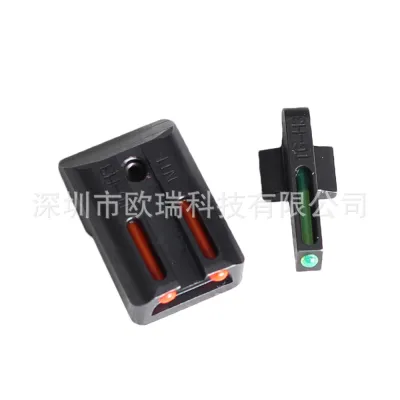
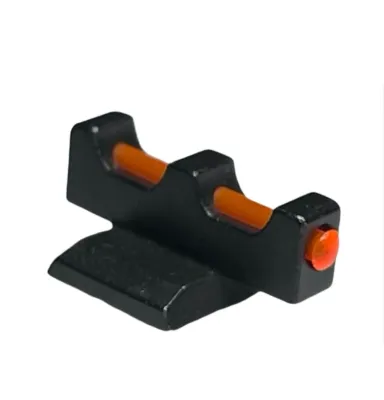
Prices are valid at publication and may change. Please refer to the product page for the latest price.
Once light enters the rod, it is trapped and directed by a physics principle known as total internal reflection. The core of the fiber rod is surrounded by a cladding material with a lower refractive index. This boundary acts like a mirror; when light hits the inside wall of the rod at a shallow angle, it bounces back into the core rather than escaping through the sides. This bouncing effect channels the trapped light continuously along the length of the rod.
All of this gathered and channeled light eventually exits through the small, cut end of the rod facing the shooter’s eye. Because a large volume of light collected over the length of the rod is concentrated into a tiny exit point, it creates a bright, glowing “dot” effect. This dot is highly visible and naturally draws the shooter’s eye, even against cluttered or dark targets.
It is critical to note that fiber optic rods do not generate their own light. They do not use batteries, and they do not contain radioactive isotopes like tritium. They are purely passive collectors, meaning their brightness is entirely dependent on the strength of the ambient light around you.
Key Specifications That Define Your 1911 Sight Performance
Not all fiber optic sights are created equal, and selecting the right one for your 1911 involves balancing several technical specifications. These specs directly influence how quickly you can acquire your target, how precisely you can align your shots, and whether the sight will actually fit your slide.

Fiber Diameter: Speed vs. Precision
The diameter of the fiber optic rod is one of the most important factors in determining how the sight performs in different shooting scenarios. The most common diameters for handgun sights are 0.040 inches (approx. 1.0 mm) and 0.060 inches (approx. 1.5 mm).
Thicker fibers, such as those measuring 0.060 inches, gather more light simply because they have a larger surface area. This results in a larger, brighter dot that is incredibly fast to acquire. This size is highly favored by action shooting competitors and those using their 1911 for fast, close-range target engagement, where speed is prioritized over extreme precision.
Conversely, thinner fibers, such as those measuring 0.040 inches or smaller, produce a much smaller, crisper aiming point. While this smaller dot gathers less light and may appear slightly dimmer, it covers less of the target at longer distances. This makes thinner fibers the preferred choice for precision bullseye shooting or longer-range target work where a massive dot would obscure the target’s center.
When buying replacement fiber rods, remember that the physical housing of your front sight limits the maximum usable fiber diameter. You must purchase replacement rods that precisely match the manufacturer’s specified channel size to ensure a secure fit.
Fiber Color: Matching Ambient Light and Contrast
Fiber optic rods are commonly available in red, green, and occasionally yellow or amber. Choosing the right color is not just a matter of personal preference; it involves human eye physiology and the environment in which you shoot.
Green fibers are highly popular because the human eye is naturally more sensitive to wavelengths in the green spectrum. In bright daylight or outdoor tropical settings, a green fiber often appears significantly brighter and sharper than other colors. This makes it an excellent choice for outdoor ranges where fast tracking is necessary.
Red fibers, on the other hand, provide excellent contrast against green foliage, brown dirt, or specific indoor range backdrops. Because red is a common color associated with warning signs, many shooters find that their brains naturally lock onto a red front sight very quickly.
Ultimately, personal eye physiology dictates the best choice. Some shooters find that red appears sharper, while others experience less eye strain with green. If possible, test both colors under your typical shooting conditions to see which one your eyes track most naturally.
Dovetail Cuts: Ensuring Slide Compatibility
Unlike many modern polymer-framed pistols that use standardized mounting systems, the 1911 platform is notorious for having a wide variety of proprietary and semi-standardized sight cuts. The sight base must match the specific dovetail cut milled into your 1911’s slide.
Common 1911 dovetail cuts include Novak, Bomar, GI (Mil-Spec), and Springfield, among other proprietary manufacturer designs. A sight designed for a Novak cut will not fit a slide milled for a Bomar cut without extensive, permanent machining. Always verify your pistol’s specific slide specifications before purchasing a new sight.
Additionally, consider the profile of the sight housing. For carry or duty 1911s, low-profile housings are generally preferred. These designs shield the delicate polymer rod from impact while ensuring the sight does not snag on clothing or the edges of a holster during a draw.
Real-World Performance Benefits on the 1911 Platform
Installing a fiber optic front sight on a 1911 offers several immediate, practical advantages on the range. The most noticeable benefit is the speed of front-sight focus. Traditional plain black iron sights require the shooter to carefully align the top of the front post with the rear notch, which can be difficult to do quickly under stress or against dark targets. The glowing dot of a fiber optic sight draws your focus instantly to the front sight, allowing for rapid target acquisition.
This high-visibility reference point is also incredibly helpful during the 1911’s recoil cycle. Because the .45 ACP or 9mm recoil causes the slide to flip upward, a bright dot allows your eyes to track the front sight as it rises and falls. This tracking capability helps you re-align your sights faster, leading to quicker and more accurate follow-up shots.
However, these performance benefits are highly dependent on the environment. They excel in well-lit conditions, such as outdoor ranges under bright sunlight or well-lit indoor competition bays. As ambient light drops—such as during dusk, dawn, or inside a dimly lit room—the brightness of the fiber optic rod naturally diminishes, eventually performing no better than a standard black iron sight.
Safe Handling and Installation Boundaries for Your 1911
Whenever you are handling, maintaining, or upgrading your 1911, safety must be your absolute priority. Equipment upgrades can never replace safe handling habits and proper training.
Before performing any work or inspection on your pistol, verify that the firearm is completely unloaded. Remove the magazine, lock the slide to the rear, and visually and physically inspect the chamber to ensure no ammunition is present. Keep all ammunition in a separate room while working on the firearm.
When it comes to installing new sights, caution is key. Sights are designed to fit tightly into their dovetails to prevent them from drifting under recoil. However, forcing a sight into a mismatched or overly tight dovetail can gall the slide, ruin the sight base, or snap the fragile fiber rod. If a sight does not slide in smoothly with reasonable hand pressure or light tapping with a brass drift punch, it likely requires careful hand-filing of the sight base.
If you are not experienced with fitting sights, or if your 1911 slide requires custom machining to accept a new dovetail profile, consult a qualified gunsmith. Attempting irreversible modifications to your slide without professional guidance can permanently damage your firearm and void its warranty.
Frequently Asked Questions (FAQ)
Do fiber optic sights work in complete darkness?
No, fiber optic sights do not work in complete darkness. Because they rely entirely on gathering and amplifying ambient light, they will appear as dull, dark shapes when there is no light source available. For low-light self-defense or night-time shooting, tritium night sights (which glow using a self-luminous radioactive isotope) or weapon-mounted lights are the appropriate and necessary alternatives.
How do I clean fiber optic sights without damaging them?
To clean your fiber optic sights, use a soft, dry microfiber cloth to gently wipe away carbon buildup and debris. If a cleaning solvent is necessary, ensure it is a mild formula that is explicitly labeled as safe for plastics and polymers. Avoid using abrasive brushes, steel wool, or harsh chemical solvents like acetone or chlorinated bore cleaners, as these can melt, scratch, or cloud the polymer rod, permanently reducing its ability to transmit light.
Community discussion
Share your experience or ask a question. Comments are reviewed before publication.