
Setting up a home gym in a shared building requires balancing your fitness goals with the comfort of those living around you. If you are an active cyclist or triathlete looking to maintain your fitness during the rainy season or to avoid busy city streets, an indoor trainer is an invaluable tool. However, the question of noise is a common barrier. The short answer is yes, indoor trainers can disturb your neighbors, but the likelihood of complaints depends heavily on the type of trainer you choose, your building’s construction, and how you manage the physical forces transmitted through your floor.
To keep the peace while getting your miles in, you must look beyond what you hear while sitting on the saddle. What feels like a quiet, smooth ride to you can translate into a persistent, low-frequency rumble for the person living directly below your apartment. Understanding how this sound travels is the first step toward building a neighbor-friendly indoor cycling setup.
Understanding Indoor Trainer Noise: Airborne vs. Structure-Borne
When evaluating the acoustic footprint of an indoor trainer, you are dealing with two distinct types of noise: airborne and structure-borne. Airborne noise consists of the sounds that travel directly through the air to your ears. In a cycling setup, this includes the high-pitched whir of the trainer’s internal resistance unit, the metallic clicking of your bike’s chain moving over the cassette, and the rushing air from any cooling fans you use to stay comfortable in a warm room. While these sounds can be loud inside your workout space, they are relatively easy to contain. Standard drywall, closed doors, and basic home furnishings generally do a good job of absorbing and blocking airborne sound waves before they reach adjacent units.
Products mentioned in this guide



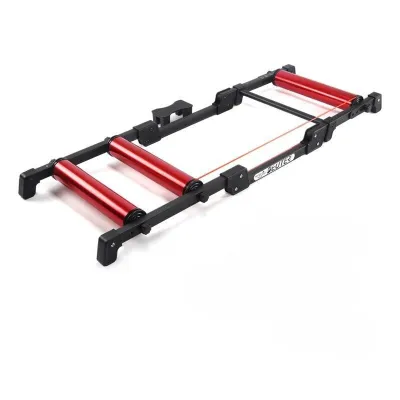


Prices are valid at publication and may change. Please refer to the product page for the latest price.
Structure-borne noise, or vibrational noise, is a much more challenging issue in multi-family buildings. As you pedal, the downward force of your legs combined with the rapid rotation of the trainer’s heavy internal flywheel generates physical vibrations. These vibrations travel down through the trainer’s legs and directly into the building’s structural frame. Once these kinetic forces enter the floor joists, they can propagate through walls and ceilings, radiating outward into neighboring apartments as a low-frequency hum or thumping sound. Because low-frequency vibrations bypass air entirely, they are incredibly difficult to ignore and are the primary cause of neighbor disputes regarding home fitness equipment.
Direct Drive vs. Wheel-On Trainers: Noise Profiles
Selecting the right equipment is the most effective way to control airborne noise. Indoor trainers generally fall into two categories: wheel-on and direct drive. Wheel-on trainers require you to keep your rear wheel on the bike and press the tire against a small metal roller. This metal-on-rubber contact creates significant friction, which produces a distinct, high-pitched whining sound that increases in volume as your wheel spins faster. Additionally, tire tread pattern and tire wear can dramatically amplify this airborne noise, making wheel-on trainers highly noticeable to anyone in your immediate household or next door.

Direct drive trainers require you to remove your rear wheel and mount your bike’s frame directly onto the trainer, which features its own pre-installed cassette. By eliminating the tire-to-roller contact point, direct drive systems remove the primary source of high-frequency airborne noise. These units are engineered to be remarkably quiet, with many modern smart trainers producing little more than a soft, mechanical hum. However, it is vital to remember that direct drive models still feature large, heavy flywheels to simulate road feel. While they excel at keeping airborne noise to a absolute minimum, they still generate substantial structural vibrations that must be managed.
Before purchasing any unit, always consult the manufacturer’s product specifications for declared decibel ratings and compatibility guidelines. Keep in mind that these laboratory ratings do not account for the unique acoustics of your living room or the structural properties of your building.
Will Your Neighbors Hear You? Assessing Your Space
Your building’s architectural design plays a massive role in whether your training sessions will trigger a knock on your door. In many modern high-rise condominiums and apartments, floors are constructed using thick concrete slabs. Concrete is excellent at blocking airborne noise and does a reasonable job of dampening high-frequency vibrations. However, if your trainer is placed directly on bare concrete, the low-frequency vibrations can still pass through to the ceiling below. If your building uses wood-frame construction or laminate flooring over a hollow subfloor, these materials can act like a drumhead, amplifying both airborne sounds and structural vibrations throughout the immediate area.
Your physical location within the building also dictates your risk level. Ground-floor apartments are ideal for indoor cycling because there is no neighbor directly below you to inherit the structural vibrations. If you live on an upper floor, placing your trainer setup in a central room directly above a neighbor’s bedroom or living area increases the likelihood of disturbance. Whenever possible, position your trainer in a corner of your apartment that aligns with structural load-bearing walls, as these areas are stiffer and less prone to flexing and transmitting vibrations.
Finally, consider the ambient noise levels of your neighborhood. During the daytime, city traffic, household appliances, and general neighborhood activity create a high baseline of background noise that easily masks the sound of your trainer. If you prefer early morning or late-night workouts, this ambient noise drops significantly. In a quiet building, even a minor vibration or chain click can feel incredibly loud to a neighbor trying to sleep.
Practical Steps to Minimize Noise and Vibration
If you want to ensure your indoor training sessions remain completely private, you can implement several highly effective mitigation strategies to isolate your equipment and protect your floors.
- Use a Dedicated Trainer Mat: Never place your trainer directly on bare tile, hardwood, or concrete. A high-density, water-resistant indoor trainer mat is essential. These mats are specifically engineered to absorb minor vibrations while catching the heavy sweat that is inevitable when riding indoors, protecting your flooring from moisture damage.
- Decouple the Trainer from the Floor: For advanced dampening, you need to decouple the trainer's feet from the floor structure. Placing heavy-duty, anti-vibration rubber pads (similar to those used for washing machines) under each contact point of the trainer can dramatically reduce the transfer of low-frequency hums. Some riders build a simple isolation platform using layers of plywood and dense foam blocks to completely isolate the equipment.
- Maintain Your Drivetrain: A dry, dirty, or misaligned chain creates a surprising amount of metallic clatter. Regularly clean your chain, chainrings, and cassette with a high-quality degreaser, and apply a fresh coat of chain lubricant. Keeping your shifting properly indexed prevents the chain from rubbing against adjacent cogs, which eliminates unnecessary airborne noise.
- Ride Mindfully: Out-of-the-saddle sprints and sudden, high-wattage accelerations put immense physical stress on your bike and trainer, resulting in a spike in structural vibrations. Save your high-intensity intervals for reasonable daytime hours when your neighbors are awake, and focus on smooth, high-cadence spinning during early morning or late-evening sessions.
- Verify Frame Compatibility: Before mounting your bicycle to any trainer, always check your bike manufacturer's manual to ensure the frame is rated for trainer use. Using incorrect adapters or exceeding weight limits can damage your frame and create unusual creaking noises during your ride.
Community discussion
Share your experience or ask a question. Comments are reviewed before publication.