
Choosing a badminton set for kids in the Philippines requires balancing physical development with local playing conditions. Unlike adults, children need rackets scaled to their height and strength to prevent injury and foster proper technique. In the tropical climate, where outdoor games on concrete driveways, local barangay courts, or grassy backyards are common, durability against humidity and rough surfaces is just as critical as weight. Selecting the right gear ensures that young players stay engaged, avoid physical strain, and develop a genuine love for the sport.
Many parents mistake cheap plastic toy sets for actual sports equipment, which can hinder a child’s progress. Toy sets often feature heavy, flexible plastic frames or soft metals that bend easily, paired with loose nylon strings that fail to bounce the shuttlecock. Investing in a proper junior badminton set provides a scaled-down version of adult gear, featuring lightweight materials and correct proportions. By focusing on the right specifications, you can find a set that offers a safe, rewarding, and durable playing experience for your child.
Quick Guide: Core Criteria for Kids' Badminton Sets
When searching for a children’s badminton set, the distinction between a novelty toy and entry-level sports gear is fundamental. Toy sets, often found in the toy aisles of department stores, are designed for very young children to play with balloons or oversized foam balls. These items lack the structural integrity required to hit a standard shuttlecock. Genuine junior sports gear, on the other hand, utilizes lightweight aluminum or graphite composites, proper string tension, and standard grip materials. This ensures the racket behaves like a real sports tool, allowing the child to learn actual badminton strokes.
Products mentioned in this guide
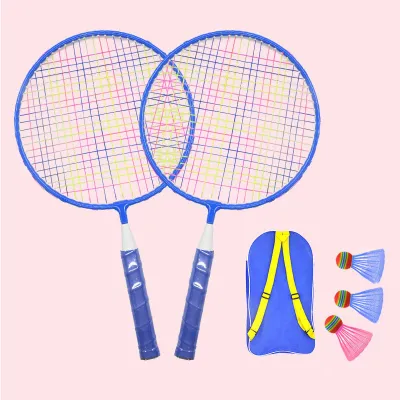
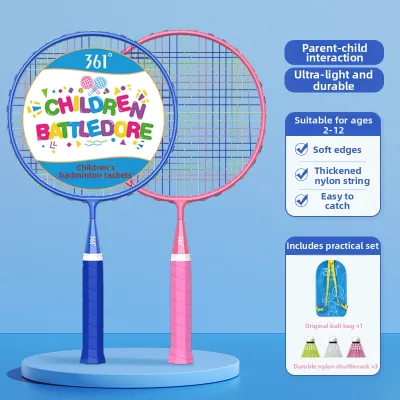
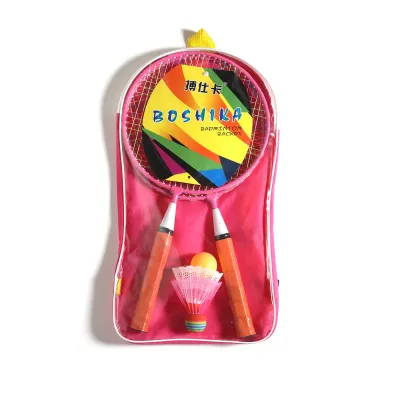
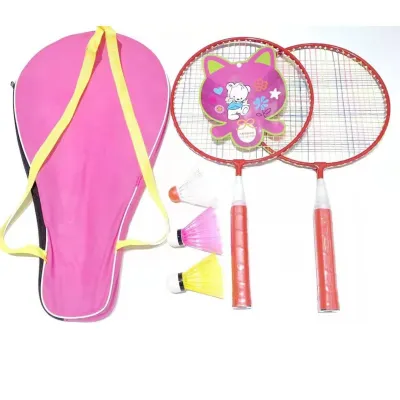
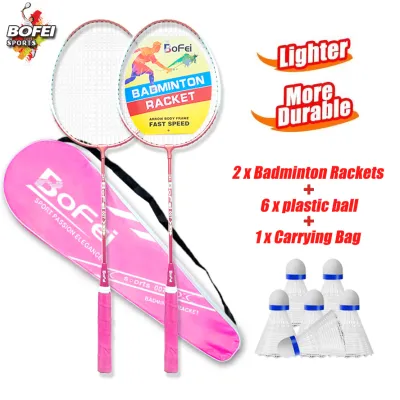
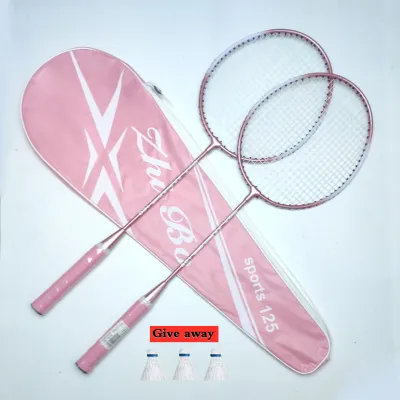
Prices are valid at publication and may change. Please refer to the product page for the latest price.
The primary decision drivers when selecting a set are racket length, overall weight, and grip circumference. A racket that is too long will scrape the ground, while one that is too heavy will quickly fatigue a child’s wrist and shoulder. Grip circumference is equally vital; if the handle is too thick, small hands will struggle to hold it securely, leading to slips and poor racket control. Balancing these three dimensions allows a child to swing naturally and build confidence without physical discomfort.
Safety and durability are the final non-negotiable baselines for active play. Children are naturally tough on equipment, often scraping rackets against concrete or accidentally striking partners and posts. Look for rackets with reinforced joints and durable frame materials that can withstand these impacts without snapping. Additionally, the strings must be durable enough to handle off-center hits near the frame, which are incredibly common as kids develop their hand-eye coordination.
Sizing and Weight Matrix by Age and Height
Matching racket dimensions to your child’s physical development is essential to prevent joint strain and encourage proper technique. A racket acts as an extension of the arm; if the lever is too long or heavy, the torque exerted on a child’s developing wrist and elbow increases exponentially. To measure the ideal racket length at home, have your child stand straight with their arms relaxed at their sides. The racket should be held by the grip, pointing down toward the floor. The head of the racket should clear the ground by at least an inch or two; if it touches the floor, the racket is too long for their current height.

Racket weight has a direct impact on swing speed, wrist fatigue, and long-term joint health. In the tropical heat of the Philippines, where outdoor play can lead to rapid physical exhaustion, a heavy racket compounds fatigue very quickly. Standard adult rackets typically weigh between 80 and 90 grams, which can feel incredibly heavy to a child under ten. Junior rackets are engineered to be much lighter, often utilizing hollow frames and lightweight alloys to keep the weight manageable. This allows children to practice longer, maintain proper form, and avoid the shoulder-dropping habits that develop when trying to swing an oversized racket.
To simplify your selection, consider this conditional sizing and weight matrix based on general age groups and physical statures:
- Ages 3 to 5 (Height under 100 cm): Look for ultra-short rackets measuring 19 to 21 inches in length. The weight should ideally fall between 70 and 80 grams. These sets are designed for basic coordination games and are often paired with soft, oversized shuttlecocks.
- Ages 6 to 8 (Height 100 cm to 120 cm): Recommended racket length is 21 to 23 inches, with a weight range of 75 to 85 grams. This size allows children to transition to hitting standard synthetic shuttlecocks with controlled, deliberate swings.
- Ages 9 to 12 (Height 120 cm to 140 cm): Opt for a racket length of 23 to 25 inches and a weight of 80 to 90 grams. These rackets closely resemble adult models but feature a shortened shaft to keep the balance point closer to the hand.
- Ages 13 and up (Height over 140 cm): At this stage, teenagers can generally transition to standard adult-length rackets (26.5 to 27 inches). However, they should start with lightweight classifications, such as 4U (80-84 grams) or 5U (75-79 grams), to build strength gradually.
Recognizing when your child is ready to transition to a larger racket involves observing their physical and technical milestones. If your child can consistently hit the shuttlecock deep into the opponent’s court with a smooth, effortless motion, they may have developed the strength for a longer shaft. Physical growth is another obvious indicator; if the junior racket looks visibly small in their hands or if they are constantly bending their knees excessively to avoid scraping the racket on low shots, it is time to move up to the next size bracket.
Evaluating Durability and Construction Materials
The materials used in a junior racket determine how long it will survive the rigors of daily play. Aluminum is the most common frame material for entry-level junior sets. It is highly impact-resistant, meaning it can survive drops on concrete barangay courts or accidental collisions with walls without cracking. The trade-off is that aluminum is stiffer and slightly heavier than carbon fiber. Carbon fiber or graphite frames are highly flexible, lightweight, and excellent at absorbing vibrations, which protects young joints. However, they are more brittle and can crack if struck hard against solid surfaces. For younger children playing outdoors, aluminum is often the more practical choice, while older kids training seriously will benefit from graphite.
Shaft flexibility and joint construction are critical safety points to evaluate. Many budget-friendly rackets feature a two-piece construction, where the head and shaft are joined by an external T-joint. While functional, these joints can loosen over time, causing the head to wobble or, in extreme cases, fly off during a hard swing. A one-piece jointless racket, where the frame and shaft are seamlessly molded together, offers superior structural integrity and aerodynamics. If you choose a two-piece racket, inspect the T-joint regularly to ensure there are no visible cracks or loose connections.
Grip material and thickness play a vital role in preventing slips, especially in the humid Philippine climate. Most factory rackets come with a basic synthetic leather grip. In high humidity, sweat can quickly make these grips slippery, causing the racket to fly out of a child’s hand. To prevent this, look for sets that allow you to easily apply an overgrip. Polyurethane (PU) overgrips offer a tacky, secure feel, while towel grips are excellent for absorbing heavy sweat. Ensuring the grip size matches your child’s hand—typically a G5 or G6 classification—prevents them from squeezing too tightly, which can cause forearm fatigue.
The type of shuttlecock included in the set also dictates the quality of play. Feather shuttlecocks, while offering the best flight paths, are incredibly fragile. A single off-center hit from a beginner can break the feathers, rendering the shuttlecock useless. For kids and outdoor play, synthetic nylon shuttlecocks are the superior choice. Nylon skirts are highly durable, resisting tears even when struck repeatedly by the frame of the racket. They also perform much better in outdoor wind conditions, making them ideal for backyard or street games.
Building Your Shortlist: Navigating Local and Online Stores
When shopping for a kids’ badminton set on local e-commerce platforms or in physical sporting goods stores in the Philippines, navigating the listings requires a discerning eye. Avoid searching for generic terms like “cheap kids racket,” which often yields low-quality toys. Instead, use precise technical keywords such as “junior badminton racket,” “lightweight aluminum badminton set,” or “short shaft racket.” These terms help filter out novelty items and direct you to actual sports equipment designed for young players.
Be on the lookout for red flags in product descriptions that indicate substandard quality. A major red flag is the complete omission of the racket’s weight or material specifications. If a listing simply describes a racket as “metal” without specifying whether it is steel, aluminum, or graphite, it is highly likely to be heavy steel, which can strain a child’s wrist. Other red flags include unbranded listings with generic photos, “toy” classifications in the product details, or strings that are described as “elastic band” material rather than nylon.
Before finalizing your purchase, use this practical pre-purchase verification checklist to ensure a reliable transaction:
- Verify the return policy: Ensure the seller offers a clear return or replacement policy in case the rackets arrive warped, damaged, or with broken strings.
- Read user reviews carefully: Look for reviews from local buyers that mention structural failures, such as "madaling maputol" (easily broken) or "natanggal ang grip" (grip came off). Pay close attention to uploaded photos to verify the actual build quality.
- Confirm included accessories: Check if the set includes essential accessories like a carrying bag to protect the rackets from dust and moisture, and a tube of durable nylon shuttlecocks.
Setting a realistic budget is key to finding a safe and durable set. In the Philippines, entry-level junior badminton sets typically range from ₱400 to ₱1,500. Sets priced below ₱300 often compromise heavily on materials, utilizing heavy steel frames and low-grade strings that stretch or snap almost immediately. Investing in the ₱800 to ₱1,500 price range generally secures a high-quality aluminum or graphite-composite racket set, complete with a protective carrying case and durable synthetic shuttlecocks. This moderate investment ensures a safer, more enjoyable experience that will last through seasons of active play.
Frequently Asked Questions (FAQ)
Can kids use standard adult badminton rackets?
Using a standard adult racket is generally not recommended for young children. The extra length of an adult racket (typically 27 inches) shifts the center of gravity further away from the child’s hand, making the racket feel significantly heavier and more awkward to swing. This imbalance forces children to use improper swing mechanics, such as dropping their elbow or using their entire shoulder to swing, which increases the risk of wrist, elbow, or shoulder strain. Additionally, the longer shaft makes it highly likely that the racket head will scrape or strike the ground during low shots, leading to damaged frames and broken strings. Children should only transition to adult rackets once they reach a height of approximately 140 centimeters and demonstrate the physical strength and coordination to control the longer frame without compromising their form.
How often should a child's badminton racket be replaced?
A child’s badminton racket should be replaced based on two primary factors: physical wear and physical growth. You should inspect the racket regularly for signs of structural damage, such as a warped frame, cracks near the joint, or loose, fraying strings. In the humid climate of the Philippines, the grip tape can also degrade, become slippery, or harbor bacteria over time; however, this can usually be resolved by wrapping a new overgrip rather than replacing the entire racket. The second trigger for replacement is a growth spurt. As your child grows taller and stronger, a short junior racket will eventually limit their reach and power. If you notice your child has outgrown the recommended height range for their current racket length, or if they are transitioning from casual backyard play to formal school training, upgrading to a longer, slightly heavier model will support their developing skills and prevent physical strain.
Community discussion
Share your experience or ask a question. Comments are reviewed before publication.