
Selecting a floating boat for adults requires a systematic evaluation of hull materials, load capacities, stability profiles, and transport logistics. Unlike lightweight recreational pool toys designed for children, adult-use watercraft must handle dynamic aquatic environments, fluctuating passenger weights, and unpredictable weather conditions. Making an incorrect choice can lead to structural failures, capsizing, or rapid material degradation under intense tropical sun and saltwater exposure.
To find a safe and reliable vessel, you must look beyond aesthetic designs and examine concrete technical specifications. The ideal boat must match your specific skill level, intended venue, and carrying capacity. Whether you plan to navigate calm inland lakes, paddle down slow-moving rivers, or explore sheltered coastal bays, understanding these core criteria ensures a safe and enjoyable experience on the water.
This comprehensive guide breaks down the four essential pillars of adult floating boat selection: material durability, weight capacity, hull design, and portability. By evaluating these factors against your personal use cases, you can confidently choose a watercraft that offers the right balance of performance, safety, and longevity.
Products mentioned in this guide
Prices are valid at publication and may change. Please refer to the product page for the latest price.
Evaluating Hull Materials and Puncture Resistance
The construction material of a floating boat directly dictates its durability, puncture resistance, and lifespan. Standard retail options generally fall into four categories: standard polyvinyl chloride (PVC), reinforced PVC, high-pressure drop-stitch fabrics, and rigid rotomolded plastics. Each material presents distinct trade-offs regarding weight, cost, and structural rigidity.
Standard PVC is lightweight and highly affordable, making it popular for entry-level recreational boats. However, unreinforced PVC is susceptible to punctures from sharp rocks, submerged branches, and fishing hooks. For adult use, it is wise to look for reinforced PVC, which features an internal polyester mesh core sandwiched between layers of vinyl, significantly increasing tear and abrasion resistance.
When evaluating fabric thickness, pay close attention to the denier rating on the product label. Denier measures the density of the internal fabric weave; higher numbers indicate stronger, heavier materials. For general recreational use on calm waters, a rating of 500D to 800D offers a reasonable balance of durability and packability. If you plan to navigate shallow rivers or areas with potential debris, look for heavy-duty commercial-grade materials rated at 1000D to 1100D.
Drop-stitch technology represents a major advancement in inflatable boat construction. This technique utilizes tens of thousands of polyester threads to link the top and bottom interior skins of the air chamber. When inflated to high pressures—typically between 10 and 15 pounds per square inch (PSI)—the floor or hull becomes rock-hard, mimicking the rigidity of a traditional wooden or fiberglass boat. This structural stiffness allows adults to stand up, walk, and paddle with minimal hull flexing.
Seam construction is another critical factor in determining a boat’s longevity, particularly in tropical climates. Look for radio-frequency (RF) welded or thermally welded seams rather than glued seams. Intense tropical heat and high humidity can soften adhesives over time, leading to slow leaks or sudden seam failures under pressure. Welded seams fuse the material layers permanently, creating a bond that is stronger than the fabric itself.
Finally, consider the environmental conditions of your local waterways. If your adventures involve navigating shallow coral-rich waters, rocky riverbeds, or gravel shorelines, a rigid rotomolded polyethylene boat or a high-denier reinforced inflatable is essential. For sandy-bottomed lakes or calm reservoirs, standard reinforced PVC will perform reliably without the added weight and cost of extreme heavy-duty materials.
In hot, humid climates, materials deteriorate rapidly under intense ultraviolet (UV) radiation. Ensure the manufacturer specification sheet explicitly states that the hull material has been treated with UV-inhibiting coatings. Additionally, look for mildew-resistant and antimicrobial fabric treatments, which prevent structural rot and unpleasant odors during storage in humid coastal areas.
Calculating Weight Capacity and Passenger Limits
Accurately calculating weight capacity is paramount for safety and vessel performance. There is a critical difference between a manufacturer’s “maximum weight capacity” and the “recommended comfortable capacity.” Operating a boat at or near its absolute maximum limit severely compromises its safety margins and handling characteristics.

Maximum weight capacity represents the absolute limit of weight a vessel can support in calm, flat water before it risks taking on water or sinking. For safe operation, your actual total load should ideally not exceed 70% to 80% of this stated maximum. Maintaining this safety buffer ensures the boat retains sufficient buoyancy and responsiveness when encountering unexpected waves or strong currents.
To calculate your required load capacity, use the following framework:
- Passenger Weight: Sum the actual weights of all adult passengers who will be on board.
- Essential Gear: Account for life jackets, paddles, anchors, ropes, and safety kits.
- Recreational Cargo: Include coolers, ice, food, dry bags, and personal electronics.
- Propulsion Systems: Add the weight of any trolling motors, mounting brackets, and heavy deep-cycle marine batteries if you plan to motorize the vessel.
Always verify the weight limit and passenger capacity directly on the physical capacity plate affixed to the boat’s hull or on the official manufacturer specification sheet. Do not rely on generic marketing descriptions like “three-person boat,” as these labels often assume small, lightweight passengers with zero gear. A boat marketed for three people may only comfortably and safely accommodate two average-sized adults with basic gear.
Exceeding the recommended weight limit dramatically reduces the boat’s freeboard, which is the distance from the waterline to the top edge of the gunwale. A low freeboard allows water to easily splash over the sides in choppy conditions, increasing the risk of swamping. Furthermore, an overloaded boat sits too deep in the water, which ruins its tracking ability, slows down travel, and makes paddling or steering incredibly exhausting.
Matching Hull Design to Your Water Conditions
A boat’s hull design, beam width, and structural features dictate how it behaves on the water. Matching these design elements to your typical water conditions is essential for ensuring stability, tracking, and overall safety.
Flat-bottom hulls offer exceptional initial stability, meaning they feel incredibly steady and solid when you first step aboard or stand up in calm, flat water. This design is highly suited for slow-moving rivers, sheltered lakes, and stationary activities such as fishing or photography. However, flat hulls track poorly in wind and offer a rough, bumpy ride in choppy water.
V-shaped hulls and pontoon-style designs provide superior secondary stability, which is the boat’s ability to resist capsizing when it is tilted by waves or rough water. V-hulls cut through chop efficiently and maintain a straight line (tracking) with minimal steering effort. Pontoon-style designs utilize dual outer inflatable tubes to maximize deck space and stability, making them excellent for relaxed coastal cruising or family outings.
The width of the boat, known as the beam, directly affects its stability and speed. A wider beam provides a more stable platform that is highly resistant to tipping, which is ideal for beginners or those carrying heavy gear. A narrower beam reduces water resistance, allowing for faster speeds and more efficient paddling, but requires better balance and technique from the operator.
To improve tracking and rigidity, look for boats equipped with inflatable keels or rigid drop-stitch floors. An inflatable keel creates a slight V-shape along the bottom of an otherwise flat inflatable hull, helping the boat cut through water rather than sliding across it. Rigid floors prevent the hull from sagging under the weight of standing adults, which significantly improves paddling efficiency and structural integrity.
Multiple independent air chambers are a non-negotiable safety feature for any inflatable adult boat. High-quality vessels feature three or more isolated chambers, typically dividing the port side, starboard side, and floor. In the event that a submerged branch or sharp coral punctures one chamber, the remaining intact chambers retain enough buoyancy to keep the passengers afloat, allowing for a safe and controlled return to shore.
Always cross-reference the boat’s design with official water classification standards before launching. A vessel rated for Category D (sheltered inland waters and small lakes) should never be taken into Category C (coastal waters, large bays, and fast-flowing rivers with moderate waves), regardless of how many passengers it is rated to carry. Equipment cannot replace sound judgment and adherence to design limitations.
Assessing Portability, Setup, and Storage Logistics
An excellent boat is only useful if you can easily transport, inflate, and store it. Evaluating the practical logistics of ownership before purchasing prevents the frustration of owning a vessel that is too cumbersome to use regularly.
Deflated dimensions and packed weight vary wildly across adult floating boats. A heavy-duty, multi-passenger inflatable can easily weigh over 40 kilograms when packed, requiring a dedicated wheeled cart or multiple people to carry. Conversely, lightweight packrafts or inflatable kayaks may weigh under 15 kilograms, allowing a single adult to carry them in a backpack over rough terrain to remote launch sites.
Fast and efficient setup depends heavily on high-quality inflation valves. Boston valves are widely used on recreational inflatables; they feature a secure two-way check valve system that allows air to enter but prevents it from escaping when the pump nozzle is removed. Halkey-Roberts valves are standard on high-pressure drop-stitch floors and kayaks, offering a robust, airtight seal capable of handling high inflation pressures.
Your choice of inflation pump significantly impacts your preparation time and physical exertion. Double-action manual hand pumps inflate the boat on both the upward and downward strokes, making them highly reliable and independent of electricity. However, inflating a large multi-chamber boat manually can take 15 to 20 minutes of strenuous effort. Electric 12V pumps that plug into a vehicle’s accessory outlet automate the process, allowing you to save your energy for the actual water activity.
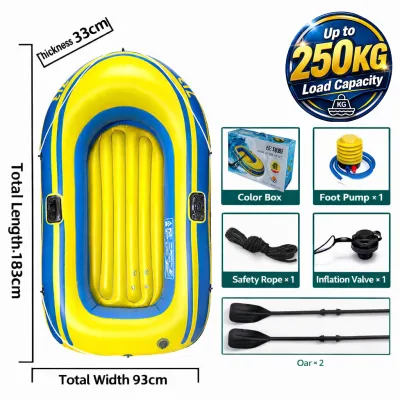
When comparing products, verify exactly what is included in the purchase kit. Some manufacturers sell complete packages that include heavy-duty aluminum oars, a high-volume pump, a repair kit, and a durable carrying bag. Other models are sold as bare boats, meaning you must purchase these essential accessories separately, which can add anywhere from ₱3,000 to ₱8,000 to your total investment.
Proper storage is critical for preventing material degradation, especially in hot, humid environments. Before storing your boat, always rinse the entire hull with fresh water to remove salt crystals, sand, and organic debris. Allow the boat to dry completely in a shaded, well-ventilated area; storing a damp boat leads to rapid mold growth and adhesive breakdown. Once dry, fold the boat loosely to avoid sharp creases and store it in a cool, dark, and pest-free location away from direct sunlight.
Verifying Safety Features and Essential Accessories
Before finalizing your purchase, you must verify that the boat possesses the necessary physical safety features and official certifications to protect you and your passengers on the water.
Examine the specification sheet for critical built-in safety features. Look for heavy-duty perimeter grab lines, which are essential for re-entering the boat from deep water or securing the vessel to a dock. Ensure there are robust, welded D-rings for anchoring, towing, and securing gear. If you plan to navigate choppy water, self-bailing drain valves are crucial for quickly clearing water that splashes into the hull.
Verify that the vessel carries recognized marine safety certifications, such as National Marine Manufacturers Association (NMMA) certification using American Boat and Yacht Council (ABYC) standards, or European CE markings. These certifications guarantee that the boat has undergone rigorous, standardized testing for buoyancy, weight capacity, material strength, and manufacturing quality.
It is vital to remember that no amount of advanced equipment can replace proper training, physical fitness, and sound judgment. Before launching, assess your personal swimming ability, understand local water currents, and check the weather forecast. Always establish clear stop conditions; if wind speeds exceed your paddling capability, or if a storm is approaching, postpone your trip and remain on shore.
Finally, remember that a floating boat is a vessel, not a life-saving device. Every adult passenger must wear a properly fitted, coast-guard-approved Personal Flotation Device (PFD) at all times while on the water. Additionally, always carry a loud whistle or signaling device, a manual water bailer or bilge pump, and a basic marine first-aid kit to handle unexpected emergencies.
Frequently Asked Questions (FAQ)
Can I attach an outboard motor to any inflatable floating boat?
No. You can only attach an outboard motor if the boat is explicitly designed with a rigid, reinforced transom and has a designated maximum horsepower (HP) or kilowatt (kW) rating. Attempting to mount a motor on a standard inflatable without these structural reinforcements will warp the hull, tear the fabric, and cause a severe safety hazard. Always check the manufacturer’s specification label to verify the maximum allowed motor weight and horsepower before purchasing an engine.
How do I properly store an inflatable boat in a tropical climate?
To protect your boat from tropical heat and humidity, always rinse it with fresh water after use to remove salt, sand, and debris. Let it dry completely in the shade; never leave an inflated boat baking in direct sunlight, as the heat causes the internal air to expand rapidly, which can rupture the seams. Once dry, deflate the boat fully, fold it loosely to avoid sharp creases, and store it in a cool, well-ventilated, and pest-free indoor area.
Community discussion
Share your experience or ask a question. Comments are reviewed before publication.