
Selecting the right size and weight of rhythmic gymnastics clubs requires balancing a gymnast’s physical measurements—specifically arm length and hand size—with their current competitive level and technical proficiency. Unlike other sports equipment where a larger size simply means more room for growth, choosing oversized or overweight clubs for gymnastics can severely hinder technical development, alter natural posture, and increase the risk of repetitive strain injuries. By matching the physical dimensions of the apparatus to the athlete’s current reach and grip capability, gymnasts can perform complex rotations, high tosses, and rapid catches with confidence and precision.
In the Philippines, where young athletes often train in warm, non-air-conditioned community gyms or school sports complexes, environmental factors like humidity also play a significant role in equipment selection. The moisture in the air directly affects how materials feel in the hand and how securely they can be gripped during high-velocity routines. Therefore, selecting the perfect pair of clubs involves evaluating not only physical dimensions and weight standards but also material performance under local tropical conditions.
Understanding Club Anatomy and Official Specifications
To make an informed decision, you must first understand that “clubs” in rhythmic gymnastics are highly specialized, precision-engineered apparatuses. They are entirely distinct from heavy fitness clubs used for strength training or the weighted clubs used by recreational jugglers. Rhythmic gymnastics clubs are designed specifically for aerodynamic stability, rapid hand-to-hand transitions, and intricate body rolls. Using the wrong type of club can result in poor performance and a high risk of injury during complex maneuvers.
Products mentioned in this guide

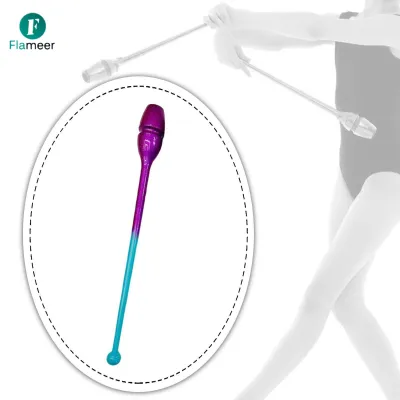
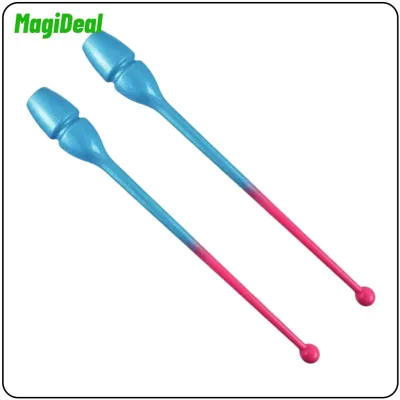
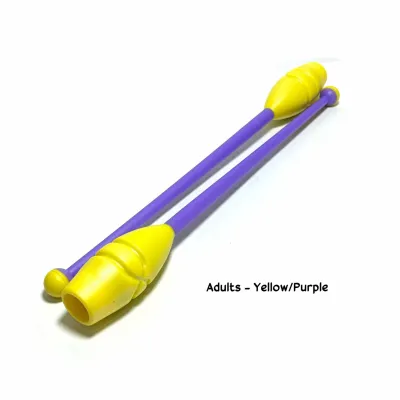
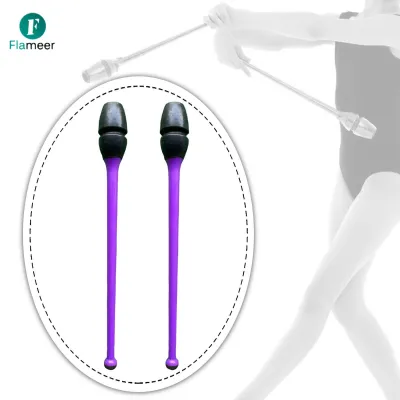
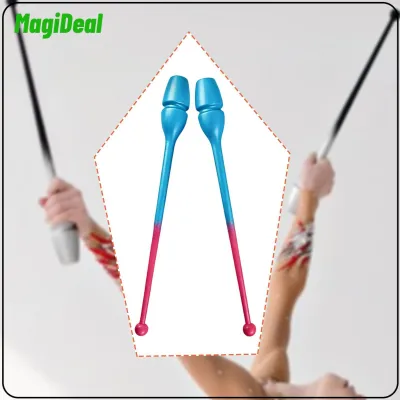
Prices are valid at publication and may change. Please refer to the product page for the latest price.
The anatomy of a rhythmic gymnastics club consists of three primary sections:
- The Head: The small, bulbous sphere at the top of the club, which allows for secure hooking between fingers during complex catches and mills.
- The Neck: The narrow, slender portion directly below the head, designed to be held comfortably between the fingers during high-speed rotations.
- The Body and Base: The wider, main portion of the club that tapers down to a flat or slightly rounded base. The distribution of mass along the body determines the club's center of gravity and overall rotational dynamics.
Governing bodies like the International Gymnastics Federation (FIG) establish strict parameters for equipment used in official competitions. For senior-level gymnasts, standard competition clubs must measure between 40 to 50 centimeters in length and weigh a minimum of 150 grams per club. Junior and developmental categories allow for shorter, lighter variations to accommodate smaller hand spans and shorter arm lengths.
Before purchasing any competition-grade equipment, always verify the specific technical rules and apparatus tolerances with your coach or the Gymnastics Association of the Philippines (GAP). Local developmental meets and school-level competitions (such as the Palarong Pambansa) may have specific weight and length allowances for younger age brackets that differ slightly from international senior standards.
Matching Clubs for Gymnastics to Age, Height, and Arm Length
Determining the correct length of your clubs for gymnastics is the most critical step in ensuring safe and effective training. An improperly sized club acts as an awkward lever, placing unnecessary torque on the wrist and shoulder joints. To find the ideal length, you can perform a simple physical measurement at home or in the gym.

Have the gymnast stand up straight with one arm fully extended parallel to the floor, keeping the hand flat and fingers pointed forward. Place the base of the club in the palm of the hand, resting against the base of the fingers. Extend the body of the club along the inside of the arm toward the chest. The head of the club should reach no further than the mid-bicep or the crease of the armpit, depending on the specific coaching style and regional federation guidelines. If the head of the club extends past the armpit or touches the neck, the club is too long and will interfere with close-body movements.
While age is often used as a general guide by manufacturers, it should only serve as a starting point. Physical growth rates vary widely, making arm span and hand size the ultimate deciding factors. The general progression of club lengths typically follows these parameters:
- Under 7 Years: 36 centimeters (often made of lightweight plastic or soft rubber for safety).
- Ages 8 to 11 Years: 40 to 41 centimeters (transitional sizes designed for intermediate youth development).
- Ages 12 Years and Older: 44 to 45 centimeters (standard junior and senior lengths that prepare gymnasts for official competition sizes).
Using clubs that are too long can lead to several technical errors and physical strains. It compromises throwing accuracy because the release point is harder to control, and it increases the difficulty of catching because the rotating mass is further from the hand. Over time, the extra leverage exerted by an oversized club puts excessive stress on the delicate tendons of the wrists and shoulders, potentially leading to chronic tendinitis.
When a young gymnast is experiencing a rapid growth spurt, the temptation to “size up” early to save money is common. However, transitioning to a longer apparatus should always be a gradual, coach-supervised process. If a gymnast is between sizes, it is generally safer to remain with the slightly shorter pair until their hand strength and shoulder stability can comfortably support the increased leverage of the larger size.
Selecting the Right Weight for Your Skill Level
While length determines reach and clearance, the weight of the club dictates how much force is required to initiate rotations, maintain momentum, and safely absorb the impact of a catch. The weight must match the gymnast’s muscular development and technical skill level to prevent fatigue-induced form breakdown.
Beginners and Young Athletes
For those just starting their gymnastics journey, starting with lighter, entry-level weights is essential. These clubs typically weigh between 100 and 130 grams. The reduced weight allows beginners to focus entirely on learning the basic mechanics of mills, circles, and small tosses without overloading their wrist joints. At this stage, the priority is building neuromuscular coordination and confidence. Lightweight clubs are also much safer when dropped, minimizing the pain and bruising that can occur during missed catches.
Intermediate to Advanced Gymnasts
As a gymnast transitions to intermediate and advanced routines, they must move up to standard competition weights, which are typically 150 grams per club. This weight is necessary because heavier clubs possess more inertia, allowing them to maintain a stable, predictable flight path during high tosses and multi-rotation throws. A club that is too light will easily drift off-course with the slightest breeze or minor release error, making high-altitude catches incredibly difficult and unpredictable.
Using clubs that do not match your physical capacity carries distinct risks:
- Too Heavy: Leads to rapid wrist fatigue, drooping elbows, and altered shoulder alignment, which ruins the aesthetic presentation of the routine and invites acute joint strain.
- Too Light: Results in a loss of spatial awareness. Because the gymnast cannot feel the weight of the apparatus rotating through the air, they lose track of its position, leading to mistimed catches and frequent drops.
To ensure a pair of clubs is balanced, hold one club horizontally by the neck using your index finger and thumb. Locate the balance point (the center of gravity) along the body. A well-constructed club will have its weight concentrated slightly toward the lower third of the body, providing a smooth, predictable swing. If the club feels excessively bottom-heavy or top-heavy, it will feel clumsy and difficult to control during rapid hand-to-hand manipulations.
Choosing Materials and Managing Grip in Humid Climates
The materials used to manufacture gymnastics clubs directly affect their durability, how they bounce when dropped, and how they feel in the hand. Modern clubs are primarily constructed from high-impact plastic, rubber, or a combination of both (dual-material clubs).
Solid plastic clubs are highly durable and generally more affordable, making them excellent for beginners. However, they are completely rigid, meaning they do not absorb shock well when dropped on hard gym floors, and they can cause painful impacts if they strike a gymnast during a failed catch. Rubber-headed or fully rubber clubs are the preferred choice for competitive gymnasts. The soft rubber head absorbs shock, bounces less erratically when dropped, and is significantly safer during high tosses. Dual-material clubs feature a rigid plastic body for structural integrity and a soft rubber head for safety and grip.
In the tropical climate of the Philippines, high humidity and heat present a unique challenge for grip management. Sweaty palms can cause plastic handles to become incredibly slippery, leading to premature releases or dropped apparatuses. Conversely, some rubber materials can become overly sticky or degrade faster when exposed to constant sweat and heat.
To manage grip effectively under these conditions, gymnasts often employ several strategies:
- Apparatus Tape: Wrapping the handle and neck with specialized, thin adhesive tape can improve friction. Ensure the tape is applied smoothly without wrinkles, as uneven surfaces can cause blisters.
- Chalk: A light application of magnesium carbonate (gymnastics chalk) on the hands can help absorb excess moisture, though it should be used sparingly to avoid drying out and cracking the skin.
- Manufacturer Compliance: Always check the manufacturer's care instructions before applying any adhesives, solvents, or grip aids. Some chemicals can degrade the synthetic rubber or plastic compounds, causing the material to become brittle or permanently sticky.
Maintaining your clubs also requires a regular safety inspection. Establish a weekly routine to check your apparatus for any signs of physical wear. Look closely for micro-cracks along the neck, seam separations where the rubber head meets the plastic body, or deep gouges on the base. If you detect any structural compromise, replace the clubs immediately. A cracked club can easily shatter upon impact with the floor or during a high-tension throw, posing a severe safety hazard to the gymnast and others nearby.
Step-by-Step Fitting and Testing Guide
Before finalizing your purchase or committing a new pair of clubs to daily training, perform this sequential testing protocol to ensure they are a perfect match for your physical proportions and skill level.
Step 1: The Grip Test
Hold the club by the neck, wrapping your fingers naturally around the shaft just below the head. Your thumb and index finger should meet comfortably without overlapping awkwardly or leaving a wide, unstable gap. If your fingers cannot wrap securely around the neck, the shaft is too thick, which will cause rapid hand fatigue. If your hand completely swallows the neck and your fingers overlap excessively, the club is too small, reducing your control during delicate maneuvers.
Step 2: The Balance Test
Extend your index finger and balance the club horizontally on it to find its center of gravity. Once balanced, gently tip the club up and down. The weight distribution should feel natural and predictable, not biased heavily toward one extreme end. A well-balanced club allows for smooth, effortless rotations around the hand and fingers without requiring excessive muscular force to keep it level.
Step 3: The Movement Test
Perform a series of basic technical movements in a safe, open space. Start with basic mills (alternating small circles close to the body), transition into figure-eights, and finish with a few small, controlled tosses. Observe how easily you can control the rotation speed and how comfortably the base of the club lands back in your palm during catches. The movement should feel fluid, and the apparatus should feel like an extension of your arm.
When to Stop: If at any point during these tests the gymnast experiences sharp joint pain in the wrists or elbows, struggles to maintain a neutral, upright posture, or consistently drops the club due to poor hand fit, halt the testing immediately. Do not attempt to “work through” the discomfort. Consult a qualified gymnastics coach to re-evaluate the measurements and select a lighter or shorter pair of clubs.
Frequently Asked Questions (FAQ)
Can I use rhythmic gymnastics clubs for juggling or general fitness?
No, rhythmic gymnastics clubs are not suitable for juggling or general fitness training. They are precision-engineered with specific aerodynamic properties, lightweight balances, and structural designs tailored solely for rhythmic gymnastics routines. Juggling clubs are typically heavier, have different weight distributions, and feature wider bodies designed to withstand constant, high-impact collisions. Using rhythmic clubs for juggling can quickly crack or break the delicate neck of the apparatus. Similarly, using them for fitness or strength training is ineffective and dangerous, as they do not provide enough resistance for muscle building and can cause repetitive strain injuries if swung forcefully like weighted fitness clubs.
How often should rhythmic gymnastics clubs be replaced?
There is no fixed calendar schedule for replacing rhythmic gymnastics clubs; instead, replacement depends entirely on training frequency, the surface of your training venue, and visible material wear. A gymnast training several hours a day on hard surfaces will need to replace their equipment much sooner than a recreational gymnast training once a week. You must replace your clubs immediately if you observe any structural defects, such as deep cracks along the neck, severe deformation of the rubber head, or a loose connection between the head and the body. Training with structurally compromised clubs is highly dangerous, as they can break apart mid-air during a high throw or shatter upon landing.
Community discussion
Share your experience or ask a question. Comments are reviewed before publication.