
Selecting the right Artengo tennis racket requires matching your current physical mechanics and playing frequency with the racket’s weight, head size, and balance. Instead of choosing the most advanced frame on the shelf, matching your equipment to your actual skill level ensures you can develop clean strokes, maintain control on the court, and avoid physical strain. In the tropical heat and high humidity of the Philippines, where court conditions can make balls feel heavy and fast, choosing a racket that complements your physical capabilities is essential for a sustainable and enjoyable game.
The ideal racket acts as an extension of your arm, helping you execute strokes with confidence. If a racket is too heavy or demanding, your technique will suffer, and you may risk injury. By understanding how different specifications influence playability, you can make an informed decision that supports your progression on the court.
Assess Your Current Tennis Skill Level
To find the right racket, you must first honestly evaluate your current playing frequency, technical consistency, and physical strength. This self-assessment establishes a baseline, preventing you from buying a frame that is either too forgiving to help you improve or too demanding for your current physical capabilities.
Products mentioned in this guide
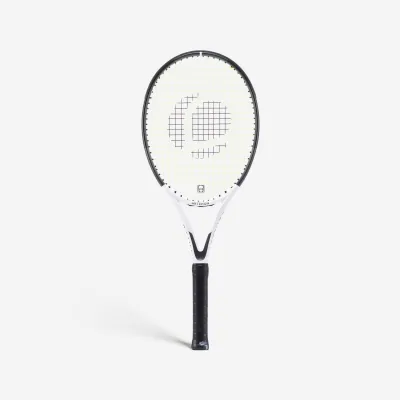
Prices are valid at publication and may change. Please refer to the product page for the latest price.
Beginner players are typically those who are still learning the basic swing paths of the forehand, backhand, and serve. If you play casually a few times a month, often struggle with inconsistent ball contact, and find yourself hitting the ball off-center, you fall into this category. At this stage, your primary equipment needs are comfort, vibration dampening, and a generous sweet spot that helps get the ball over the net even when your timing is slightly off.
Intermediate players have moved past the basics and can sustain consistent baseline rallies at a moderate pace. If you play regularly once or twice a week, are actively developing spin and directional control, and can direct your shots with some intent, you are an intermediate player. You require a racket that offers a balanced mix of power and control, allowing you to swing faster without constantly hitting the ball out of bounds.
Advanced players participate in competitive match play, possess refined stroke mechanics, and can generate their own power. If you train multiple times a week, utilize advanced footwork, and require precise shot placement to execute specific tactical strategies, you need a high-performance frame. Advanced players prioritize maximum feedback and control, as their developed swing speeds provide all the power they need.
Decode Racket Specifications for Your Needs
Translating your skill level into physical racket specifications is the next step in finding the perfect match. Rackets are defined by several key measurements, and understanding how these elements interact will help you narrow down your choices.

Head size is one of the most critical specifications to consider. Oversized frames, typically measuring 102 square inches or larger, offer a larger sweet spot and more forgiveness, making them excellent for beginners who need extra help with off-center hits. Midsize and midplus frames, usually ranging from 97 to 100 square inches, provide greater control and precision, which advanced players prefer because they can consistently hit the center of the string bed.
Weight and balance significantly affect how a racket feels during a swing. Lighter rackets, generally weighing under 280 grams, are highly maneuverable and easy on the wrist, making them ideal for developing players who are still building forearm strength. Heavier frames, weighing 300 grams or more, offer greater stability against fast incoming balls and allow advanced players to plow through the ball with more power, provided they have the physical strength to swing them consistently. Balance is also key; head-light rackets are easier to maneuver at the net, while head-heavy rackets provide more power from the baseline.
String pattern refers to the number of main (vertical) and cross (horizontal) strings. An open string pattern, such as 16×19, has wider spacing, which allows the strings to grip the ball more effectively to generate spin and power. A dense string pattern, like 18×20, offers a tighter grid that limits string movement, providing maximum control and a classic, crisp feel for players with fast, long swings.
Match Your Profile to the Right Artengo Series
Artengo categorizes its tennis rackets into distinct tiers to help players quickly identify which models are designed for their specific experience level. When browsing these options, pay close attention to the manufacturer’s intended user profiles and product labels.
The entry-level tier is designed specifically for beginners and casual recreational players. These rackets are typically pre-strung, lightweight, and constructed with materials like aluminum or graphite composites that prioritize comfort and easy handling. They feature large head sizes to maximize the sweet spot, allowing you to enjoy immediate playability without needing advanced technique.
The intermediate tier caters to players who are refining their strokes and playing more frequently. These mid-weight models, usually constructed from full graphite, offer a balanced blend of power and control. They provide better feedback than entry-level frames and are often sold unstrung or with basic factory strings, allowing you to customize your string setup as your playing style develops.
The advanced tier is engineered for competitive players who demand precision and stability. These frames are heavier, feature thinner beam widths for better aerodynamic control, and are designed to handle high swing speeds. They offer maximum court feedback, allowing you to feel exactly how the ball behaves on the string bed. When selecting from this tier, always verify the “designed for” or “skill level” tags on the specific product page to confirm the frame matches your physical capabilities.
Final Checks Before You Buy
Before finalizing your purchase, there are several practical details you must verify to ensure your new racket fits your physical dimensions and your overall budget. Taking these final steps will prevent discomfort and ensure a smooth transition to your new equipment.
Grip size is a critical physical measurement that directly impacts your technique and physical health. Playing with a grip that is too small or too large can cause you to squeeze the handle too tightly, leading to wrist fatigue or tennis elbow. To check your grip size, hold the racket in an eastern grip (like a handshake) and ensure you can fit the index finger of your non-dominant hand comfortably in the space between your ring finger and palm.
Budget allocation should extend beyond the cost of the racket frame itself. If you choose an intermediate or advanced model, you must factor in the cost of custom stringing, as these frames are often sold unstrung. Additionally, in the humid climate of the Philippines, sweat can quickly degrade your grip tape, so budgeting a portion of your funds in ₱ for replacement overgrips and a protective racket bag is highly recommended to keep your equipment in top condition.
Finally, always review the online store or local retailer’s return policies before completing your transaction. Some rackets may feel perfect on paper but prove too stiff, heavy, or unbalanced during your first few hits on the court. Knowing the return window and conditions will give you peace of mind as you test your new equipment.
Frequently Asked Questions (FAQ)
Do I need to restring a pre-strung Artengo racket?
Beginners can comfortably start with factory strings to learn basic stroke mechanics and test their commitment to the sport without extra upfront costs. However, intermediate and advanced players should plan to restring their rackets. Custom stringing allows you to select a specific tension and string material, such as co-polyester for spin or multifilament for comfort, that matches your playing style and the local court conditions.
How do I know if a racket is too heavy for me?
You can identify if a racket is too heavy by watching for specific physical signs during play. If you consistently make late contact with the ball, find yourself dropping the racket head during your swing, or experience rapid wrist and shoulder fatigue after a short session, the frame is likely too heavy. If these signs appear, step down to a lighter frame or consult a coach to adjust your mechanics before continuing play.
Community discussion
Share your experience or ask a question. Comments are reviewed before publication.