
Selecting the right basketball coaching board is a foundational decision for any coach looking to run an organized, efficient team. In the Philippines, where basketball is played on everything from polished indoor hardwood to concrete barangay courts, your coaching board must match both your team’s tactical complexity and the physical environment of your games. The ideal board serves as a clear visual bridge between your strategic vision and your players’ execution on the court.
For youth and beginner teams, a durable, lightweight clipboard-style board with a simple half-court layout is usually the most effective choice. High school and varsity teams benefit from double-sided boards that offer a balance of full-court transition planning and detailed half-court set plays. For semi-pro and elite clubs, a large-format magnetic board with dedicated carrying cases provides the tactical depth and high visibility required for complex systems and rapid adjustments during high-stakes timeouts.
Quick Guide: Matching the Board to Your Team Level
Every competitive level demands a different approach to communication, spacing, and tactical instruction. Matching your coaching board to your team’s specific level ensures that you do not overcomplicate instructions for beginners or limit your strategic options during advanced competition.
Products mentioned in this guide
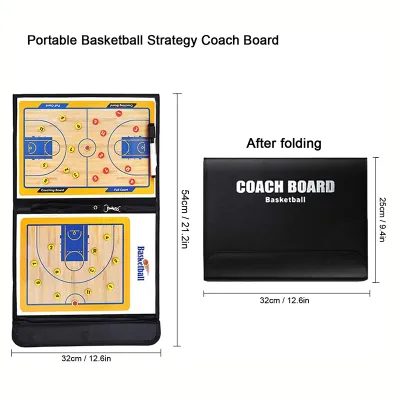
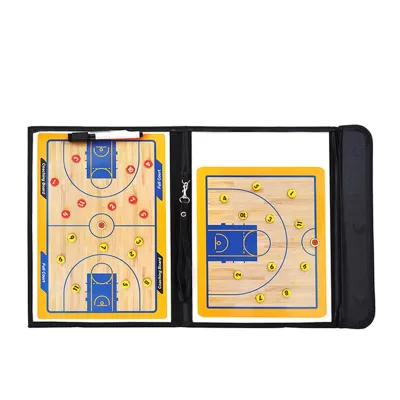
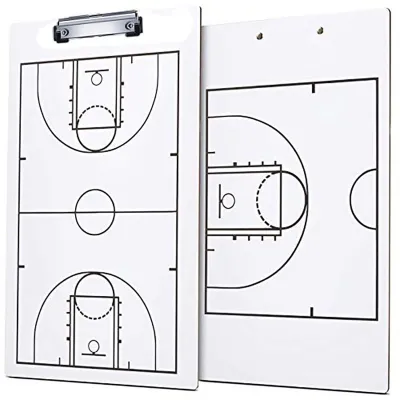
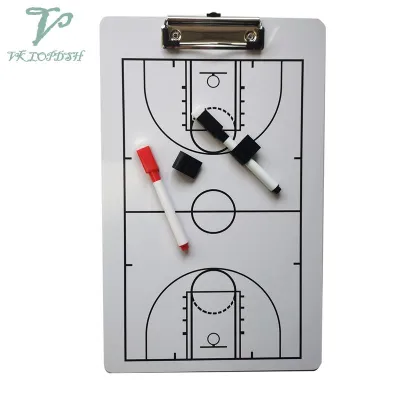
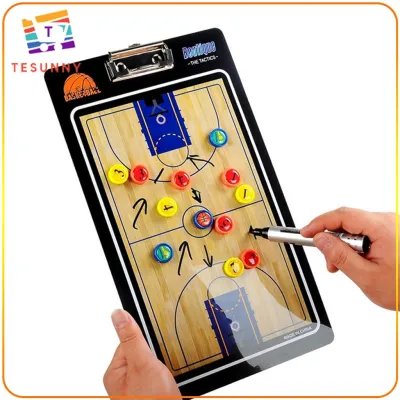
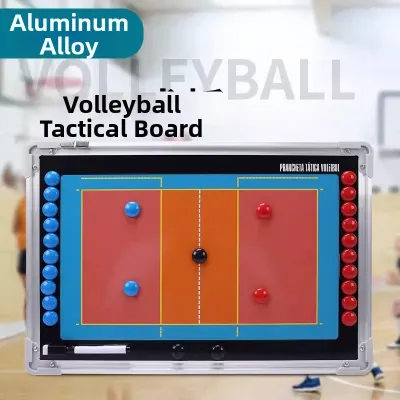
Prices are valid at publication and may change. Please refer to the product page for the latest price.
Youth and beginner teams require simplicity above all else. At this stage, players are still developing basic spatial awareness and learning fundamental positions. A complex board with multiple lines, zones, and magnetic pieces can easily overwhelm young minds. Instead, prioritize durability and simple half-court visuals. A lightweight clipboard-style board allows you to draw basic player movements quickly on the fly, making it easy to explain simple offensive spacing or basic defensive positioning without unnecessary distractions.
School and competitive varsity teams operate in a much faster, more structured environment. At this level, games are won or lost on transition play, press breaks, and baseline out-of-bounds execution. Coaches need a board that offers a balance of tactical detail and clear bench visibility. A double-sided board is highly effective here, allowing you to dedicate one side to a full-court view for press breaks and the other side to an enlarged half-court view for half-court sets. The board must be large enough for players sitting at the end of the bench to see clearly during noisy, high-pressure timeouts.
Semi-pro and advanced clubs require professional-grade tools that can handle highly detailed tactical adjustments. These teams run intricate offensive systems, multiple defensive rotations, and specific matchup adjustments. For these environments, focus on premium materials, full-court capabilities, and advanced play-drawing surfaces. Large-format magnetic boards with color-coded player markers allow you to demonstrate complex screening actions, defensive help-and-recover rotations, and precise player spacing with absolute clarity.
Essential Features to Evaluate Before You Buy
Before purchasing a basketball coaching board, it is essential to evaluate its physical and functional specifications. Sideline conditions can be unpredictable, and your board must be able to withstand the elements while remaining highly functional.

Size and Visibility
The physical dimensions of your coaching board directly impact how effectively your players can absorb information during a timeout. A small clipboard, typically measuring around 9 by 12 inches, is highly portable and excellent for individual instruction or small-group huddles. However, it is often too small for a full team huddle, especially when players on the bench are trying to peer over their teammates’ shoulders. A medium board, roughly 12 by 18 inches, or a large board, around 16 by 24 inches, offers much better visibility. To verify if a board is large enough, stand five steps back from it under typical court lighting; the lines and marker drawings should remain clearly legible without straining your eyes.
Surface and Markers
The quality of the drawing surface and the type of markers you use can make or break your sideline coaching experience. In the tropical climate of the Philippines, high humidity can cause standard dry-erase marker ink to bead up, smudge, or run if sweat or condensation gets on the board. Look for boards with high-contrast, scratch-resistant surfaces that allow dry-erase markers to glide smoothly and erase cleanly without leaving a faint residue, commonly known as ghosting. Magnetic boards offer an excellent alternative or supplement to markers, allowing you to use physical discs to represent players. However, you must verify that the magnetic backing is strong enough to hold the pieces securely when the board is held vertically or tilted during a frantic huddle.
Portability and Storage
Coaching often involves constant travel between different sports complexes, school gyms, and outdoor community courts. If you travel to away games via public transit, a motorcycle, or a packed team van, a massive, rigid board can be a major hassle to transport. Foldable designs that pack down into a compact size or clipboard-style builds with integrated carrying handles are highly practical for active coaches. Additionally, look for boards that feature dedicated storage compartments, zippered cases, or secure clips for markers and magnetic pieces. Losing your only dry-erase marker or a key player magnet right before a crucial game can severely disrupt your coaching workflow.
Ideal Board Configurations for Every Team Level
To help you narrow down your options, let us look at the optimal board configurations tailored to specific coaching environments and team structures.
Youth and Recreational Setup
For youth leagues and recreational teams, the ideal setup is a rugged, clipboard-style board made of shatterproof plastic or heavy-duty PVC. This configuration is designed to survive the rough-and-tumble nature of youth sports, including accidental drops on concrete outdoor courts. It should feature a strong metal clip at the top to secure your roster sheets, stat trackers, or tournament schedules. The back of the clipboard should feature a high-contrast, simplified half-court diagram. This setup allows you to deliver quick, direct instructions during short timeouts without worrying about losing loose magnetic pieces in the dirt or grass surrounding an outdoor court.
High School and Varsity Setup
For competitive high school and varsity teams, a double-sided, mid-size board is the gold standard. This setup typically features a full-court layout on one side and an enlarged half-court layout on the reverse. The board should be constructed from a rigid, lightweight material that does not bend or warp under pressure. Look for models that include a built-in dry-erase marker clip and a protective sleeve. This configuration allows you to quickly flip the board over to transition from drawing up a full-court press break to detailing a specific half-court offensive set, keeping your instructions fluid and professional during rapid-fire timeouts.
Semi-Pro and Elite Setup
For semi-pro, collegiate, and elite club teams, a professional-grade, large-format magnetic board is the ultimate tactical tool. This setup utilizes a high-contrast, magnetic dry-erase surface housed in a durable aluminum frame. It comes equipped with two complete sets of color-coded magnetic discs representing offensive and defensive players, along with a smaller disc representing the ball. The board should be paired with a dedicated, heavy-duty carrying bag that features zippered compartments to keep all magnets, markers, and erasers organized. This setup provides the precision and visual clarity needed to orchestrate complex tactical adjustments, set plays, and defensive matchups at the highest level of competition.
How to Maintain Your Coaching Board Throughout the Season
A basketball coaching board is an investment in your team’s success, and proper maintenance is key to ensuring it lasts for multiple seasons without degrading in quality.
Cleaning the Surface Properly
Over the course of a long season, sweat, dust, and dry-erase marker residue can build up on your board’s surface, leading to permanent staining and ghosting. To prevent this, avoid using harsh abrasive cleaners, rough scrubbing pads, or paper towels, which can create microscopic scratches on the board’s protective laminate. Instead, use a soft microfiber cloth dampened with a small amount of isopropyl alcohol or a dedicated whiteboard cleaning spray after every game. Wipe the board in gentle, circular motions, and ensure it is completely dry before storing it away in your gear bag.
Storing Magnetic Pieces and Markers Securely
Magnetic player pieces are incredibly easy to lose during the chaotic final minutes of a tight game. Establish a strict post-game routine where you or an assistant coach counts all the magnetic pieces before packing up. Store the magnets in a dedicated zippered pouch or a snap-lock plastic container rather than leaving them stuck to the board inside your bag, where they can easily slide off and get lost. Additionally, always store your dry-erase markers horizontally; storing them vertically can cause the ink to pool at one end, leading to faded lines or premature drying.
Protecting the Board from Extreme Heat and Moisture
Leaving your coaching board in the trunk of a hot car, in a humid storage locker, or exposed to direct sunlight for extended periods can cause serious damage. High temperatures can cause plastic and PVC boards to warp, bubble, or delaminate, while excessive moisture can degrade the magnetic backing and ruin the dry-erase coating. Always store your board in a cool, dry place inside a protective sleeve or carrying bag. If your board gets wet from sweat or a sudden rain shower on an outdoor court, dry it immediately with a clean towel to prevent moisture from seeping into the edges and causing structural damage.
Frequently Asked Questions (FAQ)
Can I use a standard dry-erase board outdoors in humid weather?
Yes, but you must take specific precautions. High humidity causes moisture to condense on the board’s surface, which can make standard dry-erase ink bead up, smudge, or fail to adhere properly. To ensure clear lines, always wipe the board completely dry with a clean microfiber cloth before drawing. Additionally, keep the board shaded from direct sunlight whenever possible, as intense heat can bake the marker ink onto the surface, making it extremely difficult to erase without leaving permanent stains.
Is a full-court board necessary for youth basketball?
Generally, a full-court board is not necessary for youth and beginner levels. Young players benefit much more from a simplified, enlarged half-court diagram, which allows them to focus on basic spacing, individual positioning, and simple offensive movements without visual clutter. A full-court layout can crowd the visual space and confuse players who are still learning the basics. However, as players transition to competitive high school levels where full-court press breaks and transition defense become central to the game plan, a full-court view becomes highly beneficial.
How do I stop the magnetic pieces from falling off during timeouts?
Magnetic pieces usually slide or fall off due to a buildup of dust, sweat, or skin oils on the board’s surface, which reduces the friction needed to keep them in place. Regularly clean both the board and the back of the magnetic discs with a damp cloth to remove any accumulated grime. If the magnets have weakened over time, consider replacing them with high-strength neodymium magnetic discs, which offer a much stronger hold. Additionally, try to hold the board at a slight angle rather than completely vertical during timeouts to let gravity assist the magnets.
Community discussion
Share your experience or ask a question. Comments are reviewed before publication.