
Choosing the right swim gear for a young athlete requires balancing performance gains with physical safety. When selecting a finis paddle for your child’s swimming training, the primary goal is to find a size and style that enhances their water feel and stroke mechanics without straining their developing joints. In the tropical climate of the Philippines, where year-round swim training in local club pools is highly popular, parents often look for tools to help their children excel in competitive meets. However, choosing an oversized paddle can lead to severe shoulder strain, making correct sizing the most critical decision you will make.
Hand paddles are excellent tools for improving stroke efficiency, but they must be matched precisely to the swimmer’s physical maturity and skill level. A paddle that is too large acts like a sail, catching too much water and placing immense stress on young shoulders. By understanding how to measure your child’s hand and matching their current swimming ability to the correct paddle design, you can ensure their training remains both safe and highly effective.
Why Correct Paddle Sizing Protects Your Child's Shoulders
Youth shoulder joints are still developing, meaning their growth plates, tendons, and muscles are highly susceptible to overuse injuries when subjected to excessive resistance. A hand paddle increases the surface area of the hand, which naturally increases the force required to pull through the water. If the paddle is too large, this hydrodynamic resistance rises exponentially, placing immense torque on the rotator cuff muscles and the anterior shoulder joint.
Products mentioned in this guide
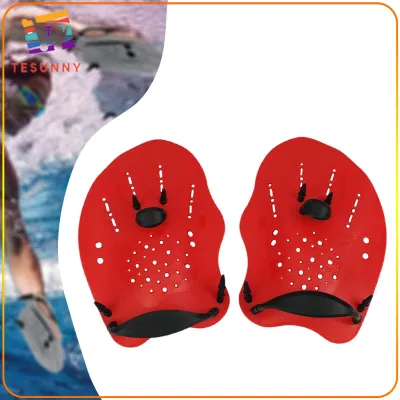
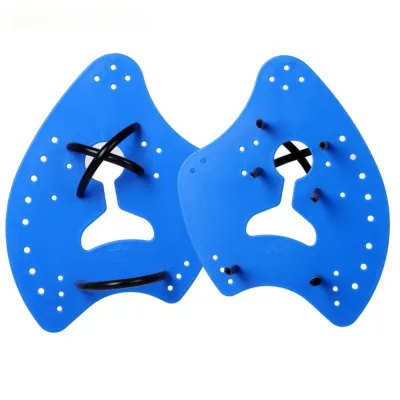
Prices are valid at publication and may change. Please refer to the product page for the latest price.
When a child uses an oversized paddle, they rarely have the physical strength to pull it through the water with proper form. To compensate for the heavy load, they will often drop their elbows, flare their wrists, or over-rotate their hips. These technical compensations not only ruin their stroke mechanics but also create repetitive strain patterns that can lead to chronic shoulder pain or tendinitis. A properly sized paddle should feel like a natural extension of the hand, allowing the child to maintain a high-elbow position and a clean catch phase.
Furthermore, parents must resist the common temptation to “size up” to allow room for growth. While buying larger sizes works well for school uniforms or casual footwear, applying this logic to swim training equipment is highly dangerous. An oversized paddle forces a young swimmer to rely on brute force rather than developing a refined feel for the water. Prioritizing correct sizing ensures that your child builds a technically sound stroke foundation while protecting their joints from long-term injury.
How to Measure Hand Size for the Right Finis Fit
To find the perfect fit, you must rely on accurate physical measurements rather than guessing based on your child’s age or shoe size. Finis sizing charts are highly specific and correlate directly with hand dimensions. Preparing a clear measurement profile before shopping will save you time and prevent the risk of purchasing an unsuitable model.

Follow these step-by-step instructions to measure your child’s hand accurately:
- Prepare the hand: Have your child place their dominant hand flat on a sheet of paper, spreading their fingers naturally as if they were resting them on the surface of the water. Do not let them clench their fingers or stretch them too far apart.
- Measure hand length: Use a ruler or measuring tape to measure from the base of the wrist (the first prominent crease at the heel of the palm) to the very tip of the middle finger. Record this measurement in centimeters.
- Measure hand width: Measure across the widest part of the palm, which is typically across the knuckles (metacarpophalangeal joints), excluding the thumb. Record this measurement as well.
- Compare with the sizing chart: Cross-reference these two measurements with the official Finis sizing guide for the specific paddle model you are considering.
When analyzing the sizing chart, you may find that your child’s measurements fall directly on the boundary between two sizes (for example, between a Junior and a Small). In these borderline scenarios, the golden rule of swim training is to always size down to the smaller paddle. Selecting the smaller size minimizes joint stress and ensures the child can maintain perfect control over their stroke mechanics.
Before letting your child jump into the pool, perform a quick dry-fit check. Have them place their hand on the paddle; their fingers should not overhang the edges of the plastic, and the straps or thumb holes should hold the hand securely without pinching the skin or cutting off circulation.
Matching Paddle Designs to Your Child's Skill Level
Not all swim paddles serve the same purpose. Finis designs various models to target specific aspects of stroke development, and choosing the right style depends heavily on your child’s current training phase.
Beginners and Technique Builders
For young swimmers who are still mastering the fundamentals of hand entry, body rotation, and stroke path, the primary focus must be on technique rather than power. Beginners benefit most from small surface area paddles and strapless designs. Strapless paddles rely entirely on the natural pressure of the water against the palm to stay in place during the pull phase.
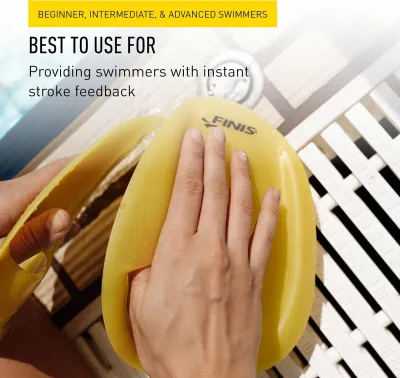
If a beginner enters the water at an incorrect angle, slices sideways, or drops their elbow, the strapless paddle will instantly slip off their hand. This immediate physical feedback is incredibly valuable, as it teaches the child to correct their entry and catch angles without the coach needing to constantly shout instructions from the pool deck. Because these paddles have a small surface area, they provide just enough resistance to build awareness of water pressure without overloading the child’s shoulders.
Intermediate and Advanced Youth Swimmers
As youth swimmers transition into competitive age-group training, their workouts become more structured, and their technical needs shift toward refining specific stroke phases and building endurance. Intermediate and advanced paddles often feature skeletal frames, contour shapes, or strategically placed flow holes.
These advanced designs allow a portion of the water to pass through or around the paddle, which helps the swimmer maintain a natural “feel” for the water. This prevents the hand from feeling numb or disconnected from the water, which can happen with solid, flat paddles. By reducing the overall physical load while still targeting key stroke mechanics—such as a high-elbow catch or an efficient sculling motion—these paddles help older youth swimmers build functional strength safely.
Top Finis Paddle Models for Junior and Youth Swimmers
Finis offers several paddle lines designed specifically for younger swimmers. Understanding the unique features, ideal use cases, and limitations of each model will help you make an informed purchase. In the Philippine market, these models are typically available through specialized swim shops or online sports retailers, with prices generally ranging from ₱1,200 to ₱2,200 depending on the model.
Finis Junior Agility Paddles
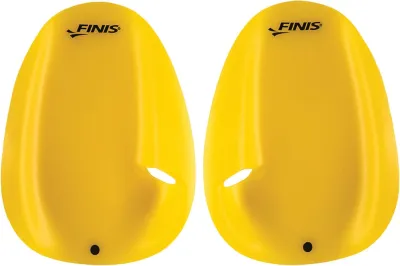
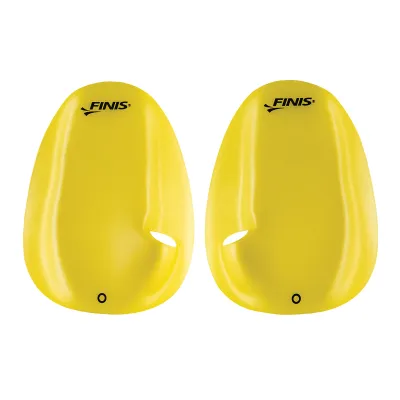
The Finis Agility paddle is famous for its strapless, ergonomic design that features only a single thumb hole. The Junior version is specifically contoured to fit smaller hands, utilizing a convex profile that matches the natural curve of a young swimmer’s palm.
- Ideal for: Young beginners and intermediate swimmers who need to build a consistent hand entry and catch technique across all four competitive strokes (freestyle, backstroke, breaststroke, and butterfly).
- Limitations: Because the design is completely strapless, it cannot be used for high-velocity sprint drills where technical form naturally degrades, nor is it intended for heavy resistance or power-building sets.
Finis Youth Instinct Paddles
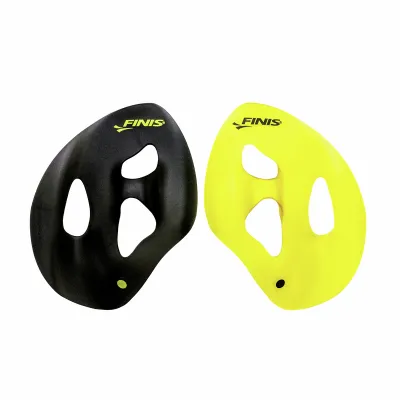
The Youth Instinct paddle is another strapless option but features a more compact, highly maneuverable shape with strategically placed flow holes. It is designed to fit comfortably in the gear bags of active club swimmers.
- Ideal for: Intermediate youth swimmers who are working on refining their catch and pull phases. The small footprint makes it highly versatile for individual medley (IM) training, allowing quick transitions between different stroke mechanics.
- Limitations: Swimmers must have a baseline level of stroke consistency to keep the paddles on their hands; absolute beginners may find them frustrating to use if their hand entry is highly unstable.
Finis Youth Freestyler Paddles
The Freestyler paddle features a distinct, elongated, surfboard-like shape with a small tracking skeg (fin) on the bottom. This highly specialized design is engineered specifically to guide the hand forward through the water, promoting a long, clean reach.
- Ideal for: Older youth or competitive age-group swimmers who specialize in freestyle and need to correct common faults like hand crossover (crossing the body's midline) or short, choppy strokes.
- Limitations: This model is strictly designed for freestyle training. Using it for breaststroke, butterfly, or backstroke drills can damage the paddle, strain the wrist, or cause shoulder discomfort due to lateral water forces.
Safe Training Limits and Usage Guidelines
To keep your child’s shoulders healthy, hand paddles should always be treated as a supplementary technical tool rather than a primary training method. Equipment cannot replace proper coaching, physical conditioning, and personal judgment. Introducing paddles too quickly or using them for too long can easily lead to overuse injuries.
When incorporating a finis paddle into your child’s routine, follow these safety guidelines:
- Limit the volume: Keep paddle work to a small percentage of the total workout distance. For young swimmers, paddle use should not exceed 10% to 15% of their total daily yardage or mileage. For example, if a child swims 2,000 meters in a practice session, they should use paddles for no more than 200 to 300 meters.
- Perform a thorough warm-up: Never let your child put on paddles at the very start of a practice. Ensure they perform a thorough, paddle-free warm-up of at least 400 to 500 meters of easy swimming, combined with dynamic shoulder mobility exercises, to prepare the rotator cuff muscles for the increased resistance.
- Monitor for warning signs: Watch your child closely during paddle sets. If they complain of shoulder or wrist pain, show signs of dropping their elbows, shorten their stroke length, or struggle to keep the paddles on their hands, they must stop using them immediately.
- Consult the coach: Always consult your child's swim coach before introducing paddles. The coach can ensure that paddle use aligns with the team's training plan and can monitor your child's form to prevent injury.
Additionally, the high humidity and intense heat in the Philippines can accelerate the degradation of swim gear. To protect your investment, always rinse the paddles in clean, non-chlorinated tap water after every practice. Dry them thoroughly in the shade, and avoid leaving them in hot cars or direct sunlight, which can warp the plastic or degrade the rubber components.
Frequently Asked Questions (FAQ)
Can my child use adult-sized paddles if they have large hands?
No, children should not use adult-sized paddles even if their hands are physically large enough to fit them. Physical hand size does not correlate with joint, tendon, or muscle maturity. An adult paddle generates a level of water resistance that a child’s developing shoulder joints and rotator cuffs cannot safely handle. Using an oversized paddle forces the child to use brute force and poor mechanics, significantly increasing the risk of long-term shoulder injuries. Always stick to youth- or junior-specific models until the swimmer reaches physical maturity and has established a robust strength base.
How often should kids use swim paddles during practice?
Kids should use swim paddles sparingly, typically no more than two to three times a week during designated technique or resistance sets. Paddles are designed to provide sensory feedback and build specific stroke mechanics, not to serve as a constant prop. Overusing paddles can make a young swimmer dependent on the extra surface area for speed, which can negatively affect their natural water feel and pacing when they swim without them. Ensure that paddle sets are always supervised by a qualified coach who can monitor form and intervene if the child’s technique begins to break down.
Community discussion
Share your experience or ask a question. Comments are reviewed before publication.