
Finding the right golf cart charger is not as simple as picking any plug that fits your cart’s receptacle. In the Philippines, golf carts serve as essential transport not just on premier golf courses in Cavite or Clark, but also as utility vehicles in gated residential villages, beach resorts, and industrial estates. To keep your cart running reliably through tropical heat and sudden downpours, you must match the charger’s specifications to your battery bank’s exact requirements. Choosing an incompatible charger can lead to sluggish performance, ruined batteries, or even serious safety hazards.
Selecting the correct charger comes down to three non-negotiable factors: matching the system voltage, aligning the charger’s algorithm with your battery chemistry, and selecting an amperage that fits your daily usage routine. By taking the time to verify these specifications, you protect your battery investment and ensure your cart is always ready for the next drive.
Identify Your Battery Voltage, Chemistry, and Capacity
Before browsing online marketplaces or visiting a local specialty shop, you must perform a quick diagnostic check of your golf cart’s battery compartment. Lift the seat to expose the battery bay. Do not guess the specifications; instead, locate the physical labels printed on the side or top of the batteries, or consult your cart’s owner’s manual. If the batteries are dirty or show signs of corrosion, wear protective gloves and eyewear to wipe them clean so you can read the labels clearly.
Products mentioned in this guide
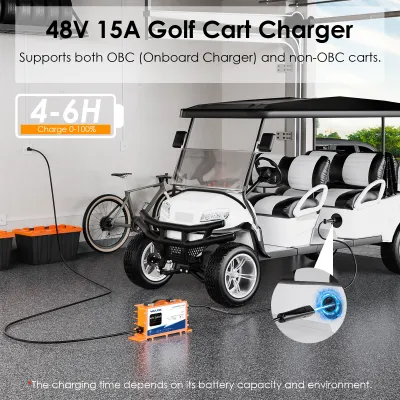
Prices are valid at publication and may change. Please refer to the product page for the latest price.
First, determine the total system voltage of your cart. Golf carts typically operate on 36-volt, 48-volt, or sometimes 72-volt configurations. This total system voltage is the sum of the individual batteries connected in a series. For example, if your cart contains six 8-volt batteries, you have a 48-volt system. If it has six 6-volt batteries, it is a 36-volt system. The output voltage of your new charger must match this total system voltage exactly. Connecting a 48V charger to a 36V battery bank will destroy the batteries, while a 36V charger will fail to charge a 48V system.
Second, identify the battery chemistry. Traditional golf carts rely on lead-acid batteries, which are heavy and require specific maintenance. Modern upgrades often feature lithium-ion batteries, which are lighter and charge faster. Look closely at the battery casing for terms like “Flooded” (or wet cell), “AGM” (Absorbed Glass Mat), “Gel,” or “LiFePO4” (Lithium Iron Phosphate).
Third, locate the Amp-Hour (Ah) rating. This number indicates the battery’s total energy capacity—essentially the size of its fuel tank. A standard lead-acid golf cart battery might have a rating of 170 Ah to 225 Ah, while lithium setups often range from 60 Ah to 100 Ah. Knowing this rating is crucial because it dictates how much current (amperage) your charger needs to supply to replenish the cells in a reasonable timeframe. Guessing these specifications can lead to severe battery damage or safety hazards; always verify via physical labels or manufacturer documentation before purchasing.
Match the Charger Profile to Your Battery Chemistry
A golf cart charger is not a simple power cord; it is a sophisticated device that delivers power using a specific charging profile, or algorithm. This algorithm dictates how much voltage and current are applied at different stages of the charging cycle. Because different battery chemistries react differently to electrical current, using a charger with the wrong profile can lead to undercharging, overheating, or catastrophic battery failure.

Lead-Acid Batteries (Flooded, AGM, and Gel)
Traditional lead-acid batteries require a multi-stage charging process to reach full capacity safely. This process typically involves three main stages: bulk, absorption, and float. During the bulk stage, the charger delivers a constant, high current to bring the battery up to about 80% capacity. The absorption stage then holds a constant voltage while gradually reducing the current to top off the remaining 20%. Finally, the float stage drops to a lower maintenance voltage to keep the battery fully charged without boiling away the electrolyte.
It is important to note that lead-acid subtypes have unique tolerances. Flooded lead-acid batteries, which require regular topping off with distilled water, can handle slightly higher voltages and benefit from periodic “equalization” charges. Equalization is a controlled overcharge that balances the voltage of individual cells and prevents acid stratification. AGM and gel batteries, however, are sealed. Gel batteries are particularly sensitive to overvoltage; excess voltage can cause bubbles in the gel, permanently damaging the battery. If you have AGM or gel batteries, you must verify that your charger has a specific setting or switch designed for these sealed chemistries.
Lithium-Ion Batteries and BMS Requirements
Lithium-ion golf cart batteries, most commonly Lithium Iron Phosphate (LiFePO4), require a completely different charging profile known as Constant Current/Constant Voltage (CC/CV). Unlike lead-acid batteries, lithium batteries must never receive a trickle charge or an equalization charge. Applying a high-voltage equalization phase to a lithium pack can cause permanent cell damage or trigger safety hazards.
Furthermore, lithium batteries rely on an internal Battery Management System (BMS). The BMS acts as the brain of the battery, monitoring cell temperatures, balancing voltages, and protecting against overcharging. When selecting a charger for a lithium battery, you must verify if the battery’s BMS requires a charger with specific communication protocols (such as CAN bus communication) to safely manage the charge cycle.
Never attempt to use a standard lead-acid charger on a lithium battery pack. Even if the voltage seems to match, the lead-acid charger’s multi-stage algorithm—specifically the float and equalization stages—can cause the lithium BMS to shut down the system unexpectedly or shorten the lifespan of your expensive lithium cells. Always refer to the battery manufacturer’s instructions to confirm charger compatibility.
Determine the Right Charger Amperage for Your Routine
Once you have matched the voltage and chemistry, you must decide on the charger’s output current, measured in amperes (Amps). The amperage of your charger determines how quickly it can replenish your battery bank. There is a direct relationship between charger amperage, battery capacity (Ah), and total charging time.
As a general diagnostic framework, battery manufacturers typically recommend a charger amperage that is between 10% and 20% of the battery bank’s total Amp-Hour (Ah) rating. For example, if you have a 100 Ah lithium battery bank, a charger with an output of 10 to 20 Amps is ideal. If you have a larger 200 Ah flooded lead-acid bank, a 15-amp to 25-amp charger is standard. Always check your battery manufacturer’s exact specifications to find the recommended charge rate.
Choosing the right amperage involves weighing clear trade-offs. A higher-amperage charger will get your cart back on the course much faster. However, rapid charging generates more heat, which can degrade battery health over time if the system is not designed to handle it. Conversely, a lower-amperage charger is gentler on the battery cells and can prolong their overall lifespan, but it requires much longer plug-in times—sometimes up to 12 hours or more for a full charge.
Align your choice with your typical usage routine. If you run a commercial facility, a resort in out-of-town destinations, or use your cart heavily every day for chores, you will likely need a higher-amperage charger to ensure a fast turnaround. If you only use your golf cart for weekend rounds or occasional leisure rides around a residential village, a lower-amperage, slower charger is a highly cost-effective and battery-friendly choice.
Check Connectors, Safety Features, and Local Storage Conditions
Before finalizing your purchase, you must address the physical and environmental realities of operating a golf cart in the Philippines.
First, inspect the DC connector. Golf cart manufacturers use proprietary charging receptacles, and there is no single universal plug. Common types include the 3-pin triangular plug for Club Car, the rectangular TXT plug for EZGO, the round RXV plug, or the classic crowfoot style. Look closely at your cart’s charging port and match it exactly to the charger’s plug. Avoid using cheap, uncertified adapters, as poor physical connections can create electrical resistance, melt the plastic housing, or cause electrical shorts.
Second, prioritize built-in safety features. A high-quality charger should feature reverse polarity protection (preventing damage if the cables are connected backward), short-circuit protection, over-temperature shutdown, and spark-free connections. These features are critical for protecting your investment and ensuring household safety.
Third, consider the local climate. The Philippines is known for its intense tropical heat, high humidity, and heavy seasonal rainfall. If you store your golf cart and charger in an open carport, a semi-outdoor garage, or near coastal areas where salt air can accelerate corrosion, you must check the charger’s Ingress Protection (IP) rating. Look for a charger with an IP65 or IP67 rating, which indicates a high level of dust and water resistance. Chargers with fully enclosed aluminum designs and moisture-resistant internal coatings are far better suited to withstand tropical humidity and prevent internal component failure than cheap, plastic models with open vents.
Frequently Asked Questions (FAQ)
Can I use a lead-acid charger on a lithium battery in an emergency?
No, you should never use a lead-acid charger on a lithium battery. Lead-acid chargers employ multi-stage charging algorithms that include float and high-voltage equalization stages. These stages can confuse or damage a lithium battery’s Battery Management System (BMS), leading to premature shutdowns, cell degradation, or severe safety hazards. Always use a charger specifically calibrated for lithium batteries.
How can I tell if my golf cart charger is failing?
Common warning signs of a failing charger include the device failing to turn on when plugged in, shutting off prematurely before the batteries are fully charged, or emitting excessive heat and unusual burning smells. You might also notice loud clicking, buzzing, or a complete lack of indicator lights. If you observe these symptoms, stop using the charger immediately and consult a professional technician or the manufacturer.
Is it safe to leave the charger plugged in for extended periods?
This depends entirely on the type of charger you own. Modern smart chargers are designed with automatic maintenance or float modes that safely monitor the battery and shut off when full, making them safe to leave connected during the off-season. However, older manual chargers will continuously pump current into the batteries and must be unplugged manually to prevent overcharging and permanent damage. Always verify your specific charger’s manual for storage guidelines.
Community discussion
Share your experience or ask a question. Comments are reviewed before publication.