
Selecting the right golf mat hitting pad is the foundation of a safe, effective, and enjoyable home practice setup. A high-quality mat does more than simply hold your golf ball; it protects your joints from repetitive impact, mimics the feel of real turf, and provides accurate feedback on your ball-striking. Because every golfer has a unique swing style, space limitation, and practice goal, there is no single option that suits everyone. Finding the ideal mat requires evaluating your physical practice environment, your skill level, and the specific material specifications of the product. By focusing on these key factors, you can build a practice space that helps you improve your game without risking injury or wasting money on gear that quickly degrades.
Assess Your Practice Space and Flooring
Before browsing online marketplaces, you must carefully measure your designated practice area. Swing clearance is the most critical spatial constraint; you need enough vertical and horizontal room to swing your longest club, typically a driver, without hitting walls, ceilings, or light fixtures. A full-size mat, which generally measures at least 1.5 meters by 1.5 meters, allows you to stand on the same level as the ball. This setup prevents stance imbalances and replicates real-world playing conditions. If your space is limited, a mid-size or compact travel mat can save space, but you may need to find a creative way to keep your feet level with the hitting surface.
The underlying floor material directly dictates the amount of cushioning your mat requires. In many residential setups, particularly in garages, carports, or outdoor patios, the mat will sit directly on hard concrete. Hitting golf balls repeatedly on a thin mat over concrete can send harsh vibrations up the club shaft, leading to joint fatigue or injury. For concrete surfaces, prioritize mats with a thick, high-density foam base of at least 15 millimeters to absorb the shock of downward strikes. If you plan to set up on natural grass or a carpeted indoor floor, you can opt for a slightly thinner base, as the underlying surface already provides some natural give.
Products mentioned in this guide
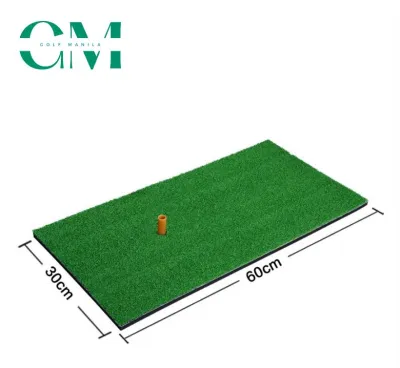
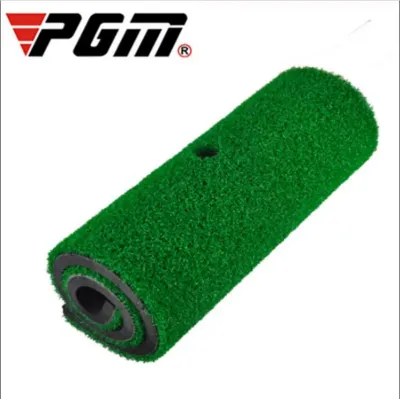
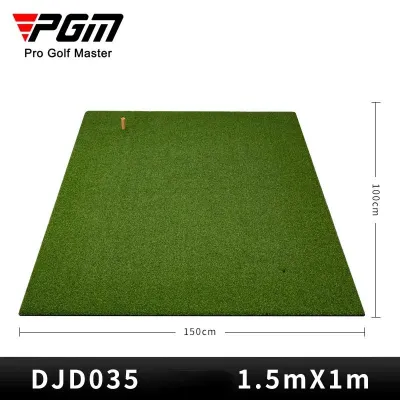
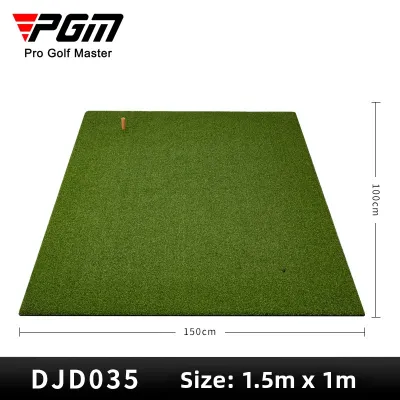
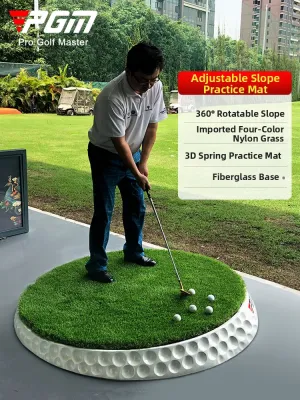
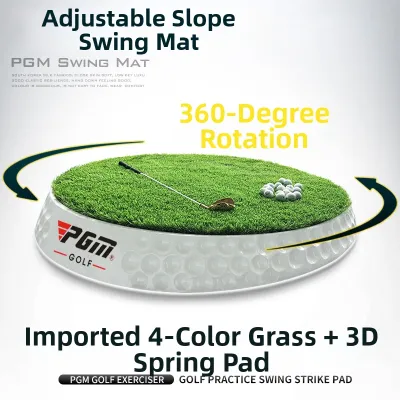
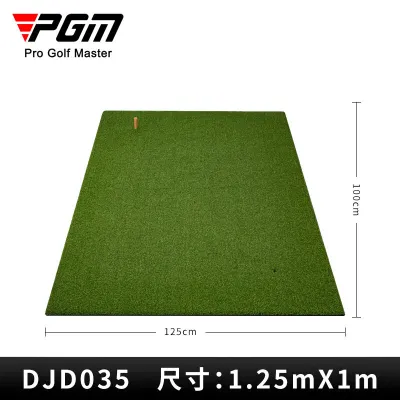
Prices are valid at publication and may change. Please refer to the product page for the latest price.
Portability and storage are equally important if your practice area serves multiple purposes. If you need to clear your carport to park a vehicle or tidy up a shared living space after practice, look for mats designed to roll up easily without retaining a permanent curl. Heavy-duty commercial mats can weigh over 15 kilograms, making them highly stable but difficult to move regularly. Lightweight, multi-panel, or folding mats offer excellent portability, though they may slide slightly on smooth floors during high-velocity swings.
Match the Mat to Your Skill Level and Swing
Your current skill level and typical swing path should heavily influence the type of turf and backing you choose. Beginners and high-handicap players often struggle with inconsistent contact, frequently hitting “fat” shots where the club strikes the ground before the ball. On a low-quality or overly firm mat, these heavy strikes can cause painful jarring in the wrists, elbows, and shoulders. If you are still refining your contact, look for a mat with a highly forgiving, thick foam layer or a cushioned base. This design dampens the impact of misstrikes, allowing you to practice longer without discomfort.

Advanced players, on the other hand, require realistic feedback to diagnose subtle swing flaws. Highly forgiving mats can mask poor contact by allowing the club head to bounce off the turf and glide into the ball, producing a decent shot despite a heavy strike. To avoid developing bad habits, experienced golfers should look for firmer, more realistic turf configurations. These mats feature specialized fiber matrices that resist the club head when you hit behind the ball, mimicking the loss of distance and feel of a real-world fat shot. This immediate feedback is crucial for maintaining a precise swing plane and clean ball-first contact.
Your typical divot pattern also determines how much resistance you need from your practice surface. Golfers with steep swing paths who take deep divots on the course will put immense stress on a synthetic mat. If you have a steep angle of attack, a mat with a deeper, plush fiber bed allows the club to dig slightly into the surface without bottoming out abruptly against the hard base. Sweepers, who take very shallow divots or pick the ball cleanly off the turf, can comfortably use thinner, tighter turf profiles without experiencing excessive resistance or joint strain.
Evaluate Turf Realism and Joint Protection
The quality of the synthetic grass determines both the realism of your practice and the longevity of the mat. High-quality mats typically utilize nylon fibers, which offer excellent durability, resistance to friction heat, and a natural feel. Polypropylene is another common option that is often more budget-friendly, but it tends to melt or mat down more quickly under the high-speed friction of club soles. Look for turf that features a dense, multi-directional fiber construction. This design prevents the grass from laying flat in one direction, ensuring the ball sits up naturally on top of the blades rather than sinking to the backing.
Joint protection is the most critical safety feature of any golf mat hitting pad. Repetitive practice sessions involve hundreds of impacts, and without proper shock absorption, this energy is transferred directly into your body. The backing layer, usually made of closed-cell foam like EVA (ethylene-vinyl acetate) or polyurethane, acts as the primary shock absorber. High-density foam bases are superior because they resist bottoming out over time, maintaining their protective qualities even after thousands of swings. Avoid cheap mats that use low-density, open-cell foam, as they compress completely under impact, leaving your joints vulnerable to the hard floor beneath.
To verify the protective capabilities of a mat before buying, look closely at the construction layers. Premium mats often feature a dual-layer or triple-layer design, combining a durable nylon turf, a stabilizing interface layer, and a thick foam or gel base. This multi-layer construction disperses the energy of the club strike horizontally across the mat rather than vertically into your wrists. If the manufacturer does not specify the density or material of the foam backing, treat it as a warning sign and look for options that clearly detail their shock-absorption technology.
Compare Mat Configurations for Your Drills
Golf mats come in several distinct configurations, each tailored to different types of practice routines. Single-surface mats are the most common and versatile option, providing a large, uniform area for full swings. These are ideal if you want a clean, uncluttered look and primarily practice with your irons and woods. However, because the turf height is uniform, single-surface mats do not allow you to practice shots from varying lies, such as the rough or semi-rough.
For golfers who want to simulate a complete round of golf, multi-surface or tri-turf mats are an excellent alternative. These mats are divided into distinct zones, typically featuring short fairway turf, longer rough grass, and a tee-box simulation area. This setup allows you to practice driving, hitting recovery shots from deep grass, and executing clean fairway strikes all on the same pad. While highly versatile, multi-surface mats are often smaller in overall footprint, meaning you may need to stand off the mat on a separate leveling pad to maintain a proper stance.
If you practice your drives frequently, pay close attention to the tee integration system. Some mats feature pre-drilled holes designed to accept standard rubber tees of varying heights. While convenient, these rubber tees can feel unrealistic and can tear over time. More advanced mats utilize a dense, high-pile turf that allows you to insert a standard wooden or plastic tee directly into the fibers at any location. This setup provides a highly realistic driving experience, though it requires a specialized, high-density turf construction that can support the tee without a pre-drilled hole.
Check Durability and Maintenance Requirements
A golf mat hitting pad is a significant investment, and proper care is essential to maximize its lifespan, especially in challenging environments. In tropical climates like the Philippines, high humidity, intense heat, and heavy rainfall can accelerate the degradation of synthetic materials. If you plan to set up your mat outdoors on a balcony, patio, or backyard, ensure the product specifications explicitly mention UV resistance. Without UV stabilizers, the synthetic fibers can become brittle and fade, while the foam backing may dry out, crack, and crumble under constant sun exposure.
Regular cleaning is necessary to remove dirt, grass stains, and plastic residue left behind by club soles. To clean your mat safely, use a soft-bristle brush, mild dish soap, and lukewarm water to gently scrub the turf. Avoid using harsh chemical solvents, pressure washers, or stiff wire brushes, as these can degrade the adhesive bonds holding the turf to the foam backing. After cleaning, or after a heavy rain, always allow the mat to dry completely in a shaded, well-ventilated area before rolling it up or storing it.
Storing your mat correctly prevents permanent damage and deformation. When rolling up a mat for storage, always roll it with the turf side facing outward. Rolling it with the turf inside can compress the fibers permanently and cause the edges of the mat to curl upward when unrolled, creating a tripping hazard and an uneven hitting surface. Never fold a golf mat, as this can crease the foam backing and cause the synthetic turf to delaminate from the base. Store the rolled mat horizontally in a dry, cool place away from direct sunlight to prevent mold growth and material breakdown.
Build Your Shortlist: Specs to Verify Before Checkout
Before finalizing your purchase on any online marketplace, compile a shortlist of candidates and verify their exact technical specifications. Do not rely solely on promotional images or generic product descriptions. Check the precise dimensions to ensure the mat fits your designated space with adequate clearance on all sides. Confirm the total thickness of the mat, paying close attention to the ratio of turf height to foam backing thickness to ensure you get sufficient joint protection.
Next, verify the material composition of both the turf and the base. Look for nylon turf and high-density EVA or polyurethane foam backing, as these materials offer an excellent balance of durability and shock absorption. Check if the mat includes essential accessories, such as rubber tees, alignment sticks, or a dedicated carrying bag, and verify if replacement parts are easily available. Finally, review the seller’s warranty terms and return policy, particularly regarding issues like premature seam separation or rapid turf thinning, to protect your investment against manufacturing defects.
Frequently Asked Questions (FAQ)
Can I practice chipping and pitching on a standard full-swing golf mat?
Yes, you can practice basic chipping and pitching mechanics on a standard full-swing mat, but it has limitations. Standard mats feature a uniform, short turf height that does not accurately replicate the soft, yielding feel of a real green-side fringe or rough. The club head may bounce off the synthetic turf more easily than it would on natural grass, which can mask slightly thin or heavy chips. For more realistic short-game practice, consider using a multi-surface mat with a dedicated rough section, or set up a separate chipping net with varied turf inserts to better simulate real-world course conditions.
Will hitting off a mat damage my golf clubs?
Hitting off a high-quality golf mat will not damage your clubs under normal conditions, but low-quality setups or improper use can cause wear. Abrasive synthetic fibers can leave green plastic residue on the soles of your clubs, though this can usually be wiped away with a damp cloth. However, repeatedly hitting down hard on a thin mat over a concrete floor can scratch club soles, bend the loft and lie angles of forged irons over time, or put excessive stress on graphite shafts. To protect your clubs, always use a mat with adequate foam cushioning and inspect your club heads and shafts regularly for signs of wear.
Community discussion
Share your experience or ask a question. Comments are reviewed before publication.