
Choosing the right tennis toys and starter sets for kids in the Philippines requires balancing physical development, safety, and local playing conditions. An ideal starter set must scale to your child’s height, feature durable materials that withstand tropical humidity, and include low-compression balls that make learning fun and accessible. By selecting equipment tailored to their age and size, you can help your child build confidence, develop proper swing mechanics, and avoid physical strain on the court.
To get started, parents should look beyond bright colors and focus on structural integrity. A proper junior tennis set is not just a toy; it is a scaled-down version of adult equipment designed to facilitate real skill development. Whether your child is playing on a subdivision driveway, a local barangay court, or an indoor living room, the right gear ensures a safe and encouraging introduction to the sport.
Quick Guide to Choosing a Kids' Tennis Starter Set
Selecting a tennis starter set involves evaluating several key components to ensure they match your child’s current physical abilities. The most critical factor is racket length, which must align with the child’s height rather than their age alone. A racket that is too long or heavy will force unnatural swing paths, leading to frustration and potential wrist or elbow discomfort.
Products mentioned in this guide
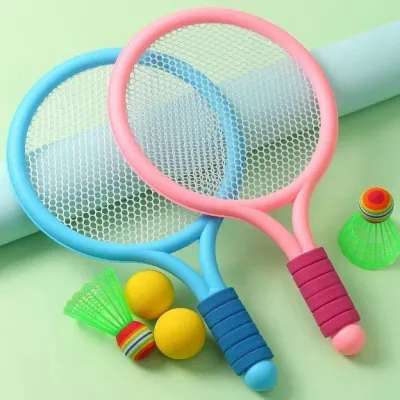
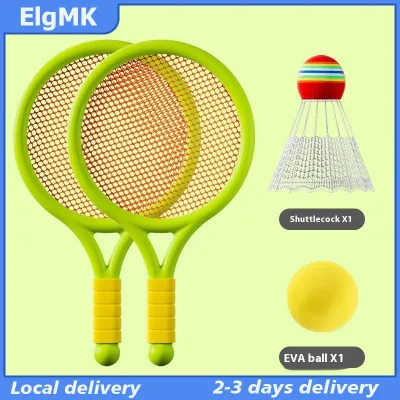
![[COD] SHPYHT TOY Kids Outdoor Badminton Tennis Set Racket Parent-child Educational Toys](https://img.lazcdn.com/g/p/a15e61c1d802962fa4586172b3b0d625.jpg_400x400q80.jpg_.webp)
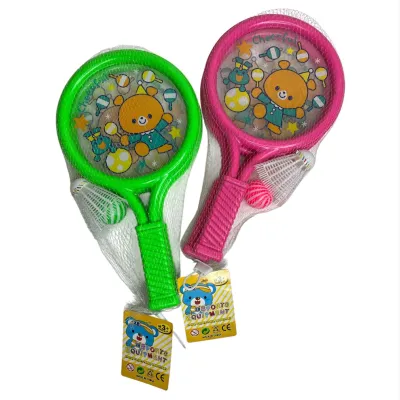
Prices are valid at publication and may change. Please refer to the product page for the latest price.
Material composition is another essential consideration for beginners. Most entry-level junior rackets are constructed from lightweight aluminum, which offers excellent durability at an affordable price point. Aluminum frames are highly resistant to accidental drops and ground strikes, making them ideal for young players learning on hard concrete surfaces. For older or more physically developed children, composite frames blending aluminum and graphite provide a stiffer feel and better shock absorption.
Ball progression is equally vital for early success. Standard yellow tennis balls bounce too high and travel too fast for young children, making it difficult to establish a rally. Starter sets should feature low-compression balls—such as foam, red, orange, or green dot balls—which bounce lower and move slower, giving kids more time to react and coordinate their movements.
Finally, a complete starter set should include practical accessories that protect the equipment and enhance usability. A dedicated carrying bag is highly recommended in the Philippines to shield the racket strings and grip from high humidity and dust. Look for sets that bundle these essentials together to get the best value and ensure your child has everything needed for their first day on the court.
Matching Racket Size and Weight to Your Child
Finding the correct racket size is the foundation of a positive tennis experience. Junior rackets are categorized by length, typically ranging from 19 to 26 inches. To determine the ideal size, have your child stand straight with their arms relaxed at their sides. Measure the distance from their fingertips to the ground; the ideal racket length should match this measurement closely, allowing the racket head to clear the floor by an inch or two when held pointing downward.

Using a racket that is too long forces the child to bend their elbow excessively or swing with their entire body, which hinders the development of clean stroke mechanics. Conversely, a racket that is too short limits their reach and can cause them to overextend. The standard progression guidelines below serve as an excellent starting point for matching height to racket length:
- 19-Inch Rackets: Best suited for children under 100 centimeters tall, typically between the ages of 2 and 4.
- 21-Inch Rackets: Ideal for heights between 100 and 115 centimeters, generally covering ages 5 to 6.
- 23-Inch Rackets: Designed for heights between 115 and 130 centimeters, usually matching ages 7 to 8.
- 25-Inch Rackets: Suitable for heights between 130 and 140 centimeters, typically for ages 9 to 10.
- 26-Inch Rackets: Recommended for heights between 140 and 150 centimeters, generally for ages 11 and older who are preparing to transition to adult frames.
Weight is another critical variable that directly impacts comfort and control. Junior rackets are engineered to be significantly lighter than adult models, often weighing between 150 and 250 grams unstrung. A lighter racket allows a child to swing freely without experiencing rapid arm fatigue, which is especially important during outdoor play in hot, tropical weather. If a child cannot hold the racket straight out in front of them with a single hand for ten seconds without their wrist dipping, the racket is likely too heavy.
Grip thickness must also be verified to prevent hand strain. Most junior rackets feature a standard grip size (typically 3-5/8 inches or 3-7/8 inches) designed for smaller hands. To check the fit at home, have your child grip the handle normally. You should be able to slide the index finger of your other hand comfortably into the space between their fingertips and the heel of their hand. If the gap is too narrow, the grip is too small, which can cause the racket to twist upon impact; if the gap is too wide, the child will have to squeeze too tightly, leading to forearm fatigue.
Selecting the Right Tennis Balls for Skill Progression
Using the correct ball is just as important as using the right racket. The International Tennis Federation (ITF) utilizes a color-coded ball progression system designed to help young players develop proper technique at a manageable pace. This system scales the speed, bounce height, and weight of the ball to match the physical and cognitive development of growing children.
Foam or sponge balls represent the earliest stage of introduction. These oversized, lightweight balls are well-suited for toddlers and very young beginners playing indoors. Because they are soft and highly compressible, they pose minimal risk of damaging household furniture or causing injury. They bounce gently on tiled or wooden floors, allowing children to practice basic hand-eye coordination and catching drills before stepping onto a real court.
Once play transitions outdoors, low-compression felt balls are introduced. The progression moves through three distinct stages:
- Red Stage (Stage 3): These balls are larger than standard tennis balls and are designed to bounce 75% slower. They are ideal for children aged 5 to 8 playing on a shortened 36-foot court. The slow speed gives beginners ample time to prepare their swings and focus on clean contact.
- Orange Stage (Stage 2): Standard-sized but with 50% less compression than normal balls, orange balls are designed for children aged 8 to 10 playing on a 60-foot court. They travel faster and bounce higher than red balls, encouraging players to develop directional control and basic footwork.
- Green Stage (Stage 1): Featuring a green dot, these balls have 25% less compression and are designed for older beginners (ages 9 to 11) playing on a full-sized 78-foot court. They behave similarly to standard balls but help prevent the high, shoulder-level bounces that can ruin a young player's stroke mechanics.
Introducing standard pressurized yellow balls too early is a common mistake. In the warm climate of the Philippines, high ambient temperatures cause the air inside pressurized balls to expand, resulting in an even faster, livelier bounce. For a young child, this means the ball quickly bounces above their strike zone, forcing them to hit from high above their shoulders. This not only leads to poor habits, such as extreme grips and chopped swings, but also increases the risk of shoulder and wrist strain. Stick to low-compression balls until your child can consistently rally with proper form.
Evaluating Set Completeness and Useful Accessories
When shopping for a starter set, it is important to distinguish between high-value components and low-quality filler items. A well-rounded starter kit should provide the essential tools to begin playing immediately without requiring immediate secondary purchases. At a minimum, a complete set must include a properly sized junior racket, at least two or three appropriate transition balls, and a protective cover.
A protective carrying bag or cover is highly valuable, particularly in tropical environments. High humidity and ambient moisture can degrade synthetic racket strings and cause the adhesive on grip wraps to peel prematurely. A zippered bag with an adjustable shoulder strap not only protects the equipment from dust and moisture when stored at home but also makes it easy for a child to carry their own gear to the local court or park.
Several optional accessories can add genuine value to a starter kit, depending on where you plan to play:
- Overgrips: These thin, absorbent wraps are applied over the racket's factory grip. In hot and humid conditions, children's hands will inevitably sweat, causing the racket to slip. A high-traction overgrip improves safety and control, and it can be easily replaced when it becomes worn or dirty.
- Vibration Dampeners: These small rubber inserts fit between the strings near the throat of the racket. While they do not reduce physical shock to the arm on lightweight junior frames, they eliminate the high-pitched "ping" sound upon impact. Many children enjoy the solid "thud" sound, which can boost their confidence during practice.
- Portable Mini-Nets: For families with a spacious driveway or access to a quiet subdivision street, a portable, easy-to-assemble net is an excellent addition. Look for nets with lightweight, powder-coated steel frames that resist rust, and ensure they can be packed away quickly to avoid exposure to sudden tropical rain showers.
Be cautious of sets that inflate their price by including low-quality plastic targets, flimsy plastic cones, or generic toys that do not contribute to tennis skill development. Prioritize kits that focus their value on a high-quality racket frame and durable, ITF-approved transition balls.
Buying and Verifying Starter Sets in the Philippines
Navigating local retail options and online marketplaces requires a careful eye to ensure you are purchasing genuine, durable sports equipment rather than fragile toys. While cheap plastic rackets are widely available, they lack the weight distribution, string tension, and structural integrity required to learn actual tennis strokes. Investing in a proper entry-level set ensures safety and a much better learning experience.
When shopping on local e-commerce platforms, always verify the seller’s credentials. Look for official brand flagship stores or authorized local sports distributors to guarantee authenticity. Read through customer reviews specifically looking for real-world photos of the product packaging, frame welds, and stringing. Be wary of listings with generic stock photos and unusually low prices, as these are often counterfeit or low-grade plastic imitations.
If you prefer to inspect the equipment in person, visit a reputable sporting goods store in a major shopping mall. Physical inspection allows you to perform several quick quality checks before purchasing:
- Frame Integrity: Run your fingers along the frame of an aluminum racket to check for smooth welds, especially near the throat where the head meets the shaft. There should be no sharp edges, cracks, or visible gaps.
- String Tension: Press your palm firmly against the center of the string bed. The strings should feel taut and uniform, with very little individual movement. Loose or uneven strings will make it difficult for your child to control the ball.
- Grip Quality: Ensure the factory grip wrap is tightly wound, smooth, and free of peeling edges or sticky adhesive residue.
Understanding typical budget ranges can help you make an informed decision. In the Philippines, basic plastic tennis toys designed for toddlers playing indoors generally cost under ₱500. Proper entry-level junior rackets made of durable aluminum from recognized sports brands typically range from ₱1,000 to ₱2,000. Complete starter sets that bundle a quality racket, transition balls, and a carrying bag generally range from ₱1,500 to ₱3,500. Spending within this range ensures you receive a durable, safe, and functional piece of sports equipment that can withstand regular use on local concrete and asphalt courts.
Frequently Asked Questions (FAQ)
At what age should a child start playing tennis?
Children can begin exploring tennis as early as age 3 or 4 using soft foam balls, oversized plastic rackets, and simple balloon-tossing games. At this early stage, the focus should be entirely on developing basic hand-eye coordination, balance, and motor skills rather than strict technical drills. Formal tennis instruction with lightweight aluminum rackets and red stage transition balls typically starts around age 5 or 6, when children have developed the attention span and physical coordination required to follow basic coaching instructions and execute simple swing paths.
Does my child need a specific racket for left-handed players?
No, junior tennis rackets feature a completely symmetrical frame and string pattern, meaning the physical racket itself is identical for both right-handed and left-handed players. The only minor difference lies in how the grip tape is wrapped around the handle. Factory grips are typically wrapped for right-handed players, but this does not affect a beginner’s play. If your left-handed child finds the grip seams uncomfortable as they progress, you can easily re-wrap the handle or apply an overgrip in the opposite direction (counter-clockwise) to accommodate their hand placement.
Community discussion
Share your experience or ask a question. Comments are reviewed before publication.