
Spearfishing in tropical waters offers an exciting way to connect with the marine environment, but success and safety depend heavily on your equipment. Choosing the right spears fishing gun is not merely about maximizing your reach; it is about finding a tool that matches your physical capabilities, diving experience, and the specific habitats you plan to explore. In the warm, high-salinity waters of the Philippines, where coral reefs and deep drop-offs host a diverse array of marine life, selecting the wrong gear can lead to missed opportunities, damaged equipment, or severe safety hazards.
Before diving into gear specifications, it is vital to recognize that spearfishing is a high-risk sport that demands respect for the ocean and your own physical limits. No piece of equipment can replace formal freediving training, breath-hold practice, and situational awareness. Safety must always be your primary focus, beginning with the golden rule of never diving alone and always maintaining a direct line of sight with your dive buddy. Your speargun is an extension of your training, and understanding how to select, load, and handle it safely is the first step toward a rewarding underwater hunting experience.
Understand the Main Types of Spearguns
When exploring your options, you will primarily choose between two distinct propulsion systems: band-powered (rubber) spearguns and pneumatic (air-powered) spearguns. Each system has unique mechanical characteristics, loading styles, and maintenance requirements that appeal to different types of divers.
Products mentioned in this guide
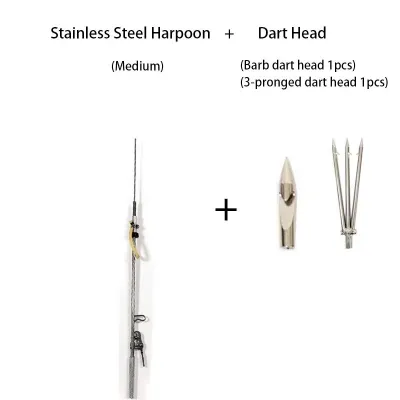
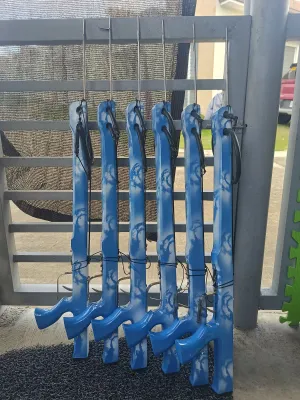
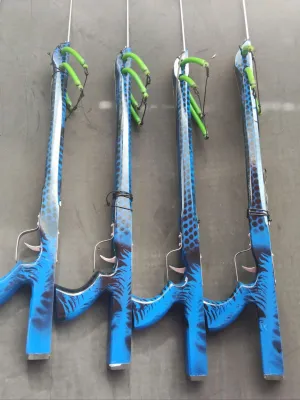
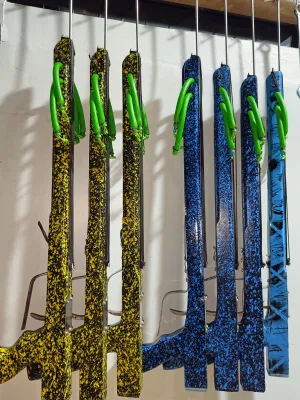
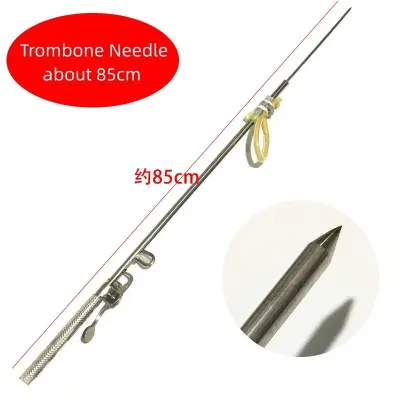
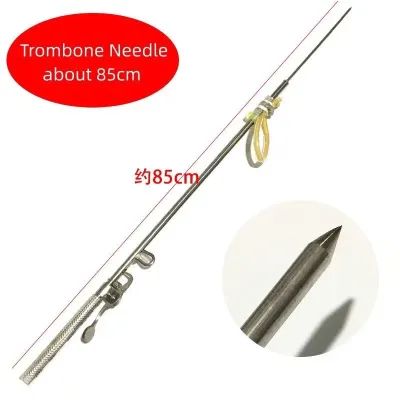
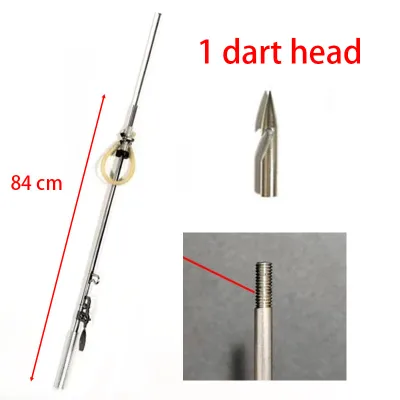
Prices are valid at publication and may change. Please refer to the product page for the latest price.
Band-powered spearguns are the most popular choice globally and are highly favored in tropical reef environments. These guns utilize heavy-duty latex rubber bands stretched along the barrel to propel the spear shaft forward. Their design is elegant in its simplicity, making them exceptionally reliable and easy to maintain in remote coastal areas. If a band snaps or wears out due to intense tropical sun and saltwater exposure, you can easily replace it yourself with basic tools. Band guns are also virtually silent when fired, which is a significant advantage when hunting skittish reef fish that react to sudden underwater noises.
Pneumatic spearguns use compressed air stored in an internal chamber to push a piston that drives the shaft out of the barrel. Because the air remains sealed inside the chamber, you do not need to pump the gun before every shot; instead, you use physical force to push the shaft back into the barrel against the pre-pressurized air. Pneumatic guns are highly compact, offering substantial power in a shorter frame, which makes them highly maneuverable in tight spaces like caves or under rocky ledges. However, they require more complex maintenance, including regular seal inspections and specialized oiling, and a failure in the internal piston mechanism usually requires professional repair.
The trade-offs between these two types come down to loading effort and the hunting environment. Band guns offer a progressive loading experience where you can load one band at a time, making them manageable for varying physical strengths. Pneumatic guns require a single, continuous push to load, which can be physically demanding in longer models. Additionally, the metallic click of a pneumatic piston can startle nearby fish, whereas the quiet release of a band gun keeps the underwater environment relatively undisturbed.
Match Speargun Length and Power to Your Target Species
The length of your speargun’s barrel directly influences its range, accuracy, and maneuverability. Selecting the correct length requires a clear understanding of where you will be diving and what species you intend to target along the coastal waters and reefs.

Short spearguns, typically measuring between 55 cm and 75 cm, are designed for close-range hunting in high-structure environments. If you plan to explore shallow coral reefs, volcanic rock crevices, and murky coastal waters, a short gun is highly maneuverable and easy to swing. These sizes are ideal for targeting smaller, hole-dwelling reef fish such as rabbitfish (samaral) or smaller snapper (mangas). The shorter shaft has limited range but offers quick tracking and sufficient power to secure a clean shot without damaging your spear tip against hard rock or coral.
Mid-length spearguns, ranging from 90 cm to 110 cm, serve as versatile all-around tools for coastal divers. This length strikes an excellent balance between maneuverability and range, allowing you to hunt along reef edges, drop-offs, and sandy flats. A mid-length gun provides the reach necessary to target medium-sized, faster-moving species like grouper (lapu-lapu) or jacks (talakitok) that rarely allow close approaches. These guns can often be configured with either a single thick band or dual thinner bands to adjust the power output.
Long spearguns, measuring 120 cm or more, are specialized instruments built for open-water or blue-water hunting. These long barrels carry heavy shafts over significant distances with high accuracy, which is essential when targeting large, fast pelagic fish such as Spanish mackerel (tanguigue) or tuna in clear, deep waters. However, these guns are unwieldy in shallow reefs and require significant physical strength to load and track.
When configuring your gun’s power, evaluate the power-to-fish-size ratio carefully. Adding more bands increases shaft velocity and penetration, but also increases recoil, which can degrade accuracy if the barrel is too light to absorb the kick. Furthermore, always verify local municipal fishing regulations and marine protected area boundaries before heading out. Spearfishing is strictly prohibited in many sanctuaries and conservation zones across the Philippines, and respecting these boundaries is crucial for preserving marine ecosystems.
Align Speargun Specifications with Your Skill Level
Your progression as a spearfisher should mirror your development as a freediver. Operating a speargun requires coordination, physical strength, and calm decision-making under water, all of which are tested as you dive deeper and stay down longer.
For beginners, the priority must always be safety, ease of handling, and building confidence. A beginner setup should ideally feature a shorter barrel (75 cm to 90 cm) with a single-band configuration. Single bands are much easier to load while floating on the surface, reducing physical exhaustion and allowing you to focus on your breathing, buoyancy, and safety protocols. A shorter gun is also easier to control, minimizing the risk of accidental muzzle sweep—pointing the loaded gun toward yourself or your dive buddy.
As your breath-hold capacity improves and you transition to intermediate diving depths, you can naturally progress to longer barrels or double-band setups. An intermediate setup, such as a 90 cm to 100 cm double-band gun, allows you to take slightly longer shots at more cautious fish. This transition requires mastering the chest-loading technique, where the butt of the speargun is placed securely against a loading pad on your wetsuit or rash guard, using your back and core muscles rather than just your arms to pull the bands back.
Advanced configurations, including multi-band wooden guns, roller guns, or heavy blue-water setups, are reserved for experienced divers who have developed exceptional physical strength and watermanship. These guns carry immense stored energy and require precise handling to avoid dangerous recoil or line tangles.
The most critical rule of speargun selection is to never upgrade to a gun that you cannot comfortably and safely load while floating in the water. If you struggle to pull the bands to the notches or find yourself straining excessively, you will quickly fatigue, shortening your dive times and compromising your safety. A gun that is too powerful for your current physical capability is not only inefficient but highly dangerous in an active marine environment.
Essential Features and Safety Checks Before Buying
Before purchasing a spears fishing gun, you must conduct a thorough inspection of its components to ensure reliability, durability, and safety in harsh marine conditions. Saltwater is highly corrosive, and the mechanical stress placed on a speargun during a dive is substantial.
First, examine the trigger mechanism. The internal sear and trigger components should ideally be constructed from high-grade stainless steel rather than plastic to withstand the high tension of loaded bands without slipping. Test the trigger pull on an unloaded gun to ensure it is smooth and predictable. Next, verify the functionality of the safety catch. While a safety catch is an important backup feature, remember that mechanical safeties can fail; never rely on a safety switch as a substitute for proper muzzle control and safe handling practices.
The spear shaft is another critical component to evaluate. Look for shafts made of spring steel or high-tensile stainless steel, which resist bending when striking hard surfaces or fighting strong fish. Shaft thickness typically ranges from 6.5 mm to 7.5 mm; thicker shafts carry more momentum for larger fish but require more band power to propel. Additionally, choose your tip style carefully: a single flopper (Tahitian style) is excellent for general reef hunting, while a breakaway slip-tip is preferred for large pelagic fish to prevent the fish from bending the shaft during the struggle.
Finally, inspect the rigging line and shock cord setup. The rigging line connects the shaft to the gun and must be strong enough to withstand both the initial shot and the subsequent pull of a thrashing fish. High-strength monofilament or braided Dyneema lines are standard choices. A quality rubber shock absorber (shock cord) integrated into the rigging line is essential, as it cushions the sudden impact when a fish runs, preventing the line from snapping or tearing out of the fish’s flesh.
Step-by-Step Selection Process
To simplify your decision, follow this structured process when evaluating spearguns online or at a local dive shop:
- Define your hunting environment and target species: Determine whether you will spend most of your time in shallow reef structures targeting small reef fish, or exploring deep drop-offs for larger coastal species.
- Assess your physical capabilities and diving skill: Be honest about your current freediving comfort level, breath-hold limits, and upper-body strength for loading heavy bands.
- Select the propulsion type and barrel length: Choose a simple band gun for ease of maintenance and quiet operation, matching the length (short, mid, or long) to your primary hunting environment.
- Verify safety and material specifications: Inspect the trigger mechanism, safety catch, shaft material, and rigging line strength to ensure they meet the demands of tropical saltwater diving.
- Perform a dry-handling test: Before taking the gun into the water, practice holding it, checking the grip comfort, and simulating the loading motion on land (without actually loading the bands or releasing the trigger) to ensure the ergonomics fit your body.
Frequently Asked Questions (FAQ)
What is the ideal speargun length for a beginner?
For most beginners diving in tropical reef environments, a speargun length between 75 cm and 90 cm is highly recommended. This size offers an optimal balance of maneuverability around coral formations and sufficient range for close-up encounters. Shorter guns are significantly easier to track through the water and require less physical effort to load, which is crucial when you are still perfecting your buoyancy and breathing techniques. Most importantly, a beginner must be able to comfortably and safely load the gun while floating on the surface without straining, making a single-band 75 cm to 90 cm gun the safest starting point.
How should I maintain my speargun after saltwater use?
Proper post-dive maintenance is essential to prevent corrosion and ensure the mechanical reliability of your speargun. Immediately after every dive, thoroughly rinse the entire gun, including the stainless steel trigger mechanism, shaft, and rubber bands, with clean fresh water to remove salt crystals and sand. Store the gun in a cool, dry place away from direct sunlight, as ultraviolet rays rapidly degrade latex rubber bands. When storing the gun for extended periods, ensure there is no tension on the bands, and consult the manufacturer’s instructions regarding the application of silicone spray or specialized lubricants to the moving parts of the trigger mechanism.
Community discussion
Share your experience or ask a question. Comments are reviewed before publication.