
Finding the correct size and fit for a taekwondo jacket is essential for both performance and comfort during training or high-stakes competition. A jacket that is too tight restricts high kicks and rapid blocks, while an excessively loose uniform can bunch up under protective gear or violate official tournament regulations. Selecting the right size requires taking precise body measurements, understanding how different manufacturers structure their size charts, and adjusting for your specific discipline—whether that is dynamic sparring or precise forms.
In tropical environments like the Philippines, where high humidity and heat are constant factors during intense dojang training sessions, fit and fabric behavior become even more critical. Sweat-soaked fabric clings to the skin, which can severely limit your range of motion if the jacket is poorly fitted. By taking the time to measure your body accurately and understanding how different cuts interact with your physical proportions, you can ensure your uniform supports every movement seamlessly.
How to Measure Your Body for a Taekwondo Jacket
To find a taekwondo jacket that allows for a full range of motion, you must start with accurate, up-to-date body measurements. Relying solely on your everyday clothing size often leads to a poor fit, as martial arts uniforms are cut differently than standard athletic wear. Gathering these metrics requires only a few minutes and a couple of basic tools.
Products mentioned in this guide
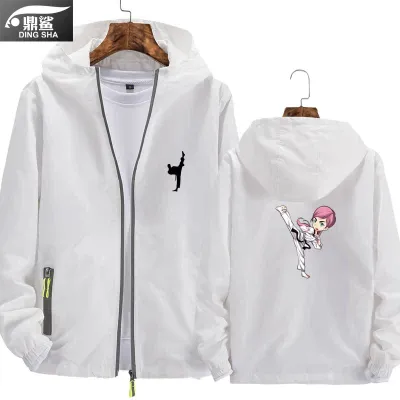
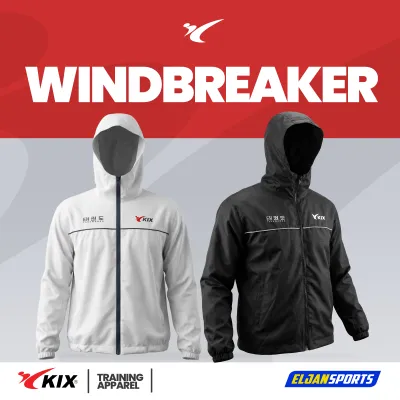
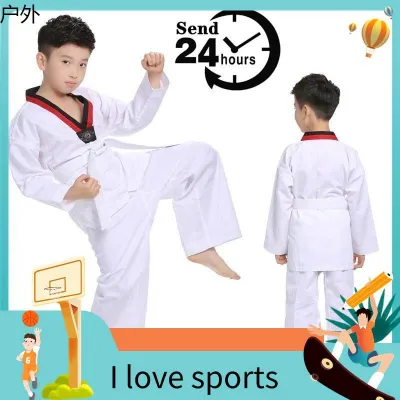
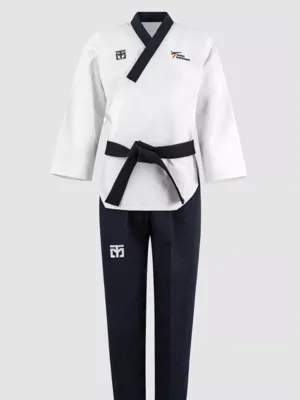
Prices are valid at publication and may change. Please refer to the product page for the latest price.
Before you begin, ensure you have a flexible measuring tape (often called a tailor’s tape). If you do not have one, you can use a piece of non-stretch string or cord, mark the lengths, and measure them against a standard metal tape measure. For the most accurate results, perform the measurements while wearing lightweight, form-fitting clothing such as a fitted t-shirt and compression shorts. Standing in bulky clothes will artificially inflate your numbers, leading to an oversized uniform.
Stand with a natural, relaxed posture. Do not puff out your chest or pull in your stomach, as this will distort the measurements you need for a comfortable fit during active training. If possible, ask a friend or family member to assist you, as keeping the measuring tape perfectly level around your body can be difficult on your own.
- Height: Stand barefoot with your heels flat against a wall and your head facing straight ahead. Measure from the floor to the very top of your head. Height is the primary metric used by most martial arts brands to categorize uniform sizes.
- Weight: Step on a reliable scale. Weight serves as a crucial secondary metric, helping to determine the overall volume and width of the jacket torso.
- Chest or Bust Circumference: Wrap the flexible tape around the widest part of your chest, keeping it parallel to the floor. Pass the tape under your armpits and across your shoulder blades. Take the measurement at the end of a normal exhale.
- Arm Length: Extend your arm slightly. Measure from the outer tip of your shoulder bone, down along the outside of your arm, and end at your wrist bone. This ensures the sleeves will not extend past your hands or sit too high up on your forearms.
Once you have collected these measurements, write them down in both centimeters and inches. Having both units on hand makes it much easier to cross-reference different manufacturer charts, as some brands use metric measurements while others rely on imperial sizing.
Understanding Taekwondo Jacket Size Charts
Most martial arts brands use a standardized numerical sizing system ranging from size 0000 (for very small children) up to size 7 or 8 (for exceptionally tall or broad adults). These numbers typically correspond directly to height ranges. For example, a size 3 uniform is often designed for individuals between 160 and 170 centimeters tall, while a size 4 is tailored for those between 170 and 180 centimeters.

However, you cannot assume that a size 4 from one manufacturer will fit exactly the same as a size 4 from another. Sizing standards, fabric blends, and tailoring cuts vary significantly across the industry. Premium brands may offer specialized cuts, while entry-level uniforms might feature a more generic, boxy fit. Always consult the specific brand’s size chart before making a purchase.
Another critical factor is the governing body of your specific style, as this dictates the design and cut of the jacket. The two most prominent styles feature distinct jacket configurations:
- World Taekwondo (WT): WT-style jackets are typically pullover V-necks. They feature a clean front with no overlapping fabric, creating a streamlined look. The collar is usually white for color-belt practitioners and black for black belts (poomsae uniforms may feature red and black collars for junior black belts).
- International Taekwon-Do Federation (ITF): ITF-style jackets feature a vertical wrap-around design. They open at the front and are secured with a hook-and-loop (velcro) strip or a zipper, bordered by a distinct wide hem at the bottom of the jacket. The fit tends to be slightly more structured than the WT pullover.
When your height falls exactly between two sizes on a chart, use your weight and chest measurements as the ultimate tie-breakers. If you have a heavier build, broader shoulders, or a wider chest, choose the larger size to ensure the fabric does not bind across your upper body. If you have a very lean or slender frame, sizing down to the smaller height range can prevent you from being swimming in excess, baggy fabric.
Fit Considerations for Different Taekwondo Styles and Body Types
Choosing the right size is not just about matching numbers on a chart; it also depends on how you train and your unique physical proportions. Your primary discipline within taekwondo will dictate whether you need a looser, more forgiving fit or a highly tailored silhouette.
Sparring (Kyorugi) vs. Forms (Poomsae) Fit
For practitioners who focus primarily on sparring, space and mobility are the top priorities. A sparring jacket needs to be slightly looser to comfortably accommodate a chest protector (hogu) underneath without binding at the shoulders or pulling tightly across the back. The extra volume also promotes air circulation, which is incredibly beneficial in warm, humid training environments. A looser fit allows the fabric to slide easily over your skin when you sweat, preventing chafing during high-intensity footwork and rapid defensive maneuvers.
Conversely, forms training requires a much more tailored, crisp fit. Poomsae is a highly aesthetic discipline where judges evaluate the precision of your lines, the correctness of your posture, and the sharpness of your movements. A jacket that is too loose will drape awkwardly and obscure your body alignment. Furthermore, poomsae uniforms are often made from heavier, stiffer fabric blends designed to produce a loud, sharp “snap” sound when you execute a punch or block. A snugger, well-fitted jacket maximizes this auditory feedback, emphasizing the power of your techniques.
Adjusting for Different Body Types
Standard size charts assume average body proportions, which means practitioners with unique physical builds must make deliberate adjustments:
- Broad Shoulders or Large Chest: If you have a muscular upper body or a wider chest, prioritize chest measurements over height. Sizing up ensures that you can cross your arms fully for blocks without tearing the back seams. If the resulting sleeve length is too long, you can have a tailor hem the sleeves to the correct length.
- Taller, Leaner Build: If you are tall and slender, prioritize your height measurement. Choosing a smaller size to fit your narrow torso will result in sleeves that are far too short, which violates competition rules. You can manage the excess torso fabric by pulling the jacket neat and flat before tying your belt tightly.
- Athletic or Slim Cuts: Some specialized brands offer "slim-fit" or "athletic-cut" uniforms. These models feature a tapered torso and narrower sleeves, making them an excellent choice for lean practitioners who want to avoid a baggy appearance without sacrificing necessary sleeve length.
How to Check the Fit of Your Taekwondo Jacket
Once your new jacket arrives, you must thoroughly evaluate its fit before wearing it to a formal class or washing it. Trying it on and performing a few diagnostic checks will confirm whether the uniform is ready for the dojang or if you need to request an exchange.
Begin by standing in front of a mirror with the jacket on and your belt tied correctly. Walk through this physical checklist to verify the fit across key areas of your body:
- Shoulder Seams: Look at where the sleeve fabric connects to the shoulder of the jacket. The seam should sit right at the outer edge of your shoulder joint. If the seam droops down toward your bicep, the jacket is too large. If the seam pulls inward toward your neck, the jacket is too tight and will restrict your arm movements.
- Sleeve Length: Let your arms hang naturally at your sides. The cuffs of the sleeves should end right around your wrist bone. They should not cover your hands, nor should they sit more than a couple of centimeters above the wrist. During active movement, the sleeves should never ride up past the middle of your forearm.
- Jacket Length: The bottom hem of the jacket must fully cover your hips and groin area, reaching down to approximately mid-thigh. A jacket that is too short will constantly ride up above your belt during training, requiring annoying manual adjustments.
- Mobility Test: Do not just stand still; move in the jacket. Execute a high block to ensure there is no painful pulling in the armpits. Perform a middle punch to verify the fabric across your upper back does not stretch to its absolute limit. Finally, perform a high front kick or side kick. The jacket hem should slide smoothly over your thighs without binding or restricting your hip rotation.
Before making a final decision, check the care label inside the collar for the fabric composition. This is crucial for anticipating how the jacket will behave after its first wash. If the jacket is a polyester-cotton blend (such as 65% polyester and 35% cotton), it will experience very minimal shrinkage. However, if the jacket is made of 100% cotton, it will shrink when exposed to water and heat. If a 100% cotton jacket fits perfectly tight right out of the box, it will likely become too small after the first wash, indicating you should exchange it for one size larger.
Frequently Asked Questions (FAQ)
Should I size up if my taekwondo jacket is 100% cotton?
Yes, sizing up is highly recommended if your jacket is made of 100% cotton, unless the manufacturer explicitly states that the fabric has been pre-shrunk. Natural cotton fibers contract when exposed to warm water and the heat of a clothes dryer. If your measurements sit near the upper limit of a specific size, choosing the next size up ensures that the uniform will still fit comfortably after its initial laundering cycles. To minimize shrinkage, always wash cotton uniforms in cold water and hang them up to air dry.
How should a taekwondo jacket fit for a WT competition?
For official World Taekwondo competitions, the jacket must comply with strict uniform regulations to avoid disqualification. The jacket must be long enough to completely cover your hips and groin area. The sleeves must extend down to at least more than half of your forearm, though they ideally should sit near the wrist bone. Sleeves cannot be rolled up or folded inward. Additionally, the jacket must fit cleanly under your electronic chest protector without excessive bunching, which can interfere with the scoring sensors or restrict your breathing during a match.
Community discussion
Share your experience or ask a question. Comments are reviewed before publication.