
Choosing the right Taekwondo uniform, or dobok, requires balancing your current belt rank, your training environment, and your specific practice goals. A beginner practicing basic stances in a local dojang needs a very different uniform than an advanced practitioner preparing for a high-intensity sparring tournament. To make the right choice, you must evaluate the fabric weight, collar style, and cut while ensuring the uniform complies with your school’s specific regulations.
In tropical climates where humidity is a constant factor, selecting the wrong material can lead to discomfort, restricted movement, and premature wear. Shifting your Taekwondo uniform as you progress through the ranks is a natural part of your martial arts journey, reflecting your growing skill and the increasing physical demands of your training. By understanding how different fabrics, weights, and cuts serve different purposes, you can select a dobok that supports your performance and respects the traditions of the sport.
Understanding Taekwondo Uniform Types
To select the correct uniform, you must first distinguish between everyday dojang practice uniforms and specialized competition doboks. Standard training uniforms are designed for daily wear, focusing heavily on durability and ease of maintenance. These uniforms typically feature a blend of polyester and cotton, which helps the fabric withstand the friction of repetitive drills, floor work, and frequent washing. They are generally cut with a traditional V-neck and provide a balanced weight that feels substantial without being overly restrictive.
Products mentioned in this guide
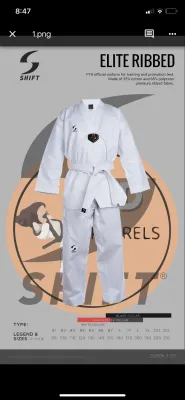
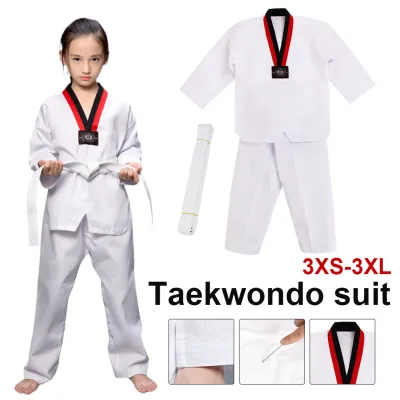
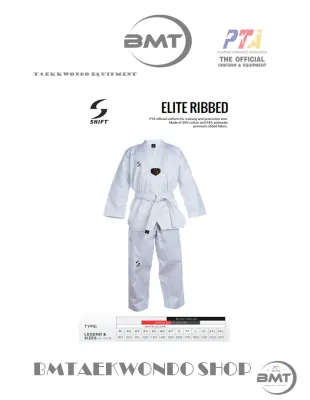
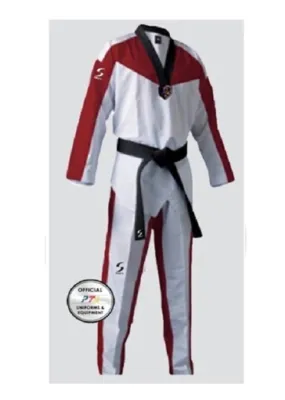
Prices are valid at publication and may change. Please refer to the product page for the latest price.
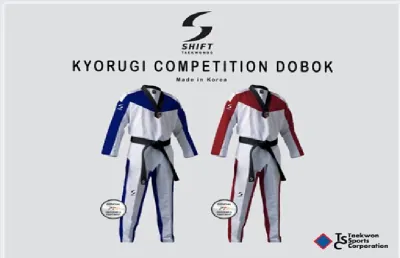
In contrast, competition uniforms are highly specialized garments tailored for specific tournament disciplines. Sparring (kyorugi) competition uniforms are engineered for maximum speed and heat dissipation. They are incredibly lightweight, often utilizing advanced synthetic fabrics with mesh ventilation panels strategically placed under the arms and along the lower back. These materials are designed to wick sweat away rapidly, keeping the athlete cool under intense physical exertion.
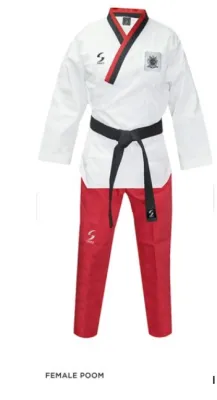
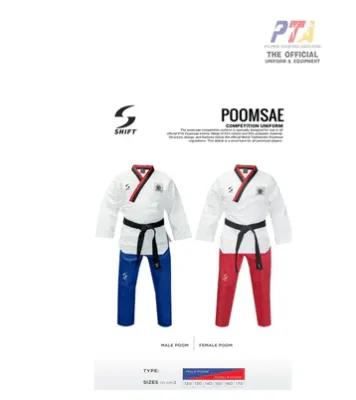
On the other hand, forms (poomsae) competition uniforms prioritize structure and presentation. These uniforms are often heavier and stiffer, designed to produce a sharp, audible “snap” when a practitioner executes a punch or kick. The cut of a poomsae uniform also varies significantly based on the division, with specific jacket designs and pants colors designated for male, female, junior, and senior competitors.
Before purchasing any uniform, it is vital to verify the regulations of your specific dojang or the tournament organizing body, such as World Taekwondo (WT) or the International Taekwon-Do Federation (ITF). Many schools require students to wear uniforms featuring the dojang’s official patch or specific color schemes. Similarly, official tournaments often mandate WT-approved or ITF-approved stamps on the uniform lapel or chest. Purchasing a highly technical competition uniform is unnecessary for a beginner, but as you transition into competitive arenas, having a dedicated tournament dobok becomes essential for meeting official gear standards.
Matching the Dobok to Your Belt Level and Skill
Your progression through the ranks in Taekwondo brings changes not only in your physical capabilities but also in the expectations surrounding your attire. For beginners (white belts to green belts), the primary focus when choosing a uniform is durability, comfort, and simplicity. Beginner uniforms are almost universally solid white with a white collar, symbolizing purity and a clean slate. These doboks are typically made from a medium-weight polyester-cotton blend that resists wrinkling and holds up well to the inevitable falls and stretches of early training. They offer a forgiving fit that allows novices to focus on learning basic stances and kicks without worrying about delicate fabric.

As you advance to intermediate ranks (blue belts to red or brown belts), your training intensity naturally increases. At this stage, practitioners often begin to look for uniforms with reinforced stitching along high-stress areas like the collar, cuffs, hem, and crotch gusset. This reinforcement prevents seams from splitting during deep stances and high-velocity kicks. Intermediate students may also transition to slightly lighter or more breathable fabrics as their sparring sessions become longer and more physically demanding.
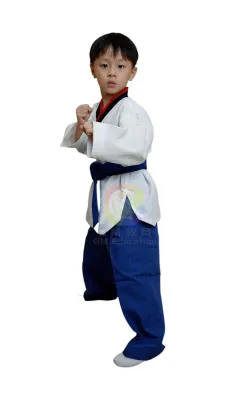
Upon reaching the advanced rank of black belt (or junior black belt/poom), the uniform style changes significantly. Black belts are traditionally permitted to wear uniforms with a black collar trim, a distinction that carries deep respect within the martial arts community. Junior black belts under the age of 15 typically wear a red-and-black collar trim (poom collar). Advanced practitioners often invest in multiple uniforms, keeping a heavier, traditional dobok for formal ceremonies and testing, and a highly breathable, flexible uniform for daily sparring and conditioning.
Shifting your Taekwondo uniform as you climb the ranks is more than just a cosmetic upgrade; it is a functional adjustment to your evolving training needs. The dynamic, explosive movements required of advanced students demand a uniform that offers zero resistance to high kicks and rapid footwork. By aligning your uniform choice with your current rank, you ensure that your gear matches the physical demands of your curriculum while honoring the traditional hierarchy of the dojang.
Key Fabric and Weight Considerations for Your Training Environment
When shopping for a new dobok, understanding fabric weight and material composition is crucial for ensuring comfort during long training sessions. Manufacturers typically specify uniform weight in ounces (oz) or grams per square meter (gsm). Lightweight uniforms generally range from 7 oz to 8 oz, medium-weight options sit between 9 oz and 10 oz, and heavyweight uniforms exceed 11 oz. Beginners and daily practitioners usually find medium-weight uniforms to be the most versatile, as they offer a good balance of durability and structure.
In hot and humid tropical climates, such as the Philippines, the training environment inside a dojang can quickly become stifling. Under these conditions, a heavy, 100% cotton uniform can become waterlogged with sweat, making it heavy, clingy, and restrictive. For tropical training, a lightweight polyester-cotton blend (such as a 65/35 or 80/20 poly-cotton mix) or a specialized 100% polyester performance fabric is highly recommended. These synthetic blends offer superior moisture-wicking properties, allowing sweat to evaporate quickly and keeping the fabric from sticking to your skin.
However, the choice of fabric also involves a trade-off between stiffness and flexibility. Heavyweight cotton or heavily textured ribbed fabrics are favored by practitioners who focus on forms (poomsae). The stiffness of these fabrics holds the shape of the uniform beautifully, presenting a sharp, professional silhouette to judges, and produces a satisfying snapping sound during crisp movements.
Conversely, if your training consists primarily of Olympic-style sparring (kyorugi), flexibility and weight reduction are your top priorities. You will want to look for ultra-lightweight, stretchable synthetic fabrics that allow your legs to move freely without any drag. Many modern sparring uniforms incorporate elasticated panels in the crotch and underarms to maximize range of motion. Carefully evaluate your primary training environment and the specific focus of your classes to decide whether a crisp, structured fabric or a soft, flexible, moisture-wicking material will serve you best.
How to Measure and Fit Your Taekwondo Uniform
A poorly fitting uniform can severely hinder your performance and safety on the training floor. Pants that are too long can cause you to trip during rapid footwork, while a jacket that is too tight across the shoulders will restrict your punches and blocks. To find the correct size, you must take accurate body measurements rather than relying on your standard clothing size. The most critical measurements to record are your total height, chest circumference, waist circumference, and inseam length.
It is important to note that sizing systems vary significantly between different martial arts brands. Some manufacturers use a numerical system ranging from 0000 (for toddlers) to 7 or 8 (for very tall adults), while others use a centimeter-based system corresponding to the wearer’s total height (e.g., size 160 for someone 160 cm tall). Because of these discrepancies, you should always consult the specific size chart provided by the brand you are purchasing. Never assume that a size 4 in one brand will fit the same as a size 4 in another.
When evaluating the fit of a dobok, look for specific parameters to ensure compliance with general martial arts standards. The jacket sleeves should ideally end just above the wrist bone when your arms are extended forward. This length allows for unrestricted hand movements and prevents the sleeves from interfering with your grip or blocking techniques.
The pants should sit comfortably on your hips or waist, secured by an elastic band or drawstring, with the cuffs ending just above the ankle bone. This prevents the hem from dragging on the floor or getting caught under your heels during movement. Additionally, ensure there is ample room in the seat and thighs of the pants; you should be able to drop into a deep side split or a low stance without feeling any tightness or pulling in the fabric.
Checklist for Shifting to a New Taekwondo Uniform
Before finalizing your purchase and stepping onto the mat in your new gear, run through a practical checklist to ensure your investment is sound. First, verify that the uniform’s design, collar color, and branding comply with your dojang’s rules. Some traditional schools only permit plain white uniforms with no external brand logos, while others are comfortable with modern designs. If you plan to compete, double-check that the uniform carries the official approval stamp of the relevant athletic federation.
Once your uniform arrives, conduct a thorough physical inspection before washing it or wearing it to class. Examine the stitching along the inner thighs, underarms, and collar to ensure there are no loose threads, skipped stitches, or uneven seams. Pull gently on the seams to verify their strength. Feel the fabric texture to ensure it matches the product description and provides the expected level of comfort against your skin.
Next, evaluate the price-to-durability ratio within your budget. While entry-level uniforms can be found for around ₱800 to ₱1,500, premium competition doboks can range from ₱3,000 to ₱6,000 or more. Consider your training frequency; if you train multiple times a week, investing a bit more in a durable, high-quality blend will save you money in the long run compared to replacing a cheap, thin uniform every few months.
Finally, review the manufacturer’s washing instructions carefully. Most cotton-blend uniforms are prone to some degree of shrinkage during their first few washes. If your uniform fits perfectly out of the box, you must wash it in cold water and hang it to dry to prevent it from shrinking into an unusable size. If the uniform is slightly large, a warm wash may help shrink it to a more customized fit, but this should be done with caution to avoid damaging the synthetic fibers.
Frequently Asked Questions (FAQ)
How often should I replace my Taekwondo uniform?
You should replace your uniform when it shows visible signs of wear that compromise either its structural integrity or its professional appearance. Look for thinning fabric around the knees and elbows, frayed seams, or tears that cannot be easily repaired. Permanent yellowing or staining around the collar and underarms is also a clear indicator that it is time for a replacement, as maintaining a clean, presentable appearance is a fundamental aspect of martial arts etiquette. Depending on your training frequency and care routine, a standard dobok typically lasts between one and two years of regular use.
Can I wear a black trim dobok if I am not a black belt?
In almost all traditional Taekwondo schools, you should not wear a black trim dobok unless you have officially earned your black belt rank. The black collar is a highly respected symbol of achievement and expertise. Wearing one prematurely is considered a breach of dojang etiquette and can be seen as disrespectful to the instructors and senior students who have dedicated years to earning that rank. Always stick to a plain white collar until your head instructor officially instructs you otherwise.
How should I wash a Taekwondo uniform to maintain its shape?
To preserve the shape, color, and fabric strength of your dobok, always wash it in cold water using a mild detergent. Avoid using chlorine bleach, as it can weaken the fabric fibers over time and cause synthetic materials to turn yellow. Hang the uniform to air dry on a sturdy hanger rather than using a high-heat clothes dryer. High heat is the primary cause of excessive shrinkage and can ruin the crisp texture of the collar and the elasticity of the waistband.

Community discussion
Share your experience or ask a question. Comments are reviewed before publication.