
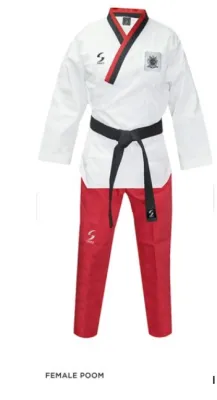
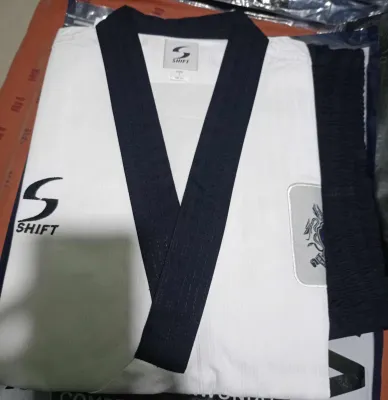
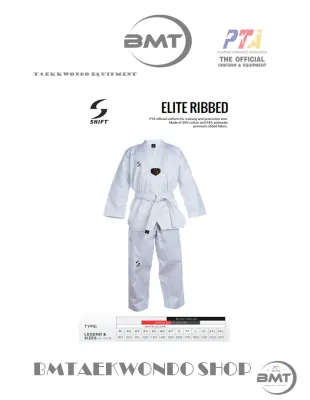
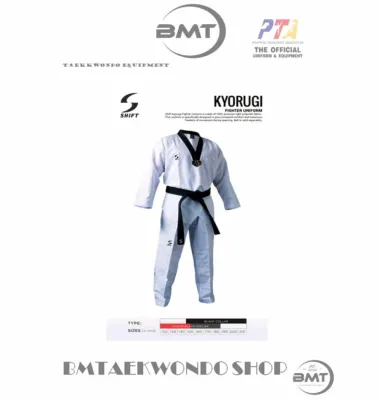
Finding the correct size for a taekwondo uniform (dobok) is essential for unrestricted movement, safety on the mat, and official competition compliance. Unlike standard casual wear, martial arts uniforms are sized using a unique numerical system based primarily on height in centimeters, which must be cross-referenced with specific brand charts. For instance, when looking to purchase a modern athletic-cut option like a shift taekwondo uniform, understanding how to measure your body accurately ensures you select a size that accommodates high kicks and rapid footwork without excess fabric dragging on the floor.
Selecting the wrong size can lead to restricted mobility or hazardous training conditions. By taking precise measurements of your height, inseam, chest, waist, and arm length, you can confidently navigate manufacturer size charts and choose a uniform that supports your performance, whether you are a beginner stepping into the dojang for the first time or an experienced competitor preparing for a tournament.
Why a Properly Fitted Dobok Matters for Performance and Safety
A properly fitted dobok is not merely a matter of aesthetics; it directly impacts your physical capabilities during training and sparring. Taekwondo relies heavily on dynamic, explosive kicking techniques, such as the roundhouse kick (dollyo chagi) and back kick (dwit chagi). If the uniform is too tight, especially around the hips and thighs, the fabric will resist your movements, limiting your range of motion and forcing you to exert more energy to execute basic techniques. Conversely, an oversized uniform creates unnecessary wind resistance and heavy, flapping fabric that can slow down your execution.
Products mentioned in this guide
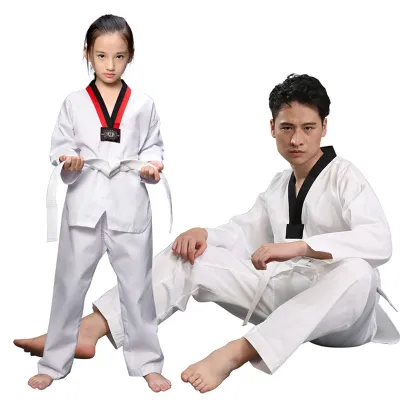
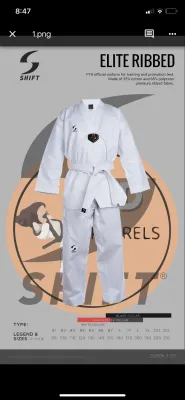
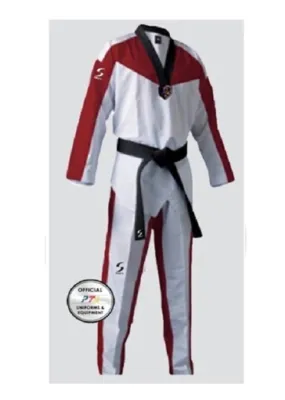
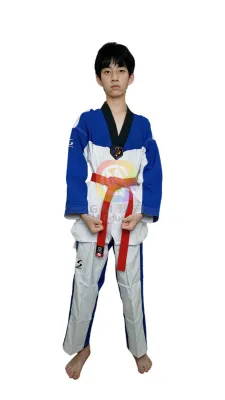
Prices are valid at publication and may change. Please refer to the product page for the latest price.
Safety is another critical factor. Pants that are too long will pool around your feet, creating a severe tripping hazard on the training mats. Excessively loose sleeves can catch on your opponent’s hands, feet, or protective gear during sparring, potentially leading to jammed fingers or sprained wrists. For children, oversized uniforms can lead to frequent stumbles during footwork drills, increasing the risk of avoidable injuries.
Furthermore, official governing bodies, such as World Taekwondo (WT), enforce strict regulations regarding uniform dimensions for sanctioned competitions. These rules dictate that the jacket sleeves must reach the wrist bone and the pants must cover the ankle bone, with specific limits on how loose or tight the fabric can be. Wearing an improperly sized dobok can result in disqualification before you even step onto the competition mat.
Finally, there is a distinct psychological advantage to wearing a well-fitted uniform. A dobok that sits perfectly on your shoulders and aligns with your limbs boosts your confidence, helping you feel professional, prepared, and focused. It allows you to concentrate entirely on your technique rather than constantly adjusting slipping pants or pulling up sagging sleeves.
What You Need Before Measuring for Your Dobok
To ensure your measurements are accurate, you need to prepare the right tools and environment before you begin. Taking hasty measurements or guessing your proportions often leads to ordering the wrong size, resulting in the hassle of returns and delayed training.

Gather the following items before starting:
- A flexible, soft tailor's measuring tape (avoid metal construction tapes, which do not conform to body curves).
- A full-length mirror to help you verify that the tape is level and positioned correctly.
- A pencil and notepad (or your smartphone) to record each measurement immediately.
- Ideally, a second person to assist you, as measuring your own inseam, shoulder width, and sleeve length accurately can be physically challenging.
For the most accurate results, wear lightweight, form-fitting clothing, such as a basic t-shirt and athletic shorts. Measuring over bulky sweaters, jeans, or loose sweatpants will artificially inflate your numbers, leading you to purchase a uniform that is too large. Stand barefoot on a flat, even floor, keeping your feet slightly apart. Maintain a natural, relaxed posture—do not suck in your stomach, puff out your chest, or stand artificially stiff, as this will distort the measurements you need for a comfortable, functional fit.
Step-by-Step Guide to Taking Accurate Body Measurements
Taking your time with body measurements is the most reliable way to find a dobok that fits well. Follow these step-by-step instructions to capture the core metrics required by martial arts size charts.
Measuring Height and Inseam
Your overall height is the primary metric used by most taekwondo brands to determine your base uniform size. To measure your height accurately, stand barefoot with your heels, upper back, and back of your head pressed flat against a straight wall. Look straight ahead, and have a helper place a flat object (like a hardcover book) flat on top of your head, parallel to the floor. Mark the point where the underside of the book meets the wall with a pencil, then use your measuring tape to measure the distance from the floor to that mark in centimeters.
To measure your inseam, stand with your feet shoulder-width apart. Run the measuring tape from the highest point of your inner thigh (the crotch) straight down to the prominent bone on the inside of your ankle. Ensure the tape measure remains straight and taut, but do not pull it so tight that it presses deeply into the skin. This measurement determines the ideal length of your dobok pants, ensuring they rest safely above the floor when you are barefoot.
Measuring Chest, Waist, and Hips
To measure your chest, wrap the measuring tape around the fullest part of your chest, keeping it directly under your armpits and flat across your shoulder blades. Ensure the tape is horizontal to the floor all the way around. Take a deep breath in and out, and record the measurement at the end of a normal exhalation to ensure the jacket will not restrict your breathing during intense aerobic workouts.
Find your natural waistline, which is typically located just above your belly button and below your rib cage. Wrap the tape comfortably around this area, keeping it snug but not tight enough to dig into your skin.
For the hips, stand with your feet together and locate the widest part of your hips and glutes. Wrap the measuring tape horizontally around this section. This hip measurement is crucial for ensuring that the elastic waistband and drawstring of the pants can slide easily over your hips and sit comfortably without binding during deep stances.
Measuring Arm Length and Shoulders
To measure your shoulder width, stand with your back to your helper. Have them locate the bony outer edge of your left shoulder (the acromion process) and measure across the curve of your upper back to the corresponding bony edge of your right shoulder. This measurement prevents you from buying a jacket that is too narrow across the back, which would restrict your arm extensions and punches.
For sleeve length, start the measurement at the outer edge of your shoulder bone (where the shoulder seam of a standard t-shirt sits). Run the tape down the outside of your arm, over the elbow, and down to your wrist bone. Keep your arm slightly bent at the elbow during this measurement to account for the natural flexion of your arms during blocks and strikes, ensuring the sleeves do not pull back too far during movement.
How to Read Size Charts and Handle Brand Variations
Once you have compiled your measurements, you must translate them into a uniform size. Traditional taekwondo uniforms do not use standard S/M/L clothing sizes. Instead, they utilize a numerical system ranging from size 0000 (for toddlers) up to size 7 or 8 (for very tall adults). This numbering system corresponds directly to height ranges in centimeters. For example, a size 3 is typically designed for individuals between 160 cm and 170 cm tall, while a size 4 generally fits those between 170 cm and 180 cm.
| Uniform Size | Height Range (cm) | Height Range (ft/in) | Approximate Weight Range (kg) |
|---|---|---|---|
| 000 | 110 – 120 cm | 3'7" – 3'11" | 15 – 22 kg |
| 00 | 120 – 130 cm | 3'11" – 4'3" | 22 – 30 kg |
| 0 | 130 – 140 cm | 4'3" – 4'7" | 30 – 40 kg |
| 1 | 140 – 150 cm | 4'7" – 4'11" | 40 – 50 kg |
| 2 | 150 – 160 cm | 4'11" – 5'3" | 50 – 60 kg |
| 3 | 160 – 170 cm | 5'3" – 5'7" | 60 – 72 kg |
| 4 | 170 – 180 cm | 5'7" – 5'11" | 72 – 85 kg |
| 5 | 180 – 190 cm | 5'11" – 6'3" | 85 – 100 kg |
| 6 | 190 – 200 cm | 6'3" – 6'7" | 100 – 115 kg |
However, you must never assume that your size is identical across all brands. A size 4 in one brand may fit like a size 3 or 5 in another. Specialized brands, such as a shift taekwondo uniform, often feature a more athletic, tapered cut designed to minimize excess fabric flapping during high-speed movements. These tailored cuts fit closer to the body than generic, boxy uniforms, meaning you must pay closer attention to your chest and shoulder measurements rather than relying solely on your height.
If your measurements fall directly between two sizes, use the following decision framework to make your choice:
- Size Up if you have a broader muscular build, carry more weight around your torso, prefer a looser fit, or plan to wear thick protective sparring gear underneath your uniform. Sizing up is also recommended if the uniform is made of 100% cotton, which will shrink during washing.
- Size Down if you have a very slender or lean build, prefer a highly tailored look for traditional forms (Poomsae), or are purchasing a pre-shrunk, fully synthetic polyester uniform that will not shrink over time.
Adjusting Your Size Choice for Age, Build, and Discipline
Standard size charts assume average body proportions, but martial artists come in all shapes, sizes, and age groups. Adjusting your size selection based on these personal variables ensures a much better fit.
Children and Growing Teens
Parents are often tempted to buy a dobok that is two or three sizes too large to allow their children to “grow into” it. While this is economical, it can be highly dangerous on the mat. Excessively long pants cause children to trip during footwork, and long sleeves cover their hands, preventing them from forming proper fists or catching themselves safely during fall breaks.
Instead, limit your purchase to a maximum of one size up from their current measurement. If the pants are slightly long, secure them tightly at the waist using the drawstring, and perform a temporary hem or cuff at the bottom. Avoid cutting the fabric; a temporary hem can be let down as the child grows, extending the lifespan of the uniform safely. Keep in mind that children’s uniforms often feature broader cuts relative to height to accommodate rapid growth spurts and ease of movement.
Different Body Proportions
If your body proportions do not align perfectly with standard charts—for example, if you have exceptionally broad shoulders, a long torso, or wider hips—you should always prioritize your largest physical measurement when choosing a size.
If your height indicates a size 3, but your chest and shoulder measurements require a size 4, purchase the size 4. It is much easier, safer, and cheaper to have a local tailor shorten the sleeves and pants of a larger uniform than it is to try to wear a uniform that is painfully tight across your shoulders or chest. A uniform that restricts your upper body will prevent you from executing proper blocks and punches, severely hindering your training.
Poomsae vs. Kyorugi (Sparring) Fit Preferences
Your primary focus within taekwondo should also influence your sizing choices:
- Poomsae (Forms): Practitioners of forms generally prefer a snugger, more tailored fit. This aesthetic emphasizes the clean, sharp lines of your stances and techniques. Additionally, Poomsae uniforms are often made of stiffer fabrics designed to make a loud, satisfying "snap" sound when you execute a fast punch or kick, which requires the fabric to sit closer to the limbs.
- Kyorugi (Sparring): Sparring competitors require a looser, more relaxed fit. The extra room is necessary to accommodate protective gear worn underneath the dobok, including a chest protector (hogu), forearm guards, shin guards, and groin guards. A looser uniform also allows for maximum dynamic flexibility and rapid footwork without any fabric resistance.
Managing Fabric Shrinkage and Choosing Weights for Tropical Climates
Fabric composition plays a major role in how your uniform fits over time and how comfortable it is during training, particularly in tropical environments.
Uniforms are generally available in two main fabric types:
- 100% Cotton: These offer a traditional, heavy feel and a crisp "snap" during movements. However, cotton is highly susceptible to shrinkage. A 100% cotton dobok can shrink by up to 5% to 10% over its first few washes, particularly if washed in warm water or dried in a machine. If you choose cotton, you must buy a size up to compensate for this inevitable shrinkage.
- Polyester-Cotton Blends: Often containing 65% polyester and 35% cotton, these blends are highly resistant to shrinkage, dry very quickly, and require minimal ironing. They maintain their original size well, allowing you to buy your exact size without worrying about post-wash changes.
In hot and humid tropical climates, such as in the Philippines, managing heat and sweat is a primary concern. Training in a heavy, non-breathable uniform can lead to rapid overheating, fatigue, and discomfort. For daily training in local dojangs, look for lightweight to mid-weight fabrics, typically rated between 8oz and 10oz. These weights offer excellent breathability, allow sweat to evaporate quickly, and dry rapidly on the line during the humid rainy season. Reserve heavy canvas weights (12oz and above) strictly for formal testing, cool-climate seminars, or high-level Poomsae competitions where the visual structure of the uniform is prioritized over heat management.
To minimize shrinkage and preserve the lifespan of your dobok, always wash it in cold water on a gentle cycle and hang it up to air dry. Avoid using commercial tumble dryers, as the high heat can damage synthetic fibers and cause cotton uniforms to shrink drastically.
How to Test and Verify the Fit Before Training
Before you remove the tags, wash your new uniform, or step onto the mat for your first class, you must perform a series of physical tests to verify that the fit is safe, comfortable, and functional.
Put on the complete uniform, tie the inner jacket strings, and secure your belt tightly around your waist to simulate actual training conditions. Then, perform the following verification checks:
- The Deep Squat Test: Perform a deep, low squat. The fabric across your thighs and seat should stretch comfortably without pulling tightly or restricting your descent. If you feel the seams straining or if the pants pull down at the waist, the pants are too small.
- The High Kick Test: Execute a high front kick (ap chagi) and side kick (yop chagi). The gusset (the crotch panel of the pants) should allow your legs to split widely without binding or pulling. If the fabric restricts your leg extension, you need a larger size or a wider cut.
- The Jacket Overlap Check: Stand naturally and ensure the left side of the jacket crosses over the right side securely. Raise your arms above your head; the jacket should not gape open widely at the chest or pull completely out of your belt.
- The Sleeve and Pant Length Check: Extend your arms straight out in front of you. The sleeves should end near your wrist bone, leaving your hands completely free. Stand barefoot on a flat floor; the hem of the pants should rest just above your ankle bone, ensuring they do not touch the floor or slide under your heels where they could cause you to slip.
If your uniform passes all of these movement tests, it is safe and ready for use. If it fails any of them, exchange it for a different size before wearing it to a class.
Frequently Asked Questions (FAQ)
How often should I replace my child's taekwondo uniform?
There is no fixed calendar timeline for replacing a child’s uniform, as it depends entirely on their individual growth spurts. You should inspect the fit every few months. It is time to replace the dobok when the pants end mid-calf (exposing the shins), the sleeves end halfway up the forearm, or the jacket can no longer overlap securely across the chest. On average, active children and growing teens require a new uniform every 12 to 18 months.
Can I alter my dobok if the pants are too long?
Yes, hemming taekwondo pants is a very common and acceptable practice. If you purchase a uniform that fits your chest and shoulders perfectly but has excessively long pants, you can easily have them hemmed. It is recommended to take the uniform to a professional tailor who understands athletic wear. Ensure they use a durable, multi-row stitch that matches the original manufacturing style, preserving the seam strength necessary to withstand high kicks and deep stances.
What size belt should I get with my uniform?
Belt sizing is generally independent of your dobok size, though some starter uniforms include a basic belt. To choose the correct belt length, measure your waist while wearing your uniform. The standard rule of thumb is that when the belt is wrapped twice around your waist and tied in a proper square knot, both hanging ends should extend roughly 20 to 30 centimeters from the knot, ending around your mid-thigh. Consult the specific belt manufacturer’s length chart, as sizes typically range from 0 (200 cm) to 6 (320 cm or more).
Community discussion
Share your experience or ask a question. Comments are reviewed before publication.