
Finding the right karate uniform—traditionally known as a gi—is one of the most important steps for any martial artist, whether you are a beginner stepping onto the tatami for the first time or an experienced practitioner preparing for competition. A properly fitting uniform does not just make you look disciplined; it directly influences your safety, execution of techniques, and overall comfort during intense training sessions. Because sizing systems vary significantly between manufacturers, relying on your standard clothing size often leads to a uniform that is either dangerously long or restrictively tight.
To secure a uniform that supports your training, you must take precise body measurements and understand how different fabrics behave under various washing and environmental conditions. In tropical climates like the Philippines, where high humidity and heat are constant factors during indoor training, choosing the correct size and material blend becomes even more critical. This guide provides a systematic approach to measuring your body, navigating manufacturer size charts, and verifying the fit of your new karate uniform.
Why Proper Karate Uniform Fit Matters
In karate, your uniform is an extension of your movement. If a gi is too tight, it restricts your range of motion, preventing you from executing deep stances like Zenkutsu-dachi (front stance) or delivering high kicks. Conversely, an excessively loose or long uniform poses serious safety hazards. Long pant cuffs can easily catch under your heels, leading to slips and trips on the training mat, while oversized sleeves can cover your hands, obscuring your grip and potentially catching an opponent’s fingers during sparring (kumite).
Products mentioned in this guide
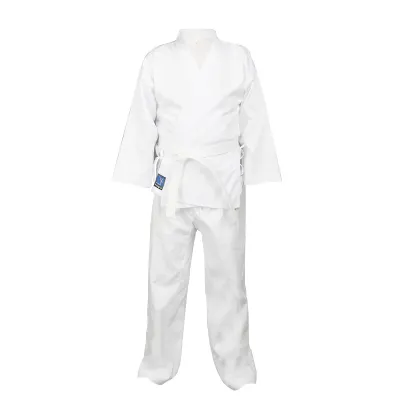
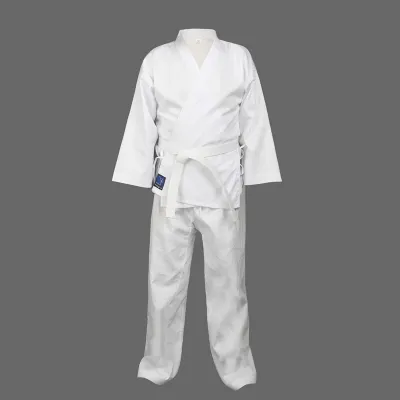
Prices are valid at publication and may change. Please refer to the product page for the latest price.
Beyond safety, the fit of your uniform must align with your specific discipline. Practitioners of kata (forms) generally prefer a heavier, crisper fabric cut slightly shorter in the sleeves and pants. This design highlights the sharp, clean lines of their techniques and produces the distinctive “snap” sound during rapid movements. On the other hand, kumite (sparring) competitors typically opt for a lighter, roomier uniform that prioritizes speed, ventilation, and maximum freedom of movement.
Tools You Need for Accurate Measurements
Taking accurate measurements requires the right tools to avoid errors that could lead to an incorrect purchase. You will need a flexible fiberglass or cloth measuring tape. Avoid using rigid metal construction tapes, as they cannot contour to the curves of your body and will yield inaccurate, oversized dimensions.

Having a helper or standing in front of a full-length mirror is highly recommended. A helper ensures the tape measure remains perfectly level across your back and hips, which is difficult to manage on your own. Additionally, make sure to wear form-fitting base layers, such as a compression shirt and athletic shorts, while measuring. Measuring over bulky everyday clothing like hoodies or loose jeans will artificially inflate your numbers, resulting in a uniform that is far too large.
Step-by-Step Body Measurement Guide
Before you begin pulling the tape measure, prepare your environment and posture. Stand barefoot on a flat, level floor with your feet slightly apart and your weight distributed evenly. Maintain a natural, upright posture; do not puff out your chest or hollow your back, as these temporary adjustments will cause the uniform to fit poorly once you relax during training.
Keep the tape measure snug against your body or base layers, but do not pull it so tight that it compresses your skin. For all circumferential measurements, ensure the tape remains parallel to the floor all the way around your body.
Measuring Height and Weight
Height and weight serve as the primary filters for almost every karate uniform sizing chart. To measure your height accurately, stand barefoot with your heels, buttocks, and upper back flat against a straight wall. Look straight ahead, place a flat object like a book on top of your head parallel to the floor, and have a helper mark the wall. Measure the distance from the floor to the mark.
Next, weigh yourself on a reliable scale while wearing only your light base layers. If your height and weight point to different sizes on a manufacturer’s chart, always prioritize the larger size. It is much easier to have a local tailor shorten the sleeves or pants of a larger uniform than it is to stretch or expand a uniform that is too tight around your torso or thighs.
Measuring Chest, Waist, and Hips
To ensure the jacket wraps securely without pulling across your back, measure the widest part of your chest. Wrap the tape under your armpits and across your shoulder blades, keeping it level. Take a deep breath in and out to ensure the measurement accounts for lung expansion during heavy cardiovascular training.
For the pants, locate your natural waistline, which is typically just above your belly button or where you prefer your uniform waistband to rest. Wrap the tape comfortably around this area. Next, measure the widest part of your hips and buttocks. This hip measurement is vital for martial artists, as deep stances and high kicks require ample fabric clearance in the seat of the pants to prevent tearing.
Measuring Arm and Inseam Length
To find your ideal sleeve length, measure from the outer edge of your shoulder seam down to your wrist bone. Keep your elbow slightly bent to mimic a natural stance. The sleeve should ideally end just above the wrist bone to keep your hands completely free for blocks, strikes, and grabbing techniques.
For the inseam, measure from the crotch junction down to the ankle bone. Karate pants should sit slightly higher than standard trousers, ending just above the ankle. This prevents the hem from dragging on the floor or getting stepped on during rapid footwork. Always check with your dojo’s chief instructor (sensei) or review your specific competition organization’s rules, as some federations have strict guidelines regarding how many centimeters of the forearm and shin must remain visible.
How to Read and Match Karate Uniform Sizing Charts
Karate uniform manufacturers do not use a single, standardized sizing system. Some brands use traditional Japanese numerical sizes ranging from 0000 (for small children) up to 7 or 8 (for very tall or broad adults). Other brands use standard letter sizes (S, M, L, XL) or base their sizes directly on height in centimeters (such as 160, 170, or 180).
When consulting a brand’s size chart, always start by locating your height and weight. Once you find the corresponding size, cross-reference your chest, waist, and hip measurements against the maximum limits listed for that size. If your torso or hip measurements are near the upper limit of a size bracket, it is highly advisable to select the next size up to maintain mobility.
If you find yourself between two sizes, consider your body build and training preferences. A slender practitioner may prefer to size down for a more tailored, less baggy fit, provided the length is still sufficient. A stockier or more muscular individual should size up to accommodate their width, budgeting roughly ₱200 to ₱500 for a local seamstress or tailor to hem the sleeves and pants to the correct length.
Accounting for Fabric Shrinkage and Material Blends
The fabric composition of your karate uniform plays a massive role in how it will fit after its first wash. Traditional uniforms made of 100% cotton (often referred to as canvas uniforms) are highly prized for their durability and traditional feel, but they are prone to significant shrinkage. Un-shrunk cotton uniforms can shrink by 5% to 10% in length and width over their first few wash cycles.
Many modern uniforms utilize a cotton-polyester blend (often a 60/40 or 55/45 mix). These blends are highly practical for training in hot, humid environments like the Philippines because they wick moisture away from the skin, dry much faster on the clothesline, and experience minimal to no shrinkage. If you choose a 100% cotton uniform that is not labeled as “pre-shrunk” or “sanforized,” you should generally buy one size larger than your current measurements dictate to allow the uniform to shrink down to your true size.
To preserve the fit and structural integrity of any karate uniform, always wash it in cold water and hang it to air-dry. Avoid using high-heat tumble dryers, as the intense heat can cause uneven shrinkage, warp the stiff collar inserts, and weaken the fabric fibers over time.
How to Verify the Fit When Your Uniform Arrives
Once your new karate uniform arrives, perform a physical fit check before removing any tags or washing the garment. Put on the jacket and pants, tie the drawstrings securely, and stand in front of a mirror. The pants should sit comfortably on your hips without slipping, and the hem should clear the floor by at least an inch to prevent tripping.
Next, perform a series of active movements to test the uniform’s mobility. Drop into a deep horse stance (Kiba-dachi) and execute a few high kicks. If you feel the fabric pulling tightly across your thighs, knees, or crotch, the pants are too small and may tear during training. Punch forward and rotate your shoulders; the jacket should not restrict your upper body, and the front panels should remain securely overlapped without gaping open.
If the uniform restricts your movement or fails to meet your dojo’s aesthetic standards, do not use it for a training session. Keep all original packaging and tags intact, and contact the retailer immediately to initiate an exchange for a different size, keeping in mind that most return policies are void once a uniform has been washed or worn in class.
Frequently Asked Questions (FAQ)
Can I shrink a karate uniform that is too big?
You can only intentionally shrink a uniform if it is made of 100% cotton. Washing a cotton gi in warm or hot water and drying it on a low-to-medium heat setting will cause the fibers to contract. However, this process carries the risk of uneven shrinkage and can damage synthetic components or stiff collars. If the uniform is significantly too large, it is always safer to exchange it for the correct size rather than attempting to force shrinkage.
Should a karate uniform fit loose or tight?
A karate uniform must always fit comfortably loose. It should never feel tight or restrictive. A loose fit ensures a complete, unrestricted range of motion for dynamic kicks and deep stances, while also maintaining the traditional, modest aesthetic of the martial art. Modern sport sparring uniforms are designed with an especially generous, airy cut to facilitate rapid footwork and heat dissipation.
Do competition karate uniforms fit differently than training uniforms?
Yes, competition uniforms are tailored to meet specific performance and regulatory standards. Kata competition uniforms are typically made of heavy, stiff cotton cut slightly shorter in the limbs to emphasize sharp techniques and clean posture. Kumite competition uniforms are made of ultra-lightweight, moisture-wicking synthetic fabrics with a looser cut to maximize speed, agility, and cooling during intense matches.
Community discussion
Share your experience or ask a question. Comments are reviewed before publication.