
Starting a home fitness journey often brings a wave of initial enthusiasm, but maintaining that momentum requires structure. Without a personal trainer guiding your daily movements, it is easy to lose focus, skip exercises, or perform routines that lack balance. A dumbbell workout poster serves as a permanent, visual reference on your wall, removing the daily decision fatigue of planning what to do next. By transforming a blank wall into an active training station, this simple tool helps you establish a reliable, self-guided exercise habit right in your living room.
To get the most out of this visual guide, you must integrate it into a well-prepared environment, learn to interpret its cues, and establish safety checks. Whether you are working out in a spacious garage or a compact bedroom corner, a systematic approach ensures your home workouts remain safe, progressive, and highly consistent over time.
Setting Up Your Home Workout Environment
Creating a dedicated workout space is the first physical step toward building a lasting routine. You do not need an entire spare room, but you do need a clear zone free of hazards. Begin by clearing a floor area of at least two meters by two meters, allowing you to perform dynamic movements like lateral lunges, overhead presses, and floor exercises without bumping into furniture. If you are training in a shared living space, temporarily moving a coffee table or chairs can quickly open up the necessary clearance.
Products mentioned in this guide
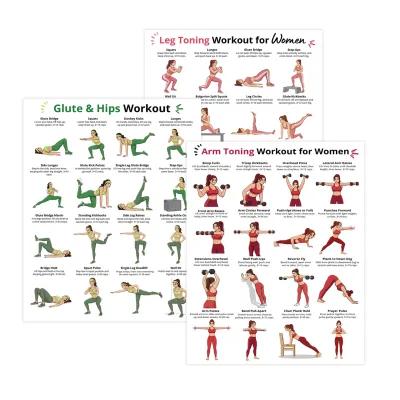
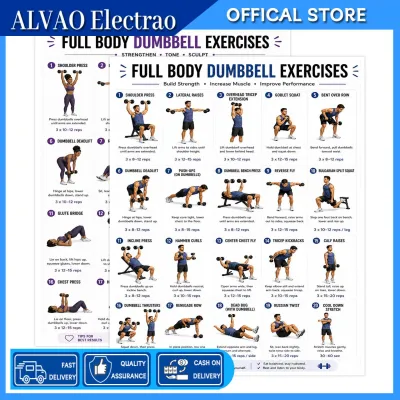
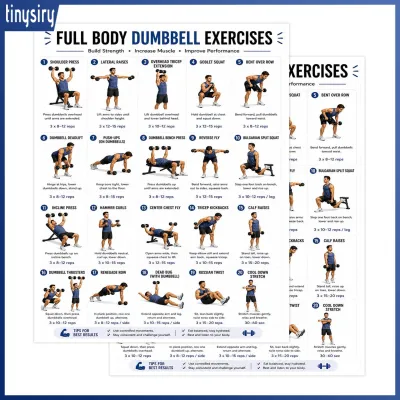
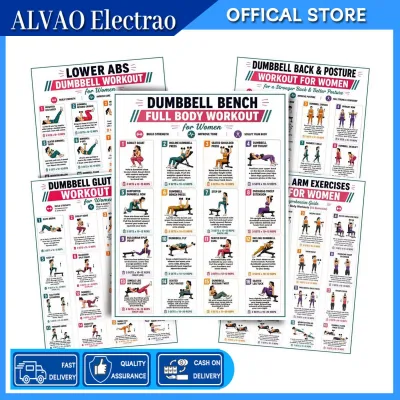
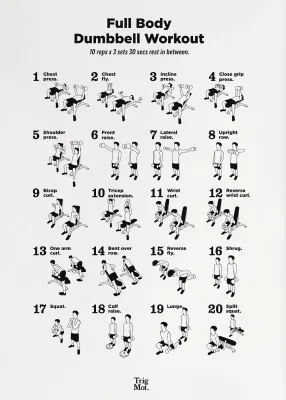
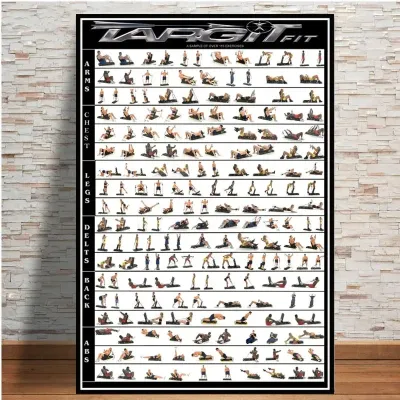
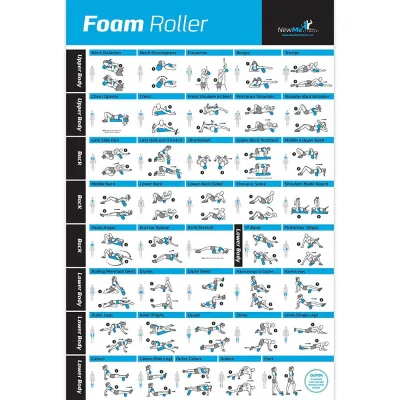
Prices are valid at publication and may change. Please refer to the product page for the latest price.
Equipment selection directly influences your safety and comfort during training. Select a set of dumbbells that matches your current strength level; adjustable dumbbells are highly practical for home use as they allow you to change weights as you transition between different muscle groups. In warm, tropical climates where humidity is high, sweaty hands can easily compromise your grip. Consider using neoprene-coated weights, textured steel handles, or wearing breathable fitness gloves to maintain a secure hold and prevent accidental drops.
The physical placement of your workout poster is equally critical for maintaining proper posture. Mount the poster securely at eye level on a flat wall directly in front of your primary exercise area. If you have to constantly bend down or twist your neck to read the illustrations, you risk straining your muscles during a set. Because high humidity and sweat can quickly degrade paper, consider purchasing a laminated poster or placing it in a lightweight frame to ensure it remains clean and readable for years.
How to Read and Follow Your Workout Poster
A high-quality workout poster is packed with visual information designed to guide you through each movement safely. Before picking up your weights, take a few minutes to study the layout, color-coding, and anatomical diagrams. Most posters group exercises by target muscle groups, such as chest, back, shoulders, legs, and core. Look closely at the start and finish illustrations for each exercise, paying attention to the arrows that indicate the direction of movement and the specific joint angles shown.

Understanding how the poster structures a workout will help you manage your energy and pacing. Posters often suggest specific training formats, such as straight sets, supersets, or circuits. In a straight-set format, you perform all sets of a single exercise, resting between each, before moving to the next. A circuit format directs you to perform one set of several different exercises in sequence with minimal rest, which elevates your heart rate and builds cardiovascular endurance. Identify these pathways on your poster so you can transition smoothly from one movement to the next without losing momentum.
You should always customize the recommended repetitions and sets to match your current physical condition rather than following the poster blindly. If the poster suggests three sets of twelve repetitions, but your form begins to break down by the eighth rep, reduce the count. Focus on completing fewer, high-quality repetitions with controlled movement rather than rushing through a high volume with poor form. As your endurance improves, you can gradually increase the repetitions and sets to match the poster’s standard recommendations.
Designing a Realistic Weekly Training Schedule
Consistency is built on realistic planning rather than overambitious daily targets. When starting out, aim for three non-consecutive training days per week, such as Monday, Wednesday, and Friday. This structure allows your muscles adequate time to recover and rebuild, which is essential for preventing overuse injuries and mental burnout. On your off days, focus on active recovery activities like light stretching, walking, or gentle mobility work to keep your body moving without adding heavy physical stress.
If your poster features a wide variety of exercises, you can group them into modular routines to keep your training balanced. A common approach is the upper-body and lower-body split, where you focus on arms, chest, and back on one day, and legs and core on the next. Alternatively, you can follow a full-body routine during each session, selecting one exercise from each major category on the poster. This modular customization keeps your workouts engaging and ensures that no single muscle group is neglected over the course of the week.
Time management is another key factor in maintaining a long-term routine. Set aside a specific, realistic time block for your workouts, such as early morning before the midday heat sets in, or early evening after work. A complete session should always include a five-minute warm-up of dynamic stretches to prepare your joints, twenty to thirty minutes of targeted dumbbell exercises from the poster, and a five-minute cool-down to lower your heart rate. Treat this time block as an unbreakable appointment with yourself, scheduling it when you are least likely to be interrupted by household chores or work demands.
Maintaining Proper Form and Safety Without a Trainer
Training alone at home requires you to become your own observer and safety advocate. Without a trainer to correct your posture, you must establish reliable self-checking habits. Placing a full-length mirror to your side or in front of you allows you to monitor your spinal alignment, knee tracking, and shoulder position in real time. Alternatively, you can use your smartphone to record a short video of your set from a side angle, allowing you to review your form immediately afterward and compare it to the illustrations on the poster.
Learning to distinguish between normal muscle fatigue and physical warning signs is vital for preventing injury. During a workout, you should expect to feel a mild, warm burn in the target muscles as they work against resistance. However, if you experience sharp, sudden pain in your joints, lower back, or tendons, stop the exercise immediately. Dizziness, shortness of breath, or a sudden loss of coordination are also clear indicators that you need to put the weights down, rest, and hydrate.
Do not hesitate to modify or regress any exercise on the poster that feels uncomfortable or exceeds your current mobility. For example, if a deep squat causes knee discomfort, reduce your depth to a half-squat, or perform the movement using a sturdy chair for support. If an overhead shoulder press feels too strenuous on your lower back, try performing the exercise while seated with your back supported. Modifying movements to fit your body’s unique structure is a sign of smart, sustainable training, not weakness.
Tracking Progress and Staying Consistent
To maintain high motivation over weeks and months, you need tangible proof of your progress. Keep a simple physical notebook or a digital log sheet right next to your workout poster. Each time you complete a session, record the date, the specific exercises you performed, the weight of the dumbbells used, and the number of sets and repetitions completed. Seeing these numbers gradually rise over time provides a powerful psychological boost and reinforces your commitment to the routine.
As the exercises on the poster begin to feel easier, apply the principle of progressive overload to continue challenging your body. You do not always need to buy heavier weights to progress; you can increase the difficulty by adding one or two repetitions to your sets, slowing down the tempo of your movements, or reducing your rest time between sets by fifteen seconds. These small, incremental adjustments keep your muscles adapting and prevent your routine from plateauing.
Finally, use environmental cues and habit-stacking to make working out an automatic part of your day. Place your exercise mat, dumbbell set, and fitness gloves directly beneath your wall poster the night before your scheduled workout. By making the physical tools highly visible and easily accessible, you reduce the mental effort required to start. Pair your workout with an existing daily habit, such as exercising immediately after your morning coffee or right after closing your work laptop, to anchor the new routine firmly into your lifestyle.
Frequently Asked Questions (FAQ)
How often should I change the exercises on my poster?
You should generally stick to the same selection of exercises for four to six weeks before introducing major variations. This consistency allows your nervous system and muscles to adapt to the movement patterns, helping you build strength and coordination safely. Signs that it may be time to rotate exercises include a noticeable plateau where you can no longer increase weight or reps, or a feeling of mental boredom with the current sequence. When you do make changes, swap out only one or two movements at a time rather than rewriting your entire routine, ensuring you maintain a stable foundation.
What if the poster includes exercises I cannot perform?
If your poster features an exercise that is too difficult or causes discomfort, identify the primary muscle group it targets and find a simpler alternative. For instance, if a standard push-up is too challenging, you can regress the movement by performing incline push-ups against a sturdy wall or the edge of a secure table. If a lunging movement causes knee strain, you can substitute it with a stationary glute bridge on your exercise mat to target the same lower-body muscles without putting stress on your knees. Always prioritize joint comfort and controlled movement over matching the poster’s illustrations exactly.
Community discussion
Share your experience or ask a question. Comments are reviewed before publication.