
Choosing a tennis racket is one of the most critical decisions you will make for your game, directly influencing your power, control, and physical comfort on the court. The Babolat Pure Drive is widely recognized as a benchmark for modern, power-focused rackets, but its distinct characteristics mean it is not a universal fit for every player. Whether this specific frame will elevate your performance or hinder your progress depends on your swing style, physical conditioning, and how you manage its stiff, energetic profile.
To determine if this racket matches your needs, you must evaluate how its design interacts with your personal mechanics. While it offers effortless depth and explosive ball speed, players who rely on a classic, flexible feel or those with sensitive joints may find its stiff construction challenging. Understanding these trade-offs is the first step toward making an informed investment in your tennis gear.
Quick Diagnostic: Is This Racket a Potential Match?
Before analyzing the technical specifications, you can perform a quick self-assessment to see if your baseline profile aligns with a power-oriented racket. This frame is primarily designed for players who want to dictate points from the back of the court with aggressive, fast-paced groundstrokes. If your natural instinct is to swing fully and push your opponent deep with heavy, penetrating balls, the inherent energy transfer of this model will complement your style.
Products mentioned in this guide
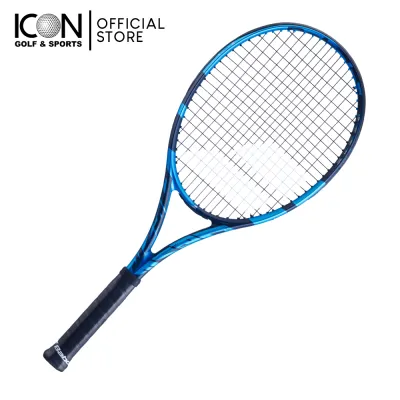
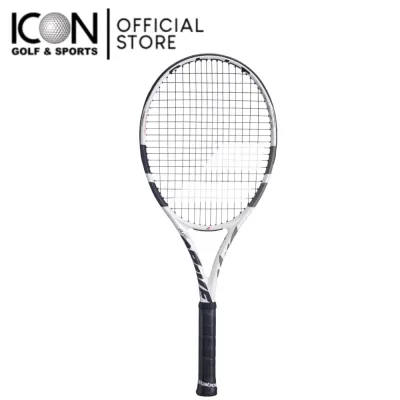
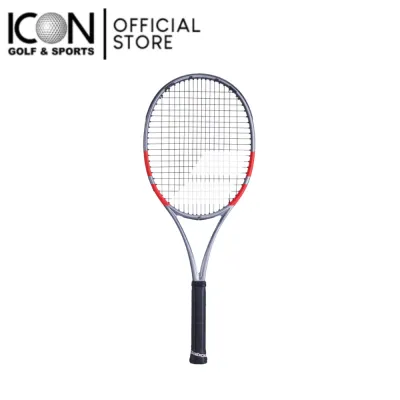
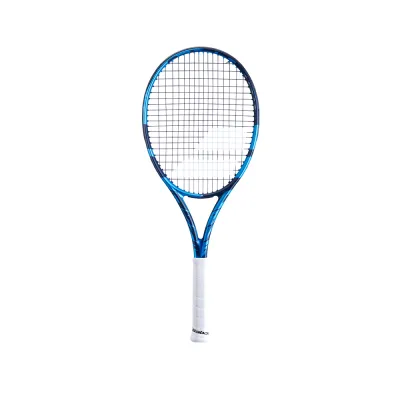
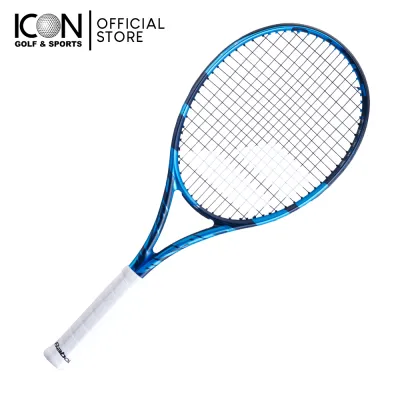
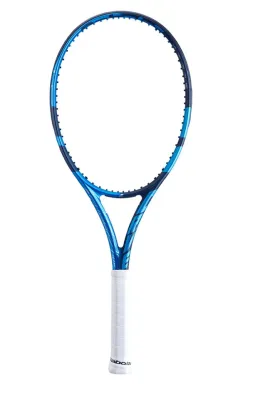

Prices are valid at publication and may change. Please refer to the product page for the latest price.
Physical strength and swing speed also play a major role in this diagnostic. Stiffer, power-focused frames require a certain level of physical preparation to handle safely and effectively over long matches. If you have a smooth, medium-to-fast swing and do not suffer from chronic arm or shoulder discomfort, you are well-positioned to harness this frame’s potential.
However, a quick diagnostic only provides a starting point. To ensure a perfect match, you must verify the exact specifications on the product tag of the specific model year you are considering, as subtle changes in weight, balance, and technology occur across different editions.
Assess Your Playing Style and Court Position
Your preferred location on the court and how you construct points should heavily influence your racket choice. The Babolat Pure Drive is engineered with a thick, aerodynamic beam that maximizes energy return, making it a formidable weapon for baseline aggressors. If you love standing behind the baseline, trading heavy groundstrokes, and looking for short balls to punish, this frame provides the depth and ball speed necessary to keep your opponents on the defensive.

Conversely, net-rushers and traditional volleyers may find the lively nature of a power-oriented frame more difficult to control. At the net, where touch, precise placement, and dampening are paramount, a highly stiff frame can sometimes feel too springy, causing volleys to float long if your wrist work is not perfectly disciplined. While it offers excellent stability against hard-hit passing shots, it sacrifices some of the plush, connected feel that touch players prefer.
Spin generation is another critical factor to consider. This racket features an open 16×19 string pattern, which allows the main strings to deflect and snap back quickly, imparting significant topspin on the ball. If you play with modern topspin, this pattern helps pull your powerful shots down inside the lines; however, if you are a flat hitter who strikes the ball with minimal rotation, you may struggle to control the depth of your shots, leading to unforced errors past the baseline.
Finally, consider your defensive capabilities. When you are stretched wide or forced to hit on the run, a powerful frame can be a lifesaver, allowing you to flick the ball back deep into the opponent’s court with minimal backswing. If your game relies on defensive retrieval and counter-punching, this extra assistance can help you stay in rallies longer, provided you can control the ball’s trajectory when transitioning back to offense.
Evaluate Your Skill Level and Physical Attributes
Your technical proficiency and physical health are just as important as your playing style when selecting a racket. One of the most critical aspects of a stiff frame is its impact on arm health and joint sensitivity. Because stiffer frames do not bend as much upon ball contact, they transmit more shock and high-frequency vibrations directly to your hand, wrist, and elbow.
In tropical climates like the Philippines, high humidity and heat can cause strings to lose tension rapidly, which alters the overall feel and can increase the physical strain on your arm. If you have a history of tennis elbow or shoulder issues, you must approach stiff frames with caution. It is highly recommended to verify the manufacturer’s dampening technologies, consider using a softer multifilament string at a lower tension, or look for more flexible alternative frames if comfort is your primary concern.
Your swing speed and physical strength also dictate how well you can control a powerful racket. Players with long, fast swings generate a massive amount of natural power and require a racket that offers control to keep the ball in play. If you have a very fast swing but lack the spin technique to control the ball, a stiff, powerful frame may cause your shots to fly out. Conversely, players with shorter, slower swings who struggle to hit the ball past the service line will find that the frame’s built-in power helps them achieve respectable depth with less physical effort.
For beginners, the margin for error with a power-oriented racket can be surprisingly slim. While the generous sweet spot is forgiving on off-center hits, the inherent power means that minor errors in racket face angle at contact are magnified, sending the ball far out of bounds. Intermediate and advanced players who have developed consistent stroke mechanics and can reliably generate topspin are generally better equipped to handle this power and use it to direct the point.
How to Verify the Racket's Specifications Before Buying
When you are ready to make a purchase, you should not rely solely on the model name. You must physically inspect the product tag or official specifications to ensure the exact version matches your physical capabilities and playing preferences.
- Unstrung Weight and Balance: Look closely at the unstrung weight listed on the frame. The standard version typically weighs around 300 grams (10.6 ounces) unstrung. If you play long matches in hot, humid conditions, swinging a 300-gram frame can lead to fatigue if your forearm strength is not fully developed. If you prefer a lighter, faster feel, look for the "Team" (typically 285 grams) or "Lite" (typically 270 grams) variations.
- Head Size and String Pattern: Confirm that the head size is 100 square inches, which is the standard configuration for balancing power and control. Verify that the string pattern is 16×19 to ensure you get the spin potential and open spacing required for modern baseline play.
- Stiffness Rating (RA): Check the stiffness rating, often printed on the throat of the racket or available in the official specifications. A rating above 68 RA indicates a very stiff frame. If you require a more arm-friendly setup, verify if the model incorporates specialized dampening materials in the layup, and plan your string setup accordingly.
- Grip Size: Selecting the correct grip size is essential to prevent the racket from twisting in your hand, especially when playing in humid weather where sweat reduces traction. In local sports shops or online marketplaces, grip sizes typically range from Grip 1 (4 1/8 inches) to Grip 4 (4 1/2 inches).
When investing upwards of ₱12,000 in a premium frame, taking the time to verify these physical specifications ensures you do not end up with a racket that is too heavy, too stiff, or uncomfortable for your hand.
Frequently Asked Questions (FAQ)
Should beginners use a power-oriented racket like this?
Beginners can use a power-oriented racket, but they must be prepared for a learning curve regarding depth control. Because these frames offer high energy transfer, novice players with unrefined, flat strokes will often find their balls landing past the baseline. This can lead to frustration and may cause beginners to shorten their swings instinctively, which hinders the development of proper, fluid stroke mechanics.
However, if you are an athletic beginner with excellent hand-eye coordination and a naturally fast swing, you may adapt to this style of racket relatively quickly. If you are concerned about control, it is often wiser to start with a slightly more flexible frame or a model with a larger head size (such as 102 to 105 square inches) that offers a larger sweet spot and more forgiving launch angles while you build your foundational technique.
How do I know if the grip size is correct for my hand?
To verify your grip size before purchasing, you can use the classic finger-gap test. Hold the racket handle in your dominant hand using an Eastern grip (where your palm is flat against the same bevel as the string face). Slide the index finger of your non-dominant hand into the gap between your ring finger and your palm.
If there is comfortable space for your index finger to fit without being squeezed, the grip size is generally correct. If the gap is too small to fit your finger, the grip is too small, which can cause you to over-squeeze and strain your forearm. If there is excess space around your index finger, the grip is too large, limiting your wrist snap. Keep in mind that adding an overgrip—which is highly recommended in humid climates to absorb sweat—will increase the handle circumference by about half a size, so factor this in when choosing your base grip size at your local sports retailer.
Community discussion
Share your experience or ask a question. Comments are reviewed before publication.