
Choosing the right training gear is a critical decision for any Taekwondo practitioner looking to improve their kicking power, speed, and overall sparring performance. When training with a partner outside the dojang, the two most common targets you will rely on are kicking shields and focus mitts. Neither tool is universally superior; instead, the ideal choice depends entirely on your specific training objectives, skill level, and the physical demands of your drills.
To make an immediate decision, use this straightforward framework: choose a kicking shield if your primary goal is to develop explosive kicking power, practice high-impact techniques like spinning back kicks, and ensure maximum protection for your training partner. Conversely, select focus mitts if you want to refine your target accuracy, increase your striking speed, practice rapid-fire combinations, and integrate hand strikes with fluid footwork. While beginners benefit from the large, forgiving target area of a kicking shield, advanced martial artists typically require both tools to build a complete, well-rounded training regimen.
Core Design Differences: How They Absorb Impact
Understanding the structural differences between these two training tools explains why they perform so differently under the impact of a Taekwondo kick. A kicking shield is a large, heavily padded target designed to withstand maximum physical force. It features a thick core made of multi-layered, high-density foam—often combining closed-cell EVA foam for structural integrity and open-cell foam for shock absorption. The outer shell is constructed from durable synthetic leather or heavy-duty vinyl, reinforced with multiple handles and adjustable forearm straps. This design allows the holder to secure the shield firmly against their body, distributing the kinetic energy of a heavy kick across a wide surface area.
Products mentioned in this guide
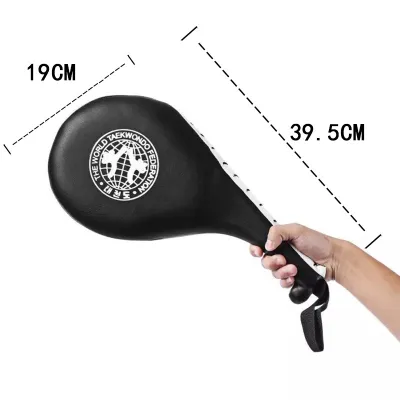
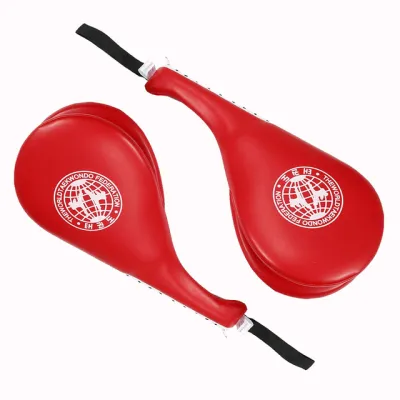
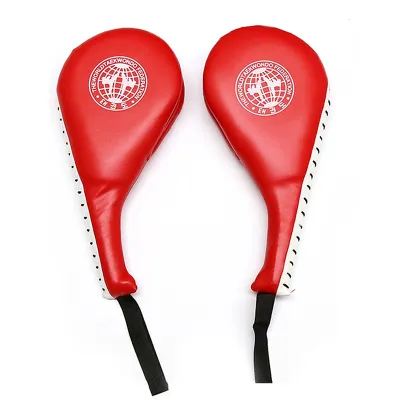
Prices are valid at publication and may change. Please refer to the product page for the latest price.
Focus mitts, on the other hand, are compact, hand-sized targets designed for precision and rapid movement. They feature a curved or flat striking surface and an integrated glove pocket on the back where the holder inserts their hand. The padding is significantly thinner than that of a kicking shield, utilizing dense foam to provide immediate tactile feedback. Many high-quality focus mitts also include an internal palm dome—a ball-shaped grip inside the glove pocket—which helps the holder maintain a secure grip and absorb minor shock waves through the palm and wrist.
These structural differences dictate how each tool interacts with the physics of a foot strike. A Taekwondo roundhouse kick (dollyo chagi) or side kick (yeop chagi) delivers massive kinetic energy, far exceeding the force of a standard punch. A kicking shield is engineered to compress and slowly release air through specialized side vents, neutralizing this heavy impact before it reaches the holder’s body. Focus mitts lack this extensive volume of foam, meaning a significant portion of the impact energy is transferred directly to the holder’s wrist, elbow, and shoulder joints. Consequently, focus mitts are optimized for light, snappy contact rather than heavy, structural power strikes.
Head-to-Head Comparison for Taekwondo Drills
To help you evaluate these tools side by side, the following table compares how kicking shields and focus mitts perform across the key training dimensions that matter most to Taekwondo practitioners.

| Feature / Dimension | Kicking Shield | Focus Mitts | Taekwondo Training Impact |
|---|---|---|---|
| Target Surface Area | Large (typically 50–70 cm in length) | Small (typically 20–25 cm in diameter) | Shields offer a forgiving target for heavy kicks; mitts demand extreme precision. |
| Impact Absorption | High; multi-layered foam with air vents | Moderate to Low; thin, dense foam padding | Shields protect the holder from heavy adult kicks; mitts transfer force to the holder's joints. |
| Speed & Agility | Low; bulky and slower to reposition | High; lightweight and easily maneuvered | Mitts excel at rapid-fire, multi-angle combinations; shields are limited to single-plane movements. |
| Holder Fatigue | Low; impact is absorbed by the shield and torso | High; holder's arms and shoulders bear the direct force | Shields allow for longer, high-power sessions; mitts require active, fatiguing holding techniques. |
| Portability & Storage | Bulky; requires significant bag space | Compact; easily fits into a standard gym bag | Mitts are ideal for travel and home use; shields require dedicated storage and carrying effort. |
Durability and Material Checks
Because training gear is a long-term investment, you must know how to inspect the quality of these tools before making a purchase. In the hot and humid tropical climate of the Philippines, training gear is subjected to intense sweat, which can accelerate material degradation, cause slipping, and lead to mold if the gear is poorly constructed.
When evaluating a kicking shield or a pair of focus mitts, always check the product specifications and labels for the following quality indicators:
- Outer Shell Material: Look for premium polyurethane (PU) synthetic leather or heavy-duty vinyl. Avoid low-grade PVC, which tends to crack, peel, and stiffen when exposed to humidity and repeated impacts.
- Stitching Quality: Inspect the seams around the handles, straps, and edges. Look for double or triple stitching with thick, heavy-duty nylon thread. Reinforced cross-stitching at the handle attachment points is critical, as these areas experience the highest tension.
- Air-Release Vents: High-quality kicking shields must feature metal grommets or mesh ventilation strips on the sides. These vents allow air to escape instantly upon impact, preventing the internal pressure from blowing out the seams.
- Foam Core Composition: Verify that the core uses multi-layered EVA, polyethylene, or polyurethane foam. Avoid single-layer open-cell foam, which bottoms out easily and permanently loses its shape after a few weeks of heavy use.
Choose Kicking Shields for Power and High-Impact Safety
If your training regimen prioritizes the development of raw, explosive power, the kicking shield is an indispensable asset. It functions essentially as a mobile heavy bag, allowing you to execute full-force kicks with realistic follow-through. This follow-through is vital for mastering the hip rotation and body weight transfer required in Taekwondo’s signature power kicks, such as the spinning back kick (dwi chagi) and the turning side kick. Training on a target that cannot safely absorb this level of force forces you to hold back, which can lead to poor habits and restricted athletic development.
Safety is another primary reason to choose a kicking shield, particularly when practicing high-risk or advanced flying techniques. Kicks like the jumping 360-degree roundhouse kick (narae chagi) or the axe kick (naeryo chagi) carry immense momentum and are difficult to target precisely during high-speed training. The generous surface area of a kicking shield provides a safe margin of error. If your foot lands slightly off-center, the shield still captures the strike safely, preventing accidental injury to your training partner’s face, ribs, or arms.
Furthermore, kicking shields are excellent for simulating realistic sparring distance and defensive body mechanics. A training partner can hold the shield against their chest or hip and actively push forward, mimicking an aggressive opponent pressure-fighting in the ring. This setup forces you to manage your distance, utilize rapid backward footwork, and execute powerful defensive kicks under realistic physical pressure. The solid physical presence of the shield teaches you how to brace your body and maintain balance upon impact.
This tool is highly recommended for intermediate to advanced students, adult martial artists training with partners of similar physical strength, and anyone preparing for full-contact kyorugi (sparring) competitions. In terms of local budget planning, standard kicking shields in the Philippines generally range from ₱1,500 to ₱3,000 for reliable training models, while heavy-duty, multi-layered professional shields can range from ₱3,500 to ₱6,000 or more.
Choose Focus Mitts for Speed, Precision, and Combos
When your training focus shifts from raw power to speed, coordination, and razor-sharp accuracy, focus mitts become the superior choice. The small, concentrated target area of a focus mitt leaves no room for error. It forces you to concentrate entirely on your point of contact, ensuring that you strike with the correct part of your foot—such as the instep for roundhouse kicks or the ball of the foot for front snap kicks (ap chagi). This precision training discourages lazy, wide-swinging kicks and encourages tight, efficient chambering and execution.
Focus mitts excel at facilitating rapid-fire, multi-strike combination drills. Because they are lightweight and attached directly to the holder’s hands, a skilled partner can rapidly change the target’s height, angle, and position in a split second. This allows you to practice complex Taekwondo combinations, such as a double roundhouse kick transitioning immediately into a spinning hook kick, or seamlessly blending hand strikes (punches and ridge hands) with rapid footwork. This fast-paced interaction closely mimics the chaotic, unpredictable nature of a real match.
Another significant benefit of focus mitts is the ease with which a holder can facilitate technique correction and defensive awareness. The holder can easily adjust the mitts to simulate an opponent’s open guard or use the mitts to lightly tap you on the side of the head if you drop your hands during a kick. This immediate feedback builds the muscle memory of keeping a high, protective guard while executing high kicks—a common vulnerability in sport Taekwondo.
Focus mitts are the ideal choice for beginners who are still learning to control their kicking trajectory, children’s classes where heavy impact absorption is not required, and advanced athletes refining their reaction times, agility, and hand-eye coordination. For those looking to purchase, entry-level focus mitts from local martial arts suppliers typically cost between ₱800 and ₱1,500, while high-quality, ergonomically curved focus mitts designed for professional training range from ₱2,000 to ₱4,000 per pair.
Buying Guide: Building Your Target Equipment Setup
If your budget and training space permit, the most effective strategy is to acquire both a kicking shield and a pair of focus mitts. Because they serve highly complementary roles, utilizing both tools ensures that you can train every aspect of your Taekwondo curriculum—from raw power and conditioning to speed, accuracy, and defensive reflexes. You can dedicate specific days to heavy power drills using the shield, and other sessions to high-speed combination work using the focus mitts.
However, if you must choose only one tool due to budget constraints or storage limitations, you can make your final decision using this targeted matrix:
- Choose a Kicking Shield if: You primarily train at home with an adult partner of similar or larger physical build, your training goals focus heavily on power development and sparring preparation, or you frequently practice heavy spinning and jumping kicks.
- Choose Focus Mitts if: You have limited storage space or need gear that easily fits into a small gym bag, you train primarily with children or lighter family members, or your current training focus is on speed, hand-eye coordination, and precision footwork.
Before finalizing your purchase on any online marketplace or at a local sporting goods store, review this quick pre-purchase checklist to ensure the gear is safe and durable:
- Strap Adjustability: Ensure the forearm straps on the kicking shield are fully adjustable and feature high-quality hook-and-loop fasteners to prevent the shield from shifting during impact.
- Grip Ergonomics: For focus mitts, look for designs that feature a curved shape and an internal palm ball, which significantly reduces hand fatigue and joint strain for the holder.
- Foam Density: Avoid targets that feel overly soft or squishy; high-quality training gear should feel firm to the touch, indicating high-density foam that will not bottom out under impact.
Finally, keep in mind a crucial safety boundary: holding targets for heavy kicking drills carries an inherent risk of joint strain, wrist hyperextension, and impact-related injuries. Always refer to the manufacturer’s guidelines for proper holding techniques, and ensure the holder wears supportive hand wraps or wrist-support gloves to stabilize their joints. If the holder experiences persistent wrist, elbow, or shoulder pain, stop the drill immediately. Equipment is designed to assist your development, but it must never replace proper technique, physical conditioning, and mutual safety awareness.
Frequently Asked Questions (FAQ)
Can I use standard boxing focus mitts for Taekwondo kicking?
While you can use standard boxing focus mitts for light, technical snap kicks, they are not recommended for regular Taekwondo kicking drills. Boxing mitts are designed specifically to absorb the impact of gloved fists, not the much heavier, concentrated force of an unshod foot strike. Repeatedly landing heavy kicks on boxing mitts will rapidly degrade the thin padding, increasing the risk of wrist, hand, or shoulder injuries for the holder, and potential foot or ankle bruising for the kicker. For Taekwondo, it is highly recommended to use focus mitts that are specifically rated for martial arts kicking or feature extra-dense foam cores.
What size kicking shield is best for adult Taekwondo practitioners?
For adult Taekwondo practitioners, the ideal kicking shield should measure at least 55 to 65 centimeters in length and 35 to 45 centimeters in width. This size is large enough to cover the holder’s entire torso, protecting their ribs and chest from accidental stray kicks. While overall width is important, the thickness and density of the foam core are far more critical for impact absorption; look for a shield with a thickness of at least 10 to 12 centimeters. A shield of this size and thickness allows the holder to maintain a stable stance and absorb heavy adult kicks comfortably without having to overextend their arms or compromise their balance.
Community discussion
Share your experience or ask a question. Comments are reviewed before publication.