
Selecting the right exercise elastic band is one of the most practical decisions you can make for your home fitness routine. Unlike heavy iron weights, elastic bands are highly portable, cost-effective, and exceptionally versatile. However, browsing online marketplaces reveals a confusing array of options: continuous loops, cylindrical tubes with handles, and thin, flat strips of rubber.
There is no single “best” band for every exercise; the right choice depends entirely on your specific fitness goals, target muscle groups, and training environment. If your priority is lower-body activation, glute development, or pull-up assistance, loop bands are your ideal choice. If you want to replicate gym cable machines for upper-body strength training, tube bands with handles are the most suitable option. For physical therapy, rehabilitation, or low-impact Pilates, flat bands provide the gentle, adjustable tension you need.
Understanding the structural and mechanical differences between these band types will prevent you from purchasing gear that sits unused in your closet. By evaluating how each band behaves under tension, how they handle wear and tear, and how to safely maintain them in challenging environments, you can make an informed investment that elevates your training.
Products mentioned in this guide
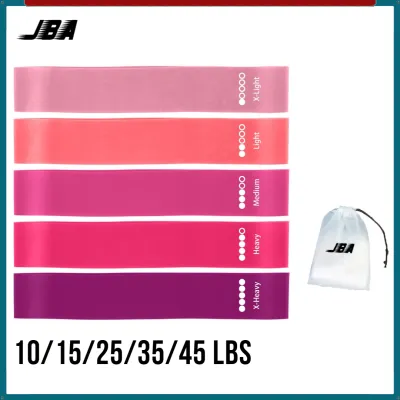

![THE SWEAT CLUB [5 PCS/SET] Rubber Resistance Bands Exercise Bands Flex Bands Different Intensity Level For Hip Legs Butt Home Indoors Sports Exercise Workout Resistance Endurance Training](https://img.lazcdn.com/g/p/13d9ac804327c9899003ee7192e1b221.png_400x400q80.png_.webp)
Prices are valid at publication and may change. Please refer to the product page for the latest price.
Core Differences: Loop, Tube, and Flat Bands Compared
To choose the right tool, you must first understand how their physical designs alter their resistance profiles and practical applications. While all elastic bands work by resisting elongation, their shapes dictate how they interact with your body and your workout space.
Loop Bands (Continuous Loops)
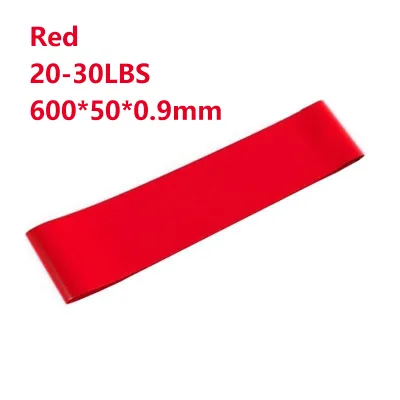
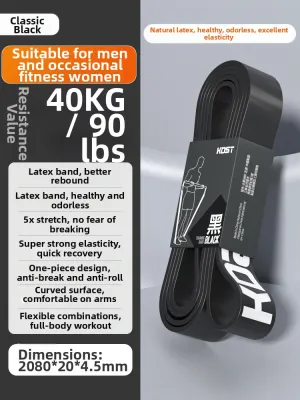
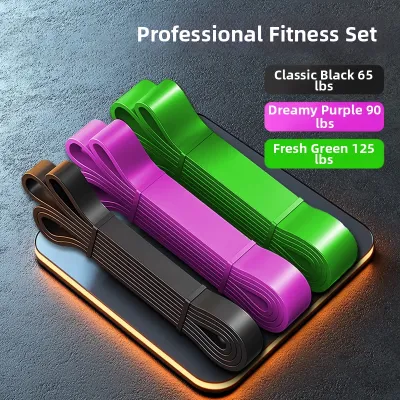
Loop bands are continuous, seamless circles of material that require no handles or external attachment points to function. They generally fall into two categories: mini loops, which are typically 9 to 12 inches long, and large power loops, which measure around 41 inches. These bands are manufactured using layered latex, thermoplastic elastomer (TPE), or woven fabric blended with elastic threads.
The primary mechanical advantage of a loop band is its ability to provide even, consistent tension across a circular plane. Because there are no handles, you can place the band directly around your thighs, calves, ankles, or wrists. This makes mini loops highly effective for lower-body lateral movements, glute bridges, and squats, where they force your hips to work against inward collapse.
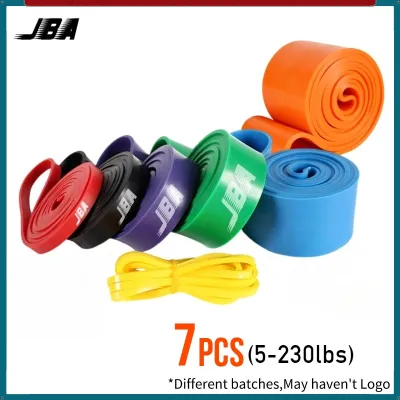
Large power loops offer a much higher resistance ceiling and are commonly used for vertical assistance. For example, looping a heavy-duty band over a pull-up bar allows you to place your foot or knee in the loop, reducing the active body weight you must lift. They are also highly effective for deep, passive stretching and adding progressive resistance to traditional barbell exercises like squats and deadlifts.
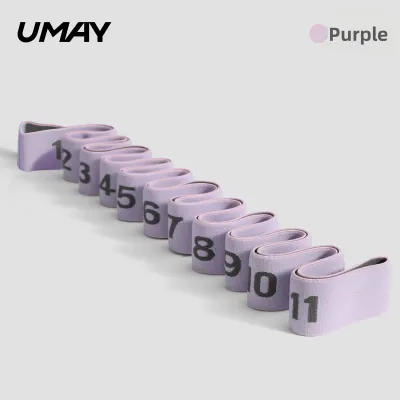
When selecting loop bands, the material choice greatly impacts comfort and usability. Fabric loop bands are wider and stiffer, which prevents them from rolling up, sliding, or pinching your skin during intense lower-body movements. However, they lack the extreme stretch capacity of latex or TPE, making latex or TPE loops the superior choice for upper-body exercises and pull-up assistance where a longer range of motion is required.
Tube Bands with Handles
Tube bands are cylindrical, hollow ropes made of natural rubber or synthetic latex. They feature metal carabiners or secure fabric webbing at both ends, allowing you to clip on interchangeable foam-covered handles, ankle straps, or door anchors. This modular design makes them the closest portable equivalent to a commercial gym cable machine.
The resistance profile of a tube band is highly linear and mimics the feel of free weights or cable pulleys. Because you hold onto ergonomically designed foam or plastic handles, your wrists and hands remain in a natural, comfortable position during traditional upper-body movements. This makes them exceptionally intuitive for exercises like bicep curls, chest presses, tricep extensions, lat pulldowns, and shoulder presses.
However, the very design that makes tube bands excellent for upper-body training limits their utility elsewhere. You cannot easily wrap a cylindrical tube around your thighs for glute work, as the narrow rubber will roll, pinch, and dig painfully into your skin. Additionally, the connection points where the rubber tube meets the plastic or metal carabiner are subject to high mechanical stress. Over time, these connection points can become failure zones if the band is overstretched or subjected to rough friction.
Flat Resistance Bands (Therapy Bands)
Flat resistance bands are thin, wide, open-ended strips of latex or TPE. They are typically sold in pre-cut lengths of four to six feet, or in large continuous rolls that you can cut to your preferred size. They do not feature loops, handles, or clips, relying entirely on your grip or simple knots to secure them.
The resistance feel of a flat band is exceptionally smooth and light, making it the standard choice for clinical physical therapy, joint rehabilitation, and low-impact disciplines like Pilates and yoga. Because the band is wide and flat, you can wrap it securely around the arch of your foot or the palm of your hand to distribute the pressure evenly, minimizing discomfort on sensitive joints.
Adjusting the resistance of a flat band is incredibly simple and requires no tool changes. To increase the tension, you simply shorten your grip on the band; to decrease it, you let out more slack. This immediate adjustability is ideal for targeting small, deep stabilizing muscles, such as the rotator cuff in the shoulder or the stabilizers of the ankle and wrist.
The primary limitation of flat bands is their relatively low resistance ceiling. They are not designed for heavy strength training or muscle hypertrophy. Because the material is very thin, it is highly susceptible to micro-tears and punctures. If a flat band is stepped on with outdoor shoes or caught on a sharp corner of a door frame, it can easily snap during use.
Feature-by-Feature Comparison Matrix
To help you quickly synthesize these differences, the following matrix compares the three primary exercise elastic band formats across key performance and design dimensions.

| Feature | Loop Bands | Tube Bands | Flat Bands |
|---|---|---|---|
| Primary Target Area | Lower body, glutes, hips, pull-up assistance | Upper-body muscle groups, chest, back, arms | Small stabilizing muscles, shoulders, ankles |
| Resistance Feel | Consistent, planar tension | Linear, cable-like pull | Ultra-smooth, highly adjustable |
| Portability | High (lays completely flat, lightweight) | Moderate (bulkier due to handles/carabiners) | Maximum (can be folded into a pocket) |
| Durability & Snapping Risk | High durability; low risk (especially fabric) | Moderate durability; risk at connection joints | Low durability; high risk of tearing if nicked |
| Best Skill Level | All levels (beginner to advanced athletes) | Intermediate (requires controlled mechanics) | Beginner, clinical rehab, or flexibility training |
This matrix highlights that no single band covers every fitness requirement. While a loop band offers maximum durability and lower-body utility, it cannot match the ergonomic upper-body pulling experience of a tube band with handles. Conversely, the gentle, highly customizable tension of a flat band is unmatched for recovery but inadequate for building significant muscle mass.
How to Match the Band to Your Workout Style
Making your final decision requires matching these physical characteristics to your daily fitness routine, your physical capabilities, and your specific environment.
Choose Loop Bands if:
- Your fitness goals center on lower-body strength, hip stability, and glute activation.
- You want to improve your bodyweight pull-up capacity using progressive vertical assistance.
- You travel frequently and need a highly durable, lightweight tool that can be packed into a small bag.
- You prefer outdoor workouts where your bands might come into contact with rough ground; fabric loop bands are exceptionally resilient in these settings.
Choose Tube Bands if:
- Your primary goal is upper-body hypertrophy, muscle toning, or strength building.
- You prefer the familiar, ergonomic grip of handles rather than gripping raw rubber or latex.
- You want to set up a highly versatile home gym system using a door anchor to perform chest presses, rows, and lat pulldowns without bulky machinery.
Choose Flat Bands if:
- You are recovering from an injury and require gentle, progressive rehabilitation exercises prescribed by a physical therapist.
- Your routine focuses on mindful movement, flexibility, Pilates, or yoga.
- You need to target small, specific joint stabilizers, such as performing rotator cuff warm-ups before lifting weights.
Before purchasing any exercise elastic band, you must perform a few critical verification checks, particularly regarding material composition. If you have sensitive skin or a known latex allergy, standard latex bands can cause severe contact dermatitis. Always check the manufacturer’s technical specifications to verify if the band is made from thermoplastic elastomer (TPE), silicone, or woven fabric. If the product label does not explicitly state the material, contact the manufacturer directly to confirm its safety before use.
For fitness enthusiasts living in tropical regions like the Philippines, weather and environment play a significant role in your choice. High humidity and ambient heat can make latex bands sticky and prone to rolling or pulling on body hair during workouts. In these conditions, fabric loop bands are highly recommended for lower-body work, as the breathable woven material remains comfortable against sweaty skin and resists sliding.
Durability, Care, and Safety Checks
Because exercise elastic bands store mechanical energy when stretched, a sudden structural failure can result in a high-velocity snap-back, leading to severe bruising, skin lacerations, or eye injuries. Proper maintenance and regular safety checks are essential to ensure your safety and prolong the lifespan of your equipment.
Pre-Workout Inspection Before every training session, perform a thorough visual and physical inspection of your bands. Unroll the band and run your fingers along the entire length, looking for micro-tears, small punctures, discoloration, or areas where the material has thinned out. Pay close attention to the connection points on tube bands where the rubber meets the carabiners. If you notice any stickiness, brittleness, or a powdery residue, the material has begun to degrade and is no longer safe to use.
Safe Stretching Limits Never stretch any exercise elastic band beyond its safe structural limit, which is generally 2 to 2.5 times its resting length. Overstretching causes micro-fractures in the polymer chain of the rubber, drastically increasing the risk of a sudden snap. Additionally, ensure your anchor points are safe. Never loop or tie a band around sharp metal edges, rough concrete posts, or wooden surfaces with splinters. If using a door anchor, always place it on the side of the door that closes away from you, so that pulling the band pulls the door shut rather than open.
Cleaning and Storage Sweat contains salts and acids that chemically degrade natural rubber and latex over time. After every workout, wipe your bands down with a clean, damp cloth. For a deeper clean, use mild soap and lukewarm water; never use harsh chemical detergents, bleach, or abrasive brushes. Allow the bands to air dry completely in a shaded, well-ventilated indoor area. Never place them on hot surfaces or leave them to dry in direct sunlight, as ultraviolet (UV) rays rapidly break down latex and TPE, causing them to become brittle and crack. Store your dry bands in a cool, dark drawer or a breathable mesh bag.
When to Retire a Band Equipment cannot replace proper training, physical preparation, or sound safety judgment. If a band fails any part of your pre-workout inspection, loses its original elasticity, or feels unusually stiff, you must stop using it immediately. Do not attempt to repair a torn or cracked band with tape, glue, or knots, as these temporary fixes will fail under tension. Replace the compromised band to maintain a safe, effective workout environment.
Frequently Asked Questions (FAQ)
Can I combine different band types in one workout?
Yes, combining different band formats is an exceptionally effective way to design a comprehensive, full-body home workout. Since different muscle groups require different movement patterns and resistance levels, using a single band type often limits your training efficiency. For example, you can begin your workout by using a fabric mini loop band around your thighs to activate your glutes and hips during squats. Once warmed up, you can transition to a tube band anchored to a door frame to perform upper-body pulling and pushing exercises like rows and chest presses. Finally, you can use a flat band for targeted rotator cuff activation or deep stretching. When combining bands, always ensure you have adequate physical space to perform each movement safely and that your anchor points are fully secured before applying tension.
How do I determine the right resistance level?
Determining the correct resistance level requires looking beyond the color of the band. While many manufacturers use a color-coding system—such as yellow for light, red for medium, and black for heavy—these colors are not standardized across the fitness industry. A black band from one brand might offer the same tension as a red band from another. To make an accurate choice, always consult the manufacturer’s specific tension chart, which typically lists the resistance range in kilograms or pounds at specific stretch lengths. If you are a beginner, it is highly recommended to start with a lighter resistance band. This allows you to master the correct movement patterns, build joint stability, and establish proper mind-muscle connection before progressing to heavier tension.
Community discussion
Share your experience or ask a question. Comments are reviewed before publication.