
When the tropical heat or sudden monsoon rains in the Philippines make outdoor running impractical, bringing your cardio workouts indoors is the most reliable way to stay consistent. Setting up a home gym requires making smart equipment choices, and one of the most common dilemmas is deciding between a manual treadmill and a motorized treadmill. The right choice is not about finding the universally superior machine, but rather identifying which design aligns with your specific fitness goals, available floor space, and household budget.
At its core, the decision comes down to a fundamental trade-off: manual treadmills rely entirely on your physical effort to move the belt and generally offer a more compact, budget-friendly design, while motorized treadmills use an electric motor to maintain a consistent pace and provide built-in workout programs. If you want a high-intensity workout that challenges your lower-body muscles and fits into a tight corner, a manual model is highly effective. Conversely, if you are training for endurance, require automated pacing, or need advanced joint cushioning, a motorized unit is typically the more suitable investment.
Core Comparison: How Manual and Motorized Treadmills Perform at Home
To make an informed choice, you must understand how these two machine types operate and how their mechanical differences translate to a home environment. A manual treadmill features a belt that remains stationary until your feet push it backward, meaning you act as the motor. A motorized treadmill uses an electric motor to turn the belt at a speed you select via a console, forcing you to keep pace with the machine.
Products mentioned in this guide
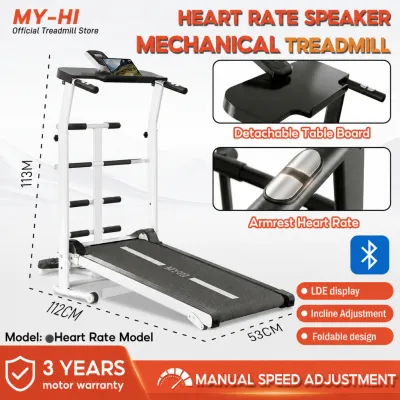
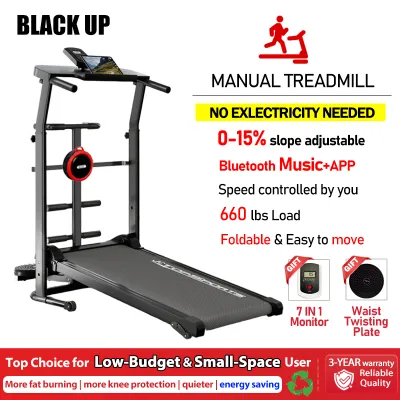
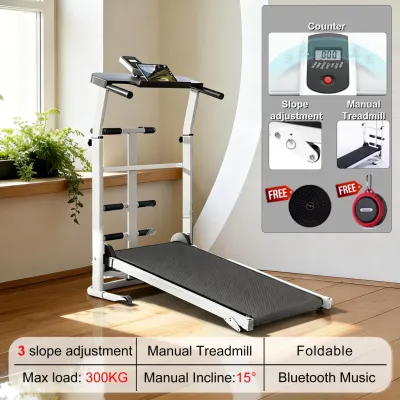
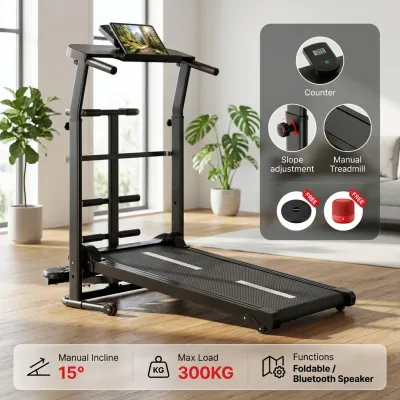
![[COD] Foldable Manual Home Treadmill with Adjustable Slope LED Display Anti-Slip Running Belt Free Twist Disc & Resistance Rope Space Saving Walking Machine for Home Fitness Exercise](https://img.lazcdn.com/g/p/1446617c7dcf63717d1a1640b68a647e.jpg_400x400q80.jpg_.webp)
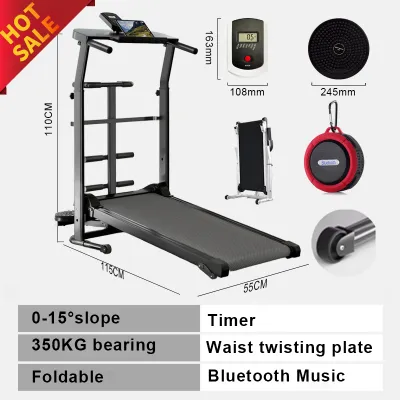
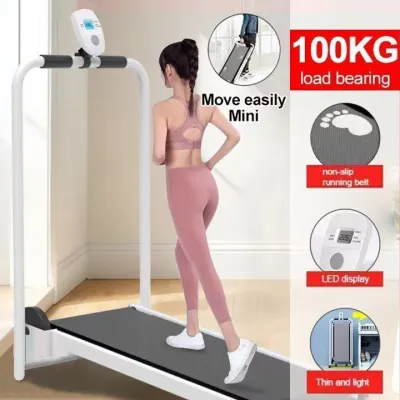
Prices are valid at publication and may change. Please refer to the product page for the latest price.
This mechanical distinction influences every aspect of your workout, from how hard your muscles work to how much space the machine occupies in your living room. By evaluating these differences across key performance areas, you can determine which system fits your daily routine and physical needs.
Workout Intensity and Muscle Engagement
Because a manual treadmill has no motor, your legs must work harder to initiate and maintain every single stride. This design requires significant engagement from your posterior chain, specifically your hamstrings, glutes, and calves, to push the belt backward. Because you are responsible for the movement, the metabolic demand can be higher, making manual models highly efficient for short, intense workouts or high-intensity interval training (HIIT).
Motorized treadmills, on the other hand, pull the belt underneath your feet, which allows you to focus on maintaining a steady stride and consistent pace. This automated movement is ideal for steady-state cardio, long-distance endurance training, and structured interval workouts where you need to hold a precise speed. Because the machine dictates the pace, it can help push you past mental fatigue during long runs.
Before purchasing either type, always check the manufacturer’s specifications for maximum speed capabilities and incline options. Some manual treadmills have a fixed incline that cannot be adjusted, while motorized models often feature motorized incline systems that let you change the deck angle at the touch of a button to simulate outdoor hills.
Space, Weight, and Portability
For many homeowners and condominium residents, floor space is a premium commodity. Manual treadmills generally have a much smaller footprint and a lighter overall weight because they lack a heavy electric motor and the reinforced steel frame required to support it. Many manual models are designed to fold completely flat, allowing you to roll them under a bed or stand them up in a closet when your workout is finished.
Motorized treadmills are substantially heavier and bulkier. The motor housing adds length to the front of the machine, and the robust frames required to handle high-speed motorized running make these units difficult to move once assembled. While many home motorized treadmills feature folding decks, they still occupy a significant amount of vertical and horizontal space even when folded.
Before ordering any treadmill, carefully measure your designated workout area. You must account for both the physical footprint of the machine and the safety clearance zones around it. Additionally, check your ceiling height; standing on a treadmill deck raises your body several inches, and if you plan to use an incline feature, you need to ensure you will not risk head injuries against the ceiling.
Power, Noise, and Ongoing Maintenance
Operating costs and household logistics are critical factors for long-term satisfaction. A manual treadmill requires zero electricity, meaning you can place it anywhere in your home without worrying about proximity to a wall outlet. In areas where electricity rates are high or power fluctuations occur, a manual treadmill offers a highly reliable, cost-effective alternative that will not add to your monthly utility bill.
Motorized treadmills require a dedicated, grounded electrical outlet to operate safely. The motor itself produces a continuous hum, and when combined with the sound of your feet striking the belt at high speeds, motorized units can be quite loud. This noise profile can be a concern if you live in a shared apartment or condo with thin walls, or if you prefer to exercise while family members are sleeping.
Maintenance requirements also differ significantly between the two types. Manual treadmills have fewer moving parts, which generally translates to fewer mechanical failures, though they still require regular belt alignment and lubrication to prevent friction damage. Motorized treadmills require more diligent upkeep, including regular deck lubrication, belt tension adjustments, and occasional vacuuming of the motor compartment to remove dust and pet hair. Always consult the product manual for specific maintenance schedules and approved lubricant types to avoid voiding your warranty.
Joint Impact and Safety Considerations
Protecting your joints from repetitive impact is essential for long-term fitness consistency. Motorized treadmills often feature advanced deck cushioning systems, such as elastomeric shock absorbers beneath the running surface, which help absorb the impact of each footstrike. This makes them a preferred option for runners recovering from joint injuries or those prone to knee and ankle discomfort.
Manual treadmills, particularly budget-friendly flat models, often have firmer decks with minimal shock absorption, which can result in a higher-impact workout. However, premium curved manual treadmills are designed with flexible slats that can provide excellent shock absorption, though these models represent a much larger physical and financial investment.
From a safety perspective, motorized treadmills are equipped with emergency stop keys that clip to your clothing; if you slip or fall, the key pulls out and cuts power to the motor instantly. Manual treadmills do not have emergency stop keys because the belt stops moving almost immediately when you stop walking or running. However, starting a workout on a manual treadmill requires good balance and core stability, as you must use your own physical force to get the heavy belt moving from a complete standstill.
Evaluating Upfront Costs and Long-Term Value
When planning your home gym budget, it is important to look at both the initial purchase price in ₱ and the potential long-term costs associated with operating and maintaining your equipment. Manual treadmills generally offer a much lower entry price point, making them highly accessible for casual fitness enthusiasts or those building a budget-friendly workout space. Because they lack complex electronics and motors, they are also less likely to require expensive professional repairs over their lifespan.

Motorized treadmills span a much wider pricing spectrum. Entry-level motorized models may fit modest budgets but often feature smaller motors and lower weight capacities, which can limit their durability under heavy use. High-end motorized treadmills represent a significant financial commitment but offer robust motors, advanced console screens, and longer warranty periods.
To maximize the value of your investment, always verify the warranty coverage before making a purchase. Look for manufacturers that offer separate, extended warranties for the motor and the frame, as these are the most expensive components to replace. Additionally, factor in the cost of specialized treadmill lubricants and potential electricity consumption if you plan to use a motorized model for multiple hours every week.
Decision Framework: Choosing the Right Treadmill for Your Routine
To finalize your decision, evaluate your personal circumstances against these clear, condition-based guidelines.
Choose a manual treadmill if:
- Space is highly limited: You live in a compact apartment or condo and need a machine that can be easily folded and stored away after every workout.
- You prioritize lower-body strength: Your primary goal is high-intensity training, power development, and active muscle engagement rather than long-distance pacing.
- You want a low-maintenance, zero-power option: You prefer to keep your utility bills low and want a machine that functions perfectly without needing to be plugged into a wall.
Choose a motorized treadmill if:
- You are training for endurance: You need to maintain a specific, steady pace for long-distance running or marathon preparation.
- You require joint protection: You need a cushioned deck to reduce the impact on your knees, hips, and lower back during regular runs.
- You want guided workouts: You benefit from built-in programs, automated incline changes, and digital tracking features to keep you motivated.
Verify first if:
- Your electrical setup is compatible: For motorized models, ensure your home has a properly grounded outlet that can handle the machine's power requirements without overloading your circuits.
- The weight capacity is sufficient: Check the structural specifications of any model you consider to ensure it safely supports the weight of the heaviest user in your household.
- You have adequate clearance: Measure your ceiling height and compare it to the deck height of the treadmill to ensure you can run safely without any risk of overhead obstruction.
Frequently Asked Questions (FAQ)
Can I convert a manual treadmill to a motorized one?
No, converting a manual treadmill into a motorized one is not feasible or safe. Manual treadmills are structurally designed to handle only the forces generated by a user’s physical stride, and their frames, rollers, and belt systems are not built to accommodate an electric motor. Attempting to mount an aftermarket motor to a manual frame poses severe electrical and mechanical hazards, and will void any manufacturer warranties. If you decide you need automated pacing and motorized speed control, you should purchase a purpose-built motorized treadmill.
Are curved manual treadmills better than flat ones?
Curved manual treadmills and flat manual treadmills serve very different training purposes. Curved models feature a specialized, low-friction belt design that allows you to run naturally, self-regulating your speed based on how far forward you step on the curve. They offer excellent shock absorption and are highly favored for athletic conditioning, but they are heavy, expensive, and do not fold. Flat manual treadmills are much more affordable and compact, but they typically require a fixed incline to keep the belt moving, which can make running feel less natural and limit you primarily to walking or power walking.
Do manual treadmills require a power outlet?
The mechanical belt on a manual treadmill is entirely user-powered and does not require an electrical outlet to function. You can place the machine anywhere in your home, including balconies or rooms without power access. However, some manual models include small, battery-operated or USB-rechargeable digital consoles to track basic workout metrics like elapsed time, estimated distance, and speed. These consoles operate independently of the belt and do not require a continuous connection to a wall outlet.
Community discussion
Share your experience or ask a question. Comments are reviewed before publication.