
Quick Answer: Which Treadmill Type is Right for You?
Choosing between a mechanical treadmill and a motorized treadmill depends on your specific fitness goals, available floor space, and willingness to perform regular equipment maintenance. A mechanical treadmill, which relies entirely on your physical effort to move the belt, is ideal if you have limited space, a tighter budget, or a preference for high-intensity interval training (HIIT) and natural walking. Within this category, flat manual models offer a basic, low-cost walking platform, while premium curved manual models provide an intense running experience that closely mimics outdoor training.
Conversely, a motorized treadmill is better suited if you require consistent pacing for long-distance runs, advanced electronic tracking, built-in workout programs, and motorized incline adjustments. Because motorized decks feature integrated shock-absorption systems, they are also highly beneficial for users seeking a joint-friendly running surface. Assessing your daily workout style, your home’s electrical layout, and your physical space will point you toward the machine that best supports your long-term fitness routine.
How Mechanical and Motorized Treadmills Work
To make an informed decision for your home gym, it is essential to understand the mechanical principles that drive these two distinct types of fitness equipment. The fundamental difference lies in the power source: your own muscles versus an electric motor.
Products mentioned in this guide
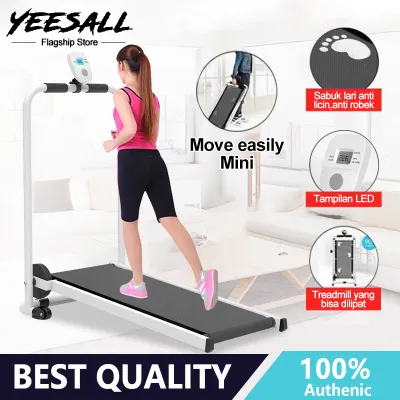
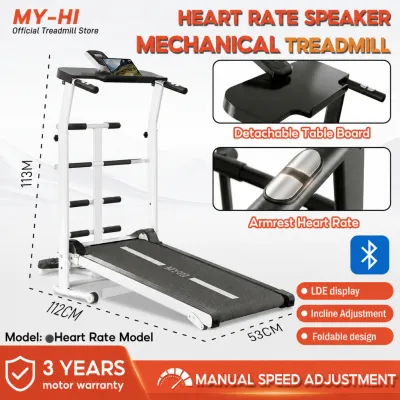

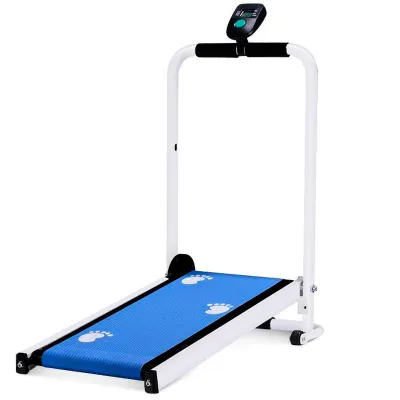
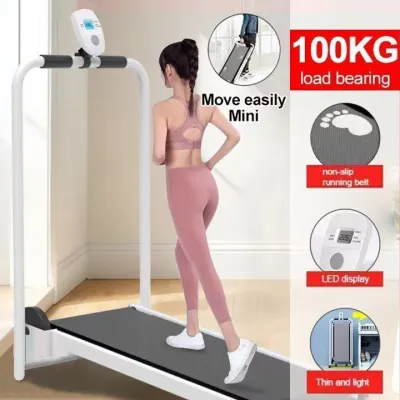
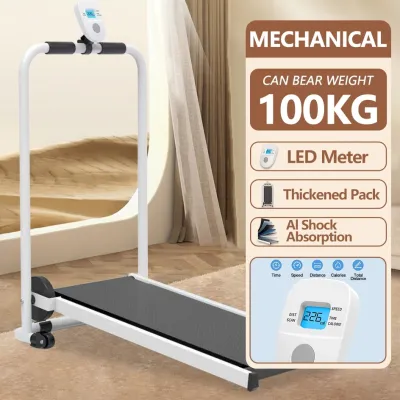
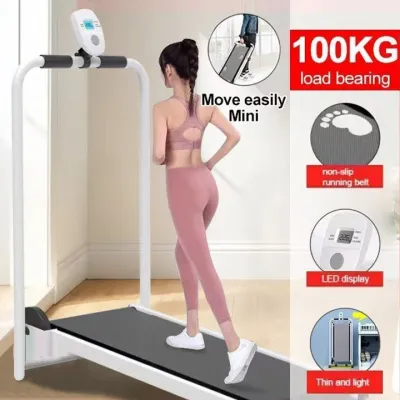
Prices are valid at publication and may change. Please refer to the product page for the latest price.

Mechanical (Manual) Treadmills
A mechanical treadmill does not use an electric motor to turn the belt. Instead, the belt only moves when your feet push against the running deck. This category is divided into two distinct designs:
- Flat Manual Treadmills: These entry-level machines use a flat deck set at a fixed incline (usually around 8% to 10%) to help initiate belt movement. Because you must overcome static friction with every step, these models require significant effort to start and maintain a steady walking pace.
- Curved Manual Treadmills: These premium, non-motorized machines feature a curved running surface. As you place your foot forward on the upward curve, gravity and your stride push the belt downward and backward. This design allows for a incredibly smooth, self-paced running experience that responds instantly to your acceleration or deceleration.
Motorized Treadmills
Motorized treadmills rely on an electric motor (typically measured in continuous horsepower, or CHP) to drive the belt at a constant speed. Once you select a speed setting on the console, the machine maintains that pace automatically. This design requires you to match the speed of the moving belt, shifting the physical demand from initiating belt movement to keeping up with the machine’s pre-set tempo.
This mechanical divergence directly impacts how your muscles engage during a workout. On a motorized unit, the machine assists with the leg turnover process. On a mechanical treadmill, your lower body must perform all the work to pull the belt under you, creating a different muscular demand and sensory experience.
Key Comparison Dimensions for Your Home Gym
Integrating a large piece of fitness equipment into your home requires balancing physical space, training objectives, utility costs, and long-term maintenance. Evaluating these dimensions helps ensure your investment remains functional and frequently used.
Space, Weight, and Portability
For many homeowners and apartment dwellers in the Philippines, floor space is a premium commodity. Manual treadmills are generally lighter, more compact, and highly portable. Because they do not feature heavy internal motors or complex steel shrouds, flat manual models can often fold completely flat and be wheeled under a bed or into a closet when not in use. Even larger curved manual models, though heavier than flat ones, do not require proximity to a wall outlet, giving you the freedom to position them anywhere—including covered balconies or outdoor patios.
Motorized treadmills are significantly heavier and demand a permanent or semi-permanent footprint. They require a dedicated space close to a grounded electrical outlet, which limits where you can place them in a room. While many home-use motorized models feature folding decks, their heavy frames and motor housings make them difficult to move frequently. Before purchasing, always verify the manufacturer’s exact product dimensions, folded clearances, and the total weight of the unit to ensure you can safely transport and position it within your home.
Workout Experience and Fitness Goals
Your training style should dictate the mechanism of your treadmill. Motorized treadmills excel at steady-state cardio, endurance training, and structured pacing. If you are training for a marathon or a specific road race, a motorized unit allows you to lock in a precise target pace and practice running at that speed for extended periods. The built-in consoles also offer programmed workouts, automated incline variations, and virtual scenic runs to keep you engaged.
Curved mechanical treadmills are highly regarded for high-intensity interval training (HIIT), sprint work, and athletic conditioning. Because there is no maximum speed limit other than your own physical capacity, you can transition from a slow walk to an all-out sprint instantly without waiting for a motor to ramp up. This self-paced movement engages more of your posterior chain muscles, specifically your glutes and hamstrings, to pull the belt backward.
Flat manual treadmills, however, have distinct limitations. Due to the friction of the belt and the steep fixed incline required to keep the belt moving, running on a flat manual treadmill can feel sluggish and awkward. Attempting to run on these models can alter your natural gait and place excessive strain on your Achilles tendons and calves. Consequently, flat manual treadmills are best reserved for light jogging or dedicated power walking.
Power, Noise, and Maintenance
Operating costs and environmental factors play a major role in daily usability. Motorized treadmills consume electricity, which will contribute to your monthly Meralco utility bill, especially with frequent, long-duration workouts. They also generate two types of noise: the hum of the electric motor and the impact sound of your feet hitting the deck. In high-humidity tropical environments like the Philippines, moisture can also affect the internal electronics, control boards, and motor wiring if the machine is not kept in a dry, well-ventilated area.
Mechanical treadmills require zero electricity, making them highly cost-effective and immune to power outages. While flat manual models operate quietly, curved manual models can produce a noticeable rhythmic clicking sound as the individual rubberized slats pass over the bearing guides.
Maintenance requirements differ substantially between the two types:
- Motorized Maintenance: Requires regular belt lubrication, vacuuming of the motor hood to prevent dust buildup, belt tension calibration, and occasional electronic troubleshooting.
- Mechanical Maintenance: Requires periodic cleaning of the belt underside, bearing lubrication, and alignment checks. Because they lack electronic drive systems, high-quality manual treadmills generally experience fewer mechanical failures over their lifespan.
Always consult your specific manufacturer’s user manual for recommended lubrication intervals and approved cleaning agents to protect your warranty.
Budget and Long-Term Value
Upfront costs vary widely across both categories, and a higher price does not always equate to a better fit for your specific routine. Flat manual treadmills are the most budget-friendly option on the market, making them highly accessible for simple walking setups. However, curved mechanical treadmills represent premium athletic equipment; their complex bearing systems and heavy-duty curved slats often cost as much as, or more than, mid-to-high-end motorized units.
Motorized treadmills span a massive price spectrum. Entry-level motorized models are widely available but may feature weaker motors, smaller running decks, and lower weight capacities. Premium motorized models offer robust motors, advanced cushioning, and interactive touchscreens but come with a higher initial price tag and potential long-term electronic repair costs. When calculating long-term value, consider the availability of local service centers in the Philippines, the length of the frame and motor warranties, and the replacement cost of wear-and-tear parts like walking belts and deck boards.
Side-by-Side Comparison: Mechanical vs. Motorized Treadmills
To help consolidate these variables, the table below provides a direct comparison of how flat manual, curved manual, and motorized treadmills perform across key operational categories. Always check individual model specifications, as features can vary by brand.
| Feature | Mechanical (Flat) | Mechanical (Curved) | Motorized |
|---|---|---|---|
| Power Source | None (User-powered) | None (User-powered) | Electricity (AC/DC Motor) |
| Belt Movement | Relies on user friction & incline | Relies on gravity & user stride | Motor-driven at set speeds |
| Best Workout Types | Walking, light jogging | HIIT, sprinting, athletic power | Steady-state cardio, paced runs |
| Space & Portability | Highly compact, easily folded | Heavy, moderate footprint | Large footprint, heavy, plug-in |
| Noise Level | Quiet (low belt friction) | Moderate (slat movement) | Moderate to high (motor & impact) |
| Maintenance Needs | Low (basic lubrication) | Low to moderate (bearing care) | High (motor, deck, electronics) |
| Electricity Cost | ₱0.00 | ₱0.00 | Variable (based on usage) |
Note: While this table outlines general class standards, high-end commercial units in any category may feature specialized construction that alters these baseline characteristics.
Decision Framework: Which Treadmill Should You Choose?
To finalize your decision, systematically evaluate your physical needs, training environment, and fitness goals using the following conditional guidelines.
Choose a Mechanical (Curved) Treadmill if:
- Your primary training focus is high-intensity interval training (HIIT), short-distance sprinting, or explosive athletic conditioning.
- You want to maximize muscle recruitment, particularly in your hamstrings, glutes, and calves, by physically pulling the belt yourself.
- You prefer a highly responsive, self-paced running experience where you can accelerate or stop instantly without pressing buttons.
- You have a flexible budget that accommodates a premium, long-lasting piece of non-motorized equipment.
Choose a Mechanical (Flat) Treadmill if:
- You are on a strict budget and want a simple, low-cost machine for daily walking.
- You have very limited floor space and need a lightweight unit that can be easily folded and stored under furniture.
- You want to walk while working at a standing desk without worrying about power cords or electrical safety.
- You prefer a zero-electricity fitness setup that requires minimal ongoing maintenance.
Choose a Motorized Treadmill if:
- Your training goals involve steady-state cardio, long-distance running, or preparing for specific race paces.
- You require integrated deck cushioning to reduce joint impact on your knees, hips, and lower back.
- You enjoy guided workout programs, automatic incline adjustments, and interactive fitness apps to maintain motivation.
- You have dedicated floor space in your home near a grounded electrical outlet with adequate clearance.
Verify First if:
- You have pre-existing joint issues: Consult a physical therapist or sports medicine professional before selecting a treadmill. A motorized deck with advanced shock absorption or a curved manual deck may be recommended over a stiff, flat manual deck.
- You live in a multi-story apartment or condominium: Verify your building's structural noise rules. A heavy motorized unit or a fast-moving curved slat belt can transmit low-frequency vibrations through the floor, which may require specialized acoustic isolation.
- You have low ceilings: Calculate your total height when standing on the treadmill deck, especially if you plan to use a motorized model at a steep incline, to ensure safe head clearance.
Safety and Setup Checklist Before You Buy
Before finalizing your purchase and setting up your new treadmill, run through these essential safety and structural checks to protect your home, your equipment, and your body.
- Verify Weight Capacities: Always check the manufacturer's specified maximum user weight limit. Ensure the limit accommodates your weight with a safe buffer of at least 15 to 20 kilograms to account for dynamic downward forces during running.
- Measure Ceiling Height: For motorized treadmills with incline features, calculate your height plus the deck's maximum step-up height. Ensure you have at least 30 to 50 centimeters of clearance above your head to prevent contact with light fixtures or concrete ceilings.
- Ensure Rear Clearance: Position your treadmill with at least 1.5 to 2 meters of completely clear space behind the running deck. If you fall on a motorized treadmill, a clear safety zone prevents you from being trapped against a wall or furniture while the belt is moving, minimizing the risk of severe friction burns.
- Protect Your Floors and Reduce Vibration: Especially in Philippine apartments and condominiums, place a high-density, water-resistant equipment mat beneath your treadmill. This protects tile or wood floors from sweat and scratches, dampens motor vibrations, and minimizes noise transfer to downstairs neighbors.
- Electrical Safety and Surge Protection: Motorized treadmills contain sensitive control boards that can be damaged by voltage fluctuations. Always plug your motorized treadmill directly into a dedicated, grounded wall outlet. Avoid using thin extension cords, and consider using a high-quality voltage regulator or surge protector designed for heavy appliances to safeguard the motor against power surges.
Frequently Asked Questions (FAQ)
Can you run on a flat manual treadmill?
While physically possible, running on a flat manual treadmill is generally not recommended. Because flat manual belts rely on high friction and a steep fixed incline to move, attempting to run can cause an unnatural, choppy stride. This awkward gait can place excessive strain on your calves, ankles, and Achilles tendons. For running, a curved manual treadmill or a motorized treadmill is a much safer and more effective choice.
Do manual treadmills burn more calories?
Research indicates that running on a curved mechanical treadmill can increase metabolic demand and calorie burn compared to running on a motorized treadmill at the exact same speed. Because your legs must physically drive the belt backward, your posterior chain muscles work harder. However, the total calories burned during any workout ultimately depend on your overall effort, heart rate, and training duration.
Is a motorized treadmill bad for your knees?
No, motorized treadmills are not inherently bad for your knees. In fact, most modern motorized treadmills feature built-in deck cushioning and shock absorbers designed to reduce joint impact compared to running on concrete or asphalt. To protect your knees, focus on maintaining proper running form, wearing supportive athletic footwear, and gradually increasing your training intensity.
Community discussion
Share your experience or ask a question. Comments are reviewed before publication.