
Selecting the right push-up equipment is not about finding a single, universally superior tool. Instead, the ideal choice depends on your current fitness level, specific training objectives, and the physical constraints of your workout space. By understanding how each design alters your body mechanics, you can select a tool that maximizes your strength gains while protecting your joints from unnecessary strain.
To guide your decision, consider this straightforward selection framework:
- Choose Push-Up Bars if your primary goal is to achieve a deeper range of motion and relieve basic wrist strain without adding unnecessary complexity to your routine.
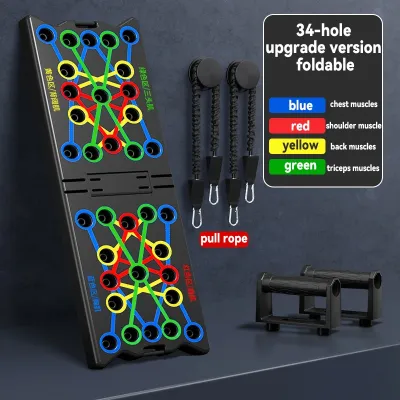
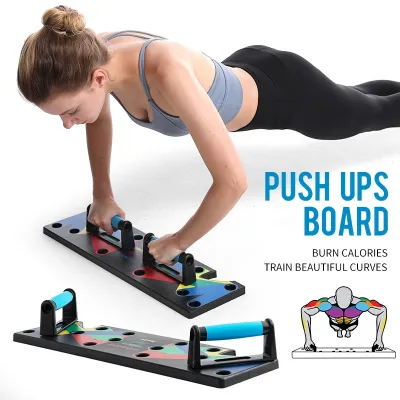
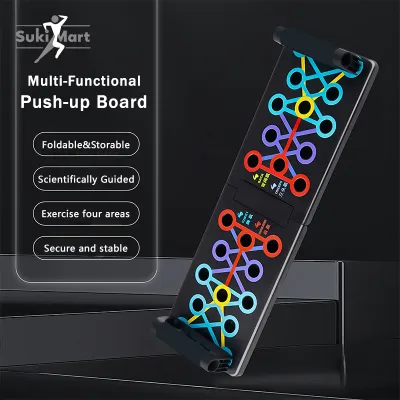
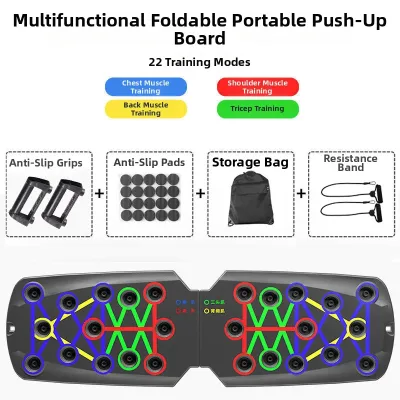
- Choose Push-Up Boards if you want to follow structured, color-coded workouts that systematically target and isolate different muscle groups using a single, guided platform.
- Choose Push-Up Stands (specifically rotating models) if you are an intermediate to advanced trainee who requires maximum joint mobility, natural wrist pivoting, and high stability for dynamic calisthenics progressions.
Understanding the physical differences between these three form factors is the first step toward making a smart purchase that genuinely supports your long-term fitness journey.
Products mentioned in this guide
Prices are valid at publication and may change. Please refer to the product page for the latest price.
Defining the Form Factors: Bars vs. Boards vs. Stands
To make an informed purchase, it is essential to first clarify what these three terms actually mean, as online retail listings often use them interchangeably. While they all serve to elevate your hands off the ground, their structural designs and mechanical functions differ significantly.
Push-Up Bars are simple, fixed handles that typically feature a U-shaped or S-shaped design. Usually constructed from steel tubing or heavy-duty molded plastic, their primary function is to elevate your hands roughly 10 to 15 centimeters off the floor. This elevation allows your chest to descend past the level of your hands, increasing the stretch on your pectoral muscles. Because the handles are straight, they allow you to grip them with a neutral wrist alignment, keeping your wrists straight rather than bent flat against the floor.
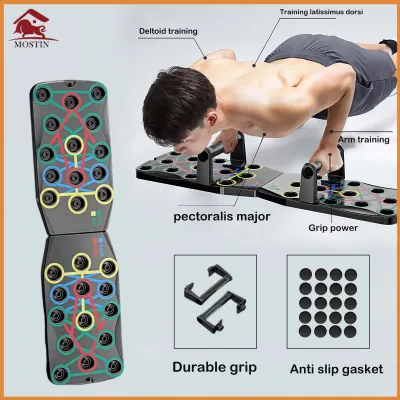
Push-Up Boards consist of a wide, flat plastic deck perforated with multiple pairs of color-coded holes, accompanied by two removable, peg-based handles. By inserting the handles into different combinations of holes, you can instantly alter the width and angle of your grip. The color-coded tracks are designed to guide your hand placement to target specific muscle groups, such as blue for the chest, red for the shoulders, yellow for the triceps, and green for the back. This design removes the guesswork from targeting different areas of your upper body.
Push-Up Stands are often confused with simple bars, but true stands feature a much wider, heavier, and more robust base designed for maximum stability. The most prominent subcategory is the rotating push-up stand. These circular stands feature an internal ball-bearing system that allows the handles to rotate smoothly as you perform the exercise. Instead of locking your hands in a fixed position, rotating stands allow your arms and wrists to twist naturally during the ascent and descent, mimicking the natural biomechanics of your joints.
Core Comparison: How Each Tool Impacts Your Training
Each of these tools alters the physics of the push-up, changing how your muscles recruit force, how your joints bear load, and how stable you feel during a set. Evaluating these differences across key performance areas will help you determine which tool fits your daily routine.

Muscle Targeting and Workout Variety
Fixed push-up bars excel at deepening the eccentric (lowering) phase of the movement. By allowing your chest to drop lower than your hands, they place a greater stretch on the pectoralis major, which can lead to increased muscle fiber recruitment. However, their variety is limited; to target different muscle heads, you must manually lift and reposition the bars on the floor, which can disrupt the flow of your workout.
Push-up boards are specifically engineered for structured variety. The color-coded peg system allows you to transition rapidly between wide, narrow, and angled grips, making it easy to perform supersets that target different muscle groups. For example, moving the handles from the outer chest slots to the inner tricep slots takes only a few seconds. This guided variety is highly beneficial for home gym users who want a systematic approach to hypertrophy without needing to memorize complex hand positions.
Rotating push-up stands offer a unique form of muscle engagement by introducing rotational movement. As you push upward, your hands naturally want to rotate from a neutral grip to a pronated grip. Rotating stands accommodate this natural movement, which increases the activation of the stabilizer muscles in your shoulders, including the rotator cuff and the serratus anterior. This makes rotating stands highly effective for building functional, athletic strength and preparing your upper body for advanced calisthenics.
Wrist Health and Joint Protection
Standard floor push-ups force your wrists into a harsh 90-degree angle of extension, which can compress the carpal tunnel and strain the surrounding tendons. All three of these tools address this issue by elevating your hands, allowing you to maintain a neutral, straight wrist alignment where your knuckles point forward or outward. This simple adjustment redistributes your body weight directly through your forearms, significantly reducing joint pain.
However, rotating stands offer the highest level of joint protection. Because they allow your hands to rotate during the movement, they prevent your wrists and elbows from being locked into a rigid, unnatural plane. This rotational freedom reduces lateral shear forces on your elbows and shoulders, making them the most comfortable option for users recovering from joint strain or those with limited wrist flexibility.
In contrast, fixed bars and push-up boards lock your wrists into a single, unyielding angle. While this is still far safer than performing push-ups flat on the floor, it requires you to be highly mindful of your form. If your elbows flare out excessively while your hands are locked in a fixed position, you can still place lateral strain on your wrists and shoulders. When using fixed tools, you must actively focus on keeping your elbows tucked at a safe 45-degree angle.
Stability, Grip, and Humid Climate Considerations
When training in a tropical climate like the Philippines, environmental factors like high humidity and sweat play a massive role in equipment safety. A slippery grip or an unstable base can cause your hand to slip mid-rep, which can lead to sudden shoulder subluxation or wrist hyperextension.
Push-up boards offer excellent overall stability because they rely on a massive, flat footprint that distributes your weight across a wide surface area. However, because the board is made of lightweight plastic, it can slide on smooth tiled floors if it lacks high-quality rubber feet. If you train on tiles or polished concrete, you must verify that the board includes non-slip rubber pads on its underside.
Rotating stands typically feature wide, circular bases with full-coverage rubber rings, making them highly stable and resistant to sliding. Their internal bearing mechanisms must be kept clean, as dust and humidity can eventually cause cheap plastic bearings to stick or squeak.
Simple push-up bars have the smallest footprint, making them the most prone to tipping. If you apply lateral force instead of pushing straight down, a narrow S-shaped or U-shaped bar can roll sideways. To prevent this, look for bars with extended base feet and high-density, sweat-resistant EVA foam or textured rubber grips. Avoid cheap, smooth plastic handles, as they become incredibly slick when exposed to sweat in humid conditions.
Space, Portability, and Storage
Your physical living arrangements and workout habits should heavily influence which form factor you select. If you live in a compact studio apartment or frequently travel, space is a premium commodity that dictates your gear choices.
Push-up bars are the undisputed champions of portability. They are lightweight, compact, and can easily be tossed into a backpack for an outdoor workout at a local park or packed into a suitcase for a business trip. Many models feature detachable legs, allowing them to lay completely flat in a drawer when not in use.
Push-up boards are much bulkier, typically measuring between 60 and 90 centimeters in length. Even foldable models take up a notable amount of floor space and are difficult to transport outside of your home. They are best suited for users who do most of their training in a dedicated home workout space where the board can be stored under a bed or behind a cabinet.
Rotating stands fall in the middle. While they are more compact than a full push-up board, they are often heavier and bulkier than simple bars due to their thick, circular bases and internal rotating mechanisms. They are highly portable around the house but are less convenient to carry in a standard gym bag for outdoor training.
Buying Checklist: Specs and Features to Verify
Before purchasing any push-up equipment, you should look past marketing claims and verify specific technical details to ensure you receive a safe, durable product.
- Weight Capacity and Base Width: Always check the manufacturer's specified weight limit. For dynamic movements or heavier users, look for equipment rated for at least 120 kilograms. Additionally, ensure the base of the bars or stands is wide enough to prevent lateral tipping; a wider base provides a safer margin of error if your form wavers.
- Handle Material and Texture: Avoid bare, smooth plastic handles. Look for high-density, non-slip EVA foam or textured thermoplastic rubber (TPR) grips. In humid environments, textured rubber is often superior to foam, as it does not absorb sweat, is easier to wipe clean, and does not degrade or tear over time.
- Rotation Mechanism (for Stands): If you are buying rotating stands, verify whether the rotation relies on steel ball bearings or simple plastic-on-plastic bushings. Steel ball bearings offer a much smoother, quieter rotation and can handle heavy loads without sticking or cracking under pressure.
- Board Hole Durability: For push-up boards, the connection point between the handle pegs and the board holes is the most common point of failure. Ensure the board is constructed from high-impact ABS plastic, and check user reviews to confirm that the holes do not crack, chip, or widen after repeated handle insertions.
Final Recommendation: Match the Equipment to Your Fitness Level
To ensure you invest in equipment that aligns with your current capabilities and long-term fitness goals, consider which of these user profiles best describes your training needs.
Beginners: Fixed Push-Up Bars
If you are just starting your fitness journey or are looking for a budget-friendly way to relieve wrist pain, basic Push-Up Bars are your best option. They are highly affordable, typically costing under ₱500, and are incredibly simple to use. By elevating your hands, they allow you to focus on mastering proper push-up depth, core tension, and elbow alignment without the distraction of multiple angles or unstable rotating mechanisms. Their high portability also makes them incredibly easy to store in small living spaces.
Intermediate and Home Gym Users: Push-Up Boards
If you primarily workout at home and want a structured, varied routine to build muscle without hiring a personal trainer, a Push-Up Board is an excellent investment. Typically priced between ₱500 and ₱1,500, these boards provide a visual, systematic guide to targeting different areas of your chest, shoulders, and arms. The guided hand placements help you break through training plateaus by forcing you to work from angles you might otherwise ignore, making your home workouts highly efficient.
Advanced and Calisthenics Athletes: Rotating Push-Up Stands
If you are an experienced trainee performing advanced push-up variations, planches, or high-volume calisthenics, you should invest in high-quality Rotating Push-Up Stands. While they are the most expensive option, often costing over ₱1,500 for premium models, they offer unmatched joint protection and biomechanical freedom. The rotating action allows your joints to move naturally, reducing the risk of chronic shoulder and elbow strain while engaging the deep stabilizer muscles required for elite-level bodyweight strength.
Frequently Asked Questions (FAQ)
Can I build significant muscle mass using only push-up boards or bars?
Yes, you can build notable muscle mass using these tools, but you must understand the law of progressive overload. While push-up bars and boards increase muscle activation by deepening your range of motion and altering your grip angles, bodyweight training eventually hits a resistance ceiling. To continue building muscle over time, you must eventually increase the difficulty. You can achieve this by wearing a weighted vest, using resistance bands, slowing down your repetition tempo, or transitioning to advanced, high-leverage variations like decline or one-arm push-ups.
Are rotating push-up stands safe for absolute beginners?
Rotating push-up stands are generally not recommended for absolute beginners. The rotating mechanism introduces a level of instability that requires significant strength in your shoulder stabilizers and core to control. If a beginner lacks this baseline stability, their hands may twist uncontrollably during a repetition, which can lead to shoulder strain or a loss of balance. Beginners should start with fixed push-up bars to build baseline strength and joint stability before transitioning to rotating models.
Community discussion
Share your experience or ask a question. Comments are reviewed before publication.