
When navigating steep alpine routes or vertical rock faces, dropping a piece of gear can mean the difference between a successful summit and a forced retreat. Selecting a retractable carabiner—more accurately known as a retractable tool tether or gear leash—requires a precise understanding of technical specifications. The critical specifications to evaluate include the safety classification, weight capacity limits, extension length, cord construction, and gate hardware. Knowing how to interpret these metrics ensures your essential tools remain secured to your harness without restricting your range of motion or creating entanglement hazards.
Critical Safety Boundary: Gear Tethers vs. Load-Bearing Carabiners
In mountaineering and rock climbing, terminology can occasionally lead to dangerous misunderstandings. A retractable carabiner is not a primary, load-bearing carabiner designed for personal protective equipment (PPE) systems. Instead, it is a specialized gear retractor or tool tether that utilizes small, non-utility carabiners at its attachment points to secure equipment like ice axes, GPS units, cameras, or rangefinders. These devices are designed solely to prevent equipment drops, not to support human weight.
Standard climbing carabiners are rigorously tested and certified to withstand immense forces, typically rated in kilonewtons (kN) to handle dynamic human falls. In contrast, retractable tool tethers do not possess a kN rating for life safety. Their internal springs, cords, and plastic housings are engineered for light utility loads and will instantly fail under the weight of a human body. Using a retractable gear tether as an anchor point, a belay connection, or a personal tether is a critical error that can result in catastrophic equipment failure and fatal accidents.
Products mentioned in this guide
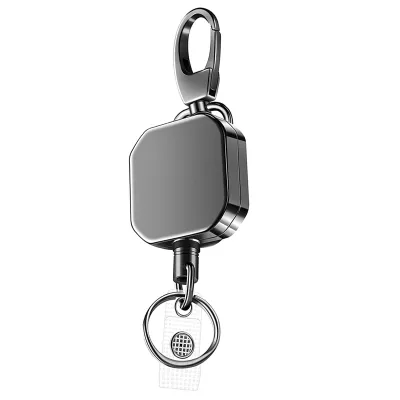
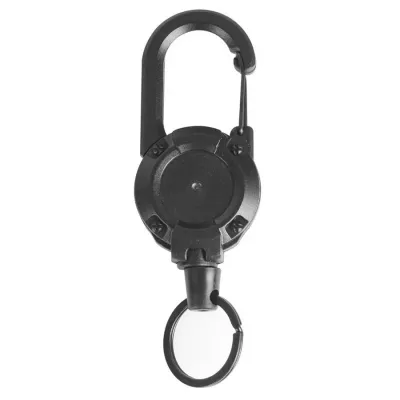
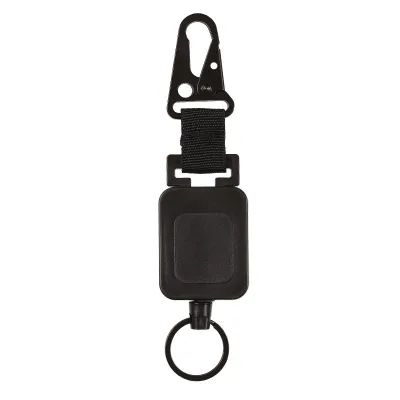
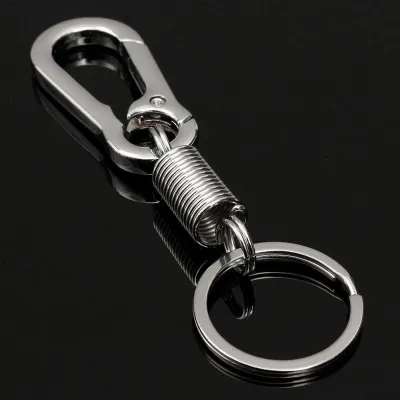
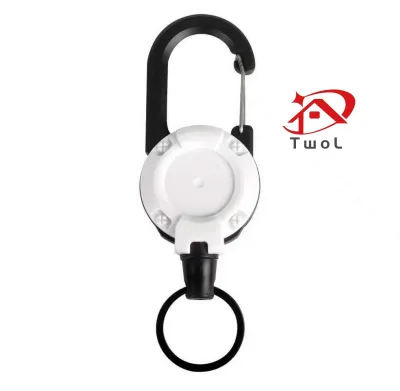
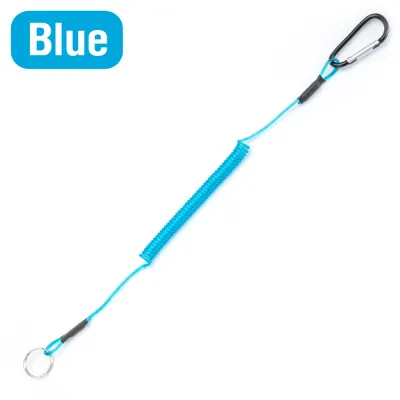
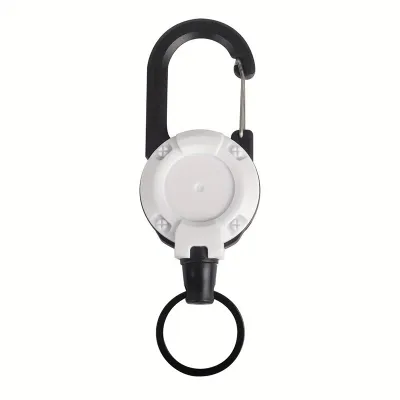
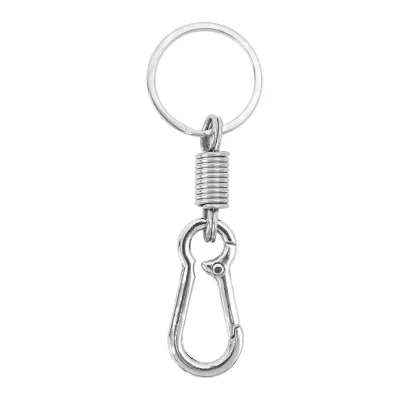
Prices are valid at publication and may change. Please refer to the product page for the latest price.
Before packing any retractable accessory for a climb, you must inspect the manufacturer markings. True climbing gear will feature clear certifications, such as CE or UIAA stamps, along with explicit major-axis strength ratings (typically 20 kN or higher). If a retractable device lacks these life-safety markings, or if the manufacturer instructions label it as “not for climbing” or “not for human support,” it must be kept strictly within its role as an auxiliary tool keeper. Equipment cannot replace proper safety training, and mistaking a gear leash for a safety lanyard bypasses the fundamental principles of climbing safety.
Load Capacity: Interpreting Tool Weight Limits vs. Breaking Strength
When evaluating a retractable carabiner, you will encounter two distinct load-related specifications: the ultimate breaking strength of the cord and the manufacturer’s recommended maximum tool weight limit. The recommended tool weight limit, which typically ranges from 1 kg to 5 kg, represents the maximum static weight the retraction mechanism can actively pull back or hold without sagging. The ultimate breaking strength, on the other hand, is the force at which the cord or housing will physically snap.

It is a common mistake to assume that a tether rated for a 2 kg tool can easily handle any tool under that weight in a fall. When a climbing tool slips from your hand, it does not remain static; it falls until the tether catches it. This sudden drop generates dynamic force, which multiplies the static weight of the tool several times over. For example, a technical ice axe weighing 650 grams can exert a shock load far exceeding its static weight when dropped from the full extension of a 100 cm tether. Staying well within the manufacturer’s recommended weight limit is essential to ensure the system can absorb this dynamic shock without failing.
Exceeding the specified load limits leads to rapid degradation of the retractor. Overloading the tether can permanently stretch or deform the internal bungee material, rendering the retraction mechanism useless. It can also cause the internal spring to slip or bind, leaving you with a slack cord that easily snags on rock edges, ice screws, or tree branches. In worst-case scenarios, the shock load from an oversized tool will snap the cord entirely, sending your expensive and critical gear tumbling down the mountain face.
Extension Length and Cord Material: Balancing Reach and Alpine Durability
The physical dimensions and material composition of a retractable tether directly dictate its usability and longevity in harsh mountain environments. Retraction lengths generally vary between 60 cm and 120 cm. Choosing the correct length requires balancing your physical reach with your carrying method. To determine your ideal extension length, measure the distance from your harness gear loops to your fully extended arm while holding your primary tool. A cord that is too short will restrict your movement and cause muscle fatigue, while an excessively long cord creates dangerous slack that can tangle with your crampons or catch on rock projections.
The internal construction of the cord plays a vital role in how the tether behaves under tension. Polyurethane (PU) coiled cords are highly elastic and compact, shrinking back to a very short length when not in use. However, they can become stiff and less responsive in freezing alpine temperatures. Alternatively, tethers featuring internal elastic bungees housed within a woven nylon or Dyneema webbing sheath offer excellent durability and a smooth draw. The outer sheath protects the elastic core from direct friction and environmental wear, making it a preferred choice for rugged mountaineering.
Environmental factors in the mountains demand high-performance materials. Alpine environments expose gear to intense ultraviolet (UV) radiation, freezing ice, abrasive granite, and, in tropical regions like the Philippines, high humidity and salt air near coastal climbing venues. UV radiation can weaken synthetic fibers over time, while moisture can freeze inside unprotected mechanisms, causing them to lock up. When selecting a tether, prioritize materials treated with UV inhibitors and sheaths made of high-abrasion-resistant fibers like Dyneema or heavy-duty nylon to ensure the gear withstands repetitive rubbing against rock and ice.
Gate Types and Hardware: Securing Tools Against Accidental Drops
The hardware at both ends of a retractable tether is the physical link between your body and your equipment. The carabiners used on these tethers feature different gate styles, each suited to specific tasks and risk levels. Non-locking wire gates are lightweight and easy to operate with one hand, even while wearing thick climbing gloves. They are ideal for low-consequence tools that you need to access quickly and frequently, such as a camera or a GPS tracker.
For high-consequence gear—where a drop means losing a tool over a deep crevasse, a bergschrund, or onto climbers below—screwgate or auto-locking carabiners are highly recommended. A locking gate prevents the carabiner from accidentally opening if it rubs against your harness, clothing, or rock surfaces. While locking gates require an extra step to open, the added security is indispensable when traversing steep, multi-pitch routes where losing an ice axe or a hammer would compromise your ability to descend safely.
The opposite end of the tether, which attaches directly to the tool, must also feature secure hardware. Common configurations include sewn webbing loops, adjustable choke-style tie-offs, or secondary mini-carabiners. For tools like ice axes, a choke-style tie-off or a dedicated leash attachment point ensures a snug, slip-free connection to the shaft. Additionally, look for tethers equipped with integrated swivel joints. A high-quality swivel allows the tool to rotate freely during complex maneuvers, preventing the cord from twisting, knotting, and experiencing premature wear from torsional stress.
Quick Spec Matching for Common Mountaineering Gear
To help you select the appropriate retractable carabiner for your equipment loadout, the following table maps common mountaineering tools to their recommended specifications. Always cross-reference these guidelines with your specific tool’s weight and the manufacturer’s data sheets.
| Tool Type | Recommended Weight Limit | Ideal Extension Length | Preferred Gate / Hardware Type |
|---|---|---|---|
| Technical Ice Axe | 1.5 kg to 3.0 kg | 90 cm to 110 cm | Screwgate or locking carabiner with integrated swivel |
| GPS / Rangefinder | 0.5 kg to 1.0 kg | 60 cm to 80 cm | Lightweight wire gate carabiner with split ring |
| Climbing Helmet | 0.5 kg to 1.0 kg | 60 cm to 80 cm | Non-locking accessory carabiner or webbing loop |
| Compact Camera | 0.5 kg to 1.5 kg | 80 cm to 100 cm | Wire gate carabiner with high-strength cord loop |
| Multi-tool / Knife | 0.2 kg to 0.5 kg | 60 cm to 80 cm | Small accessory carabiner or mini screwgate |
Before taking any new retractable carabiner or tool tether onto a climb, always read the manufacturer’s user manual carefully. Verify the exact weight limits, inspect the stitching and cord integrity, and perform a dry run at home or at a local climbing gym. Testing the gear in a controlled environment allows you to adjust your harness placement and ensure your tools are fully reachable without any restriction before you find yourself high on a mountain face.
Community discussion
Share your experience or ask a question. Comments are reviewed before publication.