
Setting up a home gym in a high-rise residence requires careful spatial planning, as floor space is often at a premium. If you are considering adding a rowing machine to your living space, understanding its physical footprint is the first step toward a successful setup. A standard rowing machine typically requires an active, in-use floor area of about 7 to 9 feet in length and 2 to 2.5 feet in width. Additionally, you must factor in a safety clearance of 1 to 2 feet around the entire perimeter to accommodate your body’s dynamic movement. When stored, many models can stand vertically or fold down to occupy a compact area of just 2 by 2.5 feet, though this transition introduces distinct vertical clearance demands.
In the context of Philippine condo living, where unit layouts range from cozy studios to compact two-bedroom spaces, every square meter counts. High humidity levels, concrete wall construction, and shared floors mean that your equipment choice must account for more than just static dimensions. You must evaluate how the machine moves, how it stores, and how its operation impacts your immediate environment, including noise transmission to neighbors below.
Comparing Floor Footprints Across Rowing Machine Types
To select the right equipment, you must first distinguish between the machine’s static footprint and its dynamic, in-use requirements. When you row, your body moves through a full range of motion that extends beyond the physical frame of the machine. Your seat glides back and forth along the rail, your torso leans backward at the finish of the stroke, and your elbows flare slightly outward. Consequently, the space required during an active workout is always larger than the dimensions listed on a product’s spec sheet.
Products mentioned in this guide
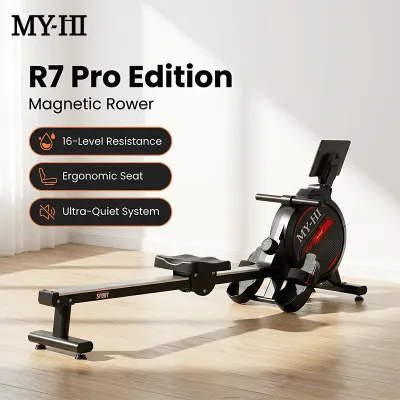
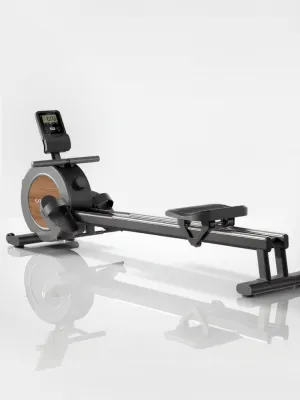
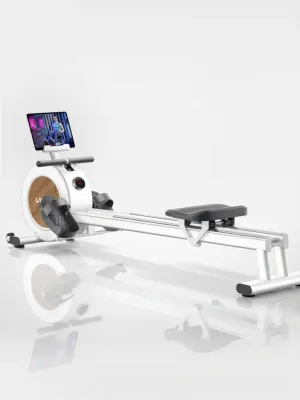
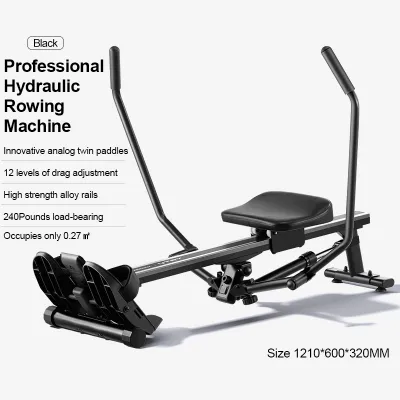
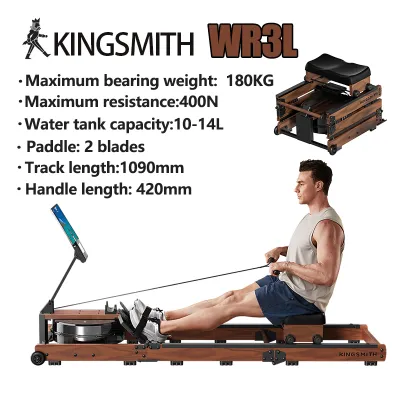

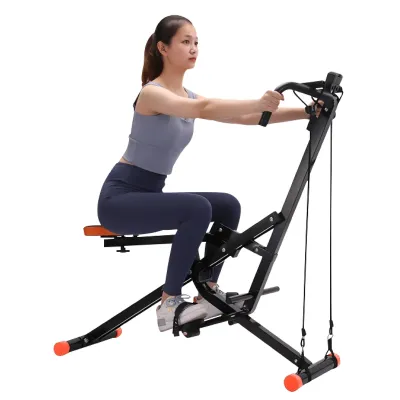
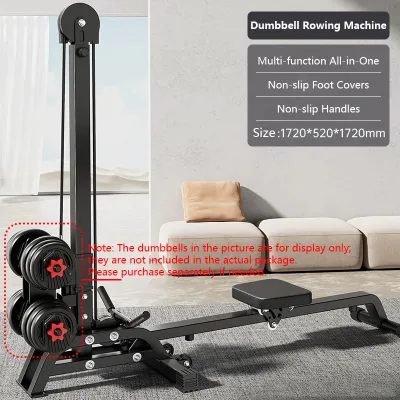
Prices are valid at publication and may change. Please refer to the product page for the latest price.
Water and Air Rowers Water and air resistance rowing machines are highly regarded for their smooth, realistic rowing feel, but they also demand the most substantial continuous floor length. These machines typically feature long, rigid, non-folding frames to ensure structural stability under intense use. A standard air rower often spans between 7.5 and 8.5 feet in length, while water rowers generally measure between 7 and 7.2 feet. While they require a long, uninterrupted stretch of floor, their width profile remains relatively narrow, usually ranging from 20 to 24 inches. This slender profile allows them to fit neatly alongside a wall or hallway when in use, provided you have the necessary length. Always verify the exact frame length on the manufacturer’s specification sheet, as some commercial-grade models can be exceptionally long.
Magnetic and Hydraulic Rowers If floor length is your primary constraint, magnetic and hydraulic rowing machines offer more compact alternatives. Magnetic rowers often utilize a folding hinge mechanism along the slide rail, allowing the machine to be folded upward when not in use. While their active length is still considerable—typically around 6.5 to 7.5 feet—their design is often slightly shorter than that of air or water models. Hydraulic rowers, which use fluid-filled pistons to generate resistance, are the most compact option available. They frequently feature shorter slide rails, resulting in an active length of just 4.5 to 5.5 feet. However, some hydraulic models employ wide, articulating arms designed to mimic actual oars. These arms swing outward during the stroke, requiring a much wider lateral clearance—sometimes up to 4 or 5 feet—compared to the linear pull of a magnetic or air rower.
The Impact of User Height and Body Span Your physical height and individual biomechanics directly influence the operational footprint of any rowing machine. Taller individuals require a longer rail travel distance to achieve a full leg extension without hitting the rear stopper. If you are over 6 feet tall, you must check the maximum slide rail travel length specified by the manufacturer to ensure you can row safely. Furthermore, at the “finish” phase of the stroke, a proper rowing technique involves leaning your torso back at roughly a 110-degree angle. This backward lean means your head and upper body will extend several inches past the physical end of the slide rail, requiring additional overhead and rear clearance that must be factored into your measurements.
How to Measure Your Condo Space for Dynamic Movement
Measuring your condo for a rowing machine involves more than laying a tape measure flat on the floor. You must plan for a dynamic environment where the machine, the user, and the surrounding household traffic can coexist safely.

Operational Length and Width Begin by measuring the clear floor space in your designated workout area, ensuring there are no permanent obstructions like pillars, heavy furniture, or low-profile coffee tables. When calculating the operational length, add a safety buffer of at least 1.5 to 2 feet behind the rear of the slide rail to accommodate your backward lean and prevent your head from striking a wall. In front of the machine, allow at least 1 foot of clearance to access the console, adjust the resistance damper, and prevent the handle or chain from colliding with delicate household items. For width, ensure you have at least 1 foot of clear space on either side of the rail so you can safely mount and dismount the machine without tripping.
Traffic and Access Routes Before finalizing your purchase, you must verify that the machine can actually reach your condo unit. High-rise buildings often present tight logistical bottlenecks, such as narrow service elevators, sharp corridor corners, and standard 80-centimeter-wide doorway frames. Check the shipping dimensions of the boxed product. A solid wood water rower or a heavy magnetic rower often ships in long, heavy boxes that may not fit horizontally in a standard residential elevator cabin. You may need to unpack the components in a common area or coordinate with building security for freight elevator access.
Floor Protection and Mats Condo units in the Philippines commonly feature flooring materials like luxury vinyl tiles (LVT), engineered wood, or ceramic tiles. Placing a heavy fitness machine directly on these surfaces can cause permanent scuffing, scratches, or moisture damage from sweat. A dedicated equipment mat is essential. The mat should extend at least 2 to 3 inches beyond the front and rear stabilizers of the rower. Standard fitness mats for rowers measure approximately 3 feet by 8.5 feet. This mat not only protects your floor but also serves as a visual boundary for your workout zone, and its dimensions should be treated as the absolute minimum static footprint required in your room layout.
Ventilation and Power In a tropical climate, proper ventilation is critical for indoor workouts. Position your rowing machine in a spot that benefits from natural cross-ventilation, such as near a balcony door, or directly within the airflow path of an air conditioning unit or mechanical fan. If you select a magnetic or smart rower that features a touchscreen console or motorized resistance adjustment, you must also plan for power access. Ensure the power cord can reach a wall outlet without stretching across high-traffic walkways. Running cables across the floor creates a severe tripping hazard and can damage the machine’s power port if the cable is accidentally yanked.
Storage Configurations and Vertical Clearance Needs
When you are not exercising, your rowing machine should integrate seamlessly into your living space without disrupting daily foot traffic. Different models employ distinct storage mechanisms, each with its own set of spatial requirements.
Upright/Vertical Storage Many air and water rowers are designed to store vertically, standing upright on their front stabilizers. This is an incredibly space-efficient method, reducing the floor footprint to a mere 2 by 2.2 feet—roughly the size of a standard dining chair. However, this configuration shifts the spatial demand from the floor to the ceiling. You must measure your ceiling height carefully. While standard residential ceilings in the Philippines are typically around 2.7 meters (8.8 feet), dropped ceilings, decorative gypsum boards, or low-hanging structural beams can reduce this clearance significantly. Additionally, you must ensure the upright machine does not interfere with ceiling fans, pendant lights, or wall-mounted split-type air conditioners. Always check the manufacturer’s instructions regarding weight distribution and utilize any provided wall-tether safety straps to prevent the machine from tipping over, especially if you have pets or small children.
Folding/Hinge Storage Many mid-range magnetic rowers feature a folding frame. A quick-release pin or locking knob allows you to lift the rear slide rail and fold it forward toward the flywheel housing. This action typically reduces the machine’s operational length by half, while increasing its height. When planning for a folding model, measure the folded height and width to ensure it can fit inside a standard condo utility closet or behind a decorative room divider. You must also verify that the locking mechanism is highly secure; a partially locked rail poses a significant safety hazard if it unexpectedly falls.
Flat/Under-Furniture Storage If you prefer to keep your fitness equipment completely out of sight, some low-profile hydraulic or compact magnetic rowers can be stored flat on the floor, sliding directly under a bed frame or sofa. To utilize this method, you must measure the “clearance height”—the vertical distance from the floor to the lowest point of your furniture frame. Compare this measurement against the tallest point of the rowing machine, which is typically the seat assembly, the handlebar bracket, or the folded console monitor. Keep in mind that dragging a heavy machine across hard floors can cause scratches, so look for models equipped with smooth-rolling transport wheels designed for hard surfaces.
Wall Mounting A few specialized rowing machine models support wall-mounting brackets to hang the machine flat against a wall. However, this storage method requires extreme caution in a condo environment. Most Philippine condo partition walls are constructed using lightweight drywall or hollow concrete blocks (CHB) covered in plaster, which may not possess the structural integrity to support a heavy, cantilevered fitness machine. Never attempt to wall-mount a rowing machine without verifying the wall type and load-bearing capacity. If you are mounting to concrete, you must use high-quality masonry anchors and a hammer drill. If you are mounting to drywall, the bracket must be anchored directly into the structural wooden or metal studs, never into the drywall sheet alone.
Common Space-Planning Mistakes in Small Apartments
Avoiding common planning oversights can save you from the frustration of buying a machine that is difficult to use or store in your condo.
Ignoring the “Return” Phase A frequent mistake is measuring only the physical frame length of the rower and assuming that is sufficient. During the “catch” and “recovery” phases of the rowing stroke, your arms extend forward, and the handle and chain travel toward the flywheel. If the front of your machine is pushed flush against a wall or a television console, you will not have enough room for your hands and the handle to complete the movement naturally. Always leave at least 12 inches of open space in front of the machine’s housing.
Overlooking Ceiling Obstructions Tipping a water or air rower upright seems simple, but many users forget to look up. In compact condos, low-hanging dining room pendant lights, track lighting, or spinning ceiling fans present immediate hazards. Striking a spinning ceiling fan with a heavy wooden or steel rowing rail can cause severe damage to both the fan and the machine’s frame, and poses a safety risk to anyone nearby.
Assuming All “Foldable” Models Are Equal Do not assume that because a model is labeled “foldable,” it will easily slide into your closet. Some folding designs remain bulky, heavy, and awkward to maneuver. If folding the machine requires significant physical exertion or complex disassembly, you are less likely to use it regularly. Check the total folded weight and the placement of the transport wheels; some wheels only engage when the machine is tilted at a specific angle, making tight turns in a small apartment challenging.
Neglecting Floor Levelness Condo floors are not always perfectly level, particularly in older buildings or near balcony transitions designed for water drainage. An uneven floor can cause a rowing machine to rock slightly during use, leading to uneven wear on the slide rail rollers and putting unnecessary strain on folding joints. For water rowers, an uneven surface can affect the water level balance inside the tank. Look for machines that feature adjustable leveling feet on the stabilizers, allowing you to compensate for slight floor imperfections.
Frequently Asked Questions (FAQ)
Can I store a water rowing machine on its side?
No, you should never store a water rowing machine on its side unless the manufacturer’s manual explicitly states it is safe to do so. Storing a water rower horizontally on its side can place undue pressure on the tank’s seals, leading to slow water leaks that can ruin your condo’s flooring. It can also cause the water stopper to loosen, resulting in immediate spillage. Furthermore, for wooden-framed water rowers, side storage can warp the frame over time due to uneven weight distribution. The only approved storage methods are standing the machine completely upright on its designated front stabilizers or leaving it flat on the floor.
Do I need an equipment mat for my condo floor?
Yes, an equipment mat is highly recommended when operating a rowing machine in a condo. The mat serves two critical functions: protection and noise reduction. First, it protects your hardwood, laminate, or vinyl floors from scratches caused by the machine’s vibrations and prevents sweat from corroding the floor surfaces. Second, it acts as a sound-dampening barrier. The hum of an air flywheel, the sloshing of a water tank, and the rolling of the seat along the rail can create vibrations that travel through the concrete slab of your building, disturbing neighbors living directly below you. A dense, high-quality rubber or PVC mat absorbs these vibrations, ensuring a quieter workout. Keep in mind that a standard mat will add slightly to the overall length and width of your setup, so factor its dimensions into your initial space measurements.
Community discussion
Share your experience or ask a question. Comments are reviewed before publication.