
There is no single “best” training marker for football; the right choice depends entirely on your specific drill objectives and field conditions. Small cones excel at close-control and agility work, tall cones provide high visibility for boundaries and passing targets, and flat discs offer the safest option for high-speed sprinting and multi-directional cuts. This guide breaks down the physical differences and practical applications of each type to help you build the most effective training setup for your squad.
Whether you are running drills on a muddy natural grass pitch during the rainy season or setting up a tactical session on a modern artificial turf pitch, choosing the right marker shape and size directly impacts player safety, drill fluidity, and coaching efficiency. Selecting the wrong equipment can lead to disrupted sessions, lost training time, or even preventable injuries. By understanding how each marker interacts with the ball, the ground, and the players, you can design sessions that run smoothly from the first whistle to the last.
Understanding the Core Differences in Marker Design
The physical design of a training marker dictates how players interact with it and how easily a coach can manage a session. Height is the most immediate differentiator, directly affecting sightlines. Tall cones stand out clearly from a distance, allowing players to scan the pitch with their heads up, whereas low-profile markers require closer visual attention. When players are sprinting at high speeds, their peripheral vision must be able to register these markers without forcing them to look directly down at their feet.
Products mentioned in this guide
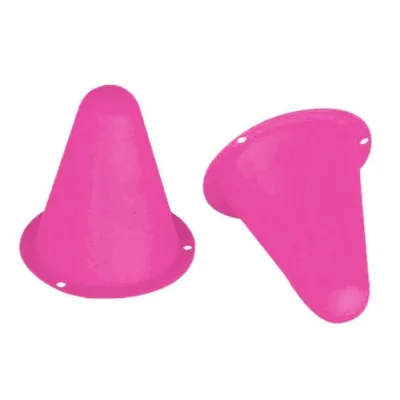

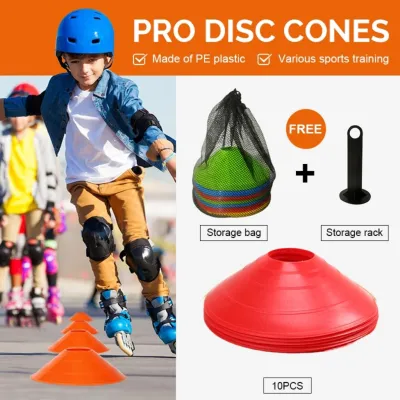
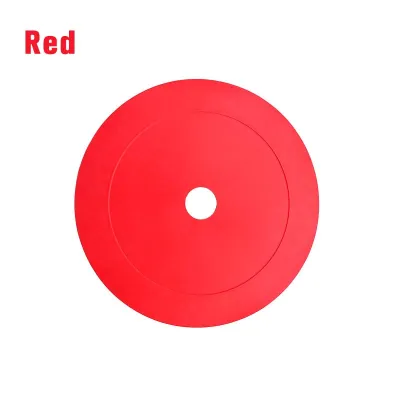
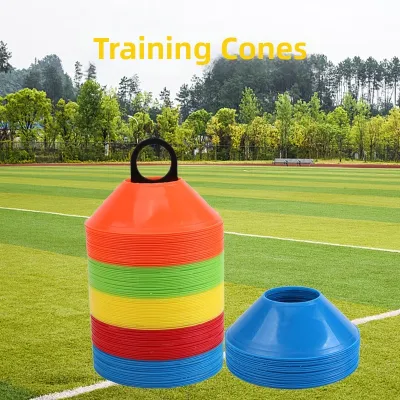
Prices are valid at publication and may change. Please refer to the product page for the latest price.
Base width and weight determine how well a marker performs on different playing surfaces. Natural grass pitches, especially uneven fields common in local community spaces, require markers with a stable footprint that will not tip over when brushed by a passing ball or a player’s boot. On artificial turf, the lack of natural soil means markers must rely entirely on their weight and aerodynamic shape to resist being blown away by strong winds or shifted by the impact of nearby play.
Tactile feedback and safety are critical considerations when selecting training gear. If a player accidentally steps on a marker, the physical response can range from a simple slip of the marker to a severe ankle roll. Rigid, high-profile markers present a physical barrier that can disrupt a player’s balance, while flexible, low-profile designs are engineered to collapse or slide safely underfoot. Balancing the need for a clear physical boundary with the safety of the players is a primary responsibility for any coach or trainer.
Small Cones: Best for Agility and Close-Control Drills
Small cones, typically standing around two inches high, are the workhorses of technical football training. Their primary strength lies in their ability to create dense, intricate patterns that force players to develop precise footwork and rapid ball manipulation. Because they occupy a small physical footprint, you can set up complex weaving patterns, tight dribbling grids, and reaction courses in highly restricted spaces.

When used for close-control dribbling, small cones provide a clear physical obstacle that players must actively navigate around. Unlike flat discs, which can be easily dribbled over without consequence, small cones require the player to lift the ball slightly or execute a clean, sharp turn to avoid contact. This physical presence encourages better spatial awareness and sharper touches with both the inside and outside of the foot.
Safety is another major advantage of small cones during technical drills. Because they are lightweight and flexible, they easily slide out of the way if kicked or stepped on, minimizing the risk of a player tripping or losing balance. This makes them exceptionally well-suited for youth development programs, where players are still mastering basic motor skills and coordination.
Choose small cones if your primary training focus is on high-repetition technical work, such as agility ladder alternatives, tight figure-eight dribbling, or multi-step coordination circuits. They are highly effective for individual warm-ups and small-group technical stations where players move at moderate speeds and focus on precision rather than raw velocity.
Tall Cones: Best for Visibility and Boundary Marking
Tall cones, usually measuring nine inches or more in height, serve as the primary visual anchors on any football pitch. Their height makes them highly visible from across the field, even when the grass is slightly overgrown or when players are scanning the horizon during full-sided tactical play. This high visibility is essential for establishing clear boundaries, marking out temporary penalty boxes, or defining the limits of small-sided games.
In addition to boundary marking, tall cones are excellent tools for creating physical targets and obstacles. Coaches frequently use them to represent passive defenders in tactical drills, forcing passing players to loft the ball over the cone or curve their passes around it. They are also highly effective in goalkeeper training, where they can be used to mark out diving zones, goalpost extensions, or starting positions for lateral movement drills.
However, the height of these cones introduces a notable tripping hazard if they are placed directly in active running lanes. A player sprinting at full speed who collides with or steps on a rigid tall cone faces a higher risk of a fall or a joint injury. For this reason, tall cones should be used with caution in high-velocity drills where players are expected to make sharp, unpredictable cuts near the markers.
Choose tall cones when you need to define large playing areas, set up distant passing targets, or create visual representations of defenders during tactical walk-throughs. They are best positioned on the outer edges of the training area or in static zones where players are unlikely to run directly over them at maximum speed.
Flat Discs: Best for Speed and Multi-Directional Movement
Flat discs, which sit virtually flush with the playing surface, are engineered specifically for high-intensity conditioning and rapid change-of-direction work. Their ultra-low profile ensures that players can run, cut, and plant their feet directly on or over the marker without any risk of tripping or rolling an ankle. This makes them the safest option for speed endurance training, shuttle runs, and explosive agility drills.
During high-speed sprinting drills, players must focus entirely on their stride and acceleration rather than worrying about avoiding physical obstacles on the ground. Flat discs provide a clear visual guide for starting points, turning lines, and finish zones without interfering with the natural running motion. If a player steps directly on a flat disc at full speed, the disc simply compresses under the boot, allowing the player to maintain their balance and momentum.
While flat discs excel in safety, they do have limitations when it comes to visibility and surface stability. On natural grass pitches, especially during the wet rainy season, flat discs can easily become obscured by mud or slightly tall grass blades. Furthermore, lightweight plastic discs can slide on wet grass or be easily displaced by strong winds, requiring frequent adjustments during the session.
Choose flat discs when safety during high-speed, multi-directional movement is your absolute priority. They are the ideal choice for fitness testing, sprint intervals, and defensive recovery drills where players must make aggressive, high-velocity cuts and transitions across the pitch.
Comparison Matrix: Matching Markers to Your Training Goals
The following matrix provides a quick reference to help you select the most appropriate marker type based on your planned training activities and field conditions.
| Marker Type | Primary Drill Focus | Visibility Level | Tripping Risk | Best Field Surface |
|---|---|---|---|---|
| Small Cones | Agility, close-control dribbling, technical grids | Moderate | Low | Short natural grass, artificial turf |
| Tall Cones | Boundaries, passing targets, goalkeeper positioning | High | Moderate to High | All surfaces (best for outer boundaries) |
| Flat Discs | High-speed sprinting, shuttle runs, cutting drills | Low to Moderate | Very Low | Artificial turf, well-maintained grass |
Using this matrix allows you to quickly cross-reference your session plan with your available equipment, ensuring that you deploy the safest and most effective markers for each specific exercise.
How to Build a Versatile Marker Kit for Your Team
Building an effective training kit does not require buying massive quantities of every marker type; instead, it requires a strategic mix that covers different training phases. For a standard squad of 12 to 18 players, a highly versatile starting kit should consist of approximately 40 small cones, 20 flat discs, and 6 to 8 tall cones. This ratio allows you to set up a complete training session, including a technical warm-up, a high-speed conditioning block, and a structured small-sided game.
When selecting markers, material quality is paramount for long-term durability, especially in tropical climates characterized by intense heat, high humidity, and heavy seasonal downpours. Look for markers made from flexible, low-density polyethylene (LDPE) or high-grade rubber. These materials are designed to bend and recover their shape when stepped on, rather than cracking or shattering. Avoid cheap, rigid plastics that become brittle under prolonged sun exposure, as shattered plastic fragments can create sharp hazards on the pitch.
Color selection is another practical factor that can significantly improve your coaching efficiency. Purchasing your markers in at least three distinct, high-contrast colors—such as bright yellow, neon orange, and clean white—allows you to set up multi-zoned drills easily. For example, you can use yellow cones for the main playing area, orange cones for the end zones, and white discs for individual starting positions, helping players understand the drill layout instantly without lengthy explanations.
Finally, consider the logistics of transporting and storing your gear. Look for marker sets that come with a dedicated carrying strap, a plastic holder, or a breathable mesh bag. This ensures that you can quickly collect and pack up your equipment at the end of a session, preventing lost markers and making transportation to and from the pitch hassle-free.
Frequently Asked Questions (FAQ)
Can I use flat discs on artificial turf?
Yes, flat discs work exceptionally well on artificial turf, but you must pay attention to their material and weight. Standard lightweight plastic discs can slide easily on dry synthetic fibers or get blown away by wind. For artificial turf, it is highly recommended to choose heavier, rubberized flat discs that provide better grip against the synthetic blades. Additionally, ensure you select high-contrast colors like bright orange or neon yellow, as white discs can easily blend in with the pre-painted boundary lines on the turf.
How many markers do I need for a standard football session?
For a standard squad session, a baseline of 40 to 50 markers is generally sufficient to run a variety of drills. This quantity allows you to set up a main possession grid (requiring about 8 to 12 markers), two separate technical agility stations (using 10 to 15 markers each), and still have enough left over to mark out goals or boundaries. If you plan to run large-group training or full-pitch tactical sessions, adding a small set of 6 to 8 tall cones will help you define distant boundaries and target zones more clearly.
Community discussion
Share your experience or ask a question. Comments are reviewed before publication.